
The shift toward a more decentralized, freelance, and entrepreneurial economy has fundamentally changed how millions of Americans interact with the Internal Revenue Service (IRS). Unlike traditional employees who have taxes automatically withheld from their paychecks, small business owners, independent contractors, investors, and those with significant “unearned” income must navigate the quarterly estimated tax system. Understanding where and how to send these payments is not merely a clerical task; it is a critical component of strategic cash flow management and a safeguard against costly underpayment penalties.
As you move through the fiscal year, knowing your options for remitting funds—whether via sophisticated digital portals or traditional mail—ensures that you remain in good standing with the federal government while maintaining a clear audit trail for your financial records.
Understanding the Quarterly Tax Ecosystem
The United States operates on a “pay-as-you-go” tax system. This means the law requires you to pay most of your tax liability during the year as you receive income, rather than waiting until the following April to settle the bill. If you expect to owe $1,000 or more when you file your return, the IRS generally requires you to make quarterly payments.
Who is Required to Make Estimated Payments?
While the most common candidates for estimated taxes are the self-employed and “gig economy” workers, the requirement extends to any individual whose income is not subject to withholding. This includes income from interest, dividends, alimony, capital gains, prizes, and awards. Furthermore, if you are a partner in a partnership or a shareholder in an S corporation, you generally have to make estimated tax payments because the income of the entity passes through to you individually.
The IRS provides a specific “Safe Harbor” rule to protect taxpayers from penalties. Generally, you will not face an underpayment penalty if you pay at least 90% of the tax for the current year or 100% of the tax shown on your return for the prior year (whichever is smaller). For high-income earners—those with an adjusted gross income over $150,000—the prior-year threshold increases to 110%.
The Financial Rationale for Compliance
Beyond legal requirements, making timely estimated payments is a sound personal finance strategy. By breaking a large annual tax liability into four manageable installments, you avoid the “tax bill shock” in April. It also prevents the accumulation of interest and penalties, which are currently set at rates that can significantly erode your investment returns or business profits. Effectively, sending your payments to the right place at the right time is a form of risk management.
Digital Payment Methods: Speed, Security, and Verification
In the modern financial landscape, digital remittance is the preferred method for the majority of taxpayers. The IRS has invested heavily in infrastructure to make electronic payments seamless, providing immediate confirmation and reducing the risk of documents being lost in transit.
IRS Direct Pay for Individuals
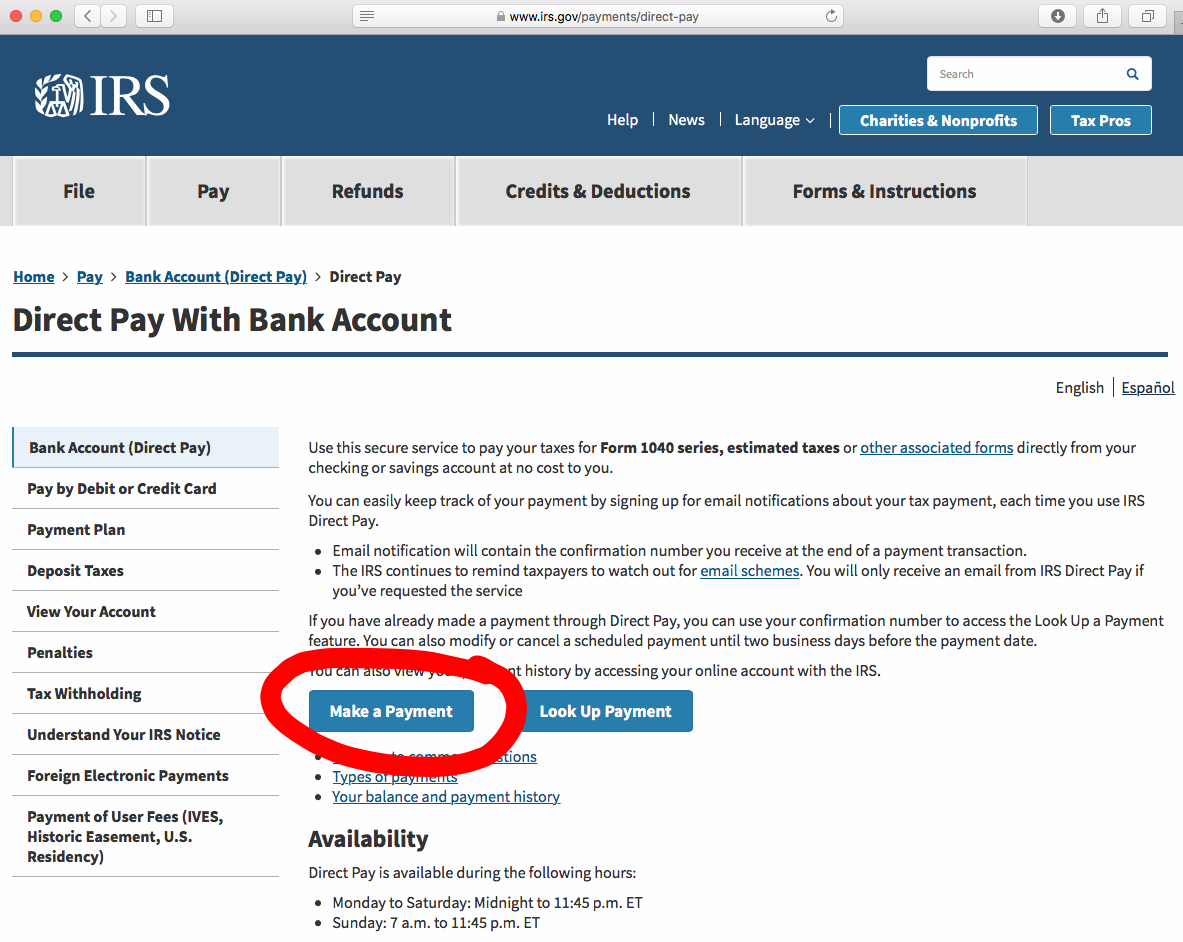
For individual taxpayers, including sole proprietors, IRS Direct Pay is the gold standard. This service allows you to pay your estimated tax directly from your checking or savings account without any additional fees.
The process is straightforward: you select the “Estimated Tax” reason for payment, choose the applicable tax year, and verify your identity using information from a previous year’s tax return. One of the primary advantages of Direct Pay is the immediate generation of a confirmation number. In the world of personal finance, this “receipt” is an essential document for your digital filing system, providing irrefutable proof of timely payment should the IRS ever question your compliance.
The Electronic Federal Tax Payment System (EFTPS)
For business owners with more complex needs or individuals who prefer to schedule payments far in advance, the Electronic Federal Tax Payment System (EFTPS) is a powerful tool. Managed by the U.S. Department of the Treasury, EFTPS is a free service that allows you to schedule payments up to 365 days in advance.
Unlike Direct Pay, EFTPS requires an initial enrollment process that involves receiving a PIN via physical mail, which adds a layer of security. For those managing a business budget, EFTPS is invaluable because it allows you to automate your tax outflows, ensuring that you never miss a deadline due to administrative oversight. It also provides a comprehensive payment history report, which is a boon for year-end bookkeeping and tax preparation.
Mobile Apps and Third-Party Processors
The IRS2Go mobile app is another convenient digital gateway, offering the same functionality as Direct Pay from a smartphone. Additionally, the IRS authorizes several third-party processors to accept payments via credit or debit cards. While these services offer the convenience of paying with plastic—potentially earning credit card rewards—they do come with processing fees. From a wealth-management perspective, one must calculate whether the value of the rewards outweighs the 1.8% to 2% convenience fee charged by the processors. Generally, these fees are tax-deductible for business-related tax payments, which can slightly mitigate the cost.
Physical Remittance: Mailing Your Form 1040-ES

While digital payments are encouraged, many taxpayers still prefer the traditional method of mailing a paper check or money order. This requires the use of Form 1040-ES (Estimated Tax for Individuals), which includes four payment vouchers, one for each quarterly deadline.
Identifying Your Regional IRS Service Center
The “where” of mailing your payment depends entirely on where you live. The IRS divides the United States into several regions, each served by a specific processing center. It is crucial to check the current year’s Form 1040-ES instructions, as these addresses can occasionally change due to IRS restructuring or facility updates.
Generally, taxpayers in states like Florida, Louisiana, Mississippi, and Texas might send their payments to a center in Charlotte, North Carolina. Conversely, those in California, Arizona, or Nevada might remit their funds to a center in Cincinnati, Ohio. Using the wrong address can delay the processing of your payment, which could lead to an erroneous late-payment notice. Always use the specific “P.O. Box” designated for estimated tax payments to ensure your check is routed to the correct department within the IRS facility.
Best Practices for Paper Payments
If you choose to mail your payment, certain protocols are non-negotiable for protecting your financial interests:
-
Make the Check Payable to the “United States Treasury”: Never leave the “pay to” line blank or address it simply to the “IRS.”
-
Include Your Identification: On the memo line of your check, write your Social Security Number (or EIN), the tax year, and “Form 1040-ES.” This ensures that if your check and voucher become separated, the IRS can still credit the funds to the correct account.
-
Use Certified Mail: The “Postmark Rule” is a lifesaver in tax law. If you mail your payment via USPS Certified Mail with a Return Receipt, the date of the postmark is legally considered the date of payment. This provides a vital layer of protection if the mail service experiences delays.
-
Do Not Staple: Avoid stapling your check to the voucher. IRS scanning equipment is sensitive, and staples can cause delays or errors in automated processing.
Strategic Timing: Deadlines and Avoiding Penalties
Knowing where to send your payments is only half the battle; you must also know when to send them. The IRS “quarterly” deadlines do not align perfectly with standard calendar quarters, which often catches new entrepreneurs off guard.
The Quarterly Schedule
For most calendar-year taxpayers, the deadlines are as follows:
-
1st Payment: April 15 (covering income received Jan 1 – March 31)
-
2nd Payment: June 15 (covering income received April 1 – May 31)
-
3rd Payment: September 15 (covering income received June 1 – Aug 31)
-
4th Payment: January 15 of the following year (covering income received Sept 1 – Dec 31)
If these dates fall on a weekend or a legal holiday, the deadline is pushed to the next business day. For example, if April 15 falls on a Saturday, your payment is due by Monday, April 17.
Safe Harbor Provisions and Avoiding the Underpayment Penalty
One of the most frequent questions in business finance is: “How much should I send?” If your income is volatile, estimating 100% of your current liability is difficult. This is where the Safe Harbor rule mentioned earlier becomes your most powerful financial tool. By paying 100% (or 110%) of your prior year’s total tax liability in four equal installments, you are shielded from penalties even if you earn significantly more in the current year. This “Safe Harbor” strategy allows you to keep more of your cash in your own interest-bearing accounts for longer, remitting only what is necessary to satisfy the IRS requirements.
Financial Optimization: Managing Cash Flow for Taxes
Mastering where and how to send estimated tax payments is ultimately about cash flow optimization. Successful freelancers and business owners treat their tax liability as a non-negotiable operating expense.
High-Yield Tax Reserves
Rather than letting tax money sit in a general business checking account where it might be accidentally spent on overhead, many financial experts recommend opening a dedicated High-Yield Savings Account (HYSA) specifically for taxes. By setting aside 25% to 30% of every payment received into this account, you ensure the funds are available when the quarterly deadline arrives. Furthermore, you earn interest on that money right up until the moment you hit “send” on IRS Direct Pay. In a high-interest-rate environment, this can result in hundreds or thousands of dollars in “found” money over the course of a year.

Leveraging Professional Software and Advice
As your income grows and becomes more complex, manual calculations and paper vouchers may no longer suffice. Bookkeeping software like QuickBooks or Xero can often calculate your estimated tax liability in real-time based on your uploaded transactions.
However, technology is not a total substitute for professional insight. A Certified Public Accountant (CPA) or Enrolled Agent (EA) can provide tailored advice on complex situations, such as the “Annualized Income Installment Method.” This method is particularly useful for seasonal businesses—like a landscaping company that earns 80% of its income in the summer—allowing them to pay smaller amounts in the first and fourth quarters to better align with their actual cash flow.
By mastering the logistics of where to send your IRS estimated tax payments and integrating that process into your broader financial strategy, you transform a burdensome administrative task into a streamlined component of your business success. Whether you choose the speed of Direct Pay or the formality of a mailed voucher, consistency and accuracy are the keys to maintaining a healthy relationship with the IRS and a stable financial future.
aViewFromTheCave is a participant in the Amazon Services LLC Associates Program, an affiliate advertising program designed to provide a means for sites to earn advertising fees by advertising and linking to Amazon.com. Amazon, the Amazon logo, AmazonSupply, and the AmazonSupply logo are trademarks of Amazon.com, Inc. or its affiliates. As an Amazon Associate we earn affiliate commissions from qualifying purchases.