
Navigating the complexities of payroll tax compliance can be a significant challenge for any business owner, large or small. Among the myriad forms and deadlines, IRS Form 941, the Employer’s Quarterly Federal Tax Return, stands as a cornerstone of federal payroll tax reporting. While the ideal scenario involves timely filing and payment, there are circumstances where a business might need to file Form 941 without accompanying payment. Understanding the correct procedure for such situations is not merely a matter of compliance; it’s a strategic imperative to avoid further penalties and maintain a good standing with the Internal Revenue Service (IRS).
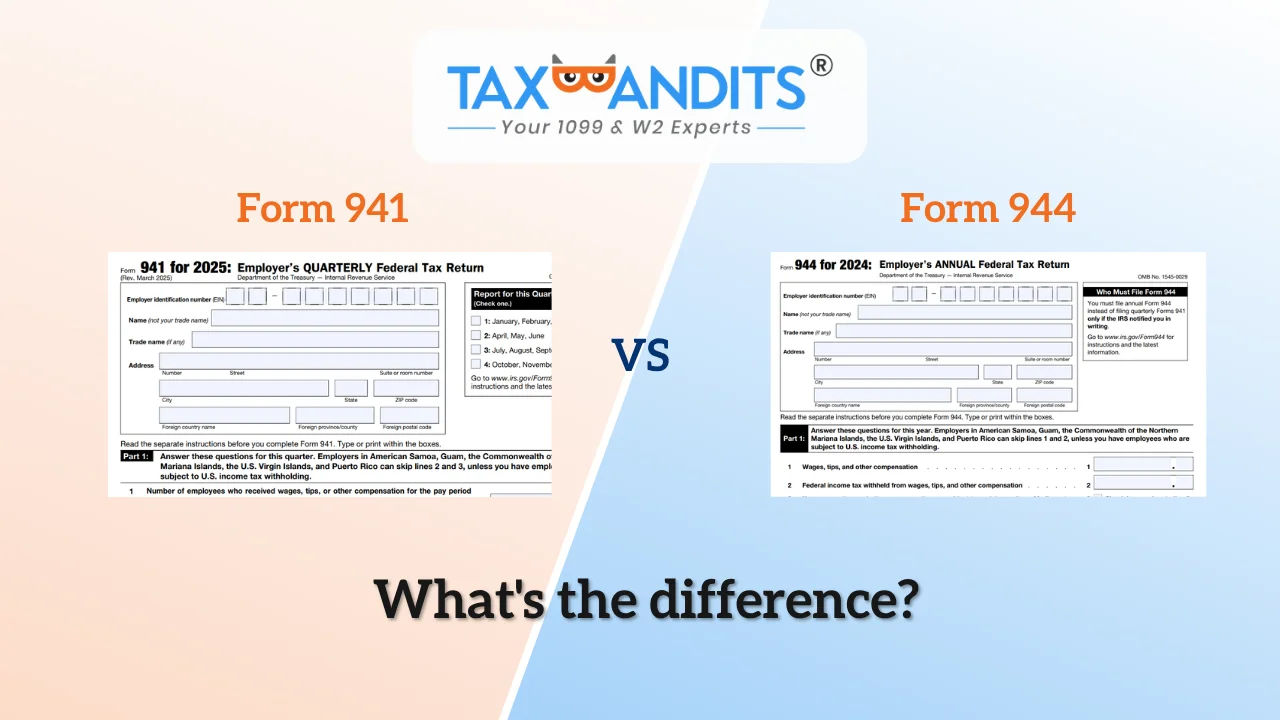
This article delves into the critical details surrounding Form 941 when a payment cannot be remitted simultaneously. We will explore the form’s purpose, the implications of non-payment, and most importantly, the precise protocols for ensuring your return reaches the IRS correctly, even when funds are tight. It’s crucial to remember that filing without payment does not negate the payment obligation; it simply separates the reporting from the remittance, demanding a proactive approach to address the underlying tax liability.
Understanding Form 941 and Payment Obligations
Form 941 is a vital document that employers use to report income taxes, Social Security tax, and Medicare tax withheld from employee paychecks, as well as the employer’s share of Social Security and Medicare taxes. Filed quarterly, it provides the IRS with a snapshot of a business’s payroll tax liabilities and payments for a given period.
What is Form 941?
At its core, Form 941 is an accounting of an employer’s federal tax responsibilities related to wages paid to employees. It covers a calendar quarter (January-March, April-June, July-September, October-December) and is typically due by the last day of the month following the end of the quarter. For instance, the Form 941 for the first quarter (January 1 – March 31) is due by April 30.
The form requires employers to detail:
- The total amount of wages, tips, and other compensation paid.
- Federal income tax withheld from employees’ pay.
- Taxable Social Security wages and tips, and the Social Security tax withheld.
- Taxable Medicare wages and tips, and the Medicare tax withheld.
- Adjustments for fractions of cents, sick pay, tips, and group-term life insurance.
- The total tax liability for the quarter.
- Total deposits made for the quarter.
The accuracy of Form 941 is paramount, as discrepancies can lead to audits, penalties, and interest charges.
When Payments Are Due (and Why They Matter)
While Form 941 is filed quarterly, the actual payment of federal payroll taxes is usually made much more frequently. Most employers follow either a monthly or semi-weekly deposit schedule, determined by the total tax liability reported on Form 941 during a lookback period.
- Monthly Depositor: If your total tax liability for the lookback period was $50,000 or less, you’re generally a monthly depositor. Payments are due by the 15th of the following month for tax liabilities incurred in the previous month.
- Semi-weekly Depositor: If your total tax liability for the lookback period was more than $50,000, you’re generally a semi-weekly depositor. Payments are due Wednesday for payrolls paid on Wednesday, Thursday, or Friday, and Friday for payrolls paid on Saturday, Sunday, Monday, or Tuesday.
The importance of timely and correct deposits cannot be overstated. Failure to deposit taxes on time can result in significant penalties, even if Form 941 is filed on time. These penalties are calculated based on the amount of underpayment and the number of days the payment is late. The IRS views payroll taxes as trust fund taxes, meaning they are collected from employees in trust for the government. Misappropriating or failing to remit these funds is taken very seriously.
Scenarios for Filing Without Payment
Ideally, a business would always file Form 941 with full payment. However, certain situations may necessitate filing the form without accompanying funds:
- Temporary Financial Hardship: A business experiencing cash flow problems might file Form 941 on time to avoid failure-to-file penalties while simultaneously working to secure funds for the tax payment or negotiate a payment plan with the IRS.
- Anticipating a Payment Plan: An employer might have already initiated discussions with the IRS for an installment agreement or an Offer in Compromise (OIC). Filing Form 941 on time demonstrates good faith and adherence to reporting obligations while the payment arrangements are finalized.
- Post-Deadline Payment Discovery: If a payment was missed for an earlier deposit period but discovered before the Form 941 filing deadline, the employer might file the form, then immediately remit the late payment, incurring only failure-to-deposit penalties, not also failure-to-file.
- Expecting a Credit or Refund: While less common for Form 941, if an employer anticipates a credit from a previous overpayment or is applying for certain tax credits that would offset the liability, they might file without an immediate payment, expecting the credit to cover the balance.
In all these scenarios, the critical message is clear: filing Form 941 without payment is a reporting action that does not absolve the business from its tax liability or associated penalties for late payment. It merely ensures that the employer meets the reporting deadline.
Navigating the IRS Filing System for Form 941
The IRS offers multiple avenues for filing Form 941, primarily electronic and paper-based. The method chosen, particularly when no payment is enclosed, dictates where the form must be sent.
Electronic Filing (e-file): The Preferred Method
The IRS strongly encourages employers to e-file Form 941. Electronic filing offers several advantages:
- Speed and Accuracy: It reduces processing time and minimizes errors common with manual data entry.
- Proof of Filing: E-filing systems provide immediate confirmation of receipt, eliminating concerns about lost mail.
- Convenience: Forms can be submitted 24/7 from anywhere with internet access.
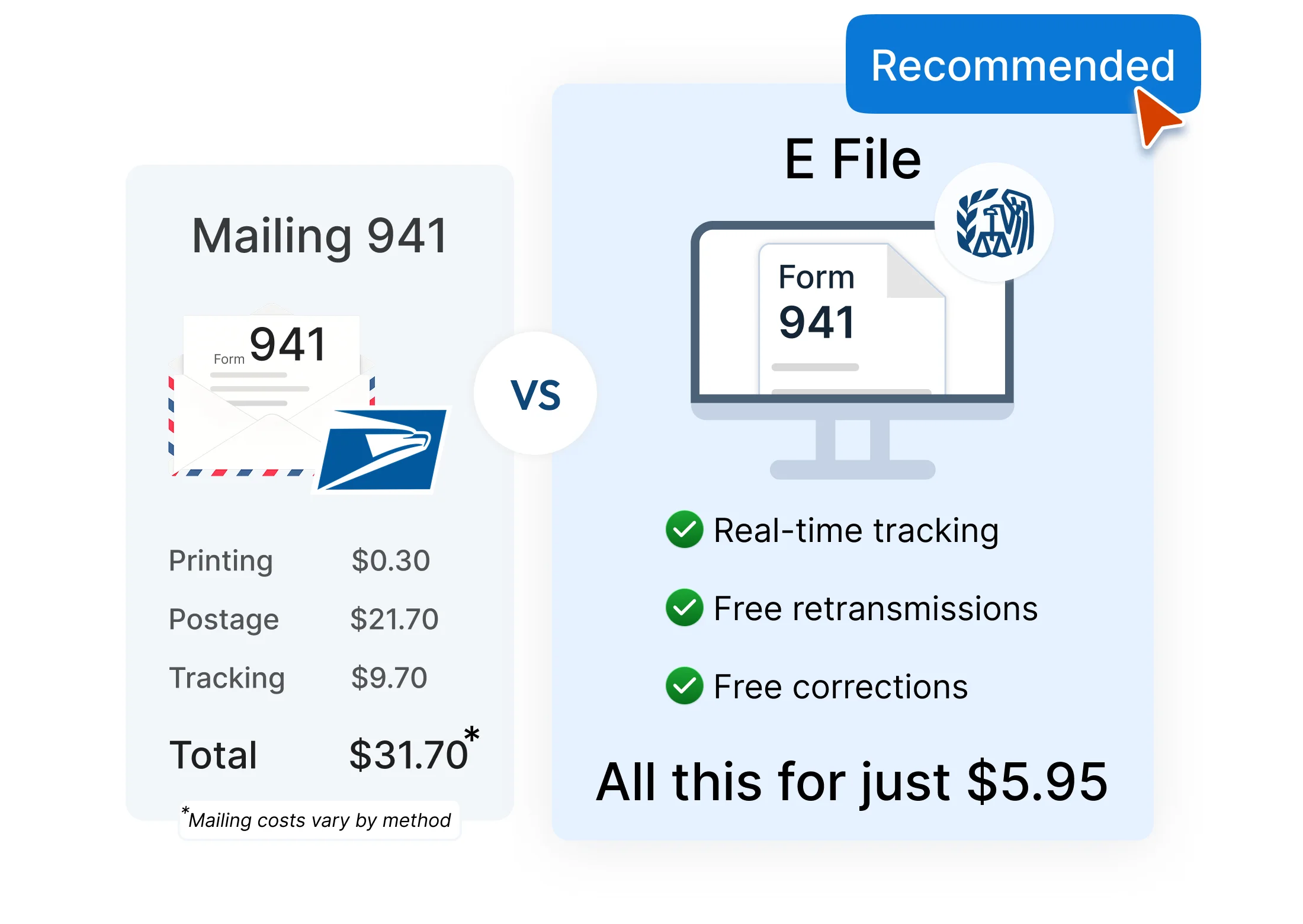
Even when filing without payment, e-filing remains the most efficient option. Most payroll software providers and tax professionals offer IRS-approved e-file services for Form 941. When e-filing without payment, the system simply records a zero payment or indicates that payment will be made separately. If you are required to make your payments electronically (which most employers are, via the Electronic Federal Tax Payment System, or EFTPS), then e-filing your Form 941 is a logical extension of your compliance strategy.
Paper Filing: When and Where to Send
For employers who choose or are required to file a paper Form 941, the address to which the form is mailed is absolutely critical, especially when no payment is included. The IRS maintains different mailing addresses for forms depending on whether a payment is enclosed, and these addresses can vary based on the state where the business is located. Sending a form with no payment to an address designated for forms with payment, or vice versa, can significantly delay processing and potentially result in penalties.
General Rule:
- If you are sending Form 941 WITHOUT a payment: There is a specific set of addresses designated for these returns.
- If you are sending Form 941 WITH a payment: There is a separate set of addresses, and typically, you would include Form 941-V, Payment Voucher.
How to Find the Correct Address (Crucial Step):
The most reliable source for the current mailing addresses for Form 941 is the official IRS instructions for Form 941 for the specific tax year you are filing. These instructions are updated annually and can be found on the IRS website (IRS.gov).
Illustrative Example (Addresses are subject to change, always verify with IRS instructions):
For instance, for a recent tax year, if your business was located in Connecticut, Delaware, District of Columbia, Florida, Georgia, Maine, Maryland, Massachusetts, New Hampshire, New Jersey, New York, North Carolina, Pennsylvania, Puerto Rico, Rhode Island, South Carolina, Tennessee, Vermont, or Virginia, and you are NOT enclosing a payment, you might send your Form 941 to:
Department of the Treasury
Internal Revenue Service
Kansas City, MO 64999-0005
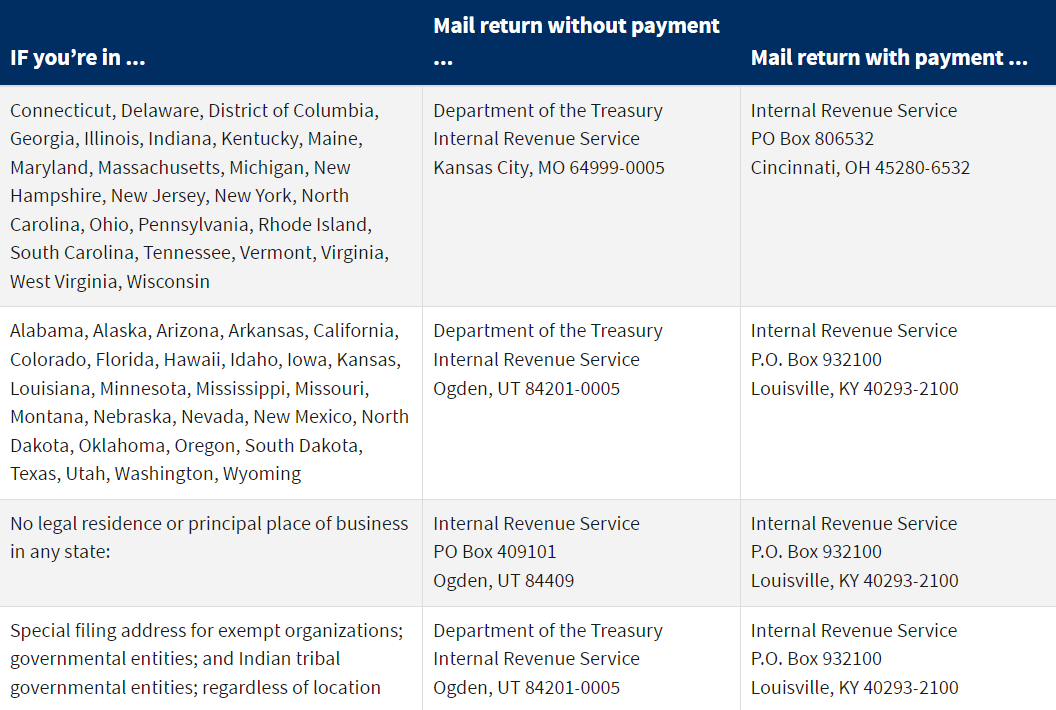
However, if your business was in Alabama, Arizona, Arkansas, California, Colorado, Idaho, Illinois, Indiana, Iowa, Kansas, Kentucky, Louisiana, Michigan, Minnesota, Mississippi, Missouri, Montana, Nebraska, Nevada, New Mexico, North Dakota, Ohio, Oklahoma, Oregon, South Dakota, Texas, Utah, Washington, West Virginia, Wisconsin, Wyoming, a foreign country, or you are an exempt organization, or a governmental entity, and you are NOT enclosing a payment, the address might be:
Department of the Treasury
Internal Revenue Service
Ogden, UT 84201-0005
Important Caveats:
- Always check the latest Form 941 instructions (Schedule A, “Where To File Your Return”). The IRS updates these addresses periodically.
- Do not send any payment to the “no payment” addresses. Payments must be made separately, preferably via EFTPS.
- Ensure the correct quarterly period is clearly marked on the form.
Crucial Information for Paper Filers
Beyond the correct address, paper filers must adhere to several best practices:
- Completeness and Accuracy: Double-check all entries to ensure they are correct and legible.
- Signature: Form 941 must be signed by the employer or an authorized representative. Unsigned returns are not processed.
- Mailing Method: While regular mail is acceptable, for critical tax documents like Form 941, especially without payment where proof of timely filing is important, consider using certified mail with return receipt requested. This provides undeniable proof that the form was sent and received by the IRS on a specific date.
- Retain Copies: Always keep a complete copy of the filed Form 941 and any supporting documentation for your records.
Addressing Payment Lapses and Avoiding Penalties
Filing Form 941 without payment is a tactical move, not a solution to payment obligations. The tax amount reported on the form is still due, and employers must proactively address the outstanding balance.
The Ramifications of Non-Payment
The IRS imposes penalties for both failure to deposit (FTD) and failure to pay (FTP).
- Failure to Deposit Penalty: This penalty applies if you don’t make required tax deposits on time, or if you under-deposit. The penalty varies based on how late the deposit is: 2% for deposits up to 5 days late, 5% for 6 to 15 days late, and 10% for over 15 days late. If you don’t deposit at all or deposit more than 10 days after the first IRS notice, the penalty can be 15%.
- Failure to Pay Penalty: This penalty is 0.5% of the unpaid taxes for each month or part of a month that taxes remain unpaid, up to a maximum of 25% of your unpaid taxes. It generally begins to accrue the day after taxes are due.
- Failure to File Penalty: This penalty is 5% of the unpaid taxes for each month or part of a month that a tax return is late, up to a maximum of 25% of your unpaid taxes. Filing Form 941 without payment on time prevents this penalty.
It’s important to note that the failure-to-pay penalty can be reduced if you also incur a failure-to-file penalty for the same month, as the maximum combined penalty for any month is 5%. However, interest also accrues on unpaid taxes and penalties, compounding the debt.
Options for Employers Facing Financial Hardship
If a business genuinely cannot pay its payroll taxes, ignoring the issue is the worst possible approach. The IRS offers several avenues for resolution:
- Payment Plan (Installment Agreement): If you owe $50,000 or less in combined tax, penalties, and interest, you may qualify for a short-term payment plan (up to 180 days) or a long-term installment agreement (monthly payments for up to 72 months). An installment agreement allows you to pay your taxes over time, though interest and penalties still apply until the balance is paid in full.
- Offer in Compromise (OIC): An OIC allows certain taxpayers to resolve their tax liability with the IRS for a lower amount than what they originally owe. This is typically an option when there is significant doubt as to collectability, or when payment would create an economic hardship. The IRS will consider your ability to pay, income, expenses, and asset equity when evaluating an OIC.
- Requesting Penalty Abatement: Under certain circumstances, the IRS may waive penalties if you can demonstrate “reasonable cause” for failure to file or pay on time. This could include natural disasters, serious illness, or other unavoidable circumstances. First-time penalty abatement may also be available to taxpayers with a clean compliance history.
Importance of Communication with the IRS
Proactive communication is key. If you know you cannot meet your payment obligations, contact the IRS as soon as possible. Demonstrating a willingness to work with them to resolve your tax debt can often lead to more favorable outcomes than waiting for the IRS to initiate collection actions.
Best Practices for Payroll Tax Compliance
Maintaining robust payroll tax compliance is essential for any business’s financial health and legal standing.
Accurate Record-Keeping
The foundation of correct Form 941 filing and payment lies in meticulous record-keeping. Businesses must keep detailed records of:
- Employee wages, tips, and other compensation.
- Federal income tax, Social Security tax, and Medicare tax withheld from each employee.
- Dates and amounts of all federal tax deposits.
- All Forms 941 filed and any related correspondence.
These records should be maintained for at least four years after the date the tax becomes due or is paid, whichever is later.
Utilizing Payroll Software and Services
Modern payroll software and professional payroll services can significantly streamline the payroll tax process. These tools can:
- Automate tax calculations and withholdings.
- Generate Form 941 and other required tax forms.
- Facilitate electronic tax payments (EFTPS).
- Provide reminders for filing and payment deadlines.
- Help maintain accurate and accessible records.
For businesses with complex payrolls or those seeking to minimize compliance risk, outsourcing to a reputable payroll service provider can be a wise investment.
Regular Review and Reconciliation
Periodically reviewing your payroll records and reconciling them with your tax deposits and reported liabilities on Form 941 can help catch errors before they become costly problems. This includes:
- Verifying that total wages reported on Form 941 align with individual wage statements (e.g., W-2s).
- Confirming that all deposits made match the liabilities reported for the quarter.
- Checking for any changes in tax rates or regulations that might impact your calculations.
Conclusion
Filing Form 941 without payment is a critical procedure that demands precision and awareness. While it allows businesses to meet their reporting obligations on time, thus avoiding failure-to-file penalties, it does not alleviate the fundamental responsibility to pay the taxes due. Understanding the correct mailing addresses for paper forms, especially when no payment is enclosed, is paramount to ensuring your return is processed efficiently.
Ultimately, a business’s approach to Form 941, whether with or without payment, should be rooted in a commitment to compliance, proactive problem-solving, and diligent record-keeping. When facing financial difficulties, immediate communication with the IRS and exploration of available payment options are crucial steps. By adhering to these principles, businesses can navigate the complexities of payroll tax, mitigate potential penalties, and safeguard their financial stability, even in challenging times. Remember, the goal is not just to file, but to ultimately fulfill the payment obligation, securing a compliant and healthy financial future for your enterprise.
aViewFromTheCave is a participant in the Amazon Services LLC Associates Program, an affiliate advertising program designed to provide a means for sites to earn advertising fees by advertising and linking to Amazon.com. Amazon, the Amazon logo, AmazonSupply, and the AmazonSupply logo are trademarks of Amazon.com, Inc. or its affiliates. As an Amazon Associate we earn affiliate commissions from qualifying purchases.