
Navigating the landscape of federal tax obligations is a critical responsibility for every business owner and financial officer. Among the various filings required by the Internal Revenue Service (IRS), Form 940—the Employer’s Annual Federal Unemployment (FUTA) Tax Return—stands as a pillar of the American social safety net. Ensuring that this form, along with its corresponding payment, reaches the correct IRS processing center is not merely a clerical task; it is a vital component of a company’s financial health and regulatory standing.
The Federal Unemployment Tax Act (FUTA) provides for payments of unemployment compensation to workers who have lost their jobs. Most employers pay both a federal and a state unemployment tax. While state unemployment taxes (SUTA) vary by jurisdiction, the federal requirements are standardized, yet the logistics of filing can be surprisingly complex. This guide provides an exhaustive breakdown of where to mail Form 940 with a payment, the nuances of the filing process, and strategic insights into managing your business’s tax liabilities.
Understanding Form 940 and the Federal Unemployment Tax Act
Before addressing the mailing logistics, it is essential to understand the fiscal mechanism behind Form 940. Unlike Social Security and Medicare taxes, FUTA tax is paid only by the employer. Employees do not have this tax withheld from their wages.
Who Must File?
Generally, you must file Form 940 if either of the following conditions met:
-
You paid wages of $1,500 or more to employees in any calendar quarter during the current or previous year.
-
You had one or more employees for at least some part of a day in any 20 or more different weeks during the current or previous year.
This includes all full-time, part-time, and temporary employees. However, partners in a partnership are not considered employees, and their compensation is handled differently for tax purposes.
Calculating the FUTA Tax Rate
The FUTA tax rate is officially 6.0% of the first $7,000 paid to each employee as wages during the year. However, most employers receive a maximum credit of 5.4% against this tax because they also pay state unemployment taxes. This results in an effective federal rate of 0.6%. Maintaining this lower rate is dependent on paying state unemployment taxes on time and ensuring that the state is not subject to a “credit reduction” due to outstanding federal loans.
Determining the Correct IRS Mailing Address for Form 940
The IRS utilizes several different processing centers across the United States. The correct address for mailing your Form 940 depends entirely on two factors: the location of your principal place of business and whether or not you are enclosing a payment. Since this guide focuses on filing with a payment, the addresses provided below are specifically for those including a check or money order along with Form 940-V (the Payment Voucher).
Group 1: Southern and Southwestern States
If your business is located in Alabama, Florida, Georgia, Louisiana, Mississippi, North Carolina, South Carolina, Tennessee, or Texas, you are part of a specific processing region.
For these states, if you are including a payment, mail your return to:
Internal Revenue Service
P.O. Box 930107
Dallas, TX 75393-0107
Group 2: Western and Midwestern States
This group includes a wide geographic range: Arizona, California, Colorado, Hawaii, Idaho, Kansas, Montana, Nebraska, Nevada, New Mexico, North Dakota, Oklahoma, Oregon, South Dakota, Utah, Washington, and Wyoming.
If you are including a payment, mail your return to:
Internal Revenue Service
P.O. Box 806530
Cincinnati, OH 45280-6530
Group 3: Northeastern and North Central States
This region covers Connecticut, Delaware, District of Columbia, Illinois, Indiana, Iowa, Kentucky, Maine, Maryland, Massachusetts, Michigan, Minnesota, Missouri, New Hampshire, New Jersey, New York, Ohio, Pennsylvania, Rhode Island, Vermont, Virginia, West Virginia, and Wisconsin.
For these states, if you are including a payment, mail your return to:
Internal Revenue Service
P.O. Box 930107
Dallas, TX 75393-0107
Note: You may notice that the Dallas address serves multiple regions. This is part of the IRS’s centralized processing strategy to streamline high-volume periods.
Group 4: Special Jurisdictions and International Filers
If your business is located in American Samoa, Guam, the Commonwealth of the Northern Mariana Islands, Puerto Rico, or the U.S. Virgin Islands, or if you are filing from a foreign country, a separate address is required.
Mail your return with payment to:
Internal Revenue Service
P.O. Box 930107
Dallas, TX 75393-0107
Payment Methods and Best Practices for Tax Compliance
While mailing a physical check is a common practice, the IRS has strict rules regarding how those payments must be structured to ensure they are credited to the correct account without delay.
Using Form 940-V (Payment Voucher)
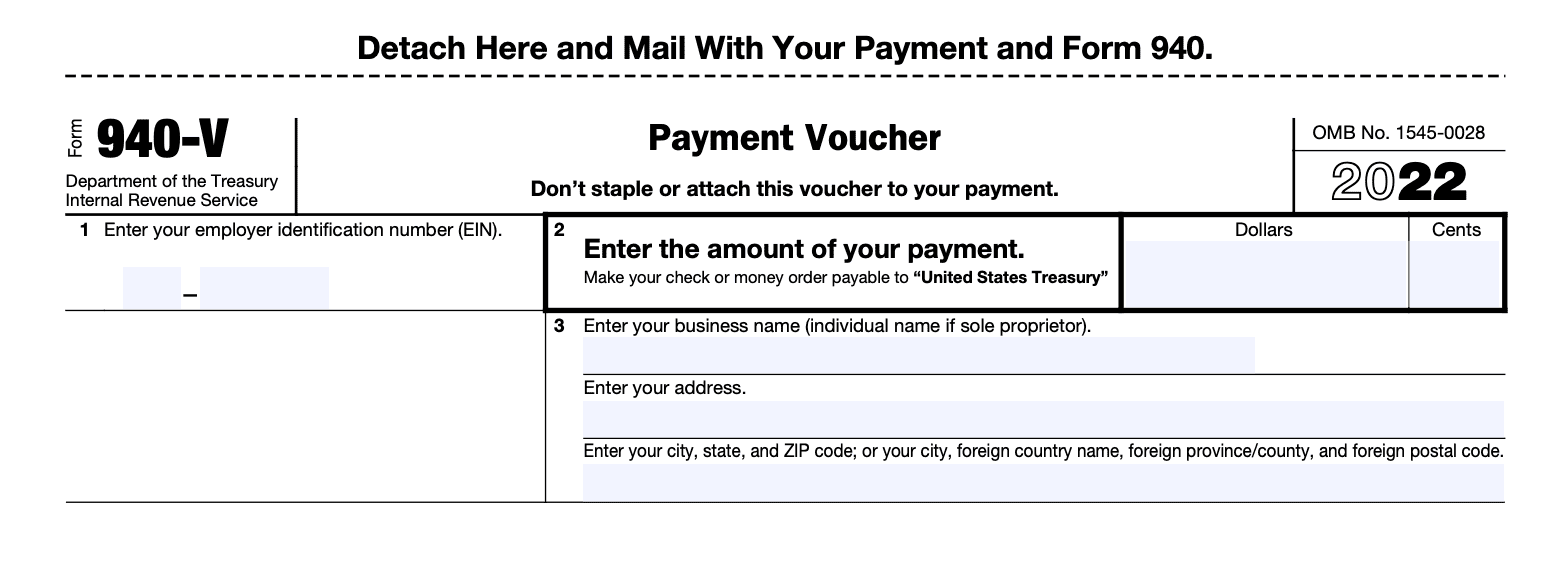
If you are mailing a payment with your return, you must use Form 940-V. This voucher helps the IRS process your payment accurately. When filling out the voucher, ensure that your Employer Identification Number (EIN) is written clearly. Small errors in the EIN can lead to significant delays and potential late-payment notices.
Check and Money Order Guidelines
When writing your check or money order:
-
Make it payable to “United States Treasury.”
-
Do not staple the check to the Form 940 or the voucher.
-
Include your EIN, “Form 940,” and the tax year on the memo line. This provides a clear audit trail if the check becomes separated from the paperwork.
The Shift Toward Electronic Payments (EFTPS)
While the prompt focuses on mailing payments, modern business finance increasingly relies on the Electronic Federal Tax Payment System (EFTPS). The IRS actually requires electronic deposits for many businesses if their total federal tax deposits exceed certain thresholds. Even if not required, using EFTPS is often safer than mailing a check, as it provides an immediate electronic receipt and eliminates the risk of mail loss.
Deposit Requirements vs. Annual Filing
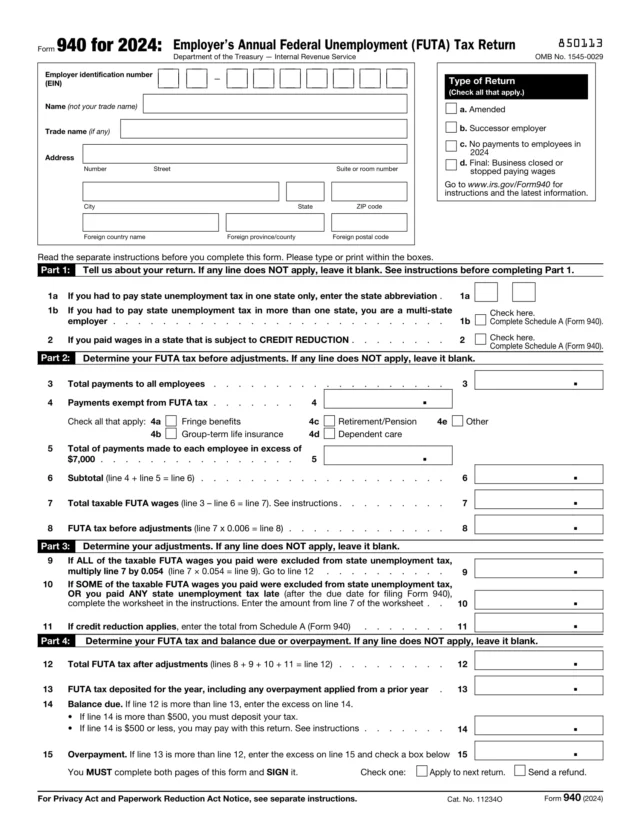
It is a common point of confusion: Form 940 is an annual return, but the tax might need to be deposited quarterly. If your FUTA tax liability exceeds $500 for a calendar quarter, you must deposit the tax by the last day of the month following the end of the quarter. If your liability is $500 or less, you can carry it over to the next quarter or pay it with your Form 940 at the end of the year.
Common Mistakes to Avoid and Deadlines to Remember
The deadline for filing Form 940 is January 31 of the year following the tax year. For example, the 2023 Form 940 was due by January 31, 2024. However, if you deposited all your FUTA tax when it was due, you have an additional 10 days (until February 10) to file the return.
Avoiding “Mailing” Pitfalls
-
Using the Wrong Address: Using an address for “Returns without Payment” when you are including a check can delay processing by weeks.
-
Incorrect Tax Year: Always ensure you are using the form version that corresponds to the tax year in question.
-
Missing Signatures: A Form 940 is not considered a valid return unless it is signed by an authorized individual (owner, CEO, or authorized corporate officer).
-
Inaccurate State Reporting: If you fail to accurately report your state unemployment contributions on Schedule A (Form 940), you may be denied the 5.4% credit, leading to a much higher federal tax bill.
Handling Credit Reduction States
A critical financial nuance involves “Credit Reduction States.” If a state has borrowed money from the federal government to pay unemployment benefits and has not repaid it within a specific timeframe, the FUTA credit for employers in that state is reduced. This means your effective tax rate will be higher than 0.6%. When mailing your payment, ensure you have checked the most recent IRS list of credit reduction states to avoid underpayment.
Optimizing Your Business Tax Strategy
Properly mailing Form 940 is the final step in a year-long process of financial management. To optimize your business finance strategy, consider the following:
Integration with Payroll Software
Most modern payroll platforms automatically calculate FUTA liabilities and generate the completed Form 940. Many even handle the electronic filing and payment. For businesses still manually calculating these figures, the risk of human error in the “Part 2” calculation of the form is high.
Record Keeping and Audits
The IRS recommends keeping copies of filed tax returns and all supporting documentation for at least four years. This includes proof of state unemployment tax payments, as the IRS often cross-references federal filings with state records to verify credit eligibility.
Strategic Cash Flow Management
Because FUTA is an employer-paid tax, it should be factored into your “burdened labor cost.” When hiring new employees, savvy business owners look beyond the hourly wage and account for the 0.6% FUTA (up to the $7,000 cap), SUTA, and the employer’s share of FICA. Understanding when these payments are due allows for better cash flow forecasting, particularly in the first and second quarters of the year when the $7,000 wage base is typically met for most employees.
In conclusion, while the physical act of mailing Form 940 with a payment is a simple logistical step, it represents the culmination of a year’s worth of payroll tax compliance. By identifying the correct processing center based on your geography and ensuring your payment is formatted correctly, you protect your business from unnecessary penalties and maintain a seamless relationship with the Internal Revenue Service. As tax laws and processing center locations can occasionally shift, always verify the instructions on the most recent iteration of the IRS website before finalizing your mailing.
aViewFromTheCave is a participant in the Amazon Services LLC Associates Program, an affiliate advertising program designed to provide a means for sites to earn advertising fees by advertising and linking to Amazon.com. Amazon, the Amazon logo, AmazonSupply, and the AmazonSupply logo are trademarks of Amazon.com, Inc. or its affiliates. As an Amazon Associate we earn affiliate commissions from qualifying purchases.