
In an era dominated by instant digital transfers and contactless payments, the paper check remains a surprisingly resilient fixture of the financial landscape. Whether it is a federal tax refund, a payroll check from a traditional employer, an insurance settlement, or a gift from a relative, millions of individuals find themselves holding a physical document that represents liquid capital. However, the convenience of holding a check is often overshadowed by the immediate logistical hurdle of converting that paper into spendable cash. Navigating the diverse landscape of financial institutions, retail outlets, and digital platforms requires an understanding of fee structures, identification requirements, and the specific policies that govern the movement of money.
Leveraging Traditional Banking Institutions and Credit Unions
The most logical and cost-effective starting point for cashing a check is a traditional banking institution or a credit union. For those who already hold a checking or savings account, the process is typically seamless and, more importantly, free of charge.
Utilizing Your Current Account Provider
When you visit a bank where you are an active account holder, you have two primary options: depositing the check or cashing it. If you choose to cash it, the bank typically grants you immediate access to the funds, provided your account balance can cover the check amount should it happen to bounce. This is often the fastest way to get the full face value of the check without losing a percentage to administrative fees. Most banks allow for cashing checks at the teller window or through sophisticated ATMs that can read and process checks in real-time.
The “On-Us” Check Policy at Other Banks
If you do not have a bank account, your best alternative is to visit the specific bank that issued the check. This is known as an “on-us” check. Because the funds are held within that specific institution, the bank can verify the availability of the money instantly. While many banks will cash their own checks for non-customers, they frequently charge a flat fee—often ranging from $5 to $10—or a small percentage of the total amount. You will be required to provide valid government-issued photo identification, and some banks may require a second form of ID or a thumbprint for security purposes.
The Role of Credit Unions
Credit unions operate under a different philosophy than commercial banks, often focusing on community-based service. Many credit unions participate in “shared branching” networks. If you belong to one credit union, you may be able to cash checks at a different participating credit union across the country. For non-members, credit unions may be more restrictive than big-box banks, but they are still worth investigating if you live in a rural area where traditional banks are scarce.
Retail Alternatives: Grocery Stores and Supercenters
For many, the standard banking hours of 9:00 AM to 5:00 PM are incompatible with a busy work schedule. This is where the retail sector provides a vital financial service. Major grocery chains and supercenters have filled the gap, offering extended hours and convenient locations for cashing payroll and government checks.
Walmart’s Financial Ecosystem
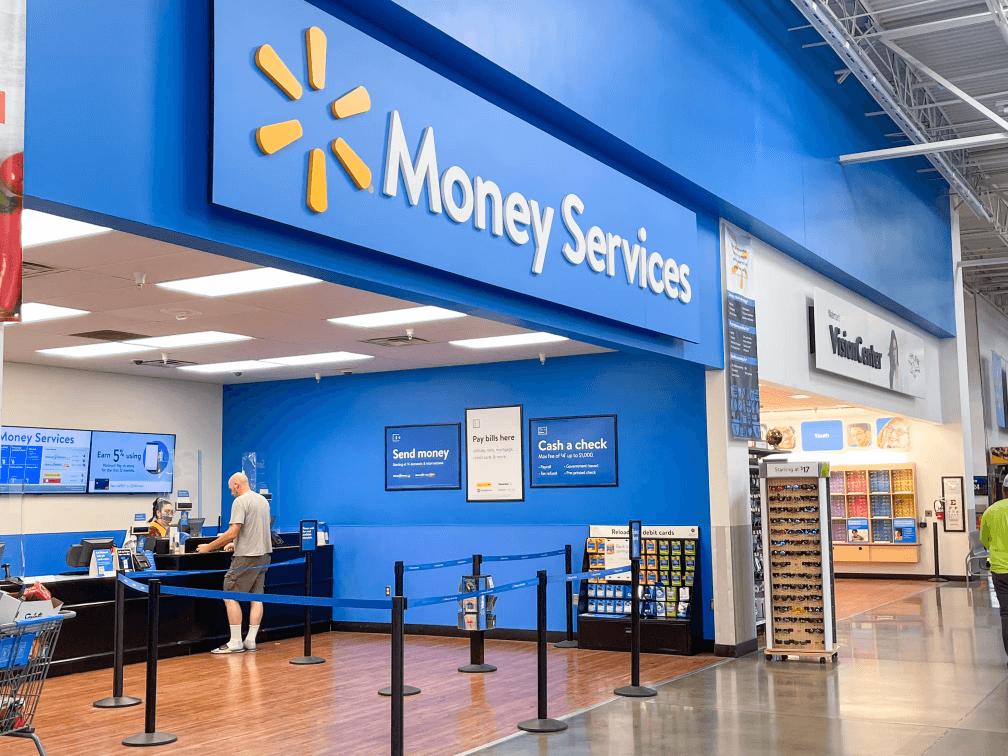
Walmart has established itself as one of the most prominent non-bank financial service providers in the United States. Through their “MoneyCenter” or customer service desks, they offer check cashing for a variety of check types, including payroll, government, tax, and even some insurance checks. Walmart typically charges a flat fee based on the amount of the check (for example, up to $4 for checks up to $1,000, and $8 for checks between $1,001 and $5,000). One significant advantage of using Walmart is the ability to load the cashed funds directly onto a Walmart MoneyCard, a reloadable prepaid debit card, which helps in managing digital payments thereafter.
Grocery Store Chains: Kroger, Publix, and Beyond
Large-scale grocery retailers like Kroger (and its subsidiaries like Fred Meyer or Ralphs), Publix, and Meijer often provide check-cashing services. These retailers generally limit their services to payroll and government-issued checks to minimize the risk of fraud associated with personal checks. Fees vary by state and brand but are generally competitive with the banking sector. The convenience of cashing a check in the same location where one buys groceries makes this a preferred method for millions of households looking to streamline their errands.
The Limitation of Personal Checks in Retail
It is important to note that most retail establishments will not cash personal checks. A personal check—written from one individual to another—is considered a higher risk because the retailer has no immediate way to verify if the writer has sufficient funds. If you are holding a personal check, you will almost certainly need to visit a bank or use a specialized check-cashing store.
Dedicated Check Cashing Stores and 24/7 Financial Centers

In urban environments and areas where traditional banking infrastructure is thin, dedicated check-cashing stores serve as the primary hub for liquidity. These businesses, such as PLS Financial Services, Ace Cash Express, and MoneyMart, specialize in high-speed transactions for those who need immediate cash.
The Speed and Accessibility Trade-Off
The primary draw of specialized check-cashing stores is their accessibility. Many are open 24 hours a day, 7 days a week, and they are far more likely to accept a wide range of check types, including personal checks, out-of-state checks, and large insurance settlements that a grocery store might refuse. However, this accessibility comes at a price. These stores operate on a fee-heavy model, often charging a percentage of the check’s total value—sometimes as high as 2% to 5% or more. For a $2,000 payroll check, a 3% fee results in a $60 loss, which can be a significant hit to a household budget.
Payday Lending and Ancillary Services
Many of these locations also offer payday loans, money orders, and wire transfers. While convenient, these services are often categorized under “alternative financial services” and should be used with caution. The high interest rates and fees associated with these centers mean they are best utilized as a last resort or for specific one-time needs rather than as a primary long-term banking solution.
The Digital Frontier: Mobile Apps and FinTech Solutions
The most significant shift in the “where can I cash a check” conversation is the move toward digital solutions. You no longer need to find a physical “place” if you have a smartphone and a stable internet connection. FinTech (Financial Technology) has revolutionized how checks are processed.
Mobile Deposit through Traditional Banks
Almost every major bank now offers a mobile app with a “Mobile Check Deposit” feature. By taking a clear photo of the front and back of the endorsed check, you can deposit funds into your account from your living room. While this does not give you physical cash immediately, most banks make a portion of the funds (usually $200) available the next business day, with the remainder following shortly after.
Third-Party Apps: Ingo Money, PayPal, and Venmo
For those who do not have a traditional bank account, apps like Ingo Money have become essential. Ingo Money allows users to “cash” a check by taking a photo and having the funds sent to a linked prepaid card, a PayPal account, or even a bank account. They offer two tiers: a “Money in Minutes” service for a fee (usually a percentage of the check) or a “Money in Days” service which is free but takes about ten days to clear. Similarly, PayPal and Venmo have integrated check-cashing features into their apps, allowing users to digitize their physical checks without ever stepping foot into a brick-and-mortar store.
Maximizing Your Payout: Preparation and Security
Regardless of where you choose to cash your check, being prepared is the key to a smooth transaction and protecting your finances. Every location will have its own set of rules, and failing to follow them can result in a declined transaction.
Identification and Endorsement
Always bring a valid, unexpired government-issued photo ID. A driver’s license, state ID, or passport is standard. If you are cashing a check at a bank where you aren’t a member, they may ask for a secondary ID, such as a credit card or a utility bill. Crucially, do not sign (endorse) the back of your check until you are physically at the counter or ready to take the photo for mobile deposit. A pre-signed check is essentially the same as cash; if you lose it, anyone who finds it can attempt to cash it.
Understanding Availability and Holds
Just because a check is “cashed” or “deposited” does not always mean the money is immediately available for withdrawal. Banks operate under Regulation CC, which dictates how long they can hold funds. Payroll and government checks usually clear faster than personal checks. If you need the money immediately for a bill payment, always ask the teller or check the app’s terms of service to see exactly when the funds will be “cleared.”

Security in the “Cash” Environment
Cashing a check, especially a large one, at a retail store or check-cashing outlet requires a high level of situational awareness. These locations are public, and carrying large amounts of physical currency carries inherent risks. When possible, consider “cashing” the check onto a debit card or into an account rather than taking the full amount in paper bills. If you must take cash, ensure you have a secure place to store it before leaving the building and avoid counting your money in plain view of other customers.
By understanding the diverse range of options—from the cost-free environment of a personal bank account to the 24/7 convenience of retail centers and the modern speed of mobile apps—you can choose the method that best aligns with your financial needs and schedule. Each path offers a different balance of speed, cost, and convenience, allowing you to maintain control over your liquid assets in an increasingly complex financial world.
aViewFromTheCave is a participant in the Amazon Services LLC Associates Program, an affiliate advertising program designed to provide a means for sites to earn advertising fees by advertising and linking to Amazon.com. Amazon, the Amazon logo, AmazonSupply, and the AmazonSupply logo are trademarks of Amazon.com, Inc. or its affiliates. As an Amazon Associate we earn affiliate commissions from qualifying purchases.