
Investing in Exchange-Traded Funds (ETFs) has become increasingly popular for both novice and seasoned investors seeking diversification, flexibility, and often lower costs compared to traditional mutual funds. But for those new to the game, the fundamental question often arises: “Where can I buy ETFs?” The answer isn’t a single platform but a spectrum of choices, each with its own advantages, features, and fee structures. This guide will demystify the process, exploring the various avenues available and arming you with the knowledge to make an informed decision about where to begin your ETF investment journey.

Understanding Exchange-Traded Funds (ETFs) Briefly
Before diving into the “where,” it’s crucial to have a foundational understanding of what ETFs are and why they’ve gained such prominence.
What is an ETF?
An Exchange-Traded Fund (ETF) is a type of investment fund that holds a collection of underlying assets, such as stocks, bonds, commodities, or a mix of these. Unlike traditional mutual funds, which are priced once per day after the market closes, ETFs trade like individual stocks on stock exchanges throughout the day. This means their price can fluctuate minute by minute, just like shares of a company. When you buy an ETF, you’re buying a share of a portfolio managed by a fund company, giving you exposure to multiple assets with a single transaction.
Why Invest in ETFs?
ETFs offer several compelling advantages that make them a cornerstone of many investment portfolios:
-
Diversification: A single ETF can provide instant diversification across various companies, industries, or asset classes, reducing the risk associated with investing in individual stocks.
-
Lower Costs: Many ETFs, particularly passive index-tracking ETFs, typically have lower expense ratios (annual fees) compared to actively managed mutual funds because they don’t require intensive management.
-
Flexibility and Liquidity: Since they trade on exchanges, ETFs can be bought and sold at any time during market hours, offering greater liquidity than mutual funds. You can also use advanced trading strategies like limit orders or stop-loss orders.
-
Transparency: Most ETFs disclose their holdings daily, allowing investors to know exactly what they own.
-
Tax Efficiency: ETFs often have a more favorable tax structure than mutual funds regarding capital gains distributions, though this can vary depending on the fund and your tax situation.
-
Access to Niche Markets: ETFs provide an easy way to gain exposure to specific sectors, countries, commodities, or investment themes that might otherwise be difficult or expensive to access individually.
The Primary Channels for Purchasing ETFs
The “where” of buying ETFs primarily boils down to different types of investment platforms, each catering to varying investor needs and preferences.
Online Brokerage Platforms
Online brokerage platforms are the most common and accessible avenue for purchasing ETFs for individual investors. These platforms provide self-directed accounts, allowing you to research, buy, and sell ETFs (and other securities) from your computer or mobile device. They offer a wide range of investment options, including thousands of ETFs from various providers.
Pros:
-
Control: You have full control over your investment decisions.
-
Low Fees: Many offer commission-free trading for ETFs, especially for their own proprietary funds or a select list of third-party ETFs.
-
Extensive Research Tools: Provide a wealth of data, charts, news, and analyst reports to aid your decision-making.
-
Variety: Access to a vast universe of ETFs.
Cons:
-
Requires Self-Direction: You need to be comfortable doing your own research and making investment choices.
-
Overwhelming Choices: The sheer number of options can be daunting for beginners.
Examples: Fidelity, Charles Schwab, Vanguard, E*TRADE, TD Ameritrade (now Schwab), Interactive Brokers, Robinhood.
Robo-Advisors
Robo-advisors are automated, algorithm-driven financial advisors that use computer programs to manage your investment portfolio. They build and rebalance diversified portfolios, often heavily utilizing ETFs, based on your financial goals, risk tolerance, and time horizon.
Pros:
-
Simplicity: Ideal for beginners or those who prefer a hands-off approach.
-
Low Management Fees: Generally charge a small annual percentage of assets under management (AUM), significantly less than human financial advisors.
-
Automatic Rebalancing: Portfolios are automatically adjusted to maintain target asset allocations.
-
Diversification: Portfolios are typically well-diversified using a selection of low-cost ETFs.
Cons:
-
Less Customization: Limited ability to choose specific ETFs or deviate from the algorithm’s recommendations.
-
No Human Interaction: While some offer hybrid models, most are purely digital, lacking personalized financial advice.
Examples: Betterment, Wealthfront, Vanguard Digital Advisor, Fidelity Go.
Traditional Full-Service Brokerages
Full-service brokerages offer a more personalized experience, providing access to human financial advisors who can offer comprehensive financial planning, investment advice, and portfolio management. While they also facilitate ETF purchases, they typically cater to clients with more complex financial situations or higher asset levels.
Pros:
-
Personalized Advice: Access to expert financial advisors for tailored strategies.
-
Comprehensive Services: Beyond investing, they may offer retirement planning, estate planning, and tax advice.
-
Hands-On Management: The advisor handles the investment decisions and transactions on your behalf.
Cons:
-
Higher Fees: Often charge higher commissions for trades and annual advisory fees (e.g., a percentage of AUM).
-
Higher Account Minimums: May require significant initial investments.
Examples: Merrill Lynch, Morgan Stanley, UBS.
Direct from Fund Providers (Less Common for ETFs)
While common for mutual funds, directly buying ETFs from the fund provider (e.g., Vanguard, iShares/BlackRock, SPDR/State Street) is less common for individual investors to open an account solely for one ETF. Instead, these providers often have their own online brokerage platforms (like Vanguard’s brokerage arm) where you can buy their ETFs (and others) commission-free. The primary way to access their ETFs directly is usually through one of the online brokerage platforms mentioned above.
Key Factors When Choosing an Investment Platform
Selecting the right platform is a crucial step. Consider the following factors to ensure it aligns with your investment style and financial goals.

Fees and Commissions
This is often the most significant consideration.
-
Commission-Free ETFs: Many online brokers offer commission-free trading on a wide selection of ETFs, often including their own branded funds. Be aware of any exceptions or special conditions.
-
Expense Ratios: These are the annual fees charged by the ETF itself (as a percentage of assets), not the brokerage. While not a platform fee, lower expense ratios directly impact your long-term returns.
-
Account Maintenance Fees: Some platforms may charge fees for inactivity, transferring assets, or closing accounts.
-
Advisory Fees (for Robo-Advisors/Full-Service): Understand the percentage of assets managed that you’ll be paying annually.
Investment Selection and Research Tools
-
Breadth of ETFs: Does the platform offer access to the specific ETFs you’re interested in, or a wide enough selection to meet your needs?
-
Research Capabilities: Look for robust screening tools, detailed performance data, analyst ratings, news feeds, and educational resources. Good research tools are vital for self-directed investors.
-
Other Investment Products: Do you plan to invest in individual stocks, bonds, options, or mutual funds in the future? Ensure the platform supports these if needed.
Account Minimums and Features
-
Minimum Deposit: Some platforms require a minimum initial deposit to open an account, though many now offer accounts with no minimum.
-
Fractional Shares: Can you buy fractional shares of ETFs? This is beneficial if you want to invest a specific dollar amount (e.g., $50) into an ETF that trades at a high share price (e.g., $200).
-
Automatic Investing: Does the platform allow you to set up recurring investments into ETFs?
-
Tax-Advantaged Accounts: Can you open various account types like Roth IRAs, Traditional IRAs, 529 plans, or taxable brokerage accounts?
Customer Support and Education
-
Accessibility: How easy is it to reach customer support (phone, chat, email)? Are they available during extended hours?
-
Quality of Support: Are the representatives knowledgeable and helpful?
-
Educational Resources: Does the platform offer articles, webinars, videos, or courses to help you learn more about investing and ETFs? This is particularly valuable for beginners.
User Experience and Mobile Access
-
Platform Interface: Is the website and trading platform intuitive, easy to navigate, and visually clear?
-
Mobile App: Does the broker offer a well-designed, functional mobile app for on-the-go investing? This is increasingly important for many investors.
-
Performance and Reliability: A platform that crashes during volatile market times or is slow to execute trades can be incredibly frustrating and costly.
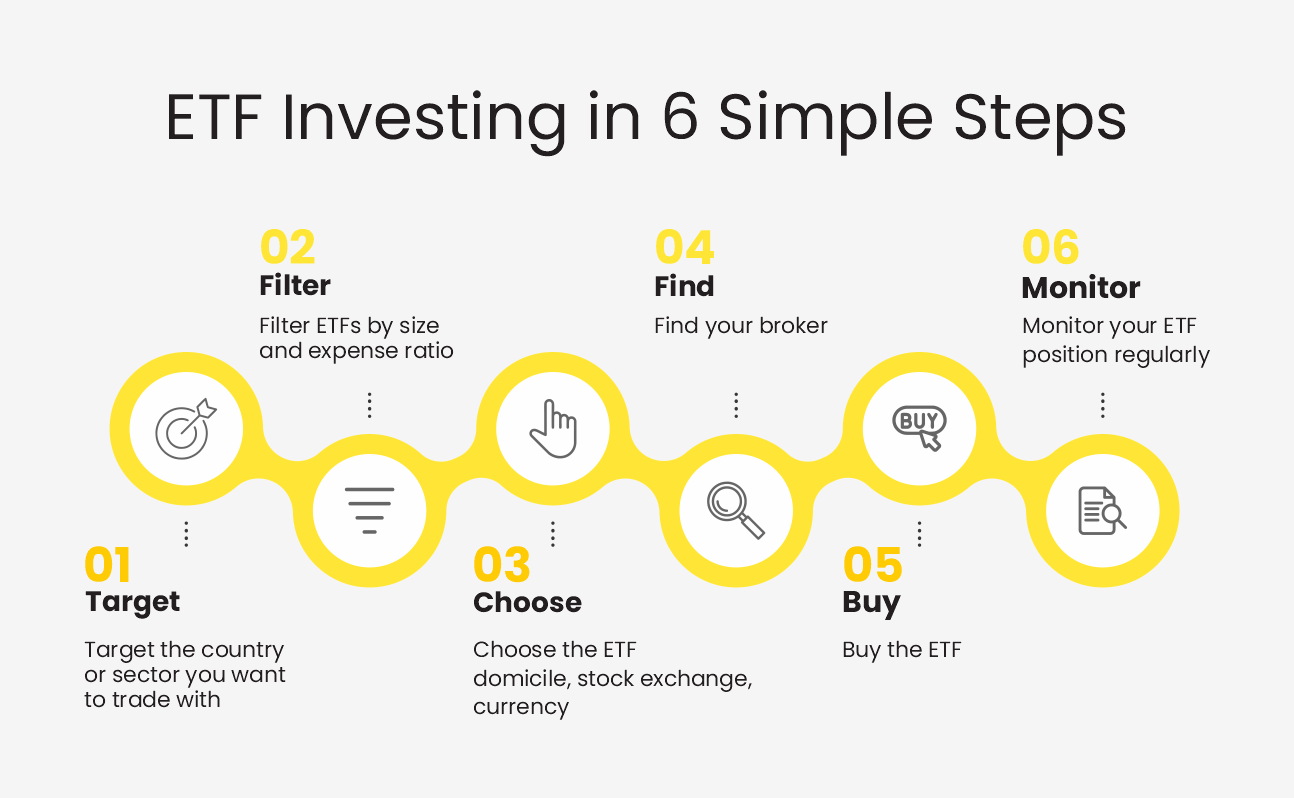
Step-by-Step Guide to Buying Your First ETF
Once you’ve chosen a platform, the process of purchasing an ETF is relatively straightforward.
Opening and Funding Your Account
-
Choose an Account Type: Decide whether you want a taxable brokerage account or a tax-advantaged retirement account (like an IRA).
-
Complete the Application: Fill out the online application, which typically requires personal information, employment details, and your Social Security number.
-
Verify Identity: You may need to provide copies of identification documents.
-
Fund Your Account: Link your bank account (ACH transfer is common), set up a wire transfer, or transfer funds from another investment account. Be aware of potential transfer limits and timelines.
Researching and Selecting ETFs
-
Define Your Goals: What are you investing for? What’s your risk tolerance?
-
Use Screening Tools: Leverage the platform’s ETF screeners to filter by criteria such as asset class, sector, geography, expense ratio, fund size, and past performance.
-
Review Fund Details: Examine the ETF’s prospectus, holdings, expense ratio, trading volume, and historical performance. Ensure it aligns with your investment objectives.
-
Consider Diversification: Look for ETFs that help you achieve broad market exposure or fill specific gaps in your portfolio. Many beginners start with broad-market index ETFs (e.g., S&P 500 ETFs).
Placing a Buy Order
-
Navigate to the ETF: Search for the ETF’s ticker symbol on the platform.
-
Select “Buy”: Choose the option to purchase shares.
-
Enter Quantity or Dollar Amount: Decide how many shares you want to buy, or if fractional shares are allowed, the dollar amount you wish to invest.
-
Choose Order Type:
-
Market Order: Buys at the best available price immediately. Simple, but the price might fluctuate between when you place the order and when it executes.
-
Limit Order: Specifies the maximum price you’re willing to pay per share. Your order will only execute if the ETF reaches that price or lower. This offers more control but may not execute if the price doesn’t drop.
-
-
Review and Confirm: Double-check all details of your order before confirming.
Monitoring and Managing Your Investments
Once you’ve bought your ETFs, don’t just forget about them.
-
Regular Review: Periodically check your portfolio’s performance and ensure your investments still align with your goals.
-
Rebalancing: Over time, some assets may grow more than others, shifting your portfolio’s asset allocation away from your target. Consider rebalancing periodically to bring it back in line.
-
Stay Informed: Keep an eye on market news and economic trends, especially as they pertain to the sectors or regions your ETFs invest in.
Tips for Smart ETF Investing
Investing in ETFs can be a powerful strategy, but a few best practices can enhance your success.
Diversification is Key
While ETFs offer inherent diversification, it’s still crucial to diversify across different types of ETFs. Don’t put all your money into a single sector ETF. Combine broad market ETFs with bond ETFs, international ETFs, or specific sector ETFs to build a truly diversified portfolio that can withstand various market conditions.
Understand the Underlying Assets
Never invest in an ETF just because you heard it’s popular. Always understand what assets the ETF holds and how it tracks its index or strategy. For instance, a leveraged ETF can amplify gains and losses, making it unsuitable for long-term buy-and-hold investors. Similarly, understand the risks associated with sector-specific or commodity-based ETFs.
Consider Your Investment Horizon
Your investment timeline significantly influences your choice of ETFs. If you have a long-term horizon (10+ years), you might tolerate more volatility and lean towards equity-heavy ETFs. For shorter-term goals, you might favor bond ETFs or more conservative options. Align your ETF choices with when you’ll need the money.
Rebalance Periodically
Market movements will cause your portfolio’s asset allocation to drift. For example, if your stock ETFs perform exceptionally well, they might represent a larger portion of your portfolio than you initially intended. Periodically (e.g., annually) rebalance your portfolio by selling some of your outperforming assets and buying more of your underperforming ones to bring your allocation back to your target weights. This helps manage risk and maintains your desired investment strategy.
In conclusion, the question “Where can I buy ETFs?” opens up a world of investment possibilities. Whether you prefer the hands-on control of an online brokerage, the automated simplicity of a robo-advisor, or the personalized guidance of a full-service firm, there’s a platform tailored to your needs. By carefully considering fees, features, research tools, and your own investment style, you can confidently choose the right home for your ETF investments and embark on a rewarding financial journey.
aViewFromTheCave is a participant in the Amazon Services LLC Associates Program, an affiliate advertising program designed to provide a means for sites to earn advertising fees by advertising and linking to Amazon.com. Amazon, the Amazon logo, AmazonSupply, and the AmazonSupply logo are trademarks of Amazon.com, Inc. or its affiliates. As an Amazon Associate we earn affiliate commissions from qualifying purchases.