
For many investors, Apple (AAPL) is the cornerstone of a modern portfolio. As one of the most valuable companies in the world, its stock movements are tracked with clinical precision by institutional analysts and retail traders alike. Among the most common questions surrounding the tech giant’s financial strategy is one rooted in accessibility and psychological pricing: “When will the Apple stock split?”
A stock split does not change the fundamental value of a company, yet it remains one of the most anticipated events in the lifecycle of a blue-chip stock. By increasing the number of outstanding shares and lowering the price per share proportionally, a company can make its stock more accessible to a broader range of investors. For Apple, a company that has utilized this strategy five times in its history, the question of “when” is often a matter of price thresholds and market sentiment.
The History and Mechanics of Apple’s Stock Splits
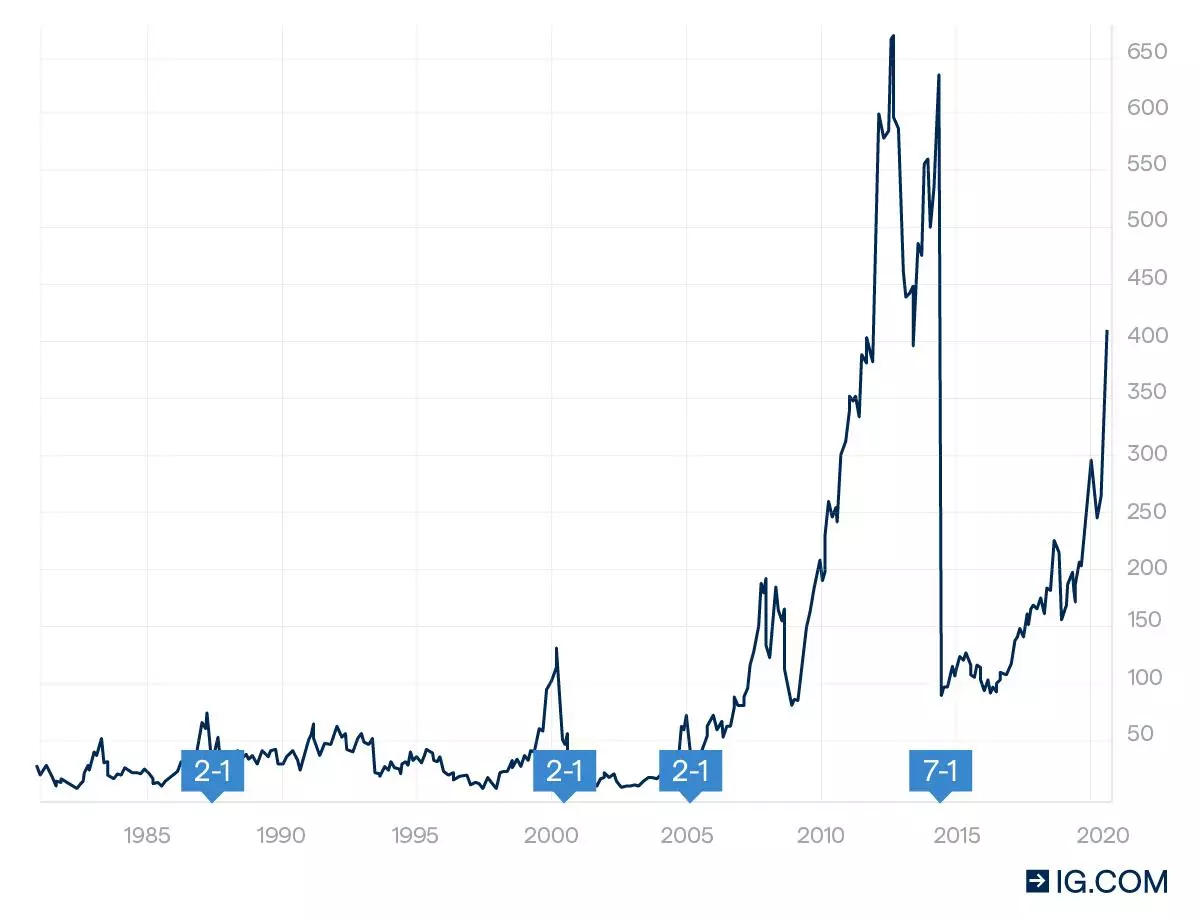
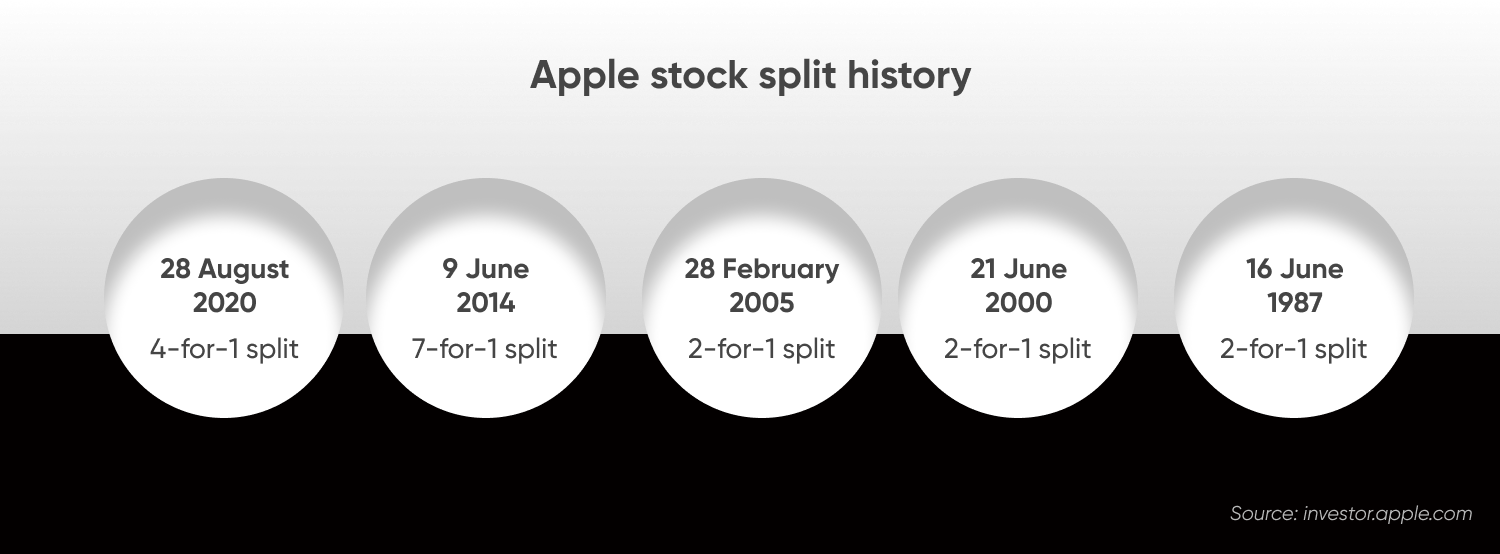
To understand when Apple might split its stock again, one must first look at its historical behavior. Apple has executed five stock splits since it went public in December 1980. These events were not random; they were calculated moves designed to manage the stock’s marketability and its position within major indices.
A Timeline of Previous Splits
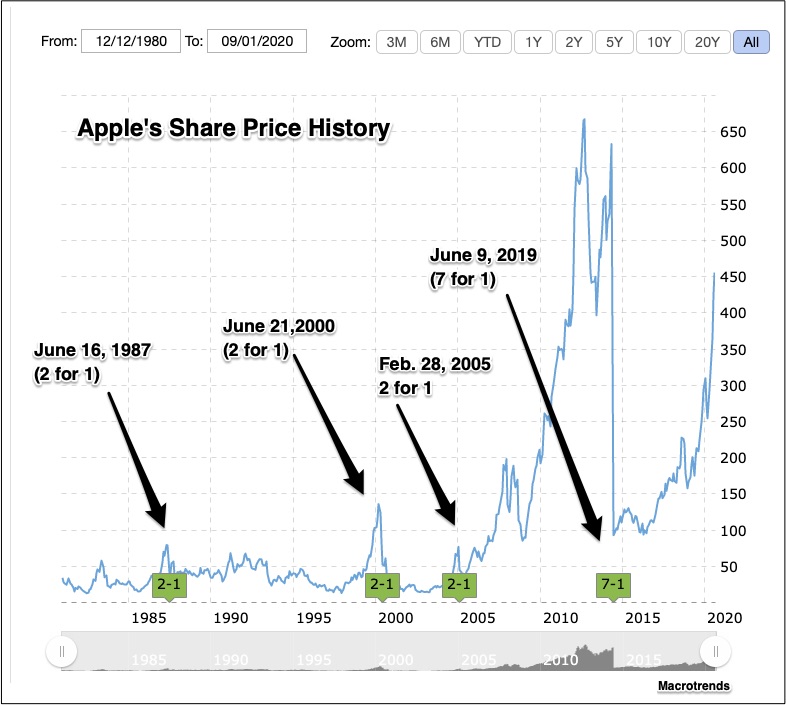
Apple’s first split occurred in June 1987, a 2-for-1 split. It would be another thirteen years before the next one in June 2000, also a 2-for-1. The third split arrived in February 2005 (2-for-1), followed by a massive 7-for-1 split in June 2014. The most recent split occurred in August 2020, a 4-for-1 distribution.
The 2014 split is particularly noteworthy because it brought the share price down from approximately $645 to $92. This move was widely viewed as a prerequisite for Apple’s inclusion in the Dow Jones Industrial Average (DJIA). Because the Dow is a price-weighted index, a $600 stock would have exerted too much influence over the index’s movement. By splitting the stock 7-for-1, Apple made itself “Dow-compatible.”
How Splits Impact the Individual Investor
In a stock split, the market capitalization of the company remains exactly the same. If you own one share of a company worth $400 and the company executes a 4-for-1 split, you then own four shares worth $100 each. While the total value of your investment hasn’t changed, the liquidity of the stock often improves. For the retail investor, a lower price point reduces the barrier to entry, allowing for easier accumulation of shares without relying on fractional share trading, which is not available on all brokerage platforms globally.
The Financial Logic: Why Apple Might Split Again
Apple does not split its stock simply to generate headlines. There are core financial and strategic reasons why the board of directors would choose to increase the share count.
Psychological Price Barriers
Even in an era where many brokerages offer fractional shares, “sticker shock” remains a real phenomenon in the equity markets. A stock trading at $500 or $700 per share can feel “expensive” to a casual investor, even if its Price-to-Earnings (P/E) ratio suggests it is undervalued. By keeping the share price in a “sweet spot”—historically between $100 and $200 for Apple—the company maintains an image of being accessible to the average consumer who also happens to be a potential shareholder.
Employee Compensation and Retention
Apple is one of the world’s largest employers of high-tier engineering and creative talent. A significant portion of employee compensation comes in the form of Restricted Stock Units (RSUs). When a stock price becomes too high, it becomes more difficult for the company to distribute these units granularly. A lower share price allows for more flexibility in structuring compensation packages, making it easier to award shares to a wider range of employees across different levels of the corporate hierarchy.
Liquidity and Options Trading
Liquidity is the lifeblood of a healthy stock. A lower share price typically leads to higher trading volume. Furthermore, the options market is heavily influenced by share price. Since one options contract controls 100 shares of the underlying stock, a high share price makes the nominal cost of a single contract prohibitively expensive for many retail traders. If Apple trades at $500, a single “at-the-money” call contract would require $50,000 of underlying value. A split makes the options market more liquid and accessible, which can contribute to overall price stability.
Key Indicators for the Next Split Announcement
While Apple does not have a formal policy regarding when a split must occur, market analysts look for specific signals that suggest the board is preparing for a move.
The Price Threshold
Historically, Apple has looked at a split when its share price approaches or exceeds the $400 to $500 range. Before the 2014 split, the stock was over $600. Before the 2020 split, it was trading near $500. If the stock maintains a steady upward trajectory fueled by growth in Services and AI-driven hardware cycles, reaching a price point above $300 or $400 would likely trigger discussions in the boardroom.
Earnings Growth and Buyback Programs
Apple is famous for its massive capital return program. The company spends tens of billions of dollars every year on share buybacks. This process reduces the number of outstanding shares, which inherently puts upward pressure on the share price. When the buyback program reaches a point where the “float” (the number of shares available for public trading) becomes tight enough to drive the price into the high triple digits, a split becomes a natural corrective measure to restore balance.
Product Cycles and Innovation
Stock splits are often announced alongside strong earnings reports or major product announcements to capitalize on positive momentum. As Apple integrates generative AI into its ecosystem (Apple Intelligence) and expands its footprint in spatial computing with the Vision Pro, any significant surge in revenue that drives the stock price to new all-time highs could serve as the catalyst for a split announcement.
What a Potential Split Means for Your Portfolio
For the long-term investor, a stock split should be viewed as a “neutral-to-positive” event. While it doesn’t change the underlying fundamentals—revenue, margins, or cash flow—it often acts as a bullish signal to the market.
Historical Performance Post-Split
Statistically, companies that split their stocks tend to outperform the broader market in the twelve months following the split. This is not necessarily because the split itself creates value, but because companies only split their stock when they are confident in their future growth. A split is a signal of corporate health. It says, “We expect our price to continue rising, and we want to make room for that growth.”
Dividend Adjustments
If you are an income-focused investor, it is important to remember that dividends are adjusted proportionally during a split. If Apple pays a dividend of $0.25 per share and undergoes a 4-for-1 split, the new dividend will be $0.0625 per share. Your total dividend income remains identical. Apple has a track record of raising its dividend annually, and a stock split does not interrupt this commitment to returning value to shareholders.
Tax Implications
A common concern for investors is whether a stock split triggers a taxable event. The answer is generally no. Because the total value of your holding remains the same, a split is not considered a capital gain. Your “cost basis” per share is simply recalculated. If you bought one share for $200 and it splits 2-for-1, your new cost basis is $100 per share for two shares. No taxes are due until you actually sell the shares.
Strategic Positioning: How to Trade the Next Split
Should you buy Apple stock specifically because you anticipate a split? Most financial advisors would suggest that the fundamentals of the business—its ecosystem lock-in, services revenue, and balance sheet—are better reasons to invest. However, there is a clear pattern in how the market reacts to split news.
Typically, there is a “run-up” period between the announcement of the split and the date it actually occurs. Traders often buy into this momentum, hoping to flip the stock once the split is executed and retail demand surges. For the long-term investor, the best strategy is often to ignore the noise of the split itself and focus on the company’s ability to maintain its competitive advantages.
Apple’s move toward high-margin services and its disciplined approach to hardware innovation suggest that the share price will continue to face upward pressure over the long term. As the company continues to retire shares through its buyback program and grow its bottom line, the “when” of the next stock split becomes less a question of “if” and more a question of at what psychological price point the board feels the need to reset the clock.
In conclusion, while there is no official date for the next Apple stock split, the company’s history and the current trajectory of its share price suggest that a split remains a key tool in its financial arsenal. Investors should watch for the $400 to $500 price range as a potential trigger point. Until then, the focus remains on Apple’s ability to innovate and dominate the global technology landscape, ensuring that whether the price is $200 or $800, the value of the enterprise remains undisputed.
aViewFromTheCave is a participant in the Amazon Services LLC Associates Program, an affiliate advertising program designed to provide a means for sites to earn advertising fees by advertising and linking to Amazon.com. Amazon, the Amazon logo, AmazonSupply, and the AmazonSupply logo are trademarks of Amazon.com, Inc. or its affiliates. As an Amazon Associate we earn affiliate commissions from qualifying purchases.