
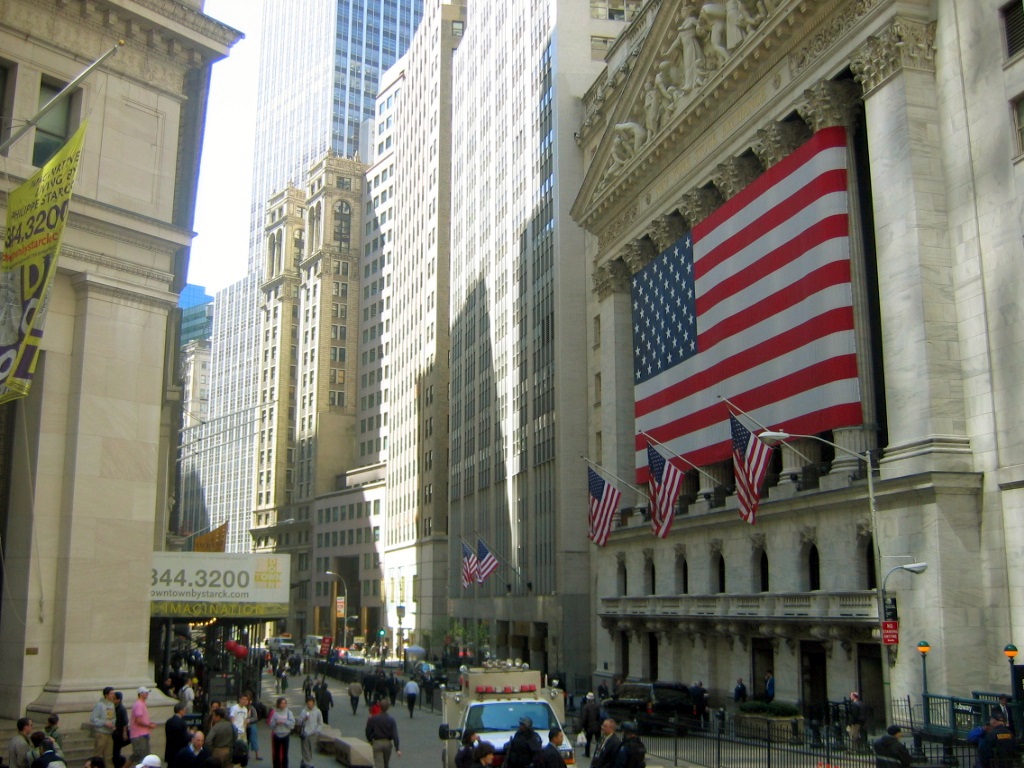
Wall Street. The name alone conjures images of towering skyscrapers, frenetic trading floors, and the undeniable pulse of global finance. It’s a place synonymous with ambition, innovation, wealth creation, and at times, intense scrutiny. For centuries, this unassuming stretch of Lower Manhattan has been the epicenter of American capitalism, shaping economies, funding nations, and defining the trajectory of countless businesses and individual fortunes. But how did this legendary financial district come into being? When was Wall Street, as we know it, truly established? The answer isn’t a single date, but rather a fascinating evolution, deeply intertwined with the very birth and growth of the United States itself. To understand its establishment is to trace the journey from a modest colonial outpost to the unrivaled engine of modern finance.
The Seeds of Commerce: New Amsterdam and the Wall’s Emergence
The story of Wall Street begins not with brokers and bonds, but with bricks and a defensive barrier in a burgeoning 17th-century settlement. Its origins are humble, rooted in the pragmatic needs of early colonial life, far removed from the complex financial instruments it would one day facilitate.
A Defensive Frontier: The Original Wall
In the mid-17th century, the southern tip of Manhattan Island was the Dutch settlement of New Amsterdam, a bustling trading post under the jurisdiction of the Dutch West India Company. Life was precarious, marked by territorial disputes and the constant threat of conflict. To protect their valuable fur trading operations and growing population from potential attacks by indigenous tribes and encroaching British colonists from the north, the Dutch authorities decided to construct a formidable defensive structure. In 1653, under the directorship of Peter Stuyvesant, a palisade was erected. This was not a decorative fence but a substantial barrier composed of wooden planks, earth, and stone, stretching from one side of the island to the other – roughly from the East River to the Hudson River, effectively marking the northern boundary of the settlement. This physical demarcation gave the future street its enduring name. The wall was a testament to the early settlers’ priority: security and the protection of their fledgling economic interests.
From Protection to Pedestrian Pathway: The Wall’s Demise and Street’s Birth
For nearly half a century, this defensive wall served its purpose, defining the northern edge of New Amsterdam. However, as the geopolitical landscape shifted and British control solidified over what became New York, the necessity of the wall diminished. By the late 17th century, the threats it was designed to counter had largely receded. The wall, increasingly seen as an impediment to urban development and traffic, was eventually ordered to be dismantled. In 1699, the last remnants of the wooden palisade were removed.
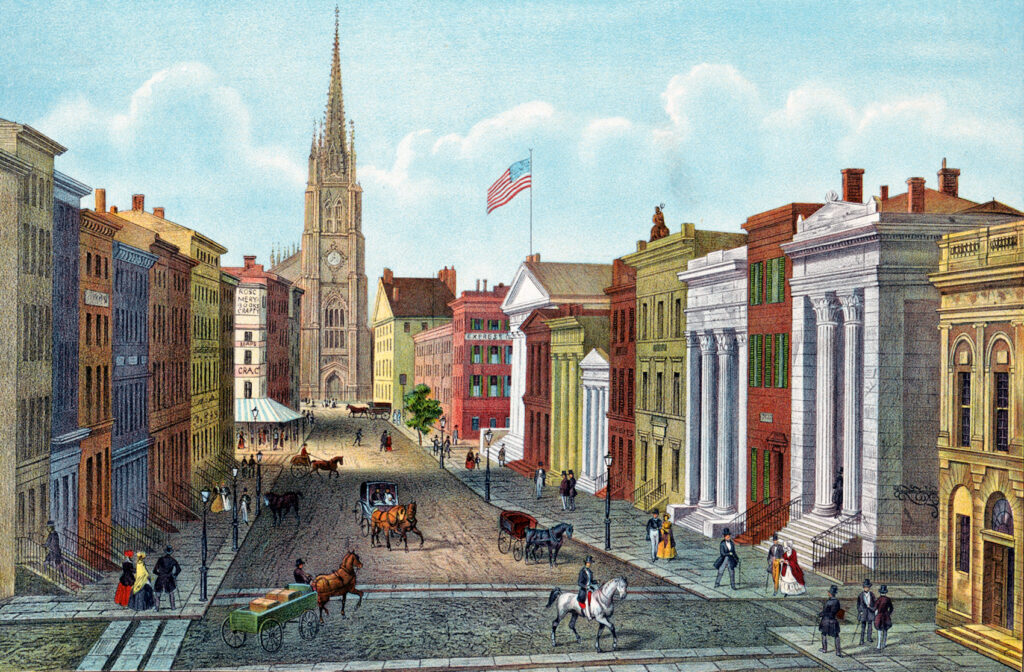
In its place emerged a nascent street, aptly named “Wall Street,” forever memorializing the defensive structure that once stood there. With the wall gone, the former boundary transformed into a vital thoroughfare, ideally situated for the burgeoning commercial activities of the rapidly expanding city. Early Wall Street was not yet the financial hub it would become, but it was already a significant nexus of trade and communication. Merchants, traders, and artisans congregated here, drawn by its central location and proximity to the docks. It was on this street that the first seeds of commerce and exchange were sown, laying the groundwork for the monumental developments that would follow.
The Budding Bourse: From Buttonwood to Exchange
While Wall Street existed as a physical location since the late 17th century, its establishment as a financial market, particularly for securities trading, is generally traced to a pivotal moment in the late 18th century, a time when the nascent United States was grappling with significant financial challenges.
The Buttonwood Agreement (1792): A Gentlemen’s Pact
The American Revolution, while securing independence, left the young nation with a substantial war debt. To manage this and foster economic growth, the federal government issued bonds. Additionally, the establishment of the First Bank of the United States and the Bank of New York created corporate stocks that needed to be bought and sold. Initially, trading in these securities was informal, conducted primarily by auctioneers in public spaces or coffee houses. There was no standardized system, commissions varied wildly, and market integrity was often questionable.
Recognizing the need for greater order and transparency, on May 17, 1792, a group of 24 prominent stockbrokers and merchants gathered under a buttonwood tree at 68 Wall Street. There, they signed what would become known as the Buttonwood Agreement. This simple, two-sentence document laid the foundational rules for organized securities trading in the United States. The signatories pledged to trade securities only among themselves, cutting out the auctioneers, and agreed to charge each other a fixed commission rate. This agreement was revolutionary; it created an exclusive, formalized marketplace, fostering trust among its members and establishing a degree of professionalism previously unseen. It marked the true “establishment” of an organized stock market in America, directly on Wall Street.
Early Financial Instruments and Capital Formation
The Buttonwood Agreement formalized trading in a limited but crucial set of financial instruments. Primarily, these included the aforementioned government bonds (specifically, 6% funded debt of the United States, 3% stock, and deferred 6% stock), and shares of the First Bank of the United States and the Bank of New York. While these might seem simplistic by today’s standards, they were vital tools for capital formation in the fledgling nation.
The trading facilitated by these early brokers played a critical role in financing the operations of the federal government and channeling private capital into essential enterprises. It enabled the government to manage its debt, established a credit market, and provided a mechanism for individuals and institutions to invest in the nation’s future. This nascent market, centered on Wall Street, was instrumental in mobilizing the capital required to build a new country from the ground up, proving the power of a centralized, organized financial exchange from its very inception.
The New York Stock & Exchange Board (1817): Formalizing the Market
The Buttonwood Agreement provided the framework, but as the volume and complexity of trading grew, a more structured organization became necessary. The informal meetings under the buttonwood tree and in various rented rooms were no longer sufficient. In 1817, the signatories of the Buttonwood Agreement decided to formalize their association, creating the New York Stock & Exchange Board. This new entity established a set of written rules, elected a president, and began leasing a dedicated meeting room. This move marked a significant step towards creating a modern stock exchange, transitioning from a gentlemen’s club to a more institutionalized body with defined procedures and a clear governance structure.
The formation of the New York Stock & Exchange Board provided the institutional bedrock upon which Wall Street’s future dominance would be built. It signaled a commitment to greater transparency, stability, and growth, ensuring that the market could adapt to the increasing demands of a rapidly industrializing nation. By providing a reliable platform for buying and selling securities, it solidified Wall Street’s position as the primary conduit for capital flows in the United States.
Catalysts for Growth: Wall Street’s Ascent in the 19th Century

The 19th century witnessed Wall Street transform from a significant regional market into the undisputed financial engine of a rapidly expanding nation. Several key developments fueled this astonishing growth, inextricably linking the district’s fortunes to the economic destiny of the United States.
The Erie Canal and Industrial Revolution
The early to mid-19th century was a period of immense infrastructural development in America. Perhaps no project better exemplifies this than the Erie Canal, completed in 1825. This engineering marvel connected the Great Lakes to the Atlantic Ocean via the Hudson River, effectively making New York City the nation’s premier port and commercial gateway. The canal drastically reduced transportation costs and time, funneling agricultural products and raw materials from the interior to the coast, and manufactured goods back inland.
This explosion of commerce demanded vast amounts of capital, and Wall Street was perfectly positioned to provide it. The canal itself was largely financed through state bonds sold on Wall Street, demonstrating its crucial role in funding large-scale public works. Beyond the canal, the burgeoning Industrial Revolution spurred the creation of new industries – textile mills, factories, and eventually, railroads. Each of these required substantial investment, and companies turned to Wall Street to raise capital by issuing stocks and bonds. This era cemented Wall Street’s role as the central clearinghouse for investment in American industry, directly financing the nation’s economic transformation.
Telegraph and Communication Revolution
The mid-19th century brought another transformative force: the telegraph. The invention and widespread adoption of this revolutionary communication technology profoundly impacted financial markets. Prior to the telegraph, market information traveled at the speed of horse or ship, meaning prices in one city could be significantly different from those in another, leading to inefficiencies and arbitrage opportunities that were difficult to exploit quickly.
With the telegraph, market data – stock prices, bond yields, news of company earnings, and political developments – could be transmitted almost instantaneously across vast distances. This meant that investors and traders in New York could react to events in Boston, Philadelphia, or even London with unprecedented speed. The telegraph fostered greater market efficiency, reduced informational disparities, and spurred a dramatic increase in trading volume and speed. It further centralized financial power on Wall Street, as New York became the nexus for this vital information flow, consolidating its dominance over other regional exchanges.
Civil War Financing and Government Bonds
The American Civil War (1861-1865) presented an unprecedented financial challenge for both the Union and the Confederacy. For the Union, prosecuting the war required immense sums of money for soldiers’ pay, armaments, and supplies. Secretary of the Treasury Salmon P. Chase turned to Wall Street. Through innovative financial strategies spearheaded by figures like Jay Cooke, a prominent Philadelphia banker, the Union government issued massive quantities of war bonds. These bonds were marketed not just to institutional investors but also, for the first time on a large scale, to ordinary citizens through a vast network of agents and banks.
Wall Street played a pivotal role in facilitating the sale and trading of these government bonds. The success of these efforts demonstrated the strength and capacity of the American financial market to mobilize capital on a national scale in times of crisis. The war debt, and the need to trade it, further expanded the volume and scope of Wall Street’s activities, cementing its position as the indispensable financial arm of the federal government and a critical component of national stability.
The Dawn of Modern Finance: Wall Street in the 20th Century and Beyond
As the 19th century gave way to the 20th, Wall Street solidified its status as a global financial powerhouse, adapting to new technologies, weathering economic storms, and continuously evolving its role in the modern world.
From Open Outcry to Digital Desks
For much of its history, trading on Wall Street was characterized by the vibrant, often chaotic, “open outcry” system. Traders in colorful jackets would shout bids and offers on the trading floor of the New York Stock Exchange (NYSE), using hand signals and verbal cues to execute transactions. This iconic image persisted for over a century, embodying the energy and human element of the market.
However, the late 20th and early 21st centuries ushered in a dramatic technological transformation. Advances in computing, telecommunications, and network infrastructure led to the gradual digitalization of trading. Electronic communication networks (ECNs) and computerized trading systems began to automate the matching of buyers and sellers, increasing speed, reducing costs, and expanding market access. While a hybrid system still exists for some trades, the vast majority of transactions on Wall Street today are executed digitally, often by complex algorithms operating at lightning speed. This shift has fundamentally altered the physical landscape of Wall Street, moving many “traders” from the bustling floor to quieter desks in front of multiple screens, yet the district remains the intellectual and symbolic heart of these high-tech financial operations.
Global Financial Hub: Impact and Influence
By the early 20th century, particularly after World War I, Wall Street had surpassed London as the world’s leading financial center. Its influence became global, extending far beyond the United States borders. New York-based investment banks, brokerage firms, and financial institutions financed international ventures, facilitated cross-border trade, and played a crucial role in the global flow of capital.
Today, Wall Street continues to be a dominant force in global capitalism. It hosts the world’s largest stock exchanges (NYSE and NASDAQ by market capitalization), is home to major investment banks, hedge funds, private equity firms, and serves as a primary market for a vast array of financial products, from equities and bonds to derivatives and foreign exchange. Its decisions and performance ripple across international markets, influencing economies and shaping financial policies worldwide. The district’s concentrated expertise and capital make it an unparalleled hub for innovation, risk management, and wealth generation on a truly global scale.
Enduring Legacy and Future Trajectory
Wall Street’s journey from a humble defensive barrier to the undisputed financial capital of the world is a testament to its adaptability, resilience, and foundational role in the American economic narrative. It has weathered panics, depressions, and recessions, constantly reinventing itself and emerging stronger. The establishment of Wall Street was not a singular event but a layered process: the physical street laid out in the late 17th century, the formalized trading beginning with the Buttonwood Agreement in 1792, and the institutionalization with the New York Stock & Exchange Board in 1817. Each step built upon the last, progressively creating the financial behemoth we know today.
Looking forward, Wall Street continues to face new challenges and opportunities, from regulatory shifts and geopolitical tensions to the rise of new financial technologies like blockchain and artificial intelligence. Its future trajectory will undoubtedly involve further evolution, but its fundamental role as a nexus for capital, a driver of innovation, and a powerful symbol of economic ambition remains firmly established, echoing the persistent spirit of commerce that first took root centuries ago.
In conclusion, Wall Street’s “establishment” is a rich tapestry woven from colonial defense, nascent commerce, groundbreaking agreements, and relentless adaptation. From a simple palisade to a global financial powerhouse, its story is the embodiment of economic progress and the enduring pursuit of prosperity.
aViewFromTheCave is a participant in the Amazon Services LLC Associates Program, an affiliate advertising program designed to provide a means for sites to earn advertising fees by advertising and linking to Amazon.com. Amazon, the Amazon logo, AmazonSupply, and the AmazonSupply logo are trademarks of Amazon.com, Inc. or its affiliates. As an Amazon Associate we earn affiliate commissions from qualifying purchases.