
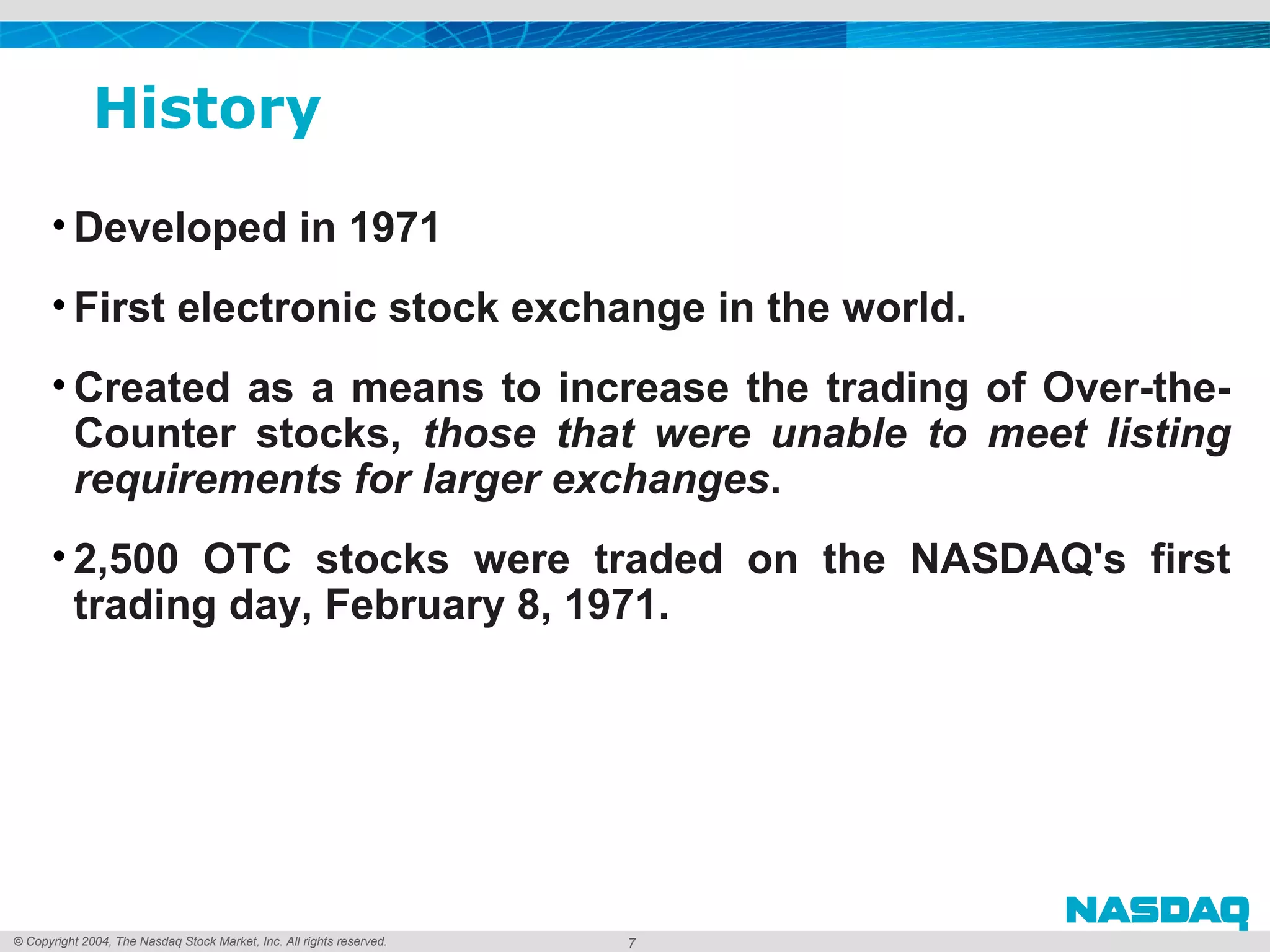
The history of financial markets is often told through the lens of mahogany boardrooms and chaotic trading floors filled with shouting brokers. However, the trajectory of modern investing changed forever on February 8, 1971. This was the day the Nasdaq (National Association of Securities Dealers Automated Quotations) officially commenced operations, marking the birth of the world’s first electronic stock market. While the New York Stock Exchange (NYSE) had already been trading for nearly two centuries, the creation of the Nasdaq represented a radical shift from physical proximity to digital connectivity, a move that would eventually define the era of growth-focused, high-tech investing.

For the modern investor, understanding when and why the Nasdaq was created is not merely a history lesson. It is an exploration of how the democratization of data and the centralization of “over-the-counter” (OTC) trading paved the way for the tech giants that dominate today’s economy. From its humble beginnings as a quotation system to its current status as the home of the “Magnificent Seven,” the Nasdaq’s evolution mirrors the rise of the digital age itself.
The Origins of the Nasdaq: From 1971 to the Digital Frontier
Before the Nasdaq’s inception in 1971, the world of “unlisted” stocks was fragmented and opaque. Stocks that did not meet the stringent requirements of the NYSE were traded over-the-counter. This meant that investors and brokers had to call multiple dealers to find the best price for a security, leading to wide spreads, slow execution, and a lack of transparency. The National Association of Securities Dealers (NASD), the predecessor to today’s FINRA, recognized that this inefficiency was a barrier to capital formation.
The Vision of the NASD
In the late 1960s, the NASD sought to create a centralized system that would aggregate the bid and ask prices from various market makers into a single electronic screen. The goal was simple: provide clarity. When the Nasdaq launched in early 1971, it was initially just a quotation system. It did not actually execute trades; instead, it provided the data that allowed brokers to see who had the best price.
This transparency had an immediate impact on the market. By narrowing the spreads between the buying and selling prices, the Nasdaq made it cheaper for individual investors to participate in the growth of smaller companies. It was the first step toward the “high-speed” trading environments we take for granted today.
Transitioning to a Listing Market
While the Nasdaq started as a way to track OTC stocks, it quickly evolved into a prestigious listing venue in its own right. By the early 1980s, the system began to transform from a mere data provider into a full-fledged exchange. This transition was fueled by the emergence of a new breed of company—those focused on software, biotechnology, and semiconductors—that found the NYSE’s traditional requirements too rigid or its culture too stagnant.
How the Nasdaq Revolutionized Global Trading Mechanics
The creation of the Nasdaq didn’t just change where people traded; it changed how they traded. Unlike the NYSE, which for centuries relied on a “specialist” system—where a single individual on the floor was responsible for maintaining a fair and orderly market for a specific stock—the Nasdaq introduced the “Market Maker” model.
The Role of Market Makers
In the Nasdaq ecosystem, multiple firms compete for investor orders by posting their own bid and ask prices. This competition was designed to ensure liquidity and price efficiency. Because there was no physical floor, the Nasdaq could operate across a vast network of computers, allowing for a level of scalability that physical exchanges could not match. This electronic backbone became the blueprint for every modern financial exchange in the world.
Redefining Listing Requirements for Growth
Historically, the NYSE required companies to have several years of sustained profitability before they could list. The Nasdaq, recognizing the potential of the nascent technology sector, implemented requirements that focused more on market capitalization and future growth potential rather than just historical dividends. This strategic move attracted companies like Apple, Microsoft, and Intel in their infancy. By providing these firms with a platform to raise capital, the Nasdaq effectively funded the personal computer revolution and, later, the internet age.
The Nasdaq-100 and the Rise of Growth-Oriented Investing

To many investors, “the Nasdaq” is synonymous with the Nasdaq-100 Index. Created in 1985, this index tracks the 100 largest non-financial companies listed on the exchange. The timing of its creation was pivotal, as it coincided with the shift in the American economy from industrial manufacturing to service and technology-oriented sectors.
The Benchmark for Innovation
The Nasdaq-100 is unique because it excludes financial companies, such as commercial and investment banks. This exclusion gives the index a heavy tilt toward technology, consumer services, and health care. For the money-conscious investor, the Nasdaq-100 became the ultimate barometer for “growth” stocks. If the Dow Jones Industrial Average represented the economy of the past, the Nasdaq-100 represented the economy of the future.
The ETF Revolution: QQQ
The creation of the Nasdaq also paved the way for one of the most successful financial products in history: the Invesco QQQ Trust. Launched in 1999, this Exchange-Traded Fund (ETF) allows everyday investors to buy the entire Nasdaq-100 in a single transaction. The QQQ has become a staple in modern portfolios, offering a liquid and low-cost way to gain exposure to the innovators driving global productivity. Without the electronic infrastructure established in 1971, the real-time pricing and transparency required for such an ETF would have been impossible.
Historical Milestones and Market Volatility: Lessons for Investors
The journey of the Nasdaq has not been without its periods of extreme turbulence. Because it is so heavily concentrated in high-growth sectors, the exchange is often the epicenter of both market euphoria and market despair. Understanding these historical cycles is essential for managing risk in a modern investment strategy.
The Dot-Com Boom and Bust
The most famous period in Nasdaq history is undoubtedly the late 1990s. As the internet went mainstream, investors poured billions into any company with a “.com” suffix. The Nasdaq Composite Index soared from under 1,000 points in 1995 to a peak of over 5,000 in March 2000.
The subsequent crash was a sobering reminder of the importance of valuation. Many companies listed on the Nasdaq at the time had no earnings and no clear path to profitability. However, the “creative destruction” of the 2000-2002 bear market also cleared the way for the titans we know today. Amazon, which survived the crash, proved that the Nasdaq’s model of favoring long-term growth over short-term dividends could produce world-changing wealth.
The Shift to a Public Company
In a move that further solidified its business-first mentality, the Nasdaq itself became a publicly traded company (ticker: NDAQ) in 2002. It later merged with the Nordic exchange operator OMX in 2008 to become the NASDAQ OMX Group. This transition highlighted a key trend in finance: exchanges were no longer just non-profit member associations; they were global, profit-seeking corporations selling data, technology, and listing services.
Choosing the Right Exchange: Nasdaq vs. NYSE for the Modern Portfolio
For many years, there was a clear hierarchy in the financial world: a company “graduated” to the NYSE once it became successful. Today, that hierarchy has dissolved. The Nasdaq is now home to many of the most valuable companies on the planet, including Alphabet, Meta, and Nvidia.
Structural Differences for Investors
While the average investor may not see a difference when clicking “buy” on a brokerage app, the underlying structures of the Nasdaq and NYSE still differ:
-
Execution Model: Nasdaq is entirely electronic, while the NYSE maintains a “hybrid” model with some floor-based elements.
-
Volatility Profiles: Nasdaq-listed stocks tend to have higher betas, meaning they are more sensitive to market movements. This offers higher potential returns but comes with increased risk during downturns.
-
Cost of Listing: Historically, listing on the Nasdaq has been more cost-effective for companies, allowing them to redirect capital toward research and development.
The Role of Technology in Financial Planning
As we look back at the creation of the Nasdaq in 1971, it is clear that the exchange was the first true “fintech” company. It used technology to solve a financial problem—liquidity and transparency in the OTC market. Today, that spirit continues through the exchange’s heavy investment in cloud computing and artificial intelligence to monitor trade patterns and prevent fraud.
For the personal finance enthusiast, the Nasdaq represents the “Growth” engine of a diversified portfolio. While the S&P 500 provides broad market exposure and the Dow provides stability through blue-chip industrials, the Nasdaq remains the primary destination for those looking to capture the upside of the next technological frontier. Whether it was the silicon chip in the 70s, the internet in the 90s, or AI in the 2020s, the Nasdaq has consistently provided the framework for investors to participate in the most significant economic shifts of our time.
In conclusion, the creation of the Nasdaq was not just a date on a calendar; it was the starting gun for the digitization of global finance. By breaking down the barriers of the physical trading floor, the Nasdaq democratized access to the market and created a home for the innovators who have reshaped our world. For any investor looking to build wealth in the 21st century, the lessons of the Nasdaq—innovation, competition, and the embrace of technology—remain as relevant today as they were in 1971.
aViewFromTheCave is a participant in the Amazon Services LLC Associates Program, an affiliate advertising program designed to provide a means for sites to earn advertising fees by advertising and linking to Amazon.com. Amazon, the Amazon logo, AmazonSupply, and the AmazonSupply logo are trademarks of Amazon.com, Inc. or its affiliates. As an Amazon Associate we earn affiliate commissions from qualifying purchases.