
In the landscape of modern retail, few companies have managed to transform a commodity product into a global cultural phenomenon quite like Build-A-Bear Workshop. While many consumers view the company through a lens of nostalgia, brand strategists view it as a masterclass in experiential marketing and emotional brand equity. To understand the power of this brand, one must look back to its inception in 1997 and analyze how its founding principles have allowed it to survive—and thrive—in an era where traditional brick-and-mortar retail has faced unprecedented challenges.

The 1997 Genesis: A Paradigm Shift in Retail Strategy
Build-A-Bear Workshop was officially created in October 1997, opening its first location in the Saint Louis Galleria in St. Louis, Missouri. The brand was the brainchild of Maxine Clark, a seasoned retail executive who recognized a fundamental shift in consumer behavior long before “experiential retail” became a corporate buzzword.
At its core, the creation of Build-A-Bear was a response to the sterilization of the toy industry. By the late 1990s, toy shopping had become a transactional, shelf-based experience dominated by big-box retailers. Clark’s vision was to pivot from a product-centric model to a process-centric model. She didn’t just want to sell stuffed animals; she wanted to sell the process of creation.
Disrupting the Traditional Retail Model
When Build-A-Bear was founded, the prevailing wisdom suggested that efficiency and price were the primary drivers of retail success. Build-A-Bear challenged this by introducing “entertainment retail.” The brand’s strategic foundation was built on the idea that if you involve the customer in the manufacturing of the product, you create a psychological bond that far exceeds the value of the physical item.
From a branding perspective, this was a move to capture the “IKEA effect”—a cognitive bias in which consumers place a disproportionately high value on products they partially created. By 1997, the brand had already established its core identity: it was a place where “best friends are made.”
The Founder’s Influence on Brand Identity
Maxine Clark’s background in department stores allowed her to imbue Build-A-Bear with a sophisticated operational structure while maintaining a whimsical brand voice. The brand identity was designed to be inclusive, accessible, and high-touch. The decision to name the store a “Workshop” rather than a “Store” was a deliberate linguistic choice that signaled to the consumer that they were entering a space of labor and love, not just commerce.
The Anatomy of Experiential Branding
The longevity of Build-A-Bear, from its 1997 debut to its current status as a multi-channel powerhouse, is rooted in its rigid adherence to a specific brand ritual. Branding is often defined as the sum of all interactions a customer has with a company. For Build-A-Bear, those interactions are choreographed with theatrical precision.
The Seven-Step Brand Journey
The brand’s success is built on a seven-step process that serves as a customer journey map. This sequence—Choose Me, Hear Me, Stuff Me, Stitch Me, Fluff Me, Dress Me, and Name Me—is a psychological funnel designed to build emotional investment.
-
Choose Me: The initial selection process establishes the “character” of the brand interaction.
-
The Heart Ceremony: This is the most critical component of the Build-A-Bear brand strategy. By asking the customer to perform a ritual—rubbing the heart on their chest, making a wish, and placing it inside the bear—the brand moves from selling a toy to facilitating a memory. This ritual is a proprietary brand asset that competitors find nearly impossible to replicate.
-
The Birth Certificate: This final step formalizes the relationship. From a branding standpoint, this is the moment the product becomes a “brand entity” with a name and an identity, further cementing the consumer’s loyalty.
Sensory Branding and Environmental Design
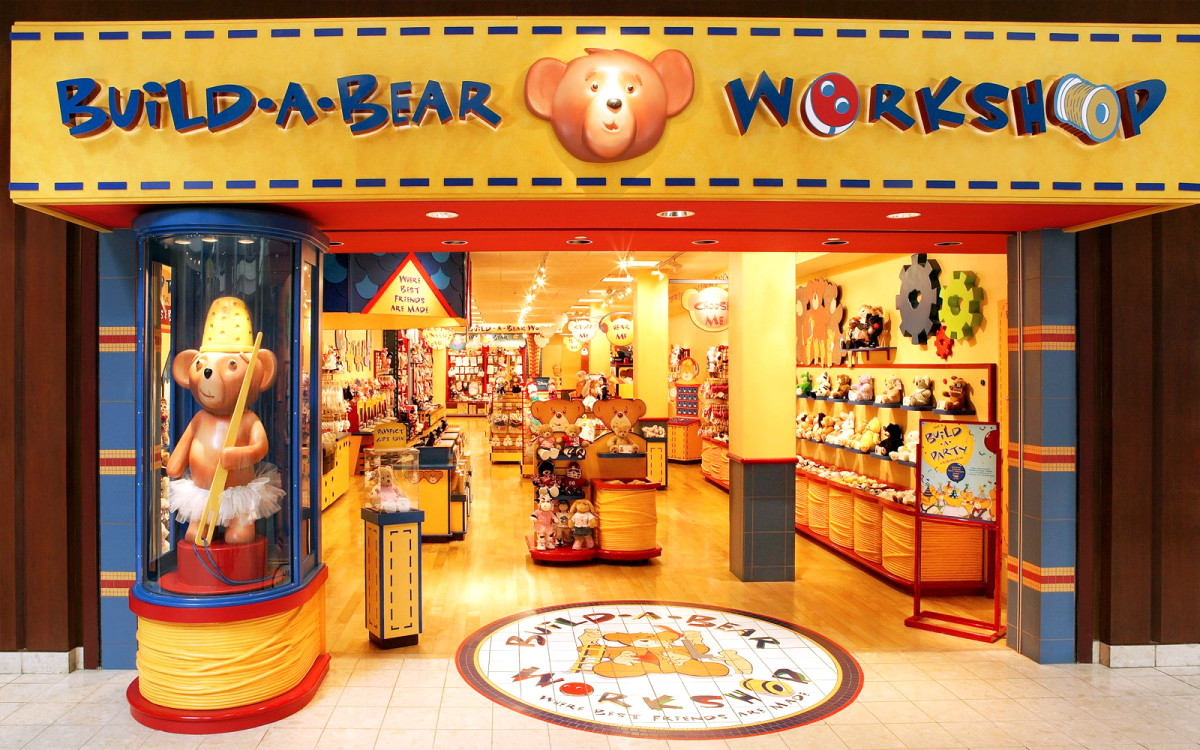
The physical design of the Build-A-Bear Workshop is a key element of its corporate identity. The use of bright yellow and blue, the tactile nature of the stuffing machines, and the distinct scents available for the bears create a multi-sensory brand experience. In branding, the more senses you engage, the higher the brand recall. Build-A-Bear’s “Workshop” aesthetic uses industrial-lite elements—cogs, pipes, and pedals—to create a sense of wonder and play that aligns perfectly with its core mission.
Building Equity Through Personalization and Licensing

As the brand moved into the 2000s, its strategy evolved to focus on two major pillars of brand growth: deep personalization and high-tier strategic partnerships. By allowing customers to customize every aspect of their product, from the sound chips inside to the shoes on the feet, Build-A-Bear mastered the art of “mass customization.”
Co-creation as a Competitive Moat
In the branding world, a “moat” is something that protects a business from its competitors. Build-A-Bear’s moat is its platform for co-creation. While a competitor can sell a cheaper teddy bear, they cannot sell the specific emotional resonance of a bear that a child (or adult) “brought to life.” This strategy shifts the focus from price-sensitivity to value-perception. The brand successfully positioned itself as a premium experience worth the higher price point because it offers something the internet cannot: physical participation.
Strategic Alliances and Brand Extension
A major part of Build-A-Bear’s brand strategy involves leveraging the equity of other massive intellectual properties. By partnering with Disney, Nintendo, Marvel, and Sanrio, Build-A-Bear has transformed its workshops into destinations for fans of these franchises.
-
Borrowing Equity: When Build-A-Bear releases a Star Wars collection, it isn’t just selling a bear; it is merging its brand identity of “heart and creation” with the fan loyalty of the Star Wars universe.
-
Expanding the Demographic: These licensing deals allowed the brand to expand beyond its core demographic of young children. It successfully tapped into the “kidult” market—adult collectors who value the brand for its high-quality plush versions of their favorite pop-culture characters.
Navigating the Digital Pivot and Modern Brand Identity
The retail landscape of the 2020s is vastly different from that of 1997. To maintain its relevance, Build-A-Bear has had to undergo a significant digital transformation while keeping its “heart” intact. This is a delicate balancing act in brand management: how do you modernize without losing the soul of the company?
From Brick-and-Mortar to Multi-Channel
The brand has successfully transitioned from being a mall-based retailer to a diversified lifestyle brand. This includes:
-
The Bear Builder Online: Recreating the workshop experience in a digital environment. While it lacks the physical touch of the store, the digital interface uses animation and storytelling to mimic the “creation” process, maintaining brand consistency across channels.
-
Entertainment and Content: Build-A-Bear has moved into content creation, including films and music. This is a classic “brand-as-publisher” strategy, where the company creates media that reinforces its values and keeps its characters top-of-mind for consumers.
Maintaining Brand Consistency in a Changing World
Throughout its evolution, the Build-A-Bear logo and core messaging have remained remarkably consistent. The “smile” logo and the “bear head” silhouette are instantly recognizable brand marks. This consistency builds trust. In an era of “rebranding” where companies often lose their way, Build-A-Bear’s commitment to its original 1997 vision—making a “best friend”—has provided a stable foundation for growth.
Lessons in Brand Longevity for Modern Entrepreneurs
Build-A-Bear’s journey from a single store in 1997 to a global icon offers several critical lessons for brand strategy and corporate identity.
The Power of Emotional Resonance
The most valuable brands are not those that solve a problem, but those that fulfill a psychological need. Build-A-Bear doesn’t solve the “need for a toy”; it fulfills the “need for connection and expression.” For any brand looking to achieve longevity, the lesson is clear: find a way to anchor your product in a ritual or an emotion.
Adapting to Consumer Shifts (The “Kidult” Market)
One of the brand’s most impressive feats has been its recent focus on the adult market. Recognizing that their original 1997 customers are now adults with disposable income, Build-A-Bear launched the “Bear Cave”—a section of their website dedicated to older collectors, featuring everything from “After Dark” collections to sophisticated pop-culture crossovers. This demonstrates the importance of “brand maturation”—growing with your audience rather than letting them outgrow you.
Resilience Through Experience
As e-commerce continues to dominate, the “Build-A-Bear model” serves as a blueprint for the future of physical retail. Stores can no longer be simple distribution points; they must be destinations. The brand’s success proves that consumers are willing to travel and pay a premium for an experience they cannot get through a screen.
In conclusion, Build-A-Bear Workshop was created at the perfect intersection of retail expertise and psychological insight. By focusing on the “heart” of the brand—literally and metaphorically—the company has built a legacy that transcends the simple sale of plush toys. Since 1997, it has stood as a testament to the power of experiential branding, proving that when you invite the customer to be part of the story, you create a brand that can last a lifetime.
aViewFromTheCave is a participant in the Amazon Services LLC Associates Program, an affiliate advertising program designed to provide a means for sites to earn advertising fees by advertising and linking to Amazon.com. Amazon, the Amazon logo, AmazonSupply, and the AmazonSupply logo are trademarks of Amazon.com, Inc. or its affiliates. As an Amazon Associate we earn affiliate commissions from qualifying purchases.