
In the modern financial landscape, Bitcoin is often discussed in terms of tens of thousands of dollars. It is analyzed by Wall Street institutionalists, held in exchange-traded funds (ETFs), and debated in the halls of global central banks. However, there was a pivotal moment in the digital asset’s infancy when its value was equivalent to a single United States dollar. For many investors, “when was Bitcoin $1?” is more than a chronological question; it is a point of reflection on the nature of speculative value, the evolution of digital scarcity, and the missed opportunities that define the history of modern finance.
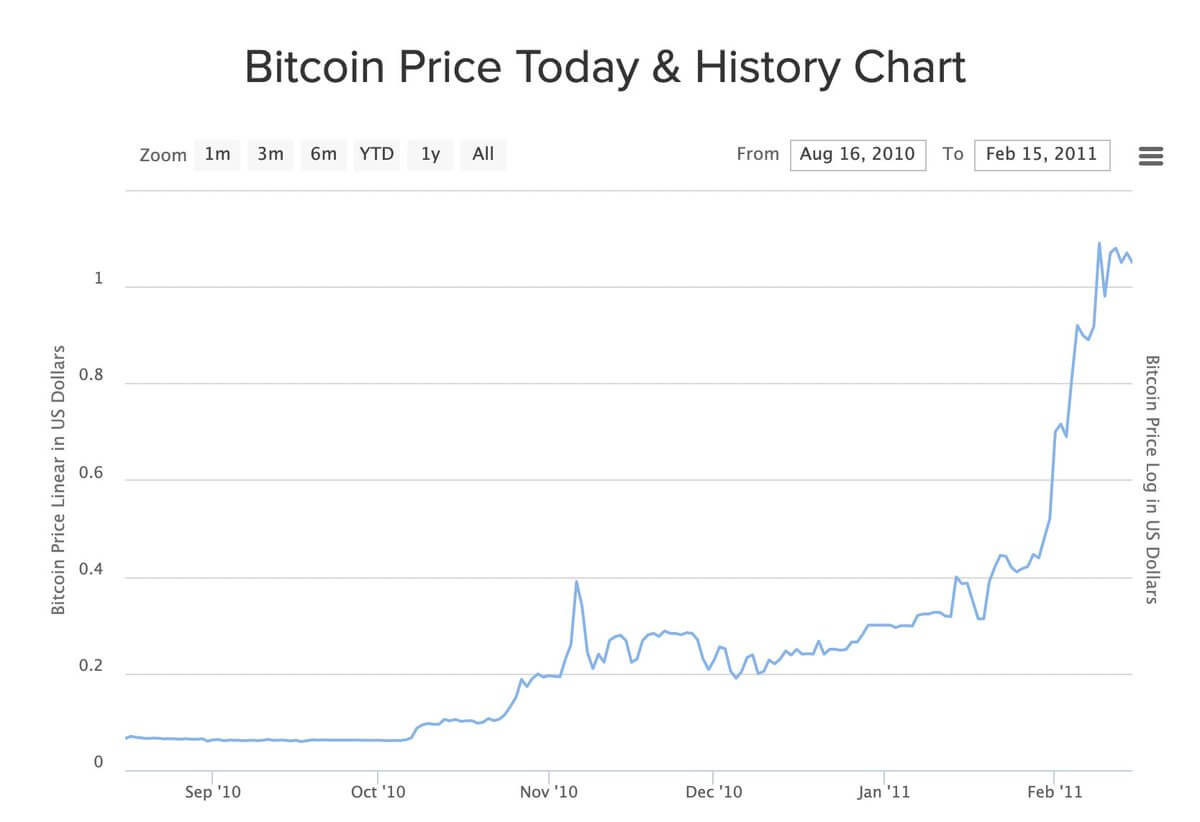
To understand when and why Bitcoin reached parity with the dollar, one must look back to February 2011. This was a period when the technology was less than two years old, known primarily to a small circle of cryptographers, cypherpunks, and hobbyist miners. Reaching the $1 mark was not merely a price movement; it was the first major validation of Satoshi Nakamoto’s experiment as a viable medium of exchange and a legitimate financial asset.
The Dawn of Digital Scarcity: 2009 to Early 2011
Before Bitcoin could reach the one-dollar milestone, it had to transition from a theoretical whitepaper to a functional software protocol with a perceived market value. When the Genesis Block was mined on January 3, 2009, Bitcoin had no exchange rate. There were no trading platforms, no “crypto-wallets” with sleek interfaces, and no institutional interest.
The New Liberty Standard and Early Valuation
The earliest recorded exchange rate for Bitcoin was established by the “New Liberty Standard” in late 2009. At that time, the value was calculated based on the cost of the electricity required to mine the coins using a computer’s CPU. In October 2009, the exchange rate was set at 1,309.03 BTC for $1 USD. To put that into perspective, a single dollar could purchase well over a thousand Bitcoins—an amount that would represent generational wealth by today’s standards.
During this era, Bitcoin was essentially a “toy” for tech enthusiasts. Transactions were rare and usually involved users sending coins back and forth to test the network’s integrity. The primary goal was not profit, but the realization of a decentralized ledger that could operate without a central authority.
The Pizza Transaction: A Milestone in Utility
A significant precursor to the $1 price point occurred on May 22, 2010, now famously celebrated as “Bitcoin Pizza Day.” A programmer named Laszlo Hanyecz traded 10,000 BTC for two Papa John’s pizzas. At the time, the transaction was valued at roughly $41, placing the price of a single Bitcoin at approximately $0.0041. While this seems incredibly low, it was the first time Bitcoin was used to purchase a physical good, proving that the digital tokens possessed real-world purchasing power. This event laid the psychological groundwork for the price to eventually climb toward parity with the dollar.
Reaching Parity: The Landmark Moment in February 2011
The milestone of $1 per Bitcoin was officially achieved on February 9, 2011, on Mt. Gox, which was then the primary exchange for the nascent asset. This achievement was a watershed moment. Reaching parity with the US dollar—the world’s reserve currency—gave Bitcoin a level of psychological legitimacy that it previously lacked.
The Influence of Mt. Gox
In 2011, the infrastructure for buying and selling Bitcoin was extremely limited. Mt. Gox, originally a platform for trading “Magic: The Gathering” cards, had transitioned into a Bitcoin exchange. It provided the liquidity necessary for a market to form. As more people became aware of the protocol through tech blogs and forum discussions on Bitcointalk, the demand began to outpace the supply of coins being mined.
The climb from fractions of a cent to $1 took roughly 25 months from the launch of the network. This growth was driven by a combination of curiosity, ideological support for decentralized finance, and the first wave of speculative investment. When the price hit $1, it triggered a “snowball effect” of media coverage, leading to even greater interest from the broader tech community.
The Slashdot Effect and Initial Media Exposure
Shortly after reaching $1, Bitcoin was featured on Slashdot, a popular technology news website. This exposure brought thousands of new users to the network. For many of these early adopters, the appeal was not just the potential for profit, but the technological breakthrough of the “Byzantine Generals’ Problem” solution—the ability to reach consensus in a distributed network without a central coordinator. By the end of February 2011, Bitcoin didn’t just stay at $1; it began a volatile climb that would see it reach nearly $30 by June of that same year, before experiencing its first “Great Crash” back down to the $2 level.

The Economic Logic Behind the Early Growth
Why did Bitcoin move from being worth nothing to being worth a dollar? From a financial perspective, the movement was dictated by the fundamental laws of supply and demand, coupled with the unique properties of digital scarcity.
Halving Events and Supply Constraints
Unlike fiat currencies, which can be printed at the discretion of central banks, Bitcoin has a fixed supply of 21 million coins. The rate at which new coins enter circulation is governed by the “halving” mechanism, which reduces the block reward by 50% every four years. In 2011, the block reward was 50 BTC. Even with this relatively high issuance rate, the growing realization that Bitcoin was a “finite” digital asset began to drive its valuation. Investors started to view it as “digital gold”—a hedge against the inflationary tendencies of traditional monetary systems.
The Network Effect and Metcalfe’s Law
The value of Bitcoin in its early days can also be explained by Metcalfe’s Law, which states that the value of a network is proportional to the square of the number of its connected users. As more people set up nodes, started mining, and created wallets, the utility of the Bitcoin network grew exponentially. In 2011, the network was small, but it was growing. Each new user who bought Bitcoin at $0.50 or $0.75 added to the liquidity and the security of the network, creating a foundation for the $1 price point to be breached.
Investment Lessons from the Sub-Dollar Era
Looking back at the period when Bitcoin was $1 provides several profound lessons for modern investors and financial analysts. It serves as a case study in risk management, high-conviction investing, and the nature of disruptive technology.
The Mirage of Risk
In 2011, buying Bitcoin at $1 was considered an extreme risk. There was a very high probability that the protocol could fail due to a software bug, government regulation, or a lack of adoption. Most “sensible” investors at the time stayed away because there was no historical data to suggest that a digital string of numbers could maintain value.
The lesson here is that the greatest returns are often found in the “pre-consensus” phase of an asset. By the time an asset is deemed “safe” by institutional standards, the era of exponential growth (like the move from $1 to $60,000) has usually passed. However, this also highlights the “survivorship bias.” For every Bitcoin that reaches parity with the dollar and then soars, hundreds of other digital experiments have failed and gone to zero.
The Importance of Infrastructure
The difficulty of purchasing Bitcoin at $1 cannot be overstated. There were no regulated exchanges, no mobile apps like Coinbase or Binance, and no hardware wallets like Ledger. An investor had to be technically proficient enough to manage their own private keys and navigate unregulated, offshore exchanges. The evolution of Bitcoin’s price is inextricably linked to the evolution of its infrastructure. As it became easier to buy, store, and trade, the price naturally rose to reflect the increased accessibility.
The Legacy of the $1 Bitcoin in Modern Finance
The moment Bitcoin reached $1 was the first step in a journey that would eventually challenge the traditional financial system. It proved that a decentralized, borderless currency could have a stable value relative to fiat money.
From Niche Experiment to Institutional Asset
Today, the $1 price point is a distant memory, but the principles that drove Bitcoin to that mark remain the same. The scarcity, the decentralization, and the transparency of the blockchain continue to be the primary value drivers. What began as a $1 experiment has evolved into a multi-trillion-dollar asset class that includes not only Bitcoin but an entire ecosystem of decentralized finance (DeFi) and smart contract platforms.

The Psychological Anchor
The $1 mark serves as a psychological anchor in the history of finance. It represents the point where “nothing” became “something.” For the financial world, it was a signal that the digital age was entering the realm of monetary policy. It challenged the monopoly that nation-states held over the creation of money and introduced the concept of “programmatic transparency.”
In conclusion, Bitcoin was $1 in February 2011. While that date is a historical fact, its significance lies in what it represented: the birth of a new financial paradigm. The move from a fraction of a cent to parity with the dollar was the hardest climb in Bitcoin’s history, as it required overcoming the greatest amount of skepticism. For today’s investors, the history of the $1 Bitcoin is a reminder that the most transformative shifts in finance often begin quietly, in the corners of the internet, valued at just a single dollar.
aViewFromTheCave is a participant in the Amazon Services LLC Associates Program, an affiliate advertising program designed to provide a means for sites to earn advertising fees by advertising and linking to Amazon.com. Amazon, the Amazon logo, AmazonSupply, and the AmazonSupply logo are trademarks of Amazon.com, Inc. or its affiliates. As an Amazon Associate we earn affiliate commissions from qualifying purchases.