
Deciding when to claim Social Security benefits is one of the most consequential financial decisions an individual will face in their lifetime. For the average American worker, Social Security provides a significant portion of their retirement income—often serving as the only inflation-indexed, guaranteed-for-life annuity in their portfolio. Because the timing of your claim permanently locks in your base benefit amount, the difference between starting at age 62 and waiting until age 70 can amount to hundreds of thousands of dollars over a lifetime.
To make an informed choice, you must move beyond the simple “bird in the hand” philosophy and analyze the decision through the lenses of actuarial math, tax efficiency, longevity risk, and portfolio management.
The Mathematical Foundation: Full Retirement Age and Benefit Adjustments
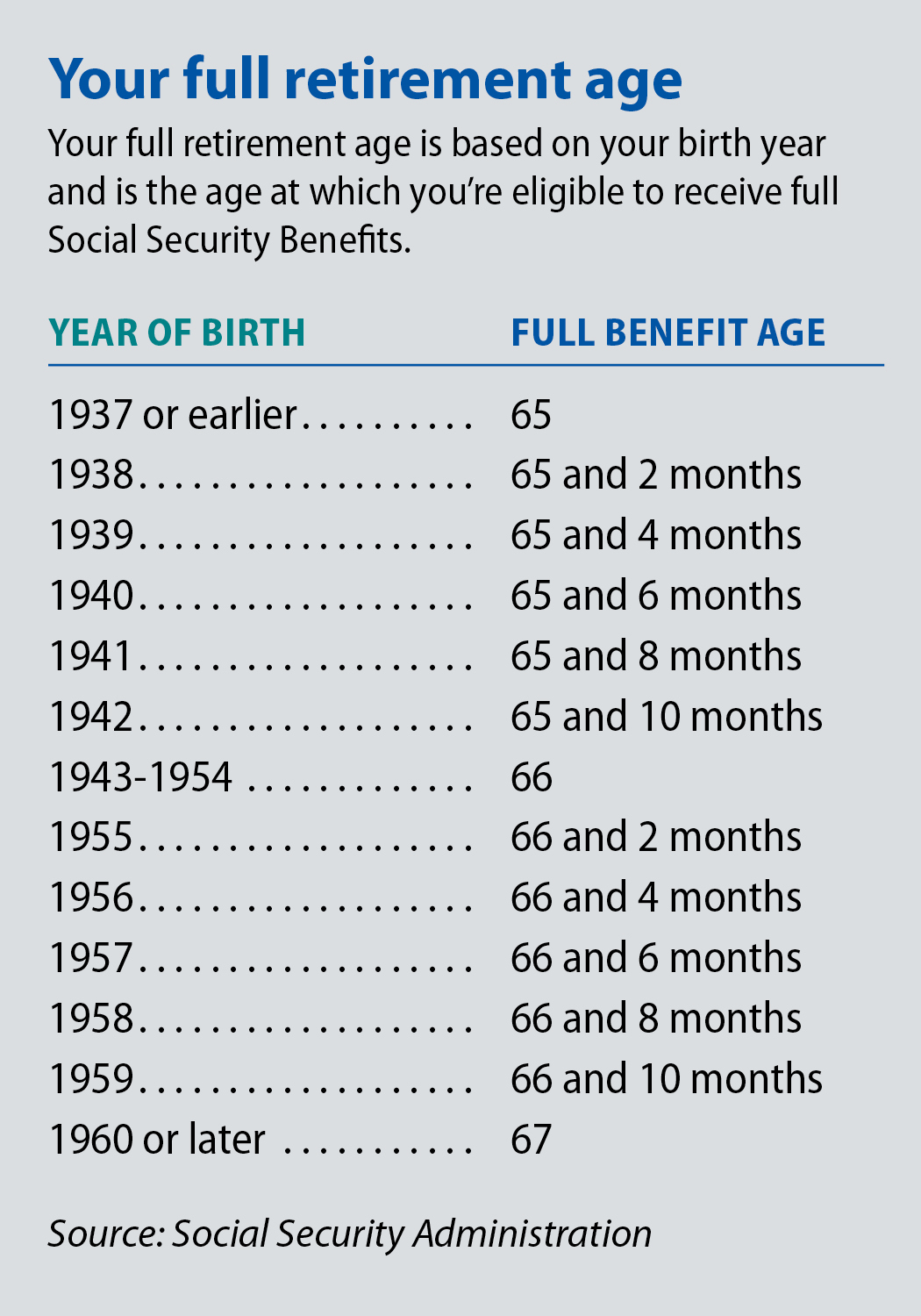
The core of the Social Security system revolves around the concept of Full Retirement Age (FRA). For anyone born in 1960 or later, the FRA is 67. If you claim benefits exactly at your FRA, you receive 100% of your Primary Insurance Amount (PIA), which is the benefit calculated based on your 35 highest-earning years.
The Cost of Filing Early: Age 62 to FRA
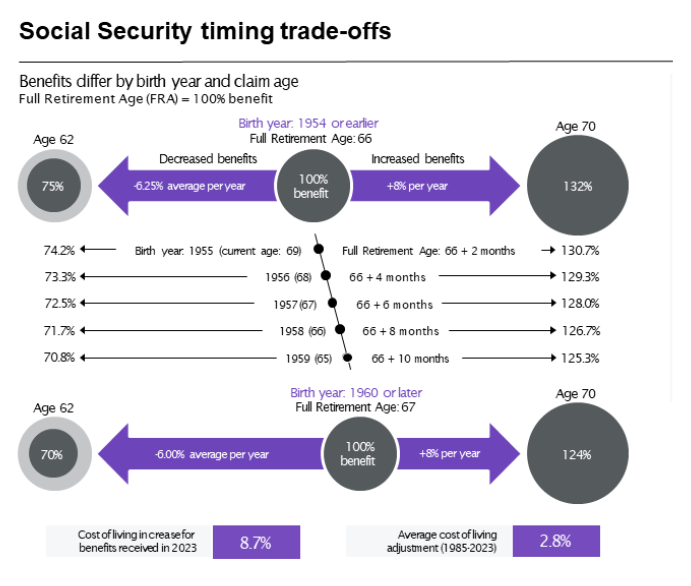
Filing for benefits as early as possible—age 62—comes with a permanent penalty. For those with an FRA of 67, claiming at 62 results in a 30% reduction in monthly benefits. This reduction is actuarially designed to account for the fact that you will likely receive checks for a longer period. However, in an era of increasing life expectancy, this “early filing discount” often proves to be a heavy price to pay for immediate liquidity. Beyond the base reduction, if you continue to work while collecting benefits before your FRA, you may be subject to the Social Security Earnings Test. In 2024, if you earn more than $22,320, the Social Security Administration (SSA) will withhold $1 in benefits for every $2 you earn above that limit, further complicating the math for early claimants.
The Power of Delayed Retirement Credits: FRA to Age 70
Conversely, if you choose to delay your claim past your FRA, your benefit increases by 8% for every year you wait, up until age 70. This is known as a Delayed Retirement Credit (DRC). Between age 67 and 70, your benefit grows by a total of 24%. This is a guaranteed, risk-free, inflation-adjusted return that is virtually impossible to replicate in the private market. When you factor in the annual Cost of Living Adjustments (COLA), the compounding effect of waiting until 70 becomes the most effective hedge against inflation available to retirees.
The Break-Even Analysis
From a purely mathematical standpoint, many retirees look at a “break-even” analysis to decide when to file. The break-even point is the age at which the total cumulative benefits of waiting for a larger check surpass the total cumulative benefits of taking a smaller check earlier. Generally, the break-even age for waiting until 70 versus claiming at 62 is approximately age 80 to 82. If you expect to live past your early 80s, waiting is almost always the superior financial move. Given that a 65-year-old non-smoking male has a high probability of reaching age 84, and a female age 87, the math heavily favors delaying for those in good health.
Strategic Tax Planning and the “Tax Torpedo”
Social Security benefits are not always tax-free. In fact, many retirees find themselves surprised by the “Tax Torpedo”—a phenomenon where an additional dollar of income triggers taxation on a larger portion of Social Security benefits, effectively creating a marginal tax rate that can exceed 40% or 50% for middle-income earners.
Understanding Provisional Income
The IRS uses a specific formula called “provisional income” to determine if your benefits are taxable. Provisional income is calculated as your Adjusted Gross Income (AGI), plus tax-exempt interest, plus 50% of your Social Security benefits. If this total exceeds $34,000 for individuals or $44,000 for couples filing jointly, up to 85% of your Social Security benefits may be subject to federal income tax.
Coordinating with Traditional IRAs and 401(k)s
Strategic claimants often use the years between age 62 and 70 to perform Roth conversions or draw down taxable traditional IRA balances. By delaying Social Security and living off traditional retirement accounts early, you can reduce the size of future Required Minimum Distributions (RMDs). Lowering your future RMDs reduces your AGI in later years, which can help keep your provisional income below the thresholds where Social Security becomes heavily taxed. This “bridge” strategy uses retirement savings to buy a higher, more tax-efficient Social Security benefit later in life.
The Role of Capital Gains and Dividends
Because the provisional income formula includes AGI, realized capital gains from selling stocks or real estate can inadvertently trigger higher taxes on your Social Security benefits. By understanding this interaction, retirees can time the sale of assets or utilize tax-loss harvesting to ensure that their Social Security income remains as protected as possible from the federal tax bite.
Coordinating Benefits for Couples
For married couples, the decision of when to claim is not an individual one; it is a joint strategy designed to maximize the total household lifetime income and provide for the surviving spouse.
The Higher Earner Strategy
In most scenarios, the highest-earning spouse should delay claiming until age 70. This isn’t just about maximizing that individual’s check; it is about maximizing the “Survivor Benefit.” When one spouse dies, the survivor is entitled to the higher of the two checks the couple was receiving. By the higher earner waiting until 70, they lock in the highest possible base for the survivor, providing a form of “life insurance” that lasts as long as the second spouse is alive.
Spousal Benefits and Timing
The lower-earning spouse may choose to claim their own benefit earlier to provide cash flow for the household while the higher-earner’s benefit continues to grow at 8% per year. However, it is important to note that a spouse can only claim a spousal benefit (which is up to 50% of the other spouse’s FRA amount) once the primary earner has filed for their own benefits. Navigating these rules requires a careful balance between immediate income needs and the long-term goal of maximizing the survivor benefit.
Divorced and Survivor Benefits
Divorced individuals who were married for at least 10 years and have not remarried may be eligible for benefits based on their ex-spouse’s record. This does not impact the ex-spouse’s benefit or the benefits of their current spouse. Similarly, widow(er)s have the unique ability to claim a survivor benefit as early as age 60 while allowing their own retirement benefit to grow until age 70, or vice versa. This “switch” strategy is one of the few remaining ways to maximize two separate records within the Social Security system.
Portfolio Management and Longevity Risk
When viewed as an asset class, Social Security behaves like a government-backed bond with an inflation kicker. In a volatile market, the stability of this income stream is invaluable.
Using Social Security as Longevity Insurance
The greatest risk in modern retirement planning is not market volatility; it is longevity—the risk of outliving your money. Social Security is the only source of income for most Americans that is guaranteed to never run out and to increase with the cost of living. By delaying until age 70, you are essentially purchasing the most expensive and robust longevity insurance policy available. This allows you to be more aggressive with your remaining investment portfolio, or conversely, it allows you to withdraw less from your portfolio in your 80s and 90s, preserving capital for heirs or healthcare costs.
The Opportunity Cost of Capital
A common argument for claiming early is that the money can be invested. If you claim at 62 and invest the proceeds, could you outperform the 8% annual increase offered by Social Security? While theoretically possible, it is functionally improbable on a risk-adjusted basis. To beat a guaranteed, inflation-adjusted 8% return, an investor would need to achieve a significantly higher nominal return in the stock market while accounting for taxes and market risk. For most retirees, the certainty of the Social Security increase outweighs the speculative gains of early-claim investing.
Managing Health and Lifestyle Factors
While the math often favors waiting, personal circumstances must prevail. If an individual has a terminal illness or a family history of short lifespans, claiming at 62 is a rational financial decision. Similarly, if a retiree has no other sources of income and would otherwise face poverty or high-interest debt, the immediate liquidity of Social Security is necessary. The goal is to maximize “utility,” not just a number on a spreadsheet. If claiming early allows a retiree to enjoy active travel while they are still physically capable, that “lifestyle dividend” must be factored into the decision.

Conclusion: Making the Final Decision
The choice of when to start collecting Social Security should not be made in a vacuum. It requires a comprehensive look at your health, your tax bracket, your spouse’s financial security, and your overall investment strategy. For those who can afford to wait, the 8% annual increase from age 67 to 70 represents one of the best financial deals in the world of personal finance.
By viewing Social Security as a strategic component of a broader financial plan—rather than just a monthly check—you can insulate your retirement from inflation, mitigate the impact of market downturns, and ensure that you and your spouse are protected for the duration of your lives. Whether you choose 62, 67, or 70, ensure the decision is backed by a rigorous analysis of your unique financial landscape.
aViewFromTheCave is a participant in the Amazon Services LLC Associates Program, an affiliate advertising program designed to provide a means for sites to earn advertising fees by advertising and linking to Amazon.com. Amazon, the Amazon logo, AmazonSupply, and the AmazonSupply logo are trademarks of Amazon.com, Inc. or its affiliates. As an Amazon Associate we earn affiliate commissions from qualifying purchases.