
Deciding when to claim your Social Security benefits is one of the most significant financial decisions you’ll make for your retirement. The choice can profoundly impact your monthly income, your overall financial security, and even the financial well-being of your spouse and other beneficiaries. While it might seem straightforward, there’s no universal “best” age to claim; the optimal time depends heavily on your individual circumstances, health, financial needs, and life expectancy.
Understanding Your Full Retirement Age (FRA)
The cornerstone of your Social Security claiming decision is your Full Retirement Age (FRA). This is the age at which you are entitled to receive 100% of the primary insurance amount (PIA) that you’ve earned based on your work history.

What is FRA?
Your FRA is determined by your birth year:
-
Born 1943-1954: FRA is 66
-
Born 1955: FRA is 66 and 2 months
-
Born 1956: FRA is 66 and 4 months
-
Born 1957: FRA is 66 and 6 months
-
Born 1958: FRA is 66 and 8 months
-
Born 1959: FRA is 66 and 10 months
-
Born 1960 or later: FRA is 67
Claiming benefits before your FRA results in a permanent reduction in your monthly payment. Conversely, delaying beyond your FRA can significantly boost your benefits.
The Trade-off: Early vs. Full Claiming
You can start claiming Social Security as early as age 62, but doing so means accepting a permanently reduced monthly benefit. If you claim at your FRA, you receive your full benefit. The magnitude of the reduction for early claiming depends on how far in advance of your FRA you elect to receive benefits. For example, someone with an FRA of 67 who claims at age 62 will see their monthly benefit reduced by about 30%. This reduction is permanent for the rest of their life.
The Financial Implications of Early Claiming (Age 62-FRA)
While tempting to access benefits sooner, claiming Social Security before your Full Retirement Age has significant financial repercussions that warrant careful consideration.
Reduced Monthly Benefits
The most immediate and impactful consequence of claiming early is the permanent reduction in your monthly payment. For every month you claim before your FRA, your benefit is reduced. For those with an FRA of 67, claiming at age 62 means a benefit reduction of approximately 30%. This percentage can translate into hundreds of dollars less per month, which accumulates to tens of thousands of dollars over a typical retirement lifespan. This reduction is not temporary; it is locked in for the duration of your benefit receipt, affecting not only your payments but potentially those of your survivors as well.
Impact on Spousal and Survivor Benefits
Your claiming decision can also affect the benefits your spouse or survivors may receive. If you claim early, your spouse’s spousal benefit, which can be up to 50% of your primary insurance amount (PIA), will be based on your reduced benefit amount if they claim before their own FRA. Similarly, survivor benefits paid to a widow or widower are generally a percentage of the deceased worker’s benefit. If you claimed early, the base amount for survivor benefits will be lower, directly impacting your loved one’s financial security after your passing.
The Earnings Test
If you claim Social Security benefits before your FRA and continue to work, you may be subject to the Social Security earnings test. This test can temporarily reduce or even withhold your benefits if your earnings exceed certain annual limits. For 2024, if you are under FRA for the entire year, $1 in benefits will be deducted for every $2 you earn above $22,320. In the year you reach FRA, $1 in benefits will be deducted for every $3 you earn above a higher limit ($59,520 in 2024) until the month you reach FRA. Once you reach your FRA, the earnings test no longer applies, and you can earn any amount without your Social Security benefits being reduced. Any benefits withheld due to the earnings test are not lost permanently; your future benefits will be recalculated at your FRA to account for the withheld amounts, resulting in a slightly higher monthly payment.
Scenarios Favoring Early Claiming
Despite the reductions, there are situations where claiming benefits early might be a prudent strategy:
-
Poor Health or Shorter Life Expectancy: If you have a serious health condition or a family history suggesting a shorter life expectancy, claiming early may allow you to receive more total benefits over your lifetime than if you waited.
-
Immediate Financial Need: If you genuinely need the income to cover essential living expenses and have no other adequate retirement savings, claiming early might be your only option. However, this should be a last resort, as it can compromise long-term financial stability.
-
Maximizing Benefits for a Sicker Spouse: In some complex family situations, one spouse might claim early to provide income while the other, typically the higher earner with a longer life expectancy, delays claiming to maximize their own (and potential survivor) benefits. This strategy requires careful planning.
Maximizing Benefits: Delaying Beyond FRA (Up to Age 70)
For many individuals, delaying Social Security benefits beyond their Full Retirement Age (FRA) can be a highly effective strategy to secure a significantly larger guaranteed income stream for life.
Delayed Retirement Credits (DRCs)
The Social Security Administration (SSA) incentivizes delaying benefits past your FRA by offering Delayed Retirement Credits (DRCs). For each year you postpone claiming benefits between your FRA and age 70, your monthly benefit increases by a certain percentage. This increase is typically 8% per year for those born in 1943 or later. These credits cease accumulating once you reach age 70, making age 70 the optimal time to claim for maximum benefit growth. For example, if your FRA is 67 and you delay claiming until age 70, your monthly benefit will be 24% higher than your FRA amount (8% per year for three years). This is a guaranteed, inflation-protected increase that continues for the rest of your life. The power of compounding these annual increases makes delaying a very compelling option for those who can afford it.
Long-Term Financial Security
A higher monthly Social Security benefit provides a stronger foundation for your long-term financial security. This larger, guaranteed income stream acts as a form of longevity insurance, protecting you against the risk of outliving your other savings. As life expectancies continue to rise, having a robust and inflation-adjusted income source becomes increasingly critical for covering late-life expenses, including potential healthcare costs. The inflation protection offered by Social Security’s annual Cost-of-Living Adjustments (COLAs) means your purchasing power is better preserved over decades, unlike many other fixed income streams.
Increased Survivor Benefits
Delaying your benefits not only boosts your own monthly income but also potentially increases the survivor benefits for your spouse. If you are the higher-earning spouse, your decision to delay claiming until age 70 will result in a larger monthly benefit for your surviving spouse if you predecease them. This can be a crucial factor in protecting your spouse’s financial well-being after your death, especially if they have limited retirement savings or a lower Social Security benefit of their own.
Scenarios Favoring Delayed Claiming
Delaying Social Security until age 70 is often the preferred strategy for individuals who:
-
Good Health and Longer Life Expectancy: If you are in good health and have a family history of longevity, delaying maximizes the total amount you will receive over your lifetime. The breakeven point (where total benefits from delaying surpass early claiming) typically falls in your late 70s or early 80s.
-
Sufficient Other Retirement Savings: If you have adequate savings in 401(k)s, IRAs, pensions, or other investments, you can draw from these accounts during the years you delay Social Security. This allows your Social Security benefit to grow, while potentially drawing down pre-tax accounts in lower tax brackets.
-
Desire for Higher Guaranteed Income: Some individuals prioritize a higher, guaranteed, and inflation-adjusted income stream for their later years, valuing the peace of mind it provides over earlier, smaller payments.
-
Continuing to Work Past FRA: If you plan to continue working full-time past your FRA, there’s little incentive to claim early, especially given the earnings test rules. You can use your earned income to cover expenses and allow your Social Security benefit to grow.
Key Factors to Consider in Your Decision
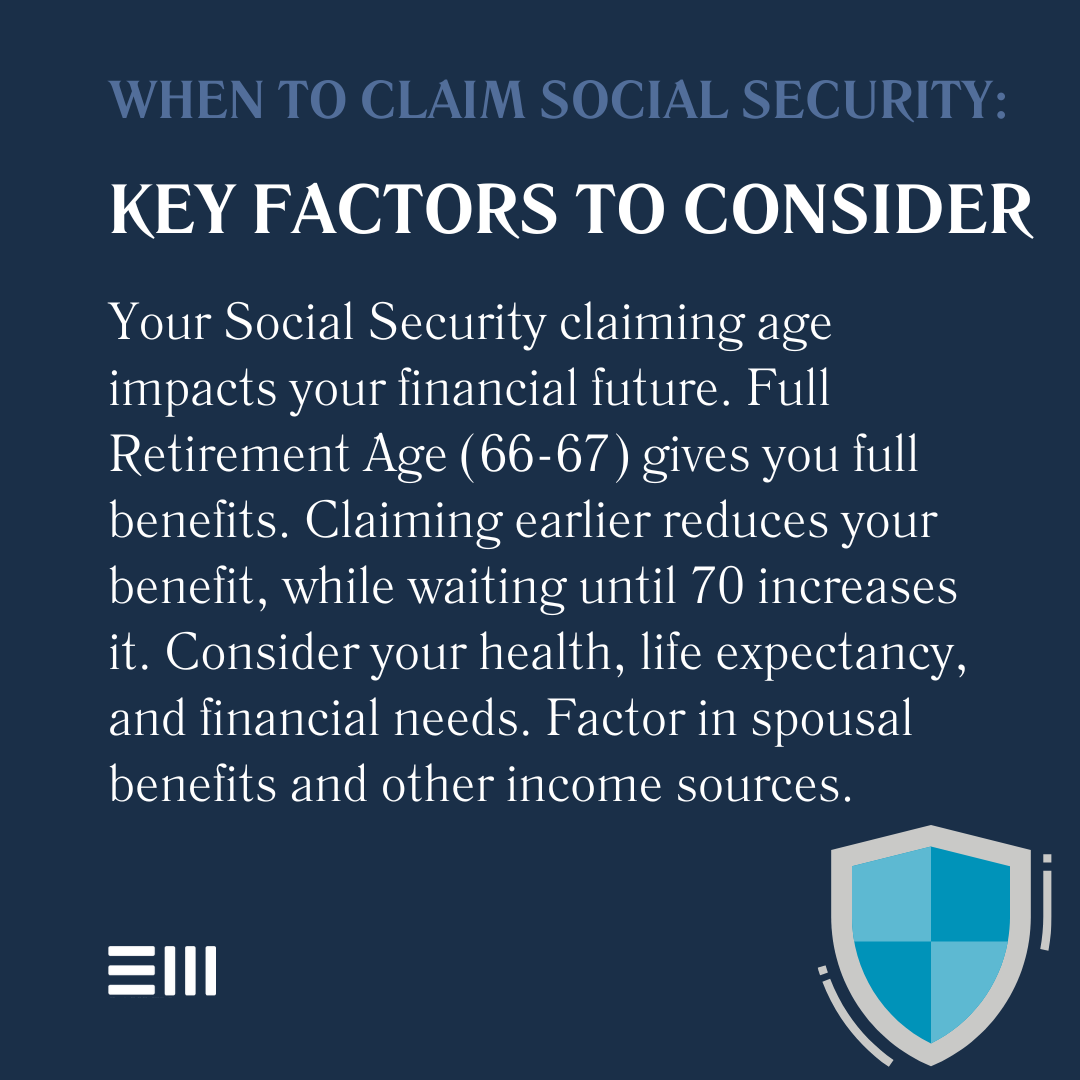
The decision of when to claim Social Security is highly personal and multifaceted. A holistic approach, weighing several key factors, is essential for making the choice that best aligns with your financial goals and life circumstances.
Your Health and Life Expectancy
This is arguably the most critical personal factor. If you anticipate a shorter life expectancy due to current health conditions or family history, claiming earlier might result in a higher total payout over your lifetime. Conversely, if you are in excellent health and expect to live well into your 80s or 90s, delaying until age 70 will likely maximize your total lifetime benefits. Be realistic and honest in assessing your health and family longevity trends.
Your Other Retirement Savings and Income Streams
Evaluate your overall financial picture. Do you need Social Security income immediately to cover living expenses, or do you have other resources like 401(k)s, IRAs, pensions, or savings accounts that can bridge the gap if you delay? If you have ample savings, you might be able to live off those assets in your early retirement years, allowing your Social Security benefit to grow significantly. Conversely, if Social Security will be your primary or sole source of retirement income, the timing of your claim becomes even more critical.
Marital Status and Spousal Considerations
If you are married, your claiming decision impacts your spouse, especially if there’s a significant difference in your earnings histories. A spouse can claim a spousal benefit up to 50% of your primary insurance amount (PIA). If you, as the higher earner, delay claiming, it increases the base for both your own benefit and your spouse’s potential spousal benefit. Crucially, your claiming decision also affects the survivor benefits your spouse would receive if you die first. By maximizing your benefit, you maximize the income stream for your surviving spouse. Coordinating claiming strategies between spouses can be complex but can yield substantial benefits for the couple as a whole.
Your Need for Income vs. Your Ability to Work
Are you planning to stop working entirely at retirement, or do you intend to continue working part-time or full-time? If you continue working before your FRA, the earnings test might reduce your benefits, making early claiming less appealing. If you can continue working and cover your expenses, you might choose to delay claiming to earn higher benefits later. This also addresses the psychological aspect: some people prefer to stop working entirely and enjoy their retirement sooner, even if it means a smaller Social Security check.
Economic Outlook and Inflation
Social Security benefits are protected against inflation through annual Cost-of-Living Adjustments (COLAs). This makes Social Security a valuable component of a retirement plan, especially in an inflationary environment. A higher starting benefit, achieved through delayed claiming, means a higher base for these COLAs to compound over time, providing more robust purchasing power throughout your retirement. Consider the value of this inflation-adjusted income stream relative to other investment returns.
Making an Informed Decision
Navigating the complexities of Social Security claiming requires diligence and a clear understanding of your personal financial landscape. An informed decision is a powerful step towards a secure retirement.
Utilize Social Security Administration (SSA) Resources
The Social Security Administration provides a wealth of personalized information and tools. The “My Social Security” online account is invaluable; it allows you to view your earnings record, verify that your reported earnings are accurate, and get personalized estimates of your future benefits at different claiming ages. The SSA website also offers calculators and publications that can help you understand the rules and explore various claiming scenarios. Use these resources to gather the foundational data relevant to your specific situation.
Consult a Financial Advisor
Given the long-term impact and the intricate rules surrounding Social Security benefits, consulting a qualified financial advisor is highly recommended. An advisor can help you integrate your Social Security claiming strategy into your overall retirement plan, considering your investments, tax situation, healthcare costs, and family dynamics. They can run detailed projections that account for different claiming ages, analyze breakeven points, and help coordinate benefits for married couples, ensuring you make a decision that aligns with your comprehensive financial goals. An advisor can also help you understand the tax implications of your Social Security benefits, which can vary based on your total income.

Re-evaluating Your Plan
Retirement planning is not a one-time event; it’s a dynamic process. Your health, financial needs, and family situation can change over time. What seems like the best decision at age 60 might need to be re-evaluated as you approach your FRA or even later. Be flexible and open to adjusting your plan if circumstances warrant it. Regular reviews of your retirement strategy, including your Social Security claiming decision, with your financial advisor can help ensure you remain on track for a secure future.
aViewFromTheCave is a participant in the Amazon Services LLC Associates Program, an affiliate advertising program designed to provide a means for sites to earn advertising fees by advertising and linking to Amazon.com. Amazon, the Amazon logo, AmazonSupply, and the AmazonSupply logo are trademarks of Amazon.com, Inc. or its affiliates. As an Amazon Associate we earn affiliate commissions from qualifying purchases.