
For the modern investor, the stock market is often perceived as a digital entity that breathes 24/7. While global connectivity allows us to check portfolio balances at any hour, the actual mechanics of buying and selling shares are governed by a strictly regulated schedule. Understanding when the stock market is open is more than a matter of simple logistics; it is a fundamental pillar of strategic personal finance and institutional investing.
Operating within the “core hours” of an exchange ensures maximum liquidity, tighter spreads, and reduced volatility. Conversely, stepping outside these bounds into the world of extended-hours trading introduces a different set of risks and opportunities. This guide provides a deep dive into the operating hours of major exchanges, the nuances of extended sessions, and how global time zones impact your investment strategy.
The Standard Trading Session: Core Hours and the Opening Bell
In the United States, the primary theaters for equity trading are the New York Stock Exchange (NYSE) and the Nasdaq. For the vast majority of retail investors, “the market” refers to the standard operating hours of these two giants.
The NYSE and Nasdaq Schedule
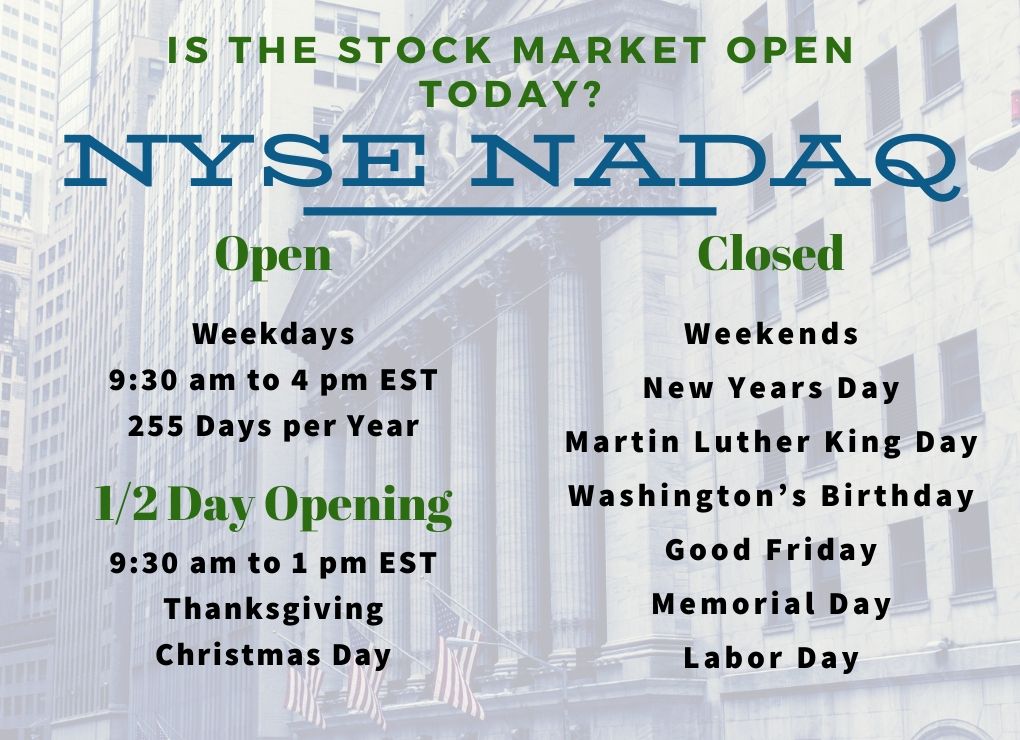
Standard trading hours for the NYSE and Nasdaq are Monday through Friday, from 9:30 AM to 4:00 PM Eastern Time (ET). Unlike some international markets, major U.S. exchanges do not close for a lunch break. This continuous seven-and-a-half-hour window is when the highest volume of trading occurs.
The 9:30 AM “Opening Bell” is more than just a ceremony; it marks the transition from pre-market price discovery to the execution of high-volume institutional orders. During these core hours, the market is at its most “liquid,” meaning there are enough buyers and sellers to ensure that trades can be executed quickly at stable prices.
Market Holidays and Special Closures
The stock market does not operate 365 days a year. It observes several federal holidays, during which the exchange is completely closed. Notable closures include New Year’s Day, Martin Luther King Jr. Day, Washington’s Birthday, Good Friday, Memorial Day, Juneteenth National Independence Day, Independence Day, Labor Day, Thanksgiving Day, and Christmas Day.
Furthermore, the market often observes “early closures” (typically at 1:00 PM ET) on the day following Thanksgiving and on Christmas Eve. Investors must track these dates to avoid being caught in a position they cannot exit during a long weekend.
The Significance of the Closing Bell
The 4:00 PM ET closing bell signals the end of regular trading. The “closing price” of a stock is a vital data point used by mutual funds to calculate their Net Asset Value (NAV) and by analysts to determine historical performance. The final minutes of trading, often referred to as the “closing auction,” see a massive influx of volume as institutional investors rebalance their portfolios to match index weightings.
Beyond the Standard Clock: Pre-Market and After-Hours Trading
The digital age has eroded the exclusivity of the 9:30-to-4:00 window. Electronic Communication Networks (ECNs) allow investors to trade outside of regular sessions. This is collectively known as extended-hours trading.
Pre-Market Trading Sessions
Pre-market trading in the U.S. can begin as early as 4:00 AM ET, though the bulk of activity starts around 8:00 AM ET. This session is particularly important for reacting to overnight news, such as international geopolitical shifts or early-morning corporate earnings releases. While it offers a head start, the pre-market is characterized by low volume and wide “bid-ask spreads,” which can lead to significant price slippage for the unwary.
After-Hours Trading Sessions
After-hours trading begins immediately following the closing bell at 4:00 PM ET and typically runs until 8:00 PM ET. This session is often the most volatile period for individual stocks, as many companies release their quarterly earnings reports shortly after the market closes. If a company misses its revenue targets, the stock may plummet in after-hours trading before the general public has a chance to react the following morning.
The Risks of Extended-Hours Participation
While the allure of trading 24/7 is strong, the “Money” niche emphasizes risk management. Extended-hours trading involves “thin” markets. With fewer participants, a single large order can swing the price of a stock disproportionately. Additionally, many brokerage firms require the use of “limit orders” during these sessions to protect investors from executing trades at unfavorable prices. For the average personal finance enthusiast, observing extended hours is often more beneficial than participating in them.
The Global Perspective: Navigating International Market Hours
For those diversifying their portfolios with international equities or ETFs, the sun never truly sets on the stock market. As the U.S. market closes, Asian markets are beginning their day, followed by Europe.
The European Market Cycle
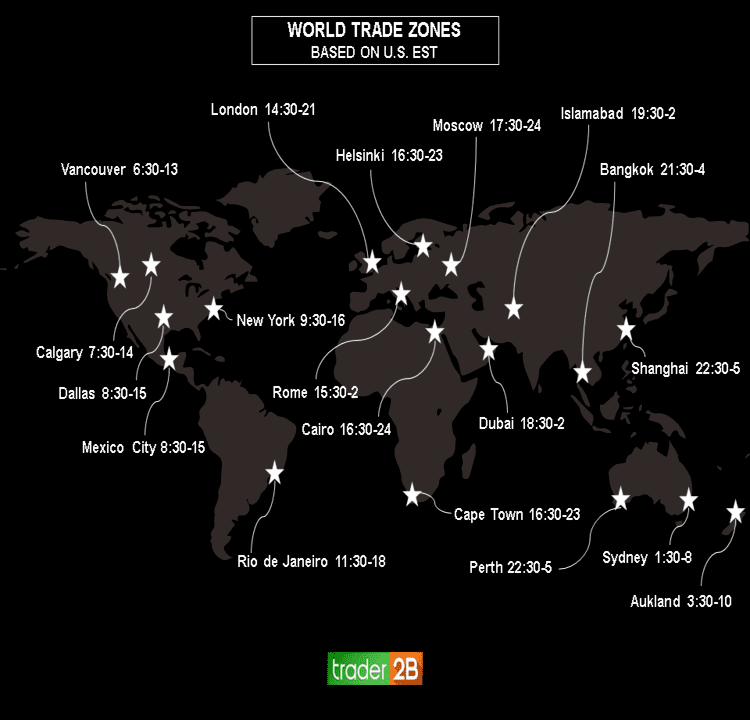
Major European exchanges, such as the London Stock Exchange (LSE) and the Euronext Paris, typically operate from 8:00 AM to 4:30 PM local time. For a trader based in New York, the London market opens at 3:00 AM ET and closes at 11:30 AM ET. This creates a crucial “overlap” period between 9:30 AM and 11:30 AM ET, where both U.S. and European markets are open simultaneously. This window often sees the highest global liquidity of the day.
The Asian-Pacific Session
The Asian markets provide the first glimpse of global sentiment for the new calendar day. The Tokyo Stock Exchange (TSE) and the Hong Kong Stock Exchange (HKEX) are major hubs. Unlike Western markets, many Asian exchanges incorporate a mandatory lunch break. For instance, the HKEX typically closes for an hour between its morning and afternoon sessions. For U.S. investors, these markets trade during the late evening and early morning hours (roughly 8:00 PM to 3:00 AM ET).
Synchronizing a Global Portfolio
Understanding these time zones is critical for investors holding ADRs (American Depositary Receipts) or foreign stocks. Events in the Nikkei 225 in Tokyo can act as a leading indicator for how the S&P 500 might open in New York. Sophisticated investors use this “follow-the-sun” approach to manage risk and anticipate market direction.
Strategic Timing: When Should You Actually Trade?
In the world of investing, when you trade can be just as important as what you trade. Market dynamics shift significantly throughout the day, influenced by the clock.
The Volatility of the Opening Half-Hour
The period from 9:30 AM to 10:00 AM ET is often the most volatile. This is when the market digests all the news that occurred overnight and during the pre-market session. Professional traders often refer to this as the “amateur hour” (though it is populated by pros as well), where prices can swing wildly before settling into a trend. For long-term personal finance goals, it is often wise to wait for this initial volatility to subside before entering a position.
The Mid-Day Lull
From roughly 12:00 PM to 2:00 PM ET, trading volume typically thins out as floor traders and institutional desk managers take lunch breaks. During this period, prices may move sideways with little conviction. This is generally the least favorable time for day traders seeking momentum, but it can be a stable time for long-term investors to execute routine rebalancing.
The “Power Hour” Finish
The final hour of trading, from 3:00 PM to 4:00 PM ET, is known as the “Power Hour.” This is when institutional investors, hedge funds, and automated algorithms finalize their positions for the day. Volume surges, and the price action during this hour often dictates the market’s sentiment heading into the next day. If the market finishes strong in the Power Hour, it often suggests “bullish” carry-over for the following morning.
Tools and Resources for Tracking Market Activity
To manage a successful investment strategy, you must stay synchronized with these market rhythms. Relying on your memory for holiday schedules or time zone conversions is a recipe for missed opportunities.
Market Clocks and Financial Calendars
Most high-quality brokerage platforms provide integrated market clocks that show the countdown to the open and close. Additionally, websites like Bloomberg, Reuters, and specialized financial calendar tools offer downloadable “Market Holiday” schedules that can be synced with your personal digital calendar.
Economic Calendars and Timing
Beyond the exchange hours, investors must watch the “Economic Clock.” The U.S. Bureau of Labor Statistics and the Federal Reserve often release critical data (like CPI inflation reports or interest rate decisions) at 8:30 AM ET or 2:00 PM ET. These releases can cause massive price movements even when the core market is closed or in the middle of a session.
Utilizing Brokerage Alerts
Most modern trading apps allow you to set alerts for “Market Open” and “Market Close.” For those managing side hustles or full-time careers alongside their investments, these alerts serve as a necessary boundary, reminding you when the window for optimal liquidity is closing.
Conclusion: Mastering the Market Clock
In the realm of money and investing, time is the ultimate currency. Knowing when the stock market is open is the first step toward disciplined financial management. By respecting the core hours of 9:30 AM to 4:00 PM ET, investors benefit from the security of high liquidity and lower costs. By understanding the extended sessions and global cycles, they gain the insight necessary to navigate a 24-hour financial world.
Whether you are a passive investor contributing to a 401(k) or an active trader seeking to capitalize on earnings volatility, the clock is your most consistent guide. Aligning your activity with the market’s natural rhythm ensures that you are trading with the flow of global capital, rather than against it.
aViewFromTheCave is a participant in the Amazon Services LLC Associates Program, an affiliate advertising program designed to provide a means for sites to earn advertising fees by advertising and linking to Amazon.com. Amazon, the Amazon logo, AmazonSupply, and the AmazonSupply logo are trademarks of Amazon.com, Inc. or its affiliates. As an Amazon Associate we earn affiliate commissions from qualifying purchases.