
Navigating the global financial landscape requires more than just an understanding of price action and fundamental analysis; it demands a precise knowledge of the clock. For the modern investor, the question of “when is the market closed today” is foundational to executing strategy, managing risk, and ensuring liquidity. While digital platforms allow for the illusion of 24/7 connectivity, the reality of the traditional stock market is governed by strict operating hours, holiday schedules, and specific regional protocols. Understanding these temporal boundaries is essential for anyone looking to optimize their portfolio and avoid the pitfalls of “gap risk” and illiquidity.
The Standard Operating Hours of Major Global Exchanges
To answer the question of when the market is closed, one must first define which market is being discussed. The global economy is a relay race, with one region’s closing bell often signaling the start of another’s pre-market activity. However, for the majority of retail and institutional investors in the West, the focus remains on the primary North American exchanges.
The New York Stock Exchange (NYSE) and NASDAQ
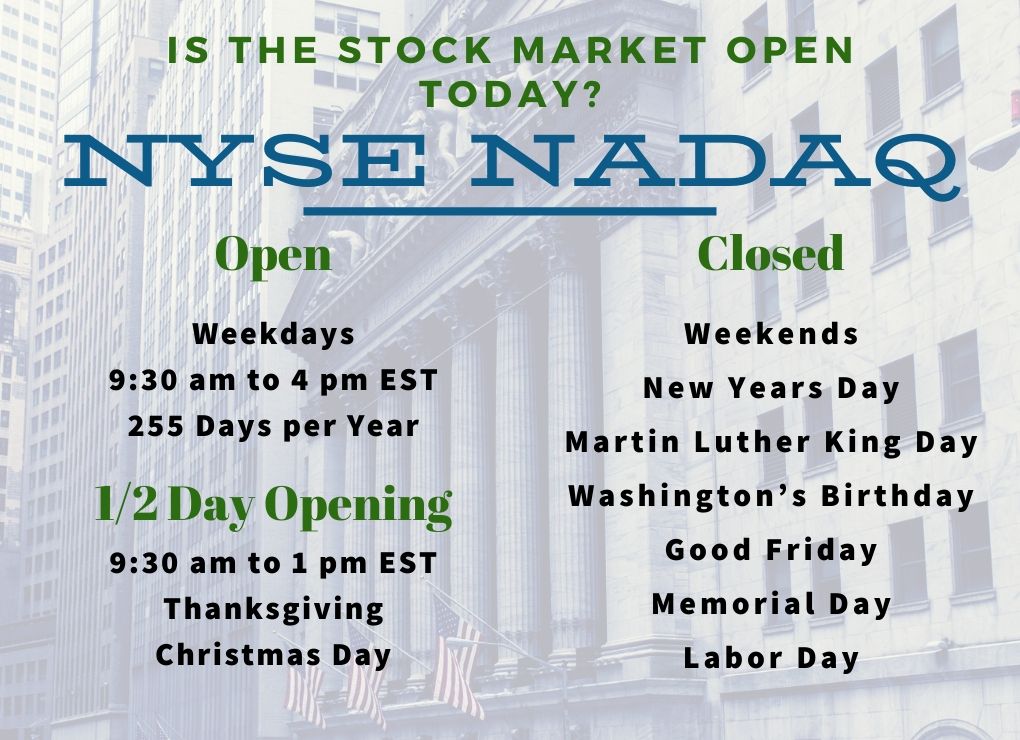
In the United States, the two dominant exchanges—the NYSE and the NASDAQ—operate on a synchronized schedule. The standard trading session runs from 9:30 AM to 4:00 PM Eastern Time (ET), Monday through Friday. When people ask if the market is closed today, they are typically referring to this “Core Session.”
Unlike the cryptocurrency market, which operates 24 hours a day, 365 days a year, the equity markets maintain these hours to concentrate liquidity. By narrowing the window in which shares are traded, exchanges ensure that there are enough buyers and sellers present to facilitate smooth transactions with minimal slippage. The “Opening Bell” and “Closing Bell” are not merely ceremonial; they represent the moments of highest volume and volatility, as the market processes overnight news at the open and squares off positions at the close.
International Markets: London, Tokyo, and Beyond
If the U.S. markets are closed for a specific domestic holiday, an investor might look toward international exchanges. The London Stock Exchange (LSE), for instance, operates from 8:00 AM to 4:30 PM Greenwich Mean Time (GMT). In Asia, the Tokyo Stock Exchange (TSE) runs from 9:00 AM to 3:00 PM local time, notably including a lunch break between 11:30 AM and 12:30 PM—a practice that has largely disappeared from Western exchanges.
Understanding these international variations is crucial for those trading American Depositary Receipts (ADRs) or global ETFs. A holiday in New York does not necessarily mean a holiday in London or Hong Kong, but the lack of participation from U.S. institutional desks often results in lower-than-average volume across the globe.
Market Holidays and Early Closures: What Every Investor Should Know
The market is closed on Saturdays and Sundays, but it also observes several federal and exchange-specific holidays. These closures are fixed in the calendar, yet their impact on a trading strategy can be profound, particularly when they create long weekends.
Fixed vs. Floating Holidays
In the United States, the stock market follows a schedule that largely aligns with the federal holiday calendar, with a few notable exceptions. The market is closed on:
-
New Year’s Day
-
Martin Luther King, Jr. Day
-
Presidents’ Day (Washington’s Birthday)
-
Good Friday (Notably a market holiday but not a federal one)
-
Memorial Day
-
Juneteenth National Independence Day
-
Independence Day (July 4th)
-
Labor Day
-
Thanksgiving Day
-
Christmas Day
When a holiday falls on a Saturday, the market usually closes on the preceding Friday. If it falls on a Sunday, the market is typically closed on the following Monday. This “observed” schedule is vital for traders to track, as it prevents the execution of stop-loss orders and the adjustment of positions during potential news-heavy weekends.
The Impact of Early Closures on Liquidity
In addition to full-day closures, the market often observes “early closes,” typically at 1:00 PM ET. These usually occur on the day after Thanksgiving (Black Friday) and sometimes on Christmas Eve or July 3rd, depending on how those dates fall in the week.
Early closures are notorious for “thin” markets. With many institutional traders taking time off, the volume of shares traded drops significantly. For the individual investor, this means that even a relatively small trade can cause a larger-than-expected price movement. Professional traders often advise against heavy activity during these shortened sessions, as the bid-ask spreads tend to widen, making it more expensive to enter or exit positions.
After-Hours and Pre-Market Trading: The Market Never Truly Sleeps
While the core session ends at 4:00 PM ET, the advent of Electronic Communication Networks (ECNs) has allowed for extended hours trading. This is often where the most dramatic price movements occur, driven by earnings reports or geopolitical events that happen outside the standard 9:30 to 4:00 window.
Risks and Rewards of Extended Hours Trading
Pre-market trading in the U.S. can begin as early as 4:00 AM ET, though the bulk of the volume starts at 8:00 AM. After-hours trading continues from 4:00 PM until 8:00 PM ET.
The primary advantage of trading when the main market is closed is the ability to react immediately to news. If a company releases a disappointing earnings report at 4:05 PM, investors can sell their shares in the after-hours session rather than waiting for the next morning’s opening bell, at which point the stock might have already “gapped down” significantly.
However, the risks are substantial. Extended hours trading is characterized by much lower liquidity and higher volatility. Many brokerages require investors to use limit orders during these times because a market order could be filled at a price far away from the last traded value. Furthermore, the price action seen in the after-hours session does not always reflect how the broader market will behave the following morning.
How Retail Investors Can Access Extended Markets
Years ago, after-hours trading was reserved for institutional giants. Today, most major retail brokerages provide access to extended sessions. However, the rules vary. Some brokers only allow trading starting at 7:00 AM or 8:00 AM, and some may charge additional fees or require a specific agreement to be signed acknowledging the risks of low-liquidity environments. If you find that the market is closed for its core session, checking your brokerage’s extended hours policy is the first step toward regaining market access.
The Psychological and Strategic Impact of Market Closures
Market closures serve a functional purpose beyond just giving floor traders a break. They provide a “cooling-off” period. In times of extreme market stress, the closing bell prevents panic selling from spiraling into a total collapse, allowing participants to digest information and return with a clearer perspective the following day.
Managing Risk Over Long Weekends
For the disciplined investor, a market closure is a period of heightened risk management. “Weekend risk” refers to the possibility of a major event—a natural disaster, a political coup, or a sudden economic shift—occurring while the markets are closed. Because you cannot trade out of your position while the exchange is shut, you are at the mercy of the opening price on Monday morning.
Strategic investors often reduce their leverage or “hedge” their positions before a long holiday weekend. By using options or reducing the size of volatile holdings, they protect themselves against a “gap” opening where the price starts significantly lower than where it closed on Friday.
“Gap Risk” and Opening Bell Volatility
The first 15 to 30 minutes after the market opens following a closure are often the most volatile. This is known as “price discovery.” During this time, the market is reconciling all the buy and sell orders that accumulated while the exchange was closed. For this reason, many professional day traders avoid trading in the first half-hour of the day, waiting instead for the “initial balance” to be established. Understanding when the market opens is just as important as knowing when it closes; it defines the period where your risk is most concentrated.
Tools and Resources for Tracking Market Schedules
In an era of instant information, no investor should be caught off guard by a market closure. Relying on a simple “is the market closed today” search is a start, but a professional approach involves more robust tools.
Economic Calendars and Brokerage Alerts
Most high-quality financial news platforms provide an annual market holiday calendar. It is a best practice to sync these dates with your personal digital calendar at the start of every year. Furthermore, many brokerages send out notifications 24 to 48 hours before a scheduled closure or early close.
Beyond just the stock market, it is important to monitor the bond market schedule, governed by the Securities Industry and Financial Markets Association (SIFMA). The bond market often follows a slightly different holiday schedule than the stock market (for example, observing Columbus Day/Indigenous Peoples’ Day and Veterans Day, when the stock market remains open). Since the bond market often dictates interest rate expectations and currency fluctuations, its closure can lead to muted or unusual behavior in the equities space.
The Role of Futures Markets
If you find the stock market closed but still need a pulse on investor sentiment, the futures markets are your best resource. S&P 500, Nasdaq 100, and Dow Jones futures trade almost continuously from Sunday evening through Friday afternoon, with only brief daily breaks. While they are not a perfect predictor of where the stock market will open, they provide a real-time gauge of how global events are affecting valuation while the primary exchanges are dormant.
By mastering the schedule of the markets, you transition from a reactive participant to a proactive strategist. Knowing exactly when the market is closed today allows you to plan your entries, protect your capital from illiquidity, and ensure that your financial decisions are made on your own terms, not dictated by an unexpected closing bell.
aViewFromTheCave is a participant in the Amazon Services LLC Associates Program, an affiliate advertising program designed to provide a means for sites to earn advertising fees by advertising and linking to Amazon.com. Amazon, the Amazon logo, AmazonSupply, and the AmazonSupply logo are trademarks of Amazon.com, Inc. or its affiliates. As an Amazon Associate we earn affiliate commissions from qualifying purchases.