
In the world of finance, timing isn’t just a factor—it is often the defining element between a successful trade and a missed opportunity. For the modern investor, understanding when the market opens and closes is far more complex than simply knowing a specific time on a clock. It involves navigating a global network of exchanges, understanding the nuances of different time zones, and recognizing how various trading sessions impact liquidity and volatility. Whether you are a retail investor managing a retirement portfolio or an active trader seeking to capitalize on short-term price movements, mastering the market clock is a fundamental pillar of financial literacy.
Understanding Major Exchange Trading Sessions
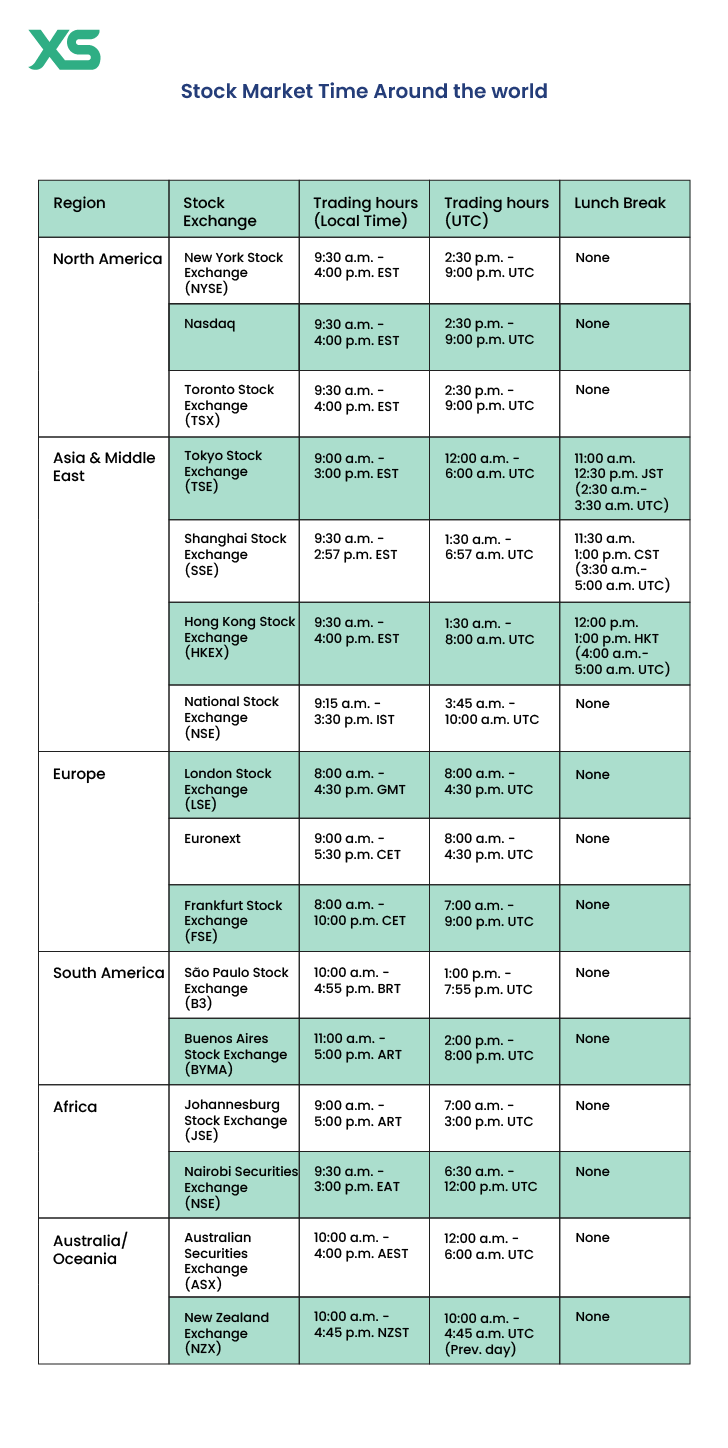
The global financial landscape is anchored by several key exchanges, each operating within its own regulatory framework and local time zone. For most domestic investors, the primary focus remains on the North American markets, but in an interconnected global economy, the movements in London, Tokyo, and Hong Kong often set the stage for the trading day.
The New York Stock Exchange (NYSE) and NASDAQ
The two largest stock exchanges in the world, the NYSE and the NASDAQ, operate on a synchronized schedule. Located in the Eastern Time (ET) zone, these markets officially open at 9:30 AM and close at 4:00 PM, Monday through Friday. This 6.5-hour window is known as “regular trading hours.” Unlike some international counterparts, U.S. markets do not take a break for lunch; trading continues uninterrupted throughout the session. This period represents the peak of liquidity for U.S. equities, meaning it is the time when the most shares are being bought and sold, usually resulting in the narrowest “spreads” (the difference between the buy and sell price).
European Markets: London (LSE) and Euronext
Moving across the Atlantic, the London Stock Exchange (LSE) is the most prominent hub for European finance. The LSE typically operates from 8:00 AM to 4:30 PM Greenwich Mean Time (GMT) or British Summer Time (BST). One of the most critical times for global investors is the “overlap” period. Between 9:30 AM and 11:30 AM ET, both the London and New York markets are open simultaneously. This window often sees a surge in volume as institutional investors manage cross-border portfolios and react to news affecting both continents.
Asian Markets: Tokyo, Hong Kong, and Shanghai
The trading day technically begins in Asia. The Tokyo Stock Exchange (TSE) generally operates from 9:00 AM to 3:00 PM local time, notably featuring a lunch break from 11:30 AM to 12:30 PM. Similarly, the Hong Kong Stock Exchange (HKEX) opens at 9:30 AM, takes a break between 12:00 PM and 1:00 PM, and closes at 4:00 PM. For Western investors, these markets are “overnight” sessions. Significant movements in the Hang Seng or the Nikkei 225 frequently provide a “leading indicator” for how U.S. futures might perform before the New York opening bell.
Pre-Market and After-Hours Trading
While the “opening bell” at 9:30 AM ET is the traditional start of the day, the digital era has extended the boundaries of the trading day. Electronic Communication Networks (ECNs) allow investors to trade outside of regular hours, though the environment is significantly different from the standard session.
The Mechanics of Extended Hours
Pre-market trading in the U.S. can begin as early as 4:00 AM ET, though the majority of activity occurs after 8:00 AM. After-hours trading begins immediately following the 4:00 PM close and can run until 8:00 PM ET. These sessions allow investors to react immediately to news that breaks outside of regular hours, such as quarterly earnings reports, geopolitical events, or unexpected economic data.
Risks and Rewards of Trading Outside Regular Hours
Trading in the extended sessions is not for the faint of heart. The primary risk is “thin liquidity.” Because far fewer participants are active, it can be difficult to execute large orders without significantly moving the price. Spreads are often wider, and price volatility can be extreme. However, for an informed investor, the pre-market and after-hours sessions offer the advantage of “first-mover” status. If a company reports stellar earnings at 4:05 PM, those who trade in the after-hours session can position themselves before the general public enters the fray the following morning.
The Significance of Market Holidays and Half-Days
The market does not follow a standard 365-day calendar. To trade effectively, one must be aware of the federal holidays and “early close” days that can halt or limit trading activity.
Standard U.S. Market Holidays
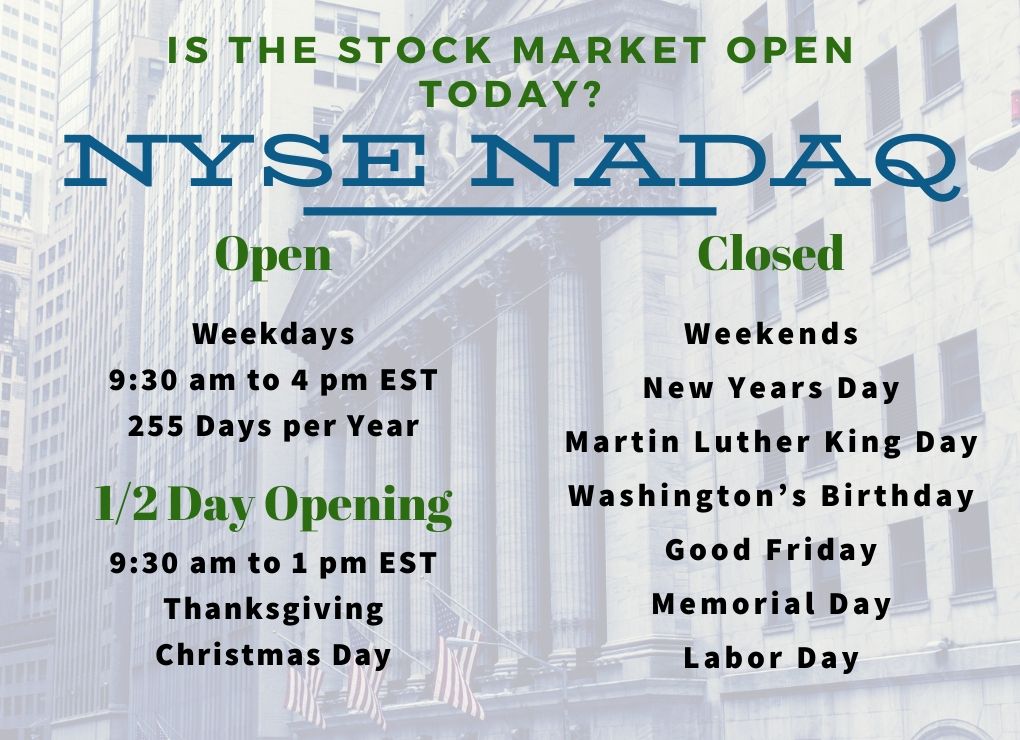
The NYSE and NASDAQ observe several holidays throughout the year, including New Year’s Day, Martin Luther King Jr. Day, Presidents’ Day, Good Friday, Memorial Day, Juneteenth, Independence Day, Labor Day, Thanksgiving, and Christmas. On these days, the markets are closed entirely. For investors, these closures mean that liquidity is non-existent, and any major news events occurring on these days will result in a “gap” in price when the market eventually reopens.
How Regional Holidays Impact Global Liquidity
Even if the U.S. market is open, a holiday in another major financial hub can impact trading. For instance, “Bank Holidays” in the United Kingdom or “Golden Week” in China can lead to lower-than-average trading volumes globally. When volume is low, the market can become more susceptible to sudden, sharp movements because there are fewer “buffers” (traders) to absorb large sell or buy orders. Savvy investors often reduce their exposure or tighten their stop-loss orders during these “low-volume” periods to avoid “flash” volatility.
Strategic Trading: When is the Best Time to Trade?
Knowing when the market is open is the first step; knowing when to act is the second. Market behavior tends to follow a predictable psychological pattern throughout the day, often referred to as the “U-shaped” intraday volume curve.
The “Opening Cross” and Initial Volatility
The first 30 to 60 minutes of the trading day (9:30 AM – 10:30 AM ET) are usually the most volatile. This is the period when the market “prices in” all the news that accumulated overnight. It is a time of price discovery where institutional “smart money” and retail “emotional money” collide. Many professional traders advise beginners to avoid trading in the first half-hour to let the initial “noise” settle and a clear trend emerge.
The Mid-Day Lull
From approximately 11:30 AM to 2:00 PM ET, trading volume typically drops. This is often referred to as the “lunchtime doldrums.” During this period, many institutional traders in New York take their breaks, and the European markets begin to close. Prices often move sideways in a narrow range. While this is a lower-risk time to enter positions, it can also be frustrating for those looking for significant price action.
The “Power Hour” and Market Close
The final hour of trading, from 3:00 PM to 4:00 PM ET, is known as the “Power Hour.” This is when volatility and volume surge once again. Mutual funds and ETFs often execute their “rebalancing” trades near the close to match the day’s closing price. The “Closing Auction” is a highly sophisticated process where the final price of a stock is determined. For long-term investors, the closing price is the most important data point of the day, as it represents the “settled” value of an asset after all the day’s information has been digested.
Modern Considerations: 24/7 Markets and Digital Assets
As we look toward the future of finance, the concept of a “closed market” is beginning to blur. The rise of digital assets and the globalization of foreign exchange have created environments where the clock never stops.
The Forex Market’s Continuous Cycle
The Foreign Exchange (Forex) market is a decentralized global market for the trading of currencies. It operates 24 hours a day, five days a week. It starts on Sunday evening (U.S. time) when the Asian markets open and runs through Friday afternoon when the U.S. markets close. Because currencies are traded in pairs (e.g., EUR/USD), there is always a market open somewhere in the world to facilitate these trades. This constant availability makes Forex a favorite for those who cannot trade during traditional business hours.
Cryptocurrency: The Market That Never Sleeps
Perhaps the most significant disruption to the traditional market clock is the rise of cryptocurrency. Bitcoin, Ethereum, and thousands of other digital assets trade 24 hours a day, 7 days a week, 365 days a year. There are no holidays, no opening bells, and no closing auctions. This 24/7 environment presents unique challenges for personal finance management, as a portfolio’s value can shift dramatically while the investor is asleep or during a holiday weekend. It represents a shift toward a “frictionless” financial world where time zones become increasingly irrelevant.

Conclusion: Why the Clock Matters for Your Wealth
Understanding when the market opens and closes is more than a logistical necessity; it is a strategic advantage. For the long-term investor, knowing these hours helps in setting realistic expectations for when orders will be filled and at what price. For the active trader, it provides a roadmap of when to expect volatility and when to seek safety.
In the realm of money and investing, knowledge is the most valuable currency. By mastering the global trading schedule, recognizing the risks of extended hours, and understanding the psychological cycles of the trading day, you position yourself to make more informed, disciplined, and ultimately more profitable financial decisions. The market clock is always ticking; make sure you are moving in sync with it.
aViewFromTheCave is a participant in the Amazon Services LLC Associates Program, an affiliate advertising program designed to provide a means for sites to earn advertising fees by advertising and linking to Amazon.com. Amazon, the Amazon logo, AmazonSupply, and the AmazonSupply logo are trademarks of Amazon.com, Inc. or its affiliates. As an Amazon Associate we earn affiliate commissions from qualifying purchases.