
The world of financial futures is often perceived as a relentlessly ticking clock, a marketplace that scarcely sleeps. Unlike traditional stock exchanges with their well-defined opening and closing bells, the futures markets operate on a much more extended schedule, frequently spanning nearly 24 hours a day, five days a week. This continuous operation is fundamental to understanding their nature, offering both unparalleled flexibility and unique challenges for traders and investors worldwide. For anyone looking to engage with these powerful financial instruments, grasping the intricate rhythm of futures market hours is not merely an operational detail but a critical component of successful strategy, risk management, and opportunity identification.

The extended trading hours of futures markets are a direct response to the globalized nature of finance. Economic events, geopolitical shifts, and market-moving news don’t adhere to a single time zone. A significant development in Asia can ripple through European markets before the United States even wakes up. Futures markets are designed to facilitate continuous price discovery and hedging capabilities against these global influences, allowing participants to react in real-time to events as they unfold across different continents. However, while the overarching principle is “24/5,” the specifics can vary considerably depending on the exchange, the type of future contract, and whether you’re considering electronic trading versus historical pit trading. This article will delve into the nuances of futures market hours, exploring why they operate as they do, examining specific contract schedules, and highlighting why this understanding is paramount for navigating the complexities of modern financial trading.
The Continuous Cycle: Understanding 24/5 Futures Trading
The concept of a “24/5” market cycle is one of the defining characteristics of futures trading. This near-continuous operation, from Sunday evening through Friday afternoon (U.S. time), distinguishes futures from traditional equity markets and underpins much of their appeal and strategic utility.
The Rationale Behind Extended Hours
The primary driver for extended futures trading hours is the global and interconnected nature of the underlying assets and economic forces. Commodities like oil and gold, currencies, and even equity index benchmarks are influenced by events occurring around the clock, across every time zone. If a major oil discovery is announced in the Middle East during Asian trading hours, or a central bank makes a policy decision in Europe while U.S. markets are closed, futures markets provide an immediate mechanism for participants to price in this new information. This continuous price discovery mechanism is crucial for:
- Risk Management and Hedging: Businesses and institutions with global operations need to hedge their exposure to price fluctuations regardless of the time of day. A global airline, for instance, might need to lock in fuel prices even when U.S. markets are closed.
- Liquidity: Extended hours ensure broader participation from a diverse range of market participants across the globe, contributing to deeper liquidity.
- Arbitrage Opportunities: Discrepancies in pricing across different geographic markets can be quickly corrected, leading to more efficient markets overall.
- Reduced Gap Risk: While gaps can still occur, particularly over weekend breaks, the 24/5 operation generally reduces the likelihood of significant price gaps between consecutive trading days, as new information can be incorporated almost instantly.
Distinguishing Between Electronic and Pit Trading Hours
Historically, futures trading was dominated by open-outcry “pits” on exchange floors. These pits operated with very specific, often shorter, daily hours. For example, the Chicago Board of Trade (CBOT) and Chicago Mercantile Exchange (CME) pits had precise opening and closing bells. While some pit trading still exists for certain contracts, the vast majority of futures trading today occurs electronically.
Electronic trading platforms have revolutionized market access and extended trading hours dramatically. For most major futures contracts—such as those for equity indices, commodities, currencies, and interest rates—electronic trading systems allow orders to be placed and executed almost continuously. The “24/5” schedule predominantly refers to these electronic trading hours. The few hours a day when markets are closed are typically for maintenance, data processing, and preparing for the next trading session. Understanding this distinction is vital: while some historical “pit close” times might still be referenced, the effective trading window for most participants is dictated by the electronic system’s schedule.
A Closer Look at Specific Futures Contract Schedules
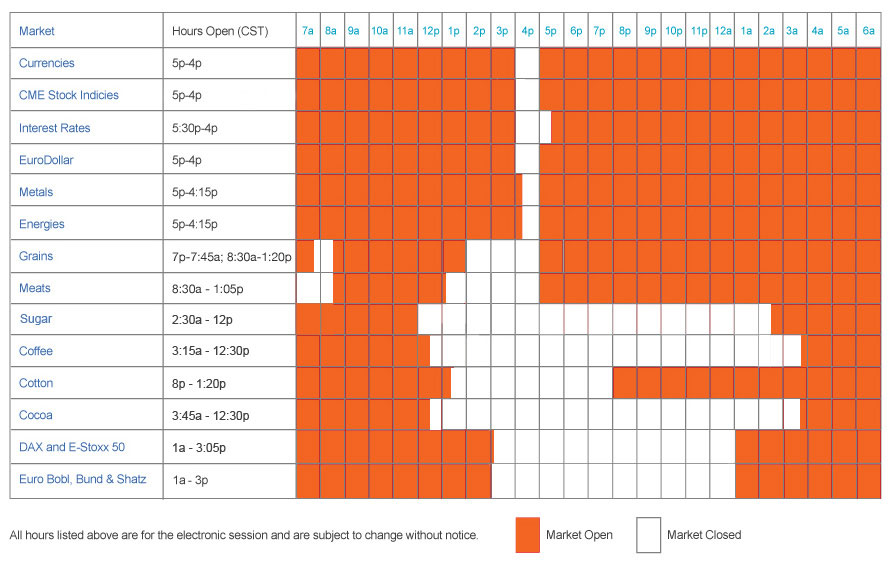
While the “24/5” mantra broadly applies, the precise open and close times, as well as any specific breaks, can vary significantly depending on the type of future contract and the exchange on which it trades. It’s crucial for traders to consult the specific exchange’s schedule for each contract they intend to trade.
Equity Index Futures (e.g., S&P 500, Nasdaq)
Equity index futures, particularly those based on major U.S. indices like the S&P 500 (ES), Nasdaq 100 (NQ), and Dow Jones Industrial Average (YM), are among the most actively traded contracts. Operated primarily by the CME Group, their electronic trading hours are extensive:
- Open: Sunday 5:00 PM CT (Chicago Time)
- Close: Friday 4:00 PM CT
- Daily Break: There is a daily 60-minute maintenance break from 4:15 PM CT to 5:00 PM CT each weekday. This means they are effectively open from 5:00 PM Sunday through 4:15 PM Friday, with brief daily pauses.
These extended hours allow traders to react to economic data releases, corporate earnings announcements, and geopolitical news that occur outside of the traditional U.S. stock market hours (9:30 AM to 4:00 PM ET).
Commodity Futures (e.g., Crude Oil, Gold, Agricultural Products)
Commodity futures exhibit some of the most diverse trading schedules, reflecting the global nature of their supply and demand.
- Crude Oil Futures (CL): Traded on NYMEX (part of CME Group), these are also largely 24/5. They typically open Sunday 5:00 PM CT and close Friday 4:00 PM CT, with a daily break from 4:15 PM CT to 5:00 PM CT. This allows continuous pricing against global events impacting energy supply and demand.
- Gold Futures (GC): Traded on COMEX (part of CME Group), gold futures follow a similar 24/5 schedule, aligning with the major financial centers in Asia, Europe, and North America. Open Sunday 5:00 PM CT, close Friday 4:00 PM CT, with the same daily break.
- Agricultural Futures (e.g., Corn, Soybeans, Wheat): These often have more segmented trading hours compared to energy or metals, sometimes with distinct daytime and overnight sessions. For example, some agricultural contracts might open Sunday 7:00 PM CT, close Friday 1:15 PM CT, with a daily break and sometimes a longer overnight close from 1:20 PM CT to 7:00 PM CT. The exact times are often tied to the specific growing seasons and physical market dynamics.
Currency Futures (Forex)
Currency futures, reflecting the 24-hour nature of the spot forex market, are also predominantly 24/5. Traded on the CME Globex platform, they generally follow the same schedule as equity index and major commodity futures: open Sunday 5:00 PM CT and close Friday 4:00 PM CT, with the daily 4:15 PM CT to 5:00 PM CT maintenance break. This allows participants to hedge currency exposure or speculate on exchange rate movements around the clock, aligning with the overlapping trading sessions of Sydney, Tokyo, London, and New York.
Interest Rate Futures
Interest rate futures, such as those for U.S. Treasury bonds (e.g., 2-Year, 5-Year, 10-Year Notes, and 30-Year Bonds), are crucial for hedging interest rate risk and speculating on monetary policy. These contracts, also traded on CME Group exchanges, adhere to the standard 24/5 electronic trading schedule: open Sunday 5:00 PM CT, close Friday 4:00 PM CT, with the daily 4:15 PM CT to 5:00 PM CT break. Their continuous operation allows market participants to react instantly to economic data releases (like inflation reports or employment figures) and Federal Reserve announcements that can dramatically impact interest rate expectations.
Cryptocurrency Futures
Cryptocurrency futures, like Bitcoin or Ethereum futures, offer the most extended hours, often operating closer to 24/7. Exchanges like CME Group offer Bitcoin futures (BTC) that trade from Sunday 5:00 PM CT through Friday 4:00 PM CT, with the same daily break. However, some other platforms and derivatives exchanges that specialize in cryptocurrencies may offer even closer to continuous trading, aligning with the underlying crypto spot markets which themselves never truly close. Traders should verify the specific exchange’s schedule for these highly volatile instruments.
Navigating Market Holidays, Breaks, and Rollover Periods
While futures markets are known for their extended hours, there are crucial exceptions and specific periods that traders must be aware of to avoid surprises.
Impact of Public Holidays
Unlike the continuous operation during weekdays, futures markets do observe major public holidays. In the U.S., holidays like New Year’s Day, Memorial Day, Independence Day, Labor Day, Thanksgiving Day, and Christmas Day typically see markets closed or operating on significantly reduced schedules. It’s important to note that a U.S. holiday might not affect futures contracts traded on non-U.S. exchanges, and vice-versa. Moreover, even on holidays where the underlying stock market is closed, futures contracts for those indices might still trade for a partial day or limited hours. Traders must consult the specific holiday schedule published by their exchange (e.g., CME Group) well in advance, as these schedules can include early closes, late opens, or full-day closures.

Daily Maintenance Periods and Breaks
As mentioned, most 24/5 electronic futures markets incorporate a short daily maintenance break, typically around 4:15 PM CT to 5:00 PM CT for CME Group products. This 45-minute window is used for system maintenance, data synchronization, and preparing for the next trading session. During this period, trading is paused, and orders cannot be placed or executed. For traders holding positions overnight, understanding this brief pause is important for managing expectations and knowing when market activity will resume.
Futures Contract Rollover Cycles
Beyond daily and holiday schedules, futures contracts have expiration dates. As an expiration date approaches, traders holding positions must either close out their position or “roll over” to the next available contract month. This rollover period is critical and affects liquidity and open interest. While not a “market open/close” event, it significantly impacts trading strategy. Rollovers usually occur over several days leading up to the contract’s expiration, with liquidity shifting from the expiring contract to the next active contract. For example, crude oil futures expire monthly, while equity index futures often expire quarterly. Awareness of these cycles is paramount for continuous trading strategies.
Why Understanding Market Hours is Crucial for Traders
For a futures trader, merely knowing “when to trade” extends far beyond simple clock-watching. It involves understanding the strategic implications of different trading sessions and how market dynamics shift throughout the 24/5 cycle.
Volatility and Liquidity Across Different Sessions
Futures markets exhibit varying levels of volatility and liquidity depending on the time of day, largely correlated with the active participation of major financial centers.
- Asian Session (e.g., Tokyo, Sydney): Often characterized by lower liquidity for U.S.-centric contracts but can react to Asian economic data.
- European Session (e.g., London, Frankfurt): Liquidity and volatility tend to increase significantly as European markets open, especially for currency and commodity futures, and for U.S. index futures pre-open.
- U.S. Session (e.g., New York, Chicago): Typically the most liquid and volatile period, particularly after the cash equity markets open. This is when major economic data releases and institutional participation are at their peak.
- Overnight/Post-U.S. Session: Liquidity can wane, leading to wider bid-ask spreads and potentially choppy price action. This can be challenging for short-term strategies.
Traders must tailor their strategies to these phases. High-frequency traders might thrive during peak liquidity, while swing traders might look for directional trends that emerge during quieter periods.
Risk Management and Overnight Exposure
Holding a futures position overnight, or over a weekend, carries distinct risks due to potential price gaps or significant moves based on news occurring when markets are closed or less liquid.
- Gap Risk: Even with 24/5 trading, weekend gaps can be substantial if major news breaks between Friday’s close and Sunday’s open.
- Slippage: During less liquid periods, executing orders can result in slippage, where the executed price differs significantly from the intended price.
- Margin Requirements: Overnight positions require sufficient margin, and rapid adverse price movements can lead to margin calls.
Understanding when volatility is likely to spike or liquidity to thin out is essential for setting appropriate stop-losses, managing position sizes, and deciding whether to hold positions through extended closures.
Strategy Adaptation to Market Phases
Different market phases demand different strategic approaches.
- Pre-Market/Overnight: Traders might use these hours to gauge sentiment, identify potential trend reversals from Asian/European activity, and prepare for the U.S. open.
- Active Session (U.S. Cash Market Hours): This period is often best for strategies that rely on high liquidity and strong directional moves driven by economic data or corporate news.
- Post-Market/Late Session: With decreasing liquidity, breakout strategies might be less effective, while range-bound trading or short-term scalping might present opportunities.
A well-rounded trading plan incorporates how market hours influence the efficacy of different technical indicators, chart patterns, and fundamental analysis.
Time Zone Considerations for Global Participants
Futures markets, by their nature, are global. Traders must be acutely aware of time zones, converting quoted market hours (often in CT or ET for U.S. contracts) to their local time. Many trading platforms automatically adjust, but double-checking is crucial. Furthermore, traders in different time zones might find certain sessions naturally more convenient for active trading, allowing them to capitalize on the most liquid periods without disrupting their sleep. This international accessibility is a cornerstone of futures trading’s global appeal, but requires careful logistical planning.
Best Practices for Trading Around Futures Market Hours
Navigating the 24/5 landscape of futures markets requires more than just knowing the schedule; it demands a strategic approach to capitalize on opportunities and mitigate risks.
Utilizing Pre-Market and Post-Market Information
The hours outside the core cash market session, particularly for equity index futures, offer valuable insights.
- Economic Data Releases: Many key economic reports (e.g., employment, inflation) are released before the cash market opens or after it closes. Futures prices will react immediately, providing a leading indicator for the day’s sentiment.
- Overnight News: Geopolitical events, central bank announcements, or corporate news from abroad can move futures markets significantly. Monitoring these events allows traders to anticipate potential directional biases or volatility spikes for the upcoming core session.
- Gauging Sentiment: The overnight price action can reveal whether institutions are accumulating or distributing, offering clues about the market’s underlying strength or weakness.
Planning for Market Opens and Closes
Market openings and closings are typically periods of heightened volatility and liquidity, making them both opportune and risky.
- Market Open: The initial minutes and hours after a major market opens (e.g., U.S. equity cash market opening at 9:30 AM ET) often see rapid price movements as pent-up orders are filled and new positions initiated. This can be a fertile ground for breakout strategies but also carries significant risk of whipsaws.
- Market Close: Similarly, the period leading up to the daily or weekly close can be volatile as traders square off positions, manage risk, or execute end-of-day strategies.
- Scheduled Events: Knowing when Federal Reserve announcements, important speeches, or major earnings reports are scheduled allows traders to position themselves strategically or, conversely, step aside to avoid event risk.
Leveraging Technology for Market Monitoring
Given the extended hours and rapid pace of futures markets, technology is an indispensable tool for traders.
- Real-time Data and Charting: Access to low-latency data and advanced charting platforms is critical for monitoring price action across different timeframes.
- Automated Trading Systems (Algos): For those with defined strategies, automated systems can execute trades even when a trader isn’t actively monitoring the market, managing overnight exposure and capitalizing on opportunities around the clock.
- Alerts and Notifications: Setting up price alerts, news alerts, and calendar alerts ensures traders are notified of significant events or price levels, regardless of their immediate availability.
- Brokerage Platform Functionality: Understanding how a broker’s platform handles order types (e.g., stop-loss, limit orders), especially during less liquid periods or close to daily breaks, is crucial for effective risk management.
By combining a deep understanding of market hours with sophisticated technological tools, futures traders can enhance their ability to navigate this dynamic and challenging financial landscape effectively.
In conclusion, while the headline “When Do the Futures Markets Open?” might suggest a simple answer, the reality is a sophisticated, globally interconnected system operating with remarkable continuity. The 24/5 nature of electronic futures trading, with its brief daily maintenance pauses, is designed to facilitate continuous price discovery and risk management in an ever-moving global economy. However, the specific nuances across different contract types, the impact of holidays, and the shifting landscape of volatility and liquidity across various trading sessions demand meticulous attention from participants. For the informed trader, mastering the intricate rhythms of futures market hours is not just about logistics; it’s about unlocking strategic advantages, effectively managing risk, and ultimately, positioning oneself for success in one of the world’s most dynamic financial arenas.
aViewFromTheCave is a participant in the Amazon Services LLC Associates Program, an affiliate advertising program designed to provide a means for sites to earn advertising fees by advertising and linking to Amazon.com. Amazon, the Amazon logo, AmazonSupply, and the AmazonSupply logo are trademarks of Amazon.com, Inc. or its affiliates. As an Amazon Associate we earn affiliate commissions from qualifying purchases.