
Interest rates are the lifeblood of an economy, influencing everything from the cost of a mortgage to the profitability of a business and the returns on savings. They are not static figures but dynamic variables that constantly shift in response to a complex interplay of economic forces, policy decisions, and market sentiment. Understanding when and why interest rates change is paramount for individuals managing personal finances, investors making strategic decisions, and businesses planning for the future. This article delves into the intricate mechanisms that drive interest rate fluctuations, demystifying the signals and processes that dictate these critical economic adjustments.
The Central Banks’ Mandate: Stewards of Monetary Policy
At the heart of interest rate determination lies the role of central banks. Institutions like the U.S. Federal Reserve, the European Central Bank (ECB), the Bank of England (BoE), and others globally are entrusted with the primary responsibility of setting monetary policy, with interest rates being their most potent tool. Their actions are not arbitrary but are guided by specific mandates aimed at fostering economic stability and growth.
Mandates and Dual Objectives: Balancing Growth and Price Stability
While specific mandates can vary slightly by country, central banks generally pursue a dual objective: maximizing employment and maintaining price stability (controlling inflation). In essence, they seek a “Goldilocks” economy – not too hot (which leads to inflation) and not too cold (which leads to recession and unemployment).
- Price Stability: A primary goal is to keep inflation at a low, stable, and predictable level (often around 2%). High inflation erodes purchasing power, while deflation (falling prices) can stifle economic activity. Central banks typically raise interest rates to cool down an overheating economy and curb inflation, making borrowing more expensive and saving more attractive. Conversely, they lower rates to stimulate economic activity when inflation is too low or economic growth is sluggish.
- Maximum Employment: Central banks also strive for an economy where most people who want to work can find jobs. Low interest rates can encourage borrowing and investment, leading to business expansion and job creation. High rates can slow down economic growth, potentially leading to job losses.
The delicate balancing act between these two objectives often means central banks must make difficult trade-offs, especially when inflation and unemployment trends diverge.
Tools of Monetary Policy: Orchestrating Economic Influence
Central banks possess an arsenal of tools to influence interest rates and the broader money supply. The most direct and frequently discussed is the setting of a target benchmark interest rate, such as the Federal Funds Rate in the U.S. or the Main Refinancing Operations Rate in the Eurozone.
- Benchmark Interest Rate: This is the rate at which commercial banks lend to each other overnight. By setting a target range for this rate, the central bank influences all other interest rates in the economy, from consumer loans to corporate bonds. When the central bank raises this rate, it makes money more expensive for banks, which then pass on those higher costs to their customers.
- Quantitative Easing (QE) and Quantitative Tightening (QT): These involve large-scale asset purchases (QE) or sales (QT) of government bonds and other securities. QE injects liquidity into the financial system, pushing down long-term interest rates and encouraging investment. QT, conversely, removes liquidity, tending to push long-term rates higher.
- Reserve Requirements: Though less frequently used today, central banks can mandate the percentage of deposits that banks must hold in reserve, influencing the amount of money available for lending.
- Discount Rate: This is the interest rate at which commercial banks can borrow money directly from the central bank. A higher discount rate discourages borrowing, while a lower rate encourages it.
Key Economic Indicators That Trigger Change
Central banks don’t change interest rates on a whim. Their decisions are data-driven, meticulously analyzing a vast array of economic indicators to gauge the health and trajectory of the economy. These indicators act as the “dashboard” that informs monetary policy adjustments.
Inflation Data and Expectations
Inflation is arguably the most critical factor influencing interest rate decisions. Central banks closely monitor various measures of inflation:
- Consumer Price Index (CPI): Measures the average change over time in the prices paid by urban consumers for a market basket of consumer goods and services.
- Producer Price Index (PPI): Measures the average change over time in the selling prices received by domestic producers for their output.
- Personal Consumption Expenditures (PCE) Price Index: The Federal Reserve’s preferred measure of inflation, as it covers a broader range of goods and services and accounts for shifts in consumer spending patterns.
Beyond current inflation, central banks pay significant attention to inflation expectations – what consumers, businesses, and investors believe future inflation will be. If inflation expectations rise, it can become a self-fulfilling prophecy, making it more likely that central banks will raise rates to anchor those expectations.
Employment Statistics
The state of the labor market provides crucial insights into economic health and potential inflationary pressures. Key employment indicators include:
- Unemployment Rate: The percentage of the labor force that is unemployed but actively seeking employment. A very low unemployment rate can signal that the economy is nearing its maximum capacity, potentially leading to wage inflation as companies compete for scarce workers.
- Job Growth (Non-farm Payrolls): The monthly increase or decrease in the number of jobs created. Strong job growth indicates a robust economy.
- Wage Growth: Increases in average hourly earnings. Significant wage growth can contribute to inflationary pressures, particularly if productivity growth doesn’t keep pace.
Economic Growth and Activity
Broader measures of economic activity help central banks understand the overall momentum of the economy:
- Gross Domestic Product (GDP): The total monetary or market value of all the finished goods and services produced within a country’s borders in a specific time period. Strong GDP growth indicates a healthy economy, while weak or negative growth can signal a recession.
- Consumer Spending: Accounts for a significant portion of economic activity. Retail sales, consumer confidence surveys, and credit card data are closely watched.
- Business Investment: Spending by businesses on new capital goods (e.g., equipment, buildings) indicates their confidence in future demand.
- Manufacturing and Services PMIs: Purchasing Managers’ Indexes provide an early indication of economic activity in the manufacturing and services sectors.
Global Economic Conditions and Geopolitical Events
In an increasingly interconnected world, domestic interest rate decisions cannot be made in isolation. Central banks also consider:
- Global Growth Outlook: The economic performance of major trading partners can influence export demand and overall economic health.
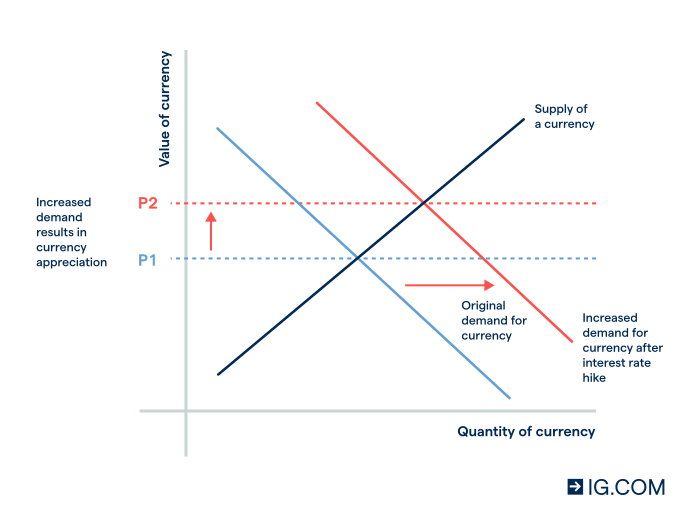
- Exchange Rates: Interest rate differentials can impact currency values, affecting trade and capital flows.
- Commodity Prices: Fluctuations in oil prices or other key commodities can have a significant impact on inflation.
- Geopolitical Risks: Events like wars, political instability, or major trade disputes can create uncertainty, disrupt supply chains, and influence economic sentiment, potentially prompting central bank action.
The Process of Interest Rate Adjustment: Deliberation and Communication
Interest rate changes are not typically sudden pronouncements but the result of careful deliberation and strategic communication by central bank committees.

Meetings and Committees: The Decision-Making Body
Decisions on the benchmark interest rate are made by a dedicated committee within the central bank. For instance, in the U.S., it’s the Federal Open Market Committee (FOMC), which meets eight times a year (roughly every six weeks). These meetings involve presentations on economic data, forecasts, and extensive discussions among committee members. Each member typically provides their economic outlook and vote on the appropriate policy action.
Forward Guidance and Market Communication: Shaping Expectations
Central banks have learned that communication is almost as powerful as the rate changes themselves. Forward guidance refers to the communication strategy used by central banks to provide indications about the future path of monetary policy. This can include:
- Statements: Official post-meeting statements explaining the decision and the committee’s outlook.
- Press Conferences: Where the central bank head (e.g., the Fed Chair) elaborates on the decision and answers questions.
- Minutes: Detailed records of the meeting discussions, often released with a lag, providing further insight into the committee’s thinking.
- Speeches and Testimonies: Public remarks by central bank officials that offer clues about policy leanings.
By clearly communicating their intentions and economic assessments, central banks aim to manage market expectations, reduce uncertainty, and ensure their policy actions are effectively transmitted through the financial system.
Lag Effects and Market Reactions: The Ripple Effect
Changes in interest rates do not instantly translate into economic effects. There are often significant lag effects, meaning it can take months or even a year or more for the full impact of a rate change to be felt across the economy. Businesses need time to adjust investment plans, consumers need time to respond to changing borrowing costs, and banks need time to adjust their lending practices.
Furthermore, financial markets often react immediately to perceived changes in central bank policy, even before an official announcement. Bond markets, stock markets, and currency markets will try to anticipate future rate moves, pricing them into asset values. This is why central bank communication is so critical; unexpected policy shifts can lead to significant market volatility.
Impact of Interest Rate Changes on You: Personal and Business Implications
The seemingly abstract concept of interest rate changes has very real and tangible effects on individuals, households, and businesses.
Borrowing Costs: Mortgages, Loans, and Credit Cards
One of the most direct impacts is on the cost of borrowing:
- Mortgages: Rising interest rates mean higher monthly payments for variable-rate mortgages and higher rates for new fixed-rate mortgages, making homeownership less affordable. Conversely, falling rates can make refinancing attractive.
- Personal Loans and Auto Loans: The cost of these loans generally moves in tandem with the benchmark rate.
- Credit Cards: Most credit card interest rates are variable and directly tied to a benchmark rate (like the prime rate), meaning higher central bank rates lead to higher credit card APRs.
Savings and Investments: Rewards and Risks
Interest rate changes also reshape the landscape for savers and investors:
- Savings Accounts and Certificates of Deposit (CDs): Higher interest rates typically translate to better returns on traditional savings vehicles, rewarding those who hold cash.
- Bonds: When interest rates rise, newly issued bonds offer higher yields, making existing bonds with lower yields less attractive, causing their prices to fall. Conversely, falling rates boost existing bond prices.
- Stocks: The impact on stocks is more complex. Higher rates can make borrowing more expensive for companies, potentially reducing their profits and making bonds more attractive relative to stocks. However, if rates rise due to a strong economy, corporate earnings might still grow. Falling rates can make stocks more appealing.
Business and Economic Activity: Growth and Contraction
For businesses, interest rates impact:
- Investment Decisions: Lower rates encourage businesses to borrow and invest in expansion, equipment, and innovation. Higher rates can deter such investments.
- Operating Costs: Businesses with variable-rate loans or lines of credit will see their interest expenses rise or fall with policy changes.
- Consumer Demand: As borrowing costs for consumers change, their willingness and ability to spend on goods and services fluctuate, directly affecting business revenues.
Forecasting Interest Rate Movements: An Ongoing Challenge
Predicting interest rate changes with absolute certainty is impossible, as central bank decisions are contingent on evolving economic data and geopolitical developments. However, individuals and businesses can improve their ability to anticipate likely shifts by closely monitoring key information:
Analyzing Central Bank Statements and Speeches
Pay close attention to the language used by central bank officials. Look for clues about their economic outlook, their inflation tolerance, and their forward guidance on future policy. Reading between the lines of FOMC statements, ECB press conferences, or BoE minutes can provide valuable insights.
Watching Economic Data Releases
Regularly follow the release of key economic indicators: inflation reports (CPI, PCE), employment statistics (jobless claims, non-farm payrolls), GDP figures, and consumer confidence surveys. These data points are the primary inputs into central bank decision-making.
Market Expectations and Futures Contracts
Financial markets often price in expected interest rate changes. Fed Funds Futures (for the U.S.) or similar instruments in other regions reflect traders’ collective bets on where the benchmark rate will be at future dates. While not foolproof, these provide a real-time gauge of market sentiment and probabilistic outcomes.
In conclusion, interest rates are a critical barometer of economic health and a powerful tool for central banks to achieve their mandates. Their changes are not random but are the calculated outcomes of economic analysis, policy objectives, and careful communication. By understanding the forces that drive these changes, from central bank mandates to global economic shifts, individuals and businesses can better navigate the financial landscape and make more informed decisions in an ever-evolving monetary environment.
aViewFromTheCave is a participant in the Amazon Services LLC Associates Program, an affiliate advertising program designed to provide a means for sites to earn advertising fees by advertising and linking to Amazon.com. Amazon, the Amazon logo, AmazonSupply, and the AmazonSupply logo are trademarks of Amazon.com, Inc. or its affiliates. As an Amazon Associate we earn affiliate commissions from qualifying purchases.