
The world of financial markets operates on a 24-hour global clock, but the precise opening and closing times for futures markets are a nuanced subject critical for anyone involved in investing, trading, or risk management. Far from a simple 9-to-5 operation, futures trading spans continents, time zones, and a diverse range of asset classes, each with its own specific schedule. Understanding these timings is not merely a logistical detail; it’s a cornerstone of effective strategy, risk mitigation, and opportunity capture in the fast-paced realm of derivatives.
Futures contracts, agreements to buy or sell an asset at a predetermined price on a specified future date, are traded on organized exchanges. These exchanges facilitate price discovery, provide liquidity, and ensure orderly market operations. The shift from physical trading pits to predominantly electronic platforms has significantly extended trading hours, often blurring the lines between traditional “open” and “close.” Yet, specific official opening and closing times, along with various trading sessions, remain highly relevant, defining periods of heightened volatility, liquidity shifts, and strategic importance for market participants worldwide. This comprehensive guide will delve into the intricacies of futures market hours, exploring the global landscape, specific asset class timings, influencing factors, and the profound implications for traders and investors.

Understanding the Global Nature of Futures Trading Hours
The financial world never truly sleeps, and futures markets are a prime example of this continuous operation. While equities markets typically adhere to national business hours, futures often transcend these boundaries, offering participants near 24-hour access across various global sessions. This extended availability is a direct response to the international flow of capital, information, and economic events that can impact asset values at any moment.
The 24-Hour Cycle and Electronic Trading
The advent and widespread adoption of electronic trading platforms have revolutionized futures markets, transforming them from localized pit-trading environments into interconnected global networks. Most major futures exchanges now offer extensive electronic trading hours, often beginning on Sunday evenings (ET) and continuing almost uninterrupted until Friday afternoons (ET). This “nearly 24-hour” cycle is punctuated by brief maintenance breaks and daily settlement periods, which typically last from minutes to a few hours.
For instance, the CME Group (comprising the Chicago Mercantile Exchange, Chicago Board of Trade, New York Mercantile Exchange, and COMEX) operates its Globex electronic trading platform for most of its key products for nearly 23 hours a day, five days a week. This continuous access allows traders to react to economic data releases, geopolitical events, and market movements happening anywhere in the world, regardless of their local time zone. It also ensures that liquidity is spread across different geographical trading sessions, from Asia to Europe to North America, providing greater flexibility and responsiveness for market participants.
Key Futures Exchanges and Their Respective Schedules
Different exchanges specialize in various types of futures contracts and operate under their own jurisdictional rules and market conventions. While many share a common thread of extended electronic hours, their precise schedules can vary.
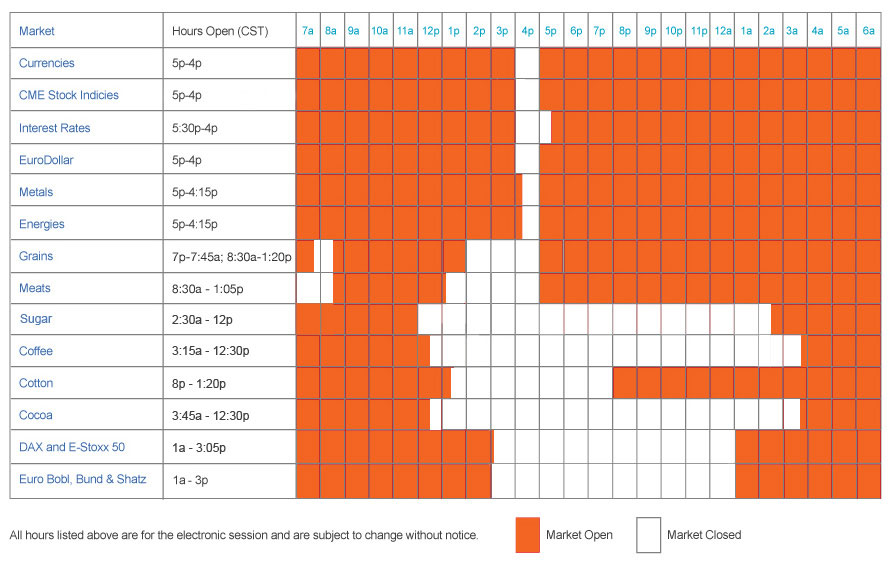
- CME Group (Globex): As one of the largest and most diversified derivatives exchanges globally, CME Group offers contracts across equity indices (e.g., E-mini S&P 500, Nasdaq 100), interest rates (e.g., Treasury futures), foreign exchange (FX), commodities (e.g., crude oil, gold, agricultural products), and more. Most CME products on Globex trade from Sunday 5:00 PM CT (6:00 PM ET) until Friday 4:00 PM CT (5:00 PM ET), with a daily 60-minute break from 4:00 PM CT to 5:00 PM CT. Some specific products might have minor variations or additional brief breaks.
- Intercontinental Exchange (ICE): ICE is another major player, particularly significant in energy (e.g., Brent Crude), agricultural commodities, and interest rates. Many ICE futures contracts also follow an extended electronic trading schedule, often mirroring the near 24-hour model with similar daily breaks. For example, ICE Futures Europe operates its Brent Crude futures from Sunday 8:00 PM GMT to Friday 10:00 PM GMT, with a daily 1-hour break.
- Eurex: Based in Europe, Eurex is prominent for its equity index futures (e.g., Euro Stoxx 50) and fixed income futures (e.g., Bund futures). Eurex typically has shorter trading hours compared to the extensive 24-hour cycles of CME or ICE for certain products, although many significant contracts trade from early morning CET until late evening. For example, Euro Stoxx 50 futures often trade from 7:00 AM CET to 10:00 PM CET, highlighting a more focused European trading day but still extended beyond traditional equity hours.
- Asia-Pacific Exchanges: Exchanges like the Singapore Exchange (SGX), Hong Kong Exchanges and Clearing (HKEX), and Japan Exchange Group (JPX) offer futures on Asian equity indices, commodities, and currencies. Their electronic trading hours are tailored to capture liquidity during Asian business hours and often extend into European or even early North American sessions to attract international participants. For instance, SGX Nikkei 225 futures might trade from early morning Singapore time until late at night, bridging multiple global sessions.
It’s imperative for traders to consult the official websites of the respective exchanges for the most current and precise trading schedules, as these can be subject to change due to holidays, market conditions, or regulatory updates.
Specific Market Segments and Their Trading Timings
While the general principle of extended electronic trading holds true for most futures, the specifics can vary significantly depending on the underlying asset class. These variations are often driven by the primary geographic centers of supply and demand for the asset, the regulatory environment, and the typical news cycles that impact their prices.
Equity Index Futures
Equity index futures, such as those tracking the S&P 500 (E-mini S&P 500 futures on CME) or Nasdaq 100 (E-mini Nasdaq 100 futures on CME), are among the most actively traded contracts. Their trading hours are designed to allow investors to hedge or speculate on stock market movements well beyond the standard cash equity market hours.
- Typical Schedule (e.g., E-mini S&P 500): These contracts on CME Globex generally open on Sunday evening at 5:00 PM CT (6:00 PM ET) and trade continuously until Friday afternoon at 4:00 PM CT (5:00 PM ET), with a 60-minute break each day from 4:00 PM CT to 5:00 PM CT. This means they are available throughout the Asian, European, and North American trading sessions, allowing participants to react immediately to global economic news or corporate earnings reports released outside of conventional equity market hours.
- Importance: This extended schedule is particularly valuable for institutional investors managing large portfolios and for retail traders looking to capitalize on after-hours news or global macroeconomic events before the main stock market opens.
Commodity Futures
Commodity futures cover a vast array of physical assets, including energy (crude oil, natural gas), metals (gold, silver, copper), and agricultural products (corn, wheat, soybeans). Their trading hours often reflect the global nature of their production, consumption, and shipping.
- Energy Futures (e.g., Crude Oil): Crude oil futures (like WTI Crude on NYMEX/CME or Brent Crude on ICE) are among the most liquid commodity contracts. They typically follow an extensive electronic schedule, often beginning Sunday evening and trading through Friday afternoon with short daily breaks. For example, NYMEX WTI futures on CME Globex trade from Sunday 5:00 PM CT to Friday 4:00 PM CT, with a 60-minute break daily from 4:00 PM CT to 5:00 PM CT. This continuous trading is essential due to the constant global demand and supply dynamics, and geopolitical events that can impact prices around the clock.
- Precious Metals Futures (e.g., Gold): Gold futures (e.g., COMEX Gold on CME) also boast nearly 24-hour electronic trading, reflecting gold’s role as a global safe-haven asset and its sensitivity to international economic and political developments. Their schedule is often identical to that of equity index and energy futures on the CME Globex platform.
- Agricultural Futures (e.g., Corn, Soybeans): These futures, primarily traded on the CBOT (CME Group), have more distinct trading sessions. While they offer electronic trading, there are often longer breaks or specific “open outcry” pit sessions that define their primary liquidity periods. For instance, CBOT corn futures might trade electronically from Sunday evening through Friday, but with a significant daily break after the primary US daytime session and an overnight session that might have lower liquidity compared to the day session. This is partly due to the concentrated nature of agricultural news (e.g., crop reports) and the physical markets.
Interest Rate and Currency Futures
Interest rate futures (e.g., Treasury bond futures, Eurodollar futures) and currency futures (e.g., Euro/USD, Yen/USD) are highly sensitive to central bank announcements, economic data, and geopolitical shifts. Their trading hours are crucial for hedging interest rate risk or speculating on currency movements.
- Interest Rate Futures: Contracts like the 10-Year Treasury Note futures (on CBOT/CME) are vital for financial institutions and typically follow the nearly 24-hour electronic schedule (Sunday 5:00 PM CT to Friday 4:00 PM CT, with daily breaks) to allow for continuous reaction to global interest rate outlooks and economic indicators.
- Currency Futures: FX futures (on CME Group) also operate on a similar extended schedule, reflecting the underlying 24/5 nature of the spot foreign exchange market. This allows participants to manage currency risk and respond to news from any major economy instantly.
Understanding these segmented schedules is crucial for traders to align their strategies with peak liquidity, relevant news cycles, and periods of expected price action.
Factors Influencing Futures Market Opening and Closing Times
While electronic trading has standardized many aspects of futures market operations, several factors continue to influence and shape their specific opening and closing times, creating variations that traders must be aware of.
Exchange Operating Policies and Regulations
Each futures exchange is an independent entity with its own governance structure, rules, and operating policies. These policies dictate the official trading hours for various contracts, balancing the need for broad market access with operational efficiency and regulatory compliance. Exchanges consider factors such as:
- Underlying Asset Market Hours: For instance, futures on equity indices are heavily influenced by the trading hours of the underlying stock exchanges.
- Global Demand and Liquidity: Exchanges strive to offer hours that capture peak liquidity from major financial centers worldwide.
- Regulatory Frameworks: Different jurisdictions have varying rules regarding market holidays, circuit breakers, and reporting requirements, which can affect trading schedules.
- Technological Capabilities: The capacity of electronic trading systems to operate continuously while performing necessary end-of-day processes (settlement, risk management) also plays a role.
Weekends, Holidays, and Early Closures
Futures markets are generally closed during weekends. However, many “open” on Sunday evening to begin the new trading week, anticipating the opening of Asian markets. Public holidays, especially those in the country where the primary exchange is located, also lead to market closures or modified hours.
- National Holidays: U.S. holidays (e.g., New Year’s Day, Memorial Day, Independence Day, Thanksgiving, Christmas) typically result in full closures for U.S.-based futures contracts. However, even on U.S. holidays, non-U.S. exchanges might remain open, and some U.S. products may still have limited electronic trading or specific short sessions.
- Holiday-Shortened Schedules: It’s common for exchanges to announce early closures on days preceding or following major holidays, or to have reduced hours on specific holiday trading days. For example, on the day after Thanksgiving (Black Friday), many markets might close early.
- Impact of Global Holidays: While a U.S. holiday might close CME, a European holiday would likely impact Eurex more directly, although highly globalized products might see reduced liquidity across the board.
Traders must always check the official exchange calendars well in advance, as these closures and shortened hours can significantly impact liquidity and volatility, potentially leading to increased risk or missed opportunities.
Daylight Saving Time Adjustments
Daylight Saving Time (DST) changes, implemented in many countries, can cause considerable confusion for traders. Futures exchanges, particularly those with a global participant base, need to synchronize their schedules with these shifts.
- Impact on Stated Times: When a region observes DST, its local time shifts by an hour. If an exchange’s trading hours are quoted in its local time, traders in other time zones (especially those that don’t observe DST or observe it on a different date) must adjust their interpretation of the opening and closing times.
- Exchange Adjustments: Major exchanges like CME Group will often announce their adjustments relative to Eastern Time (ET) or Central Time (CT), ensuring consistency. For instance, if Europe shifts to DST before the U.S., there will be a temporary one-hour shift in the time difference between European and U.S. trading sessions, affecting when European economic data arrives relative to the U.S. market open.
- Criticality for International Traders: For traders operating across multiple time zones, understanding when and how these DST changes occur is vital to avoid missing critical openings or miscalculating the timing of trades.
Staying informed about these operational and calendar-based factors is non-negotiable for anyone actively participating in futures markets.
The Strategic Importance of Knowing Market Hours for Traders
Beyond mere operational awareness, a deep understanding of futures market opening and closing times is a critical component of a robust trading strategy. It influences everything from risk management and trade execution to opportunity identification and overall portfolio performance.
Managing Risk and Volatility Around Openings
Market openings, particularly after a weekend or a significant break, are often characterized by heightened volatility and potential price gaps. This phenomenon is due to the accumulation of news and events that occurred while the market was closed, leading to a concentrated period of price discovery as participants react simultaneously.
- Increased Volatility: The initial minutes or hours after a major futures market opens can see rapid price swings, wider bid-ask spreads, and significant order flow imbalances. Traders who are unaware of these dynamics may enter trades at disadvantageous prices or be caught off guard by sudden movements.
- Gap Risk: Futures markets can “gap” up or down at the open if there’s been substantial news overnight that pushes prices significantly away from the previous close. This gap risk needs to be managed through position sizing, stop-loss orders, and careful timing of entries.
- Strategic Entry/Exit: Knowledge of opening times allows traders to either avoid the initial volatile period, using it for observation, or to strategically enter positions to capitalize on directional moves if they have a strong thesis and robust risk controls. Some strategies specifically target the opening range breakout or the reversal from initial volatility.
Opportunity Identification and Execution
Different trading sessions within the nearly 24-hour futures cycle present unique opportunities based on liquidity, volatility, and the types of news influencing the market.
- Asian Session: Often characterized by lower liquidity for Western contracts but can be crucial for Asian-specific news or the initial reaction to weekend global news.
- European Session: Sees increased liquidity and volatility as European economic data is released and major European financial institutions come online.
- North American Session (U.S. Open): Typically the most liquid and volatile session for U.S.-centric contracts, driven by U.S. economic data, corporate news, and the opening of the cash equity markets.
- Overlap Sessions: Periods where two major trading sessions overlap (e.g., late European and early North American) are often the most liquid and active, offering prime trading opportunities.
By knowing these patterns, traders can tailor their strategies to the specific characteristics of each session, focusing on high-probability setups when conditions are most favorable.
Geographic Considerations and Time Zone Management
For international traders, managing multiple time zones is not just about converting numbers; it’s about understanding the asynchronous flow of information and capital. A trader in London needs to know when the U.S. market opens relative to their local time to anticipate the influx of U.S. order flow and data. Similarly, a U.S.-based trader tracking Asian markets needs to understand when key Asian economic indicators are released in their local time zone. Tools like time zone converters and world clocks become indispensable for maintaining an accurate trading schedule.

The Role of Pre-Market and Post-Market Trading
While often considered part of the extended electronic hours, it’s worth noting the distinct characteristics of “pre-market” and “post-market” segments relative to the main cash market sessions (e.g., for equity index futures). These periods, particularly for equity-related futures, can provide valuable insights into market sentiment before the official stock market open or after its close. Significant price action during these times can foreshadow movements in the underlying cash markets and offer early opportunities for positioning. However, liquidity can also be thinner, requiring careful attention to order sizing and execution.
In conclusion, the question of “when do futures markets open” reveals a complex, dynamic landscape that demands continuous vigilance and strategic planning. For anyone navigating the derivatives world, mastering these hours is not just about staying informed; it’s about optimizing performance, managing risk effectively, and ultimately, enhancing the chances of financial success in a truly globalized market.
aViewFromTheCave is a participant in the Amazon Services LLC Associates Program, an affiliate advertising program designed to provide a means for sites to earn advertising fees by advertising and linking to Amazon.com. Amazon, the Amazon logo, AmazonSupply, and the AmazonSupply logo are trademarks of Amazon.com, Inc. or its affiliates. As an Amazon Associate we earn affiliate commissions from qualifying purchases.