
The question “when did the stock market open?” seems simple at first glance, but it unravels a fascinating tapestry of financial history, regulatory evolution, and investor behavior. It’s not merely about a specific time on a clock but rather the culmination of centuries of economic activity, the establishment of formal exchanges, and the continuous adaptation to modern financial landscapes. Understanding the genesis and evolution of market opening times provides critical insight into the structure, stability, and future of global finance.
The Genesis of Organized Trading: From Coffee Houses to Formal Exchanges
The concept of people buying and selling shares of companies or commodities is ancient, tracing its roots back to Roman times and medieval European trade fairs. However, the formal “opening” of a stock market, as we understand it today, is a relatively modern phenomenon, intricately linked to the birth of organized exchanges.
Early Bourses and the Dutch Pioneering Spirit
The true precursor to modern stock markets emerged in the early 17th century. While Venice had commodity exchanges earlier, it was Amsterdam that pioneered the world’s first true stock exchange. In 1602, the Dutch East India Company (VOC) issued shares to the public, effectively creating the first publicly traded company. To facilitate the buying and selling of these shares, a formal trading floor was established in Amsterdam. While there wasn’t a strict “opening bell” in the modern sense, trading would commence as soon as merchants and investors gathered, often in designated areas or coffee houses, reflecting a nascent form of market activity. The Amsterdam Exchange quickly became the center of global finance, establishing practices that would influence exchanges for centuries.
London’s Financial Revolution
London soon followed suit. By the late 17th century, merchants and brokers in London began to congregate in coffee houses, most notably Jonathan’s Coffee-House, to trade shares in various ventures. This informal gathering eventually led to the establishment of the London Stock Exchange (LSE) in 1773. Initially, trading hours were largely dictated by daylight and the social customs of the time, often lasting from mid-morning to late afternoon. The LSE’s formalization marked a significant step towards structured trading, bringing order to what was once a chaotic, albeit vibrant, speculative environment.
The Buttonwood Agreement and Wall Street’s Birth
Across the Atlantic, the New York Stock Exchange (NYSE) traces its origins to the Buttonwood Agreement, signed in 1792 by 24 stockbrokers under a buttonwood tree on Wall Street. This agreement established rules for commissions and trading, laying the groundwork for what would become the world’s largest stock exchange. Early trading on the NYSE was less about specific opening times and more about the availability of brokers and demand. It wasn’t until the exchange moved indoors to a formal building in 1817 that more structured hours began to take shape, gradually evolving into the defined schedule we recognize today. The push for formal opening and closing times was driven by the need for transparency, market efficiency, and regulatory oversight to protect investors and maintain orderly markets.
Modern Market Hours and Their Rationale
Today, major global stock markets operate with highly standardized opening and closing times, meticulously observed to ensure fair and efficient trading. These hours are not arbitrary but are carefully chosen based on a complex interplay of historical practice, logistical considerations, and regulatory mandates.
The United States: NYSE and NASDAQ
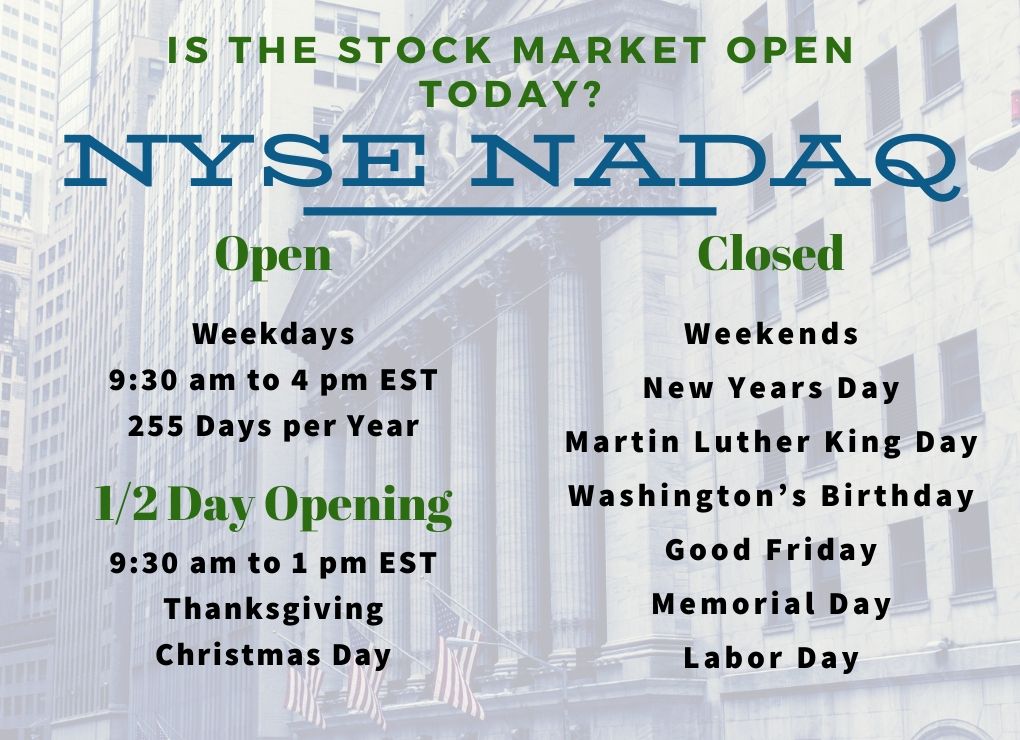
For the major U.S. equity markets, the New York Stock Exchange (NYSE) and NASDAQ, the standard trading hours are from 9:30 AM to 4:00 PM Eastern Time (ET) on weekdays. This seven-hour window, punctuated by an opening bell and a closing bell, is considered the “regular trading session.”
- Pre-Market and After-Hours Trading: While 9:30 AM to 4:00 PM ET defines the core session, electronic trading allows for activity outside these hours. Pre-market trading typically begins as early as 4:00 AM ET, and after-hours trading can extend until 8:00 PM ET. These extended sessions, while offering flexibility, usually involve lower liquidity and higher volatility, making them more suitable for institutional investors or experienced traders.
- Weekend and Holiday Closures: Stock markets are closed on weekends and major national holidays (e.g., New Year’s Day, Martin Luther King, Jr. Day, Memorial Day, Independence Day, Labor Day, Thanksgiving Day, Christmas Day). This practice provides a crucial break for market participants, allows for system maintenance, and prevents trading on days when market liquidity would be significantly reduced.
Global Market Variations
While the U.S. model is influential, market opening times vary significantly across the globe, reflecting local business cultures, time zones, and regulatory environments:
- London Stock Exchange (LSE): 8:00 AM to 4:30 PM GMT/BST.
- Tokyo Stock Exchange (TSE): 9:00 AM to 11:30 AM JST (morning session), 12:30 PM to 3:00 PM JST (afternoon session). A lunch break is a common feature in many Asian markets.
- Shanghai Stock Exchange (SSE): 9:30 AM to 11:30 AM CST (morning session), 1:00 PM to 3:00 PM CST (afternoon session).
- Euronext (e.g., Paris, Amsterdam, Brussels): Generally 9:00 AM to 5:30 PM CET.

These staggered hours create a continuous, rolling cycle of global trading, allowing investors to react to news and events across different time zones.
The Rationale Behind Defined Hours
Several key factors underpin the established trading hours:
- Liquidity: Concentrating trading activity into specific hours maximizes liquidity, meaning there are always enough buyers and sellers to facilitate transactions without excessive price impact. This is crucial for efficient price discovery.
- Regulatory Oversight: Defined hours allow regulators (like the SEC in the U.S.) to monitor market activity effectively, detect manipulation, and enforce rules. This oversight is more challenging in a 24/7 environment.
- Human Factor: Market professionals, from traders to analysts to back-office staff, require breaks. The structured day allows for processing trades, settling accounts, and preparing for the next day’s session.
- Market Stability: Predictable hours contribute to market stability by providing a structured environment where information can be digested and reacted to in an orderly fashion.
Impact of Market Hours on Investors and Strategies
The fixed hours of operation profoundly influence how investors approach the market, shaping everything from daily trading strategies to long-term investment planning.
Day Traders vs. Long-Term Investors
For day traders, who aim to profit from intra-day price movements, market hours are paramount. The opening and closing bells often trigger periods of heightened volatility and liquidity, presenting both opportunities and risks. The initial 30 minutes after the open and the final 30 minutes before the close are particularly active, known as the “power hour.” Conversely, long-term investors are less concerned with hourly fluctuations. Their focus is on fundamental analysis and holding assets for years, rendering the precise opening and closing times less critical to their strategy.
Information Processing and Volatility
Company earnings reports, economic data releases, and major news events are often scheduled outside regular trading hours. This allows market participants time to digest the information before the next trading session begins, theoretically leading to more informed and less chaotic reactions once the market opens. However, significant news can still cause dramatic price gaps at the open, known as “gap up” or “gap down,” as pent-up demand or supply is unleashed.
Global Trading and Arbitrage
The staggered opening and closing of global markets create opportunities for cross-market arbitrage and allow investors to react to overnight news. For instance, an economic announcement in Asia can influence European markets, which then impacts American markets hours later, creating a domino effect that traders can attempt to capitalize on. Managing exposure across different time zones is a critical skill for international investors.
The Future of Market Trading: Towards 24/7 Operations?
In an increasingly digital and interconnected world, the traditional fixed market hours are facing scrutiny. The rise of cryptocurrencies, which trade 24/7, has opened discussions about the feasibility and desirability of round-the-clock trading for traditional assets.
Technology as an Enabler
Advancements in electronic trading platforms, artificial intelligence, and blockchain technology make 24/7 trading technically plausible. These technologies can automate many functions currently performed by humans, from trade execution to clearing and settlement. The infrastructure required for continuous trading is increasingly available.
Arguments for 24/7 Trading
Proponents argue that 24/7 trading would:
- Increase Efficiency: Allow for immediate reaction to global news, potentially reducing overnight gaps and volatility at market open.
- Enhance Liquidity: Provide continuous access to markets, beneficial for global investors.
- Democratize Access: Enable retail investors in different time zones to participate more easily.
- Level the Playing Field: Reduce the advantage institutional traders might have with sophisticated pre-market and after-hours access.
Challenges and Concerns
However, significant hurdles remain:
- Regulatory Oversight: Ensuring fair play and preventing manipulation in a continuous market would be a massive regulatory challenge.
- Human Endurance: Traders and support staff would face immense pressure, potentially leading to burnout or the need for entirely automated systems.
- Market Fragmentation: Without a concentrated trading window, liquidity could become fragmented across various platforms, making price discovery more difficult.
- Settlement and Clearing: The current settlement cycles (T+2) are based on business days. Continuous trading would necessitate a complete overhaul of these processes.
While the “opening bell” remains a powerful symbol of financial activity for traditional markets, the boundaries of when trading begins and ends are continuously blurring. From humble beginnings in coffee houses to sophisticated electronic exchanges, the journey of market opening times reflects humanity’s relentless pursuit of efficient capital allocation and wealth creation. The question “when did the stock market open?” is not just a historical query but a living dialogue shaping the future of global finance.
aViewFromTheCave is a participant in the Amazon Services LLC Associates Program, an affiliate advertising program designed to provide a means for sites to earn advertising fees by advertising and linking to Amazon.com. Amazon, the Amazon logo, AmazonSupply, and the AmazonSupply logo are trademarks of Amazon.com, Inc. or its affiliates. As an Amazon Associate we earn affiliate commissions from qualifying purchases.