
For any seasoned investor or newcomer to the equities market, the trajectory of Nvidia Corporation (NVDA) has been nothing short of legendary. As the powerhouse behind the hardware driving the artificial intelligence revolution, Nvidia has seen its share price skyrocket, often reaching levels that make it difficult for individual retail investors to purchase whole shares. To address this, the company has frequently turned to a common corporate action: the stock split.
Understanding when Nvidia stock split—and why those splits occurred—is crucial for any investor looking to analyze the company’s financial history and future potential. A stock split does not change the fundamental value of a company, but it significantly impacts market liquidity, accessibility, and investor psychology.

Understanding Nvidia’s Most Recent 10-for-1 Stock Split
In 2024, Nvidia executed one of the most highly anticipated stock splits in the history of the Nasdaq. Following a period of unprecedented growth driven by the demand for data center GPUs, the share price had climbed well above the $1,000 mark.
The Timeline: From Announcement to Execution
Nvidia officially announced its 10-for-1 forward stock split on May 22, 2024, during its first-quarter earnings report. The announcement was a response to the massive appreciation in share value over the previous 18 months. Following the board’s approval, shareholders of record as of the close of business on June 6, 2024, were eligible to receive the additional shares. The split-adjusted trading officially commenced on Monday, June 10, 2024. This move effectively reset the trading price from a “four-digit” luxury stock to a more manageable price point in the $120 range.
Immediate Impact on Liquidity and Accessibility
The primary financial motivation for a 10-for-1 split is to increase liquidity. When a stock trades at $1,200, the barrier to entry for a retail investor is high, especially for those whose brokerage accounts do not support fractional shares. By dividing each share into ten, Nvidia lowered the cost of a single “entry ticket” into the company. Furthermore, this increase in the number of outstanding shares facilitates more active trading in the options market, where contracts are typically written for 100 shares. A lower share price makes it significantly more affordable for investors to write or buy call and put options, thereby deepening the overall market for the stock.
A Historical Perspective: Every Nvidia Stock Split Since Its IPO
To understand Nvidia’s current financial standing, one must look back at its history of corporate actions. Since going public in 1999, Nvidia has split its stock a total of six times. Each split serves as a mile marker for a period of intense innovation and subsequent market reward.
The Dot-Com Era and Early Growth (2000–2007)
Nvidia’s early history was marked by the rapid adoption of dedicated graphics processing units (GPUs) for gaming.
- June 27, 2000: A 2-for-1 split shortly after the IPO as the company gained traction.
- September 12, 2001: Another 2-for-1 split, demonstrating resilience despite the broader tech bubble burst.
- April 7, 2006: A 2-for-1 split as Nvidia expanded into broader computing markets.
- September 11, 2007: A 3-for-2 split, the only time Nvidia used this specific ratio, reflecting steady but controlled growth.
During these years, the splits were reactive measures to the success of the GeForce line of products. For investors of that era, these splits allowed for the compounding of shares that would eventually become worth a fortune during the AI boom decades later.
The Transition to Modern GPU Dominance (2021)
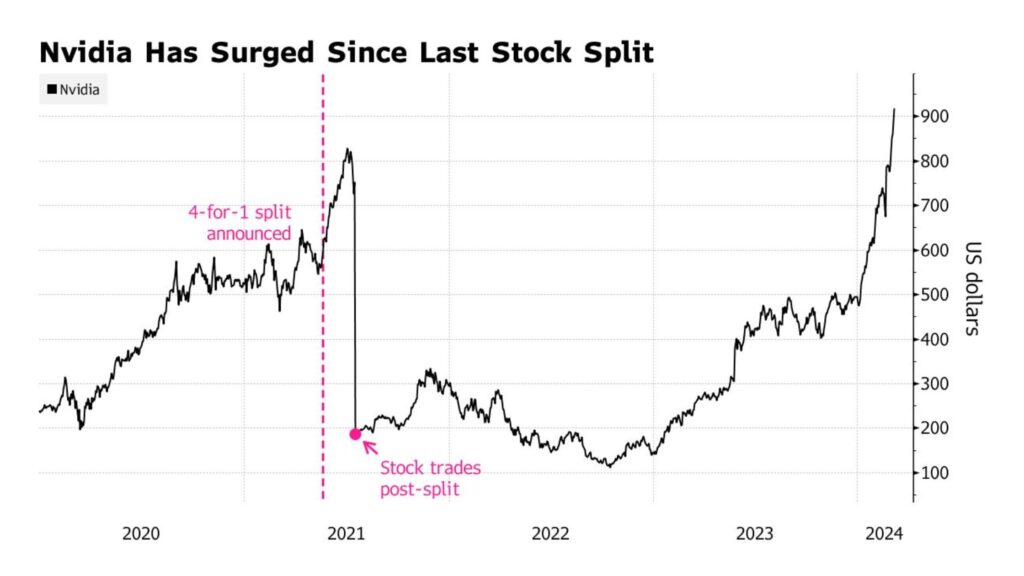
Before the massive 2024 split, the most significant recent action was the 4-for-1 split on July 20, 2021. At this time, Nvidia was transitioning from being a “gaming company” to a “data center and AI company.” The 2021 split was a signal to the market that management expected sustained, high-level growth. Investors who held shares through the 2021 and 2024 splits have seen their total share count increase by a factor of 40 in just three years, showcasing the power of share multiplication in a high-growth environment.
The Financial Rationale Behind Stock Splits for High-Growth Corporations
From a balance sheet perspective, a stock split is a neutral event. The company’s assets, liabilities, and total market capitalization remain unchanged. However, from a strategic finance perspective, splits are powerful tools used by boards of directors to manage the “marketability” of their equity.
Lowering the Barrier to Entry for Retail Investors
While institutional investors—like hedge funds and mutual funds—deal in millions of dollars and are indifferent to share price, retail investors often view price through a different lens. A high share price can discourage small-scale participation. By splitting the stock, Nvidia ensures that its shares remain “tradable” for the average person. This democratizes ownership and can lead to a more diverse and stable shareholder base, which is less prone to the massive swings sometimes caused by institutional exits.
Psychological Pricing and Market Sentiment
There is a profound psychological component to investing. Investors often perceive a $100 stock as having more “room to grow” than a $1,000 stock, even if the valuation (Price-to-Earnings ratio) is identical. Furthermore, a stock split is often interpreted by the market as a “signal of confidence.” A board of directors rarely authorizes a split unless they believe the share price will continue to rise. Historically, companies that announce splits tend to outperform the S&P 500 in the twelve months following the announcement, largely due to this positive sentiment and the underlying growth that necessitated the split in the first place.
Investment Strategies: How to Approach Nvidia Post-Split
For those looking at Nvidia through the lens of personal finance and wealth building, the timing of a stock split offers several strategic considerations.
Valuation vs. Share Price: Avoiding the “Cheap” Stock Fallacy
The most important lesson for any investor is that a lower share price does not mean the stock is “cheaper” in terms of value. After the 2024 split, an investor might be tempted to think Nvidia is a bargain at $120 compared to $1,200. However, the investor must still evaluate the Price-to-Earnings (P/E) ratio and the Price-to-Sales (P/S) ratio. If the company’s earnings growth doesn’t keep pace with its valuation, the stock could still be “expensive” even at a lower nominal price. Disciplined investing requires looking past the unit price and focusing on the total market cap relative to future cash flows.
Dividend Adjustments and Long-Term Portfolio Growth
Following the 2024 split, Nvidia also announced an increase in its quarterly cash dividend by 150%, from $0.04 per share to $0.10 per share (pre-split). On a post-split basis, this resulted in a dividend of $0.01 per share. While Nvidia is not primarily a dividend play—its yield remains low because most capital is reinvested into R&D—the increase alongside the split demonstrates a commitment to returning value to shareholders. For long-term investors, the combination of share multiplication through splits and incremental dividend growth can significantly accelerate the “snowball effect” of a portfolio.
Future Outlook: Will Nvidia Split Again?
Given Nvidia’s dominant position in the AI infrastructure market, many analysts are already speculating on the possibility of future splits. The answer lies in the company’s ability to maintain its breakneck growth pace.
Tracking Earnings Growth and Market Capitalization
If Nvidia continues to beat earnings expectations and its share price eventually climbs back toward the high hundreds or low thousands, another split becomes almost inevitable. The company’s financial strategy appears to favor keeping the stock accessible. Investors should monitor the company’s quarterly revenue from its Data Center division, as this is currently the primary engine driving the share price toward potential future split thresholds.

The Role of AI in Sustaining Share Price Momentum
The financial health of Nvidia is currently tethered to the global build-out of artificial intelligence. As long as tech giants continue to invest billions into AI training and inference, Nvidia’s cash flow remains robust. From a money-management perspective, the “when” of the next stock split is less important than the “why.” As long as the split is driven by fundamental earnings growth rather than speculative fervor, it remains a positive indicator of a healthy, appreciating asset.
In conclusion, Nvidia’s history of stock splits is a map of its journey from a niche hardware maker to a global financial titan. For the investor, these splits are more than just changes in a ledger; they are opportunities to reassess position sizing and participate in the growth of a company that has fundamentally changed the landscape of modern finance and technology. Regardless of the nominal price, the focus should always remain on the company’s intrinsic value and its role in a diversified financial plan.
aViewFromTheCave is a participant in the Amazon Services LLC Associates Program, an affiliate advertising program designed to provide a means for sites to earn advertising fees by advertising and linking to Amazon.com. Amazon, the Amazon logo, AmazonSupply, and the AmazonSupply logo are trademarks of Amazon.com, Inc. or its affiliates. As an Amazon Associate we earn affiliate commissions from qualifying purchases.