
The story of Apple Inc. is synonymous with innovation, design, and disruption. Yet, before it became a household name and a global titan, commanding trillion-dollar valuations, Apple was a fledgling company founded in a garage. Its journey from a private startup to one of the world’s most valuable public companies is a testament to vision, resilience, and the power of the financial markets. The precise moment Apple invited the public to participate in its groundbreaking venture — when Apple stock went public — marked a pivotal turning point, not just for the company, but for the burgeoning technology industry and the landscape of investing itself.
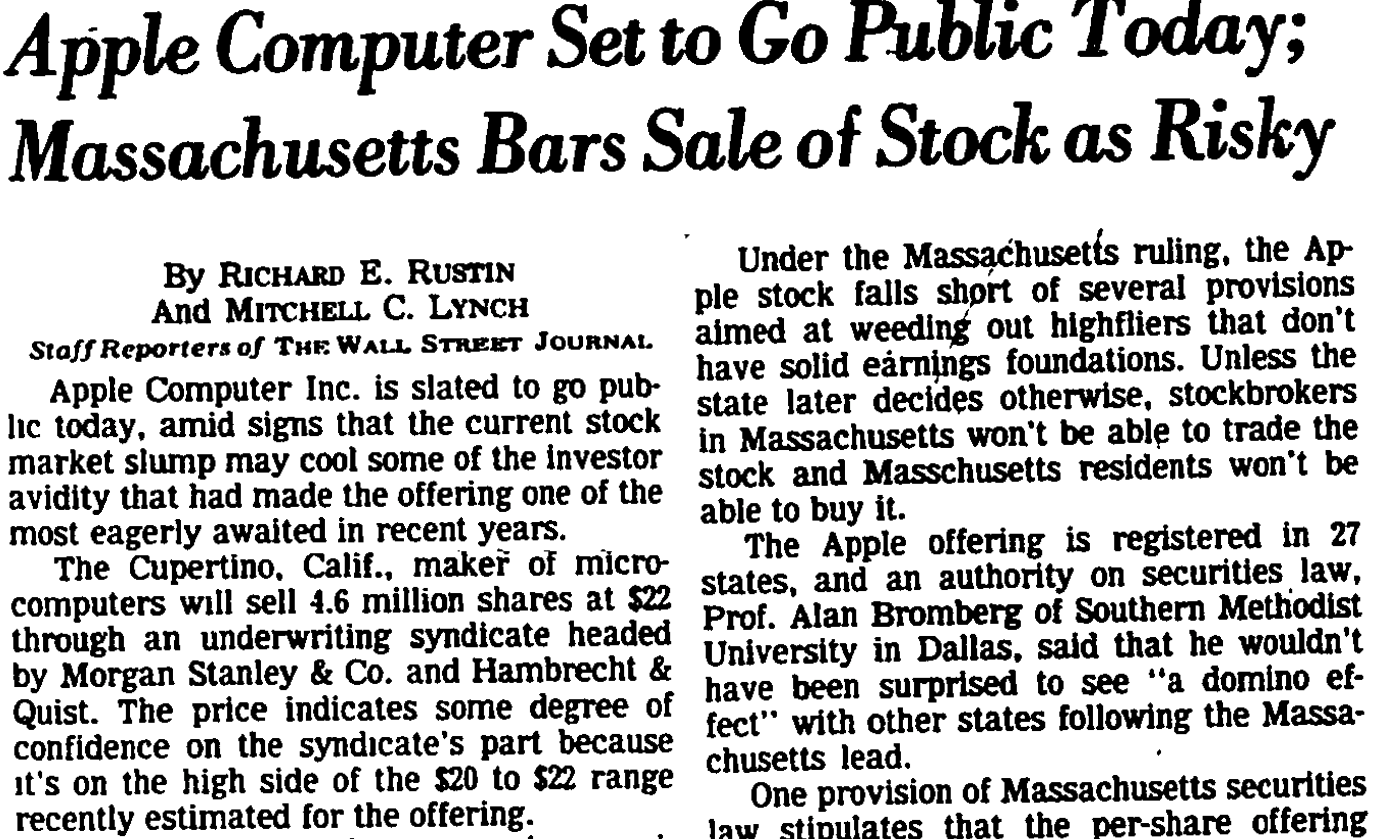
On December 12, 1980, Apple Computer, Inc. made its debut on the stock market. This date, etched into financial history, saw the company offer 4.6 million shares to the public at an initial price of $22 per share. The event was met with overwhelming enthusiasm, instantly creating more millionaires than any IPO since Ford Motor Company in 1956, and forever changing the financial trajectory of its founders, early employees, and eager investors. This initial public offering (IPO) was more than just a transaction; it was the formal declaration of a new era, opening the floodgates for public investment in technology companies and setting the stage for one of the most remarkable growth stories in corporate history.
The Dawn of a Tech Titan: Apple’s Historic IPO
The decision to go public is a monumental step for any company, signaling a shift from private ownership to a more transparent, publicly accountable entity. For Apple, founded by Steve Jobs, Steve Wozniak, and Ronald Wayne, the IPO in 1980 was the culmination of years of audacious innovation and rapid growth.
Setting the Stage: The Pre-IPO Landscape
Apple’s origins trace back to 1976, born from the creative synergy of Jobs and Wozniak. Their early products, the Apple I and Apple II, were revolutionary. The Apple I, hand-built by Wozniak, was one of the first personal computers with a single-circuit board. It was the Apple II, however, launched in 1977, that truly put the company on the map. With its user-friendly design, color graphics capabilities, and expandable architecture, the Apple II became a commercial success, transforming personal computing from a hobbyist pursuit into a mainstream phenomenon.
By the late 1970s, Apple was experiencing exponential growth. Sales were skyrocketing, and the company quickly outgrew its garage beginnings. This rapid expansion necessitated significant capital investment for research and development, manufacturing, marketing, and global distribution. While venture capital could provide some funding, the scale of Apple’s ambition — and the capital required to achieve it — pointed towards the public markets. The company needed a substantial infusion of cash to compete with established giants and to fund its next wave of innovations, including the ambitious Macintosh project. The market itself was ripe for such an offering; investors were beginning to recognize the immense potential of the burgeoning personal computer industry, though many still viewed it with a mix of excitement and skepticism.
The IPO Event: December 12, 1980
The eagerly anticipated IPO took place on December 12, 1980. Apple offered 4.6 million shares at $22 each, underwritten by a syndicate led by Hambrecht & Quist and Salomon Brothers. The demand for Apple shares was unprecedented. The offering was significantly oversubscribed, meaning investors wanted to buy far more shares than were available. This fervent interest pushed the stock price up immediately, closing at $29 per share on its first day of trading, an impressive 31.8% jump.
This single event instantaneously created approximately 300 millionaires, many of whom were early employees who had received stock options as part of their compensation packages. Steve Jobs, still in his mid-twenties, saw his net worth soar to over $200 million. Steve Wozniak also became a multi-millionaire, as did numerous engineers, sales staff, and executives who had believed in Apple’s vision from its nascent stages. The IPO not only solidified Apple’s financial standing but also dramatically underscored the wealth-generating potential of the technology sector, paving the way for countless future tech startups to pursue similar public offerings.
A Financial Phenomenon: Impact and Growth Post-IPO
Going public provided Apple with much more than just a capital injection; it granted the company legitimacy, enhanced its public profile, and provided a liquid market for its shares, which became a powerful tool for attracting and retaining talent.
Fueling Innovation: How IPO Capital Powered Apple
The substantial capital raised from the IPO was instrumental in fueling Apple’s ambitious research and development initiatives. A significant portion went towards the development of the Macintosh computer, a project that Steve Jobs passionately championed. The Macintosh, with its graphical user interface (GUI) and mouse, introduced in 1984, was revolutionary. While initially not a commercial runaway success, it laid the groundwork for modern computing and established Apple’s reputation for user-friendly design and innovation.
The IPO funds also enabled Apple to expand its manufacturing capabilities, build a robust distribution network, and invest heavily in marketing and advertising, exemplified by the iconic “1984” Super Bowl commercial. Furthermore, being a public company allowed Apple to offer attractive stock options, which were crucial in recruiting top-tier engineers, designers, and business leaders in a highly competitive Silicon Valley environment. The ability to raise capital from public markets at scale meant Apple could think bigger, take more risks, and pursue grander visions than would have been possible as a privately held entity.
Navigating Market Volatility: Ups and Downs
Apple’s journey as a public company was far from a smooth, upward trajectory. The period following the IPO was marked by significant successes but also intense struggles. The initial excitement surrounding the Macintosh eventually gave way to internal strife and market challenges, leading to Steve Jobs’ departure from the company in 1985. The late 1980s and 1990s saw Apple struggle with market share, intense competition from Microsoft and IBM, and a fragmented product strategy. Its stock price, reflecting these challenges, experienced significant volatility, testing the patience of many investors.

The company teetered on the brink of bankruptcy in the late 1990s. However, the dramatic return of Steve Jobs in 1997, along with a strategic investment from Microsoft and a renewed focus on core products, began a remarkable turnaround. This era ushered in a series of iconic products: the iMac (1998), iPod (2001), iTunes Store (2003), and ultimately the iPhone (2007). Each of these innovations not only revitalized Apple’s brand but also fundamentally reshaped entire industries, leading to an unprecedented period of financial growth and market dominance. This period demonstrated the resilience of Apple’s underlying innovation engine and its ability to redefine markets, rewarding patient investors handsomely.
The Long-Term Investor’s Dream: Apple’s Enduring Value
For those who invested in Apple at its IPO and held onto their shares through its tumultuous journey, the returns have been nothing short of extraordinary. Apple stands as a powerful case study for the long-term compounding effect of holding shares in a truly disruptive company.
From IPO to Trillion-Dollar Valuation
If an investor had purchased just one share of Apple stock at its IPO price of $22 in December 1980 and held onto it, their investment would have grown exponentially. Through several stock splits over the years – a 2-for-1 split in 1987, 2-for-1 in 2000, 2-for-1 in 2005, a 7-for-1 split in 2014, and a 4-for-1 split in 2020 – that single original share would have multiplied significantly. For example, the 2020 4-for-1 split meant that for every share an investor owned, they received three additional shares, reducing the price per share but increasing the total number of shares held.
Factoring in all these splits, that original single share would have become 224 shares by 2020. At Apple’s peak stock prices in recent years, the value of that initial $22 investment would have been worth hundreds of thousands of dollars, representing an astounding return on investment.
Apple was the first publicly traded U.S. company to achieve a $1 trillion market capitalization in August 2018, then the first to hit $2 trillion in August 2020, and later the first to touch $3 trillion in January 2022. These milestones are not just symbolic; they reflect the immense financial success and investor confidence in Apple’s business model, its ability to generate massive profits, and its continued innovation.
Lessons for Modern Investors
Apple’s trajectory offers profound lessons for modern investors:
-
The Power of Long-Term Investing: Short-term market fluctuations can be disorienting, but investing in fundamentally strong companies with a long-term horizon can yield incredible results.
-
Identifying Disruptive Innovation: Apple consistently disrupted existing markets and created new ones. Investors who can identify companies with truly innovative and transformative potential are often rewarded.
-
Resilience through Adversity: Apple faced near-catastrophic challenges. Its ability to reinvent itself and overcome adversity highlights the importance of strong leadership and a resilient business model.
-
The Compounding Effect of Reinvestment: While Apple only started paying dividends relatively recently (reinstating them in 2012), the growth in its stock price over decades exemplifies the power of compounding.
Beyond the Balance Sheet: Apple’s Financial and Cultural Legacy
Apple’s IPO and subsequent financial success have had far-reaching implications, extending beyond its own balance sheet to influence the broader economy and the financial strategies of other tech companies.
The Ecosystem of Wealth: Beyond Stock Price
Apple’s financial success has created an enormous ecosystem of wealth. This includes not only its shareholders but also countless suppliers, logistics partners, and the millions of developers who create apps for its iOS platform. The app economy alone, built on the foundation of Apple’s devices, generates billions of dollars annually, providing livelihoods and fostering innovation for a vast network of businesses and individuals globally.
Furthermore, Apple’s massive cash reserves and consistent profitability have allowed it to engage in significant capital return programs, including share buybacks and quarterly dividends. These actions benefit shareholders directly, providing consistent income and often boosting the stock price by reducing the number of outstanding shares. This strategy reflects Apple’s maturity as a public company, moving beyond pure growth to also provide stable returns to its long-term investors.

A Blueprint for Tech IPOs
Apple’s highly successful IPO in 1980 set a powerful precedent for future technology companies. It demonstrated to investors and entrepreneurs alike that public markets could be a viable and lucrative avenue for funding rapid growth in the tech sector. The enthusiasm for Apple’s shares undoubtedly influenced the successful public offerings of other tech giants that followed, such as Microsoft, Amazon, Google, Meta (Facebook), and countless others.
The “tech IPO” became a phenomenon, characterized by high growth potential, often significant initial share price volatility, and the promise of transformative innovation. While not every tech IPO replicates Apple’s enduring success, the blueprint laid down in 1980 continues to shape how Silicon Valley startups dream of scaling their operations and how venture capitalists plan their exit strategies.
The day Apple stock went public, December 12, 1980, was not merely a date on a calendar; it was a pivotal moment in financial history. It marked the formal entry of a company that would redefine personal technology and, in doing so, create unprecedented shareholder value. Apple’s journey from a $22-a-share offering to a multi-trillion-dollar valuation stands as an unparalleled example of the transformative power of innovation, strategic financial management, and the enduring potential of public markets to foster immense wealth creation. For investors, it remains a powerful reminder of the rewards that await those who invest wisely, patiently, and in companies that truly change the world.
aViewFromTheCave is a participant in the Amazon Services LLC Associates Program, an affiliate advertising program designed to provide a means for sites to earn advertising fees by advertising and linking to Amazon.com. Amazon, the Amazon logo, AmazonSupply, and the AmazonSupply logo are trademarks of Amazon.com, Inc. or its affiliates. As an Amazon Associate we earn affiliate commissions from qualifying purchases.