
For investors, both seasoned and novice, understanding the mechanics of a company’s stock is crucial. Among the various corporate actions that can influence a stock’s dynamics, a stock split stands out as a significant event, often signaling management’s confidence and a desire to make shares more accessible. Few companies exemplify this phenomenon with as much market impact and investor interest as Apple Inc. (AAPL). With a history punctuated by several strategic stock splits, Apple’s journey provides a compelling case study for anyone navigating the world of investing. This article will unravel the specific dates of Apple’s stock splits, explain the underlying rationale, and explore the broader implications for investors and the market.
Understanding Stock Splits: The Mechanics and Motivation
Before diving into Apple’s specific timeline, it’s essential to grasp what a stock split entails and why companies undertake such actions. While seemingly complex, the core concept is quite straightforward and driven by clear strategic objectives related to market perception and investor accessibility.
What is a Stock Split?
A stock split is a corporate action in which a company increases the number of its outstanding shares by dividing each existing share into multiple new shares. Crucially, while the number of shares increases, the total market value of the company remains unchanged. Instead, the price per share is proportionally reduced. For example, in a 2-for-1 stock split, a shareholder who previously owned 100 shares at $200 each ($20,000 total value) would now own 200 shares at $100 each, maintaining the same total investment value. Similarly, a 4-for-1 split would quadruple the number of shares and divide the price by four.
This is a purely accounting adjustment. The underlying fundamental value of the company – its assets, liabilities, earnings, and future prospects – does not change an iota because of a split. It’s akin to taking a pizza and cutting it into more slices; the total amount of pizza remains the same, just the individual slices are smaller.
Why Do Companies Split Their Stock?
Companies typically initiate stock splits for a few key reasons, all aimed at enhancing market dynamics and investor appeal:
-
Improving Stock Accessibility: When a stock’s price rises significantly over time, it can become prohibitively expensive for individual retail investors, particularly those with smaller portfolios. A high share price might deter new investors who can’t afford a full share or who prefer to buy in round lots (multiples of 100 shares). By reducing the per-share price, a split makes the stock more affordable and accessible, opening it up to a broader base of potential shareholders.
-
Increasing Liquidity: With more shares outstanding and a lower per-share price, the stock often experiences higher trading volume and liquidity. Increased liquidity means it’s easier to buy and sell shares without significantly impacting the share price, which can be attractive to both institutional and individual investors.
-
Sending a Positive Signal: A stock split is often perceived by the market as a sign of management’s confidence in the company’s future growth and sustained profitability. Companies typically split their stock after a period of significant price appreciation, suggesting that the business has performed exceptionally well. This positive signal can generate renewed interest and optimism among investors.
-
Psychological Appeal: There’s a psychological element at play where investors might perceive a lower-priced stock as “cheaper” or having more room to grow, even if its intrinsic value hasn’t changed. Owning more shares, even if each is worth less, can also provide a sense of greater ownership or control.
Impact on Shareholders
For existing shareholders, a stock split is generally a non-event in terms of their total investment value. They own more shares, but each share is proportionally worth less. However, the indirect impacts can be beneficial due to increased liquidity, potential for broader investor interest, and the positive signal a split sends about the company’s health. For options traders, split-adjusted contracts ensure their positions remain equivalent in value and share count.
Apple’s Stock Split History: A Timeline of Growth
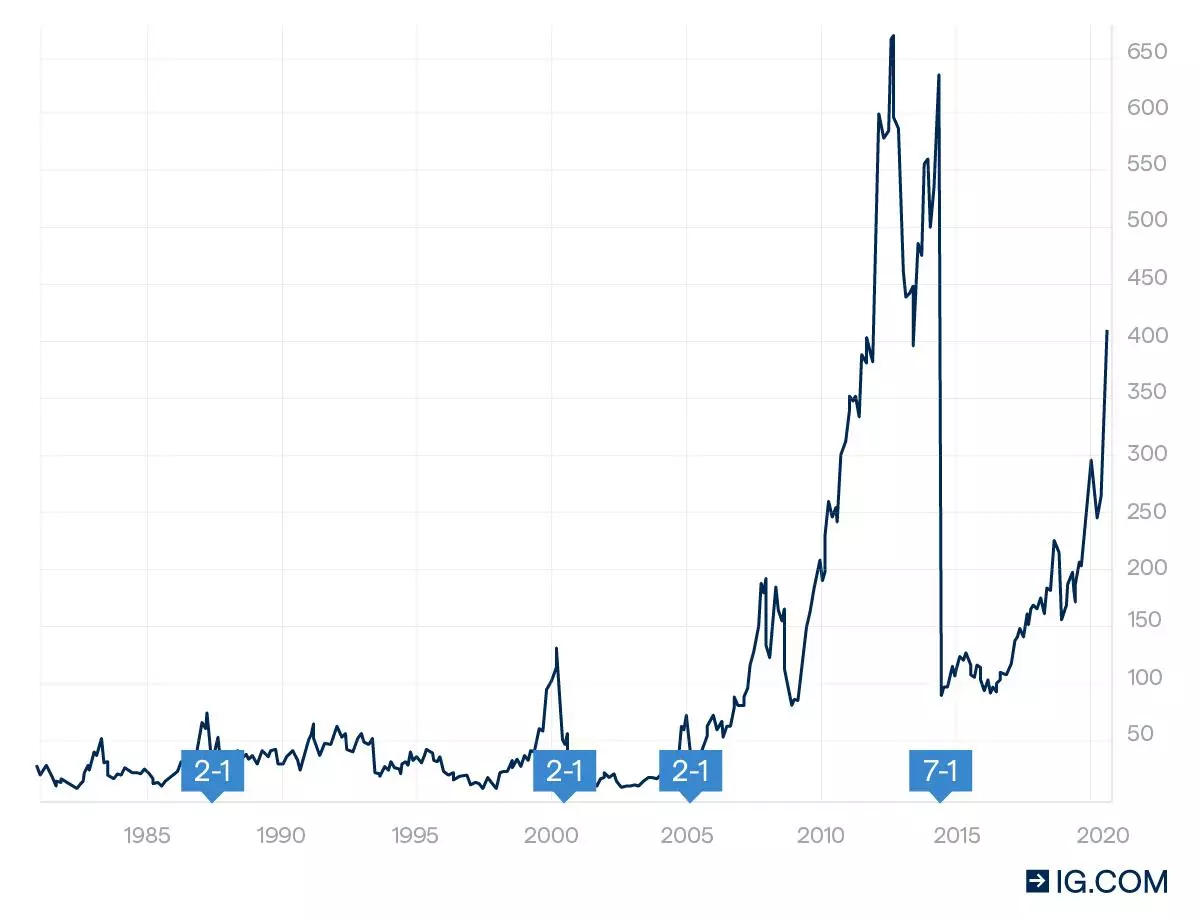
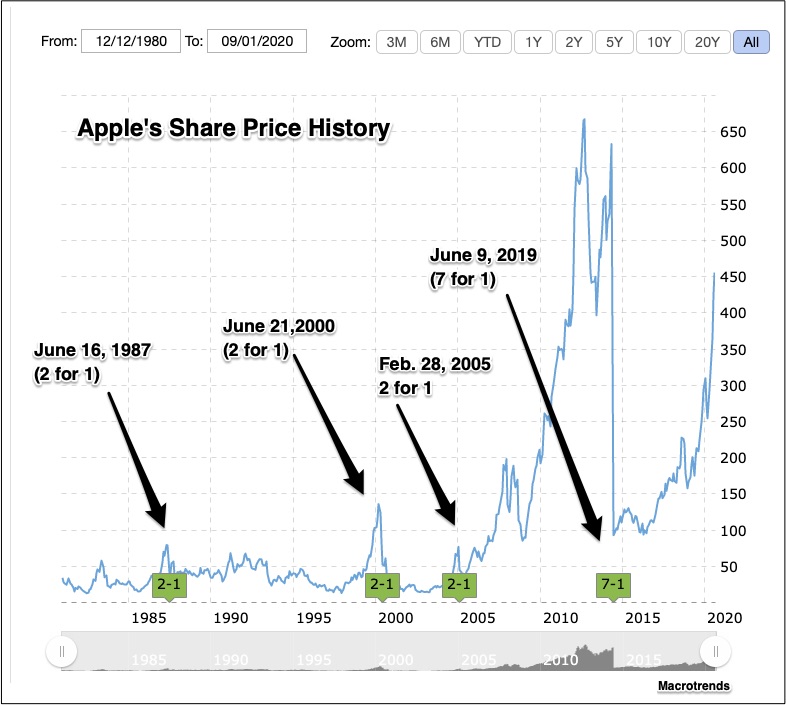
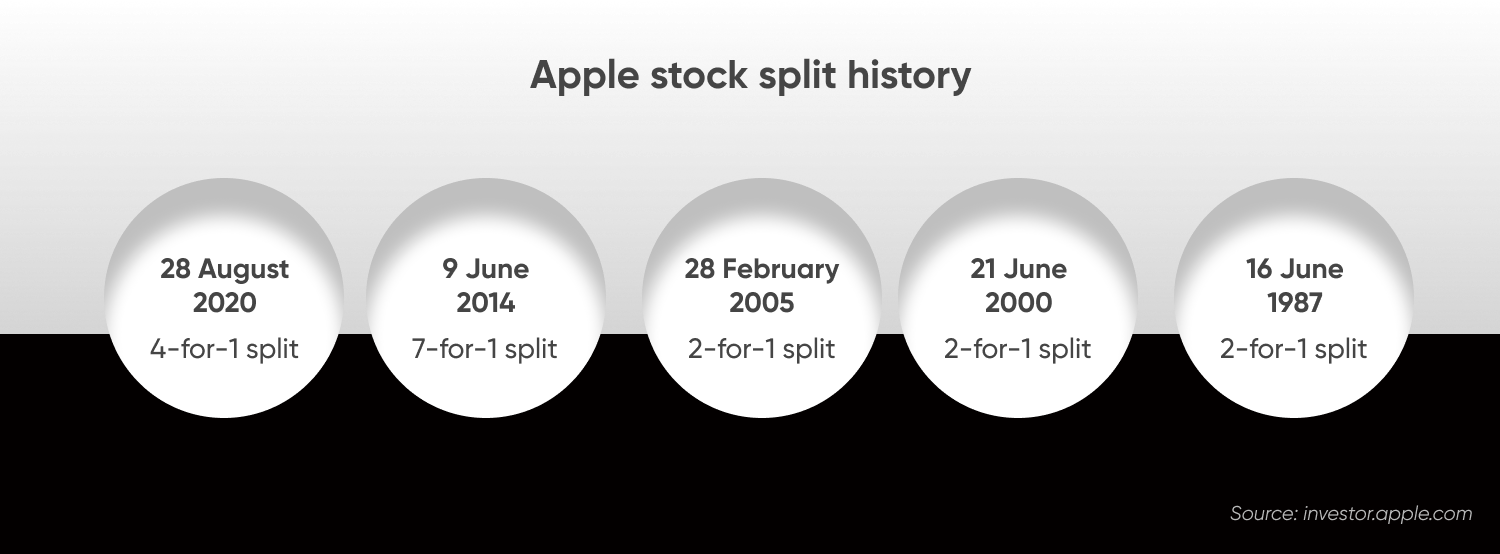
Apple Inc. has a storied history marked by periods of immense innovation, market dominance, and, consequently, significant stock price appreciation. This growth has led the company to execute five stock splits since its initial public offering (IPO) in December 1980, each reflecting a specific phase in its corporate journey.
The Early Splits (2-for-1 Splits)
Apple’s first three stock splits were all 2-for-1, occurring at different points as the company matured and its stock value climbed. These early splits were indicative of Apple’s steady growth and increasing prominence in the technology landscape, particularly through the era of personal computing.
-
June 16, 1987 (2-for-1): This was Apple’s first stock split, taking place just seven years after its IPO. It reflected the company’s early success with Macintosh computers and its growing market presence. At this point, the shares had appreciated considerably since their debut, making a split a logical step to maintain accessibility.
-
June 21, 2000 (2-for-1): The second split occurred during a turbulent period for Apple, just prior to the dot-com bubble burst. However, it also came after Steve Jobs’ return to the company and the initial successes of products like the iMac. Despite challenges, the stock had still reached a point where a split was deemed appropriate.
-
February 28, 2005 (2-for-1): This third split was a testament to Apple’s resurgence, driven largely by the phenomenal success of the iPod and the impending anticipation of transformative products like the iPhone. The company was on an upward trajectory, and its stock price reflected this renewed investor confidence.
The Game-Changing 7-for-1 Split (2014)
Perhaps the most impactful of Apple’s splits, due to its sheer magnitude and the context in which it occurred, was the 7-for-1 split.
- June 9, 2014 (7-for-1): This was a landmark event. By 2014, Apple’s share price had soared, trading around $600 per share (pre-split). The iPhone and iPad had cemented Apple’s position as a global technology leader, and the company was generating massive profits. A 7-for-1 split dramatically lowered the per-share price, making it significantly more accessible to a wider range of investors, particularly those new to the market. This split was also seen as a move to potentially increase Apple’s weighting or make it more appealing for inclusion in certain indexes like the Dow Jones Industrial Average, which is price-weighted.
The Recent 4-for-1 Split (2020)
Even after the 2014 split, Apple’s unparalleled growth continued, driven by its robust ecosystem, services expansion, and consistent innovation. This necessitated another split just six years later.
- August 31, 2020 (4-for-1): By August 2020, Apple’s stock price had once again surged, reaching over $500 per share (pre-split) on an adjusted basis from the 2014 split. The company had become the world’s most valuable public company, captivating investors with its resilience during the pandemic and its strong financial performance. The 4-for-1 split, executed in conjunction with other tech giants like Tesla also splitting their stock, aimed to maintain accessibility for retail investors and continue to foster liquidity, particularly during a period of heightened market interest in technology stocks.
The Rationale Behind Apple’s Splits
Each of Apple’s stock splits, while sharing common objectives, also had specific nuances dictated by the company’s market position and strategic goals at the time. However, the overarching themes remained consistent: making shares more attractive and liquid.
Enhancing Accessibility and Liquidity
Apple’s stock has consistently been a high-performer, leading to a steadily climbing share price. Without splits, the cost of a single share could easily run into thousands of dollars, effectively pricing out many individual investors. By reducing the per-share price, Apple ensures that its stock remains within reach for a broader demographic, encouraging participation and potentially increasing the investor base. This increased accessibility, in turn, often leads to higher trading volumes and improved market liquidity, which benefits all shareholders.
Attracting Retail Investors
Retail investors, who often have smaller capital pools than institutional investors, are particularly sensitive to share price. A stock trading at $100 per share is psychologically more appealing than one at $700, even if the underlying company value is the same. Apple, with its globally recognized brand and highly popular products, has a strong appeal to individual consumers. By making its stock affordable, Apple converts some of its vast customer base into shareholders, fostering a deeper connection between the company and its users.
Managing Share Price Perception
There’s a prevailing perception that “cheaper” stocks have more room to grow. While fundamentally untrue in terms of percentage gains, this psychological aspect plays a role in attracting certain investors. A split helps manage this perception, preventing the stock from appearing “overpriced” purely based on its nominal share value, thus maintaining a positive image in the minds of potential buyers. For a company as high-profile as Apple, managing public perception is an ongoing strategic consideration.
The Investment Implications of Apple’s Stock Splits
While a stock split does not alter the fundamental value of a company, it carries several practical and psychological implications for investors and market dynamics. Understanding these can help investors interpret future corporate actions and manage their portfolios effectively.
No Change in Fundamental Value
The most crucial takeaway is that a stock split, by itself, does not change the intrinsic value of your investment. If you owned $10,000 worth of Apple stock before a split, you still owned $10,000 worth afterward. The company’s earnings, revenue, assets, and liabilities remain precisely the same. Therefore, investors should not view a split as a reason to buy or sell a stock purely based on the corporate action itself. Investment decisions should always be based on the company’s underlying business fundamentals, growth prospects, and valuation.
Psychological Impact and Market Perception
Despite the lack of fundamental change, the psychological impact of a stock split can be significant.
-
Perceived Affordability: A lower share price makes the stock seem more “affordable” and accessible to smaller investors, potentially leading to increased demand and trading volume.
-
Positive Sentiment: Splits are often interpreted as a vote of confidence from management, signaling past success and anticipated future growth. This can generate positive market sentiment, sometimes leading to short-term price bumps, although these are rarely sustained if not backed by strong financial performance.
-
Analyst Adjustments: While analysts adjust their price targets to reflect the new share count, the overall valuation metrics (like P/E ratio) remain consistent. However, the sheer volume of reports and discussion around a split can bring renewed attention to the company.
Dividend Adjustments
For dividend-paying stocks like Apple, any declared dividends are also adjusted proportionally after a split. For example, if Apple paid a $0.25 quarterly dividend per share before a 4-for-1 split, it would likely adjust that to $0.0625 per share after the split, ensuring that the total dividend income for a shareholder remains the same ($0.25 * 1 share = $0.25; $0.0625 * 4 shares = $0.25). This ensures investors receive the same total payout, just distributed across more shares.
Implications for Index Inclusion (e.g., Dow Jones)
For price-weighted indices like the Dow Jones Industrial Average (DJIA), a stock split can have significant implications. The DJIA’s value is determined by summing the prices of its 30 component stocks and dividing by a factor. A high-priced stock like Apple, before its splits, would have had a disproportionately large impact on the index’s movement. By splitting its stock and reducing its price, Apple’s influence within the Dow becomes more proportionate, making it a more suitable candidate for inclusion or maintaining its existing position without skewing the index. This was a notable consideration for the 2014 7-for-1 split, as Apple subsequently joined the DJIA in 2015.
Beyond the Split: Apple’s Enduring Investment Appeal
While stock splits are interesting corporate actions, they are merely footnotes in Apple’s broader investment narrative. The true drivers of Apple’s sustained success and investment appeal lie in its fundamental strengths and strategic vision.
Innovation and Market Dominance
Apple’s consistent innovation, from the Mac to the iPod, iPhone, iPad, Apple Watch, and its expanding services ecosystem, has been the bedrock of its growth. The company’s ability to create highly desirable products, command premium pricing, and cultivate a fiercely loyal customer base has allowed it to maintain strong market positions across multiple segments. Its robust R&D, coupled with a focus on user experience and seamless integration across devices, ensures a powerful ecosystem that encourages customer retention and new acquisitions.
Financial Health and Capital Returns
Apple is renowned for its exceptional financial health, boasting massive cash reserves and consistent profitability. This financial strength enables significant investments in future technologies, strategic acquisitions, and substantial capital return programs for shareholders. The company regularly engages in share buybacks, which reduce the number of outstanding shares and boost earnings per share, and also pays a growing dividend, further enhancing its attractiveness to long-term investors.
Long-Term Investor Perspective
For those looking at Apple as a long-term investment, the splits represent milestones in a journey of immense value creation. They reflect moments when the company’s growth necessitated an adjustment to its share structure to maintain accessibility and liquidity. Smart investors understand that while splits can generate short-term buzz, the real value in Apple (or any company) comes from its enduring business model, strategic execution, and ability to generate free cash flow over decades. Apple’s history of splits is a fascinating chapter, but it’s the continuous innovation and financial prowess that truly underpin its status as a cornerstone of many investment portfolios.
aViewFromTheCave is a participant in the Amazon Services LLC Associates Program, an affiliate advertising program designed to provide a means for sites to earn advertising fees by advertising and linking to Amazon.com. Amazon, the Amazon logo, AmazonSupply, and the AmazonSupply logo are trademarks of Amazon.com, Inc. or its affiliates. As an Amazon Associate we earn affiliate commissions from qualifying purchases.