
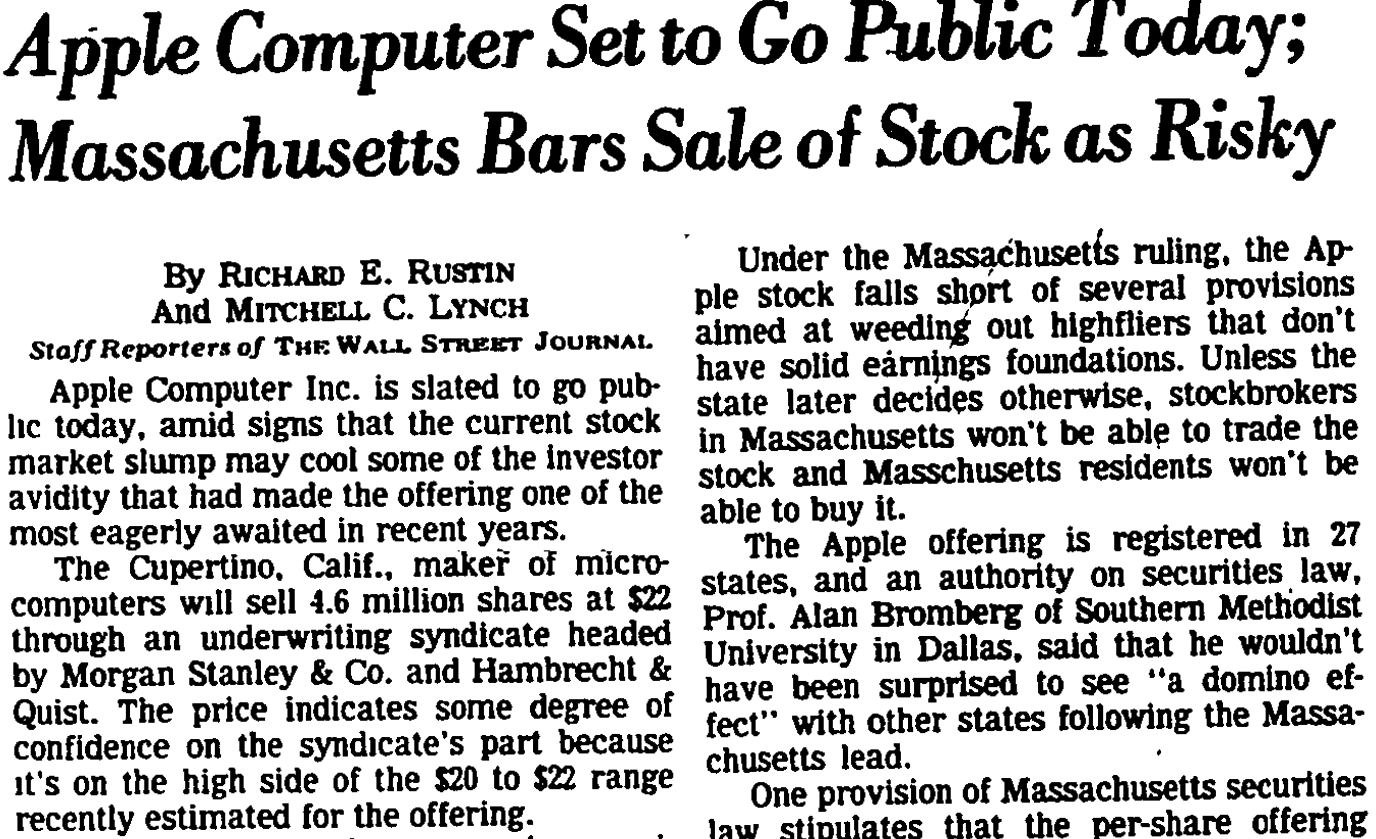
On December 12, 1980, a young technology company based in Cupertino, California, fundamentally altered the landscape of the American stock market. When Apple Computer Inc. went public, it wasn’t just a milestone for the personal computing industry; it was a watershed moment for high-growth investing. The initial public offering (IPO) of Apple remains one of the most significant financial events of the 20th century, serving as a blueprint for how a venture-backed startup can transform into a global financial powerhouse.
For the modern investor, understanding Apple’s journey from its 1980 debut to its current status as a cornerstone of the S&P 500 offers invaluable lessons in valuation, market cycles, and the power of long-term compounding. This article explores the financial mechanics of Apple’s public debut, its subsequent growth through the lens of capital markets, and what its trajectory reveals about wealth creation in the digital age.

The Historic Debut: December 12, 1980
The transition from a private entity to a publicly traded corporation is a complex financial maneuver, and for Apple, the timing was both daring and opportunistic. In late 1980, the United States was grappling with high inflation and a sluggish economy, yet the appetite for innovation was reaching a fever pitch.
Setting the Stage: The 1980 Financial Climate
In the early 1980s, the investment landscape was dominated by industrial giants and energy companies. Technology, as a sector, was still in its infancy regarding public equity. When Apple filed its S-1 with the Securities and Exchange Commission (SEC), it sought to capitalize on the success of the Apple II, which had proven that personal computers were a viable consumer product.
The underwriting for the IPO was led by Morgan Stanley and Hambrecht & Quist. At the time, Hambrecht & Quist was a boutique firm specializing in high-tech startups, while Morgan Stanley provided the institutional “blue chip” credibility. This partnership signaled to Wall Street that Apple was not just a hobbyist’s experiment but a serious contender for institutional portfolios.
The Initial Public Offering Details
Apple went public at a price of $22.00 per share. On that Friday in December, the company offered 4.6 million shares to the public. The demand was so overwhelming that the stock sold out within minutes, and by the end of the trading day, the price had risen to $29.00.
This gave Apple a market capitalization of approximately $1.778 billion. To put this in perspective, the IPO created more millionaires (over 300) than any company since Ford Motor Company’s public debut in 1956. Steve Jobs, who held 7.5 million shares, saw his net worth soar to over $200 million in a single day. For the investment community, this was the moment “Silicon Valley” became a synonymous term for massive wealth generation.
Analyzing the Growth: Stock Splits and Valuation Milestones
For a “buy and hold” investor, the nominal IPO price of $22.00 is a misleading figure if one does not account for the series of stock splits that have occurred over the last four decades. Stock splits are a financial tool used by companies to keep their share prices accessible to retail investors and to increase liquidity.
The Power of Multipliers: A History of Stock Splits
Since 1980, Apple (AAPL) has undergone five stock splits. These events are crucial for understanding the modern valuation of an original IPO share:
- June 16, 1987: 2-for-1 split
- June 21, 2000: 2-for-1 split
- February 28, 2005: 2-for-1 split
- June 9, 2014: 7-for-1 split
- August 28, 2020: 4-for-1 split
Due to these splits, a single share purchased at the IPO in 1980 has effectively multiplied into 224 shares today. When you adjust the original $22.00 IPO price for these splits, the “split-adjusted” cost basis for an original investor is roughly $0.10 per share. This staggering multiplication is why Apple is often cited as the ultimate example of the “long game” in equity investing.
From Garage Startup to Market Cap Dominance
The financial trajectory of Apple wasn’t a straight line. The company faced a near-collapse in the late 1990s, with its stock price plummeting as it struggled for market share against Microsoft. However, the subsequent decades saw a series of fiscal triumphs that redefined the limits of market capitalization.
In August 2018, Apple became the first U.S. company to reach a $1 trillion market cap. It doubled that figure to $2 trillion in August 2020 and breached the $3 trillion mark in early 2022. These milestones are not just vanity metrics; they represent a fundamental shift in how the market values ecosystem-based businesses. Apple’s ability to generate massive free cash flow—often exceeding $100 billion annually—allows it to maintain a balance sheet that is, in many ways, stronger than some sovereign nations.
The Investor’s Perspective: What an Early Stake Would Be Worth Today
Calculating the Return on Investment (ROI) for Apple requires more than just looking at the share price increase. It involves examining the total shareholder return, which includes capital appreciation, dividends, and the impact of share buybacks.
Calculating the Adjusted Cost Basis
If an investor had the foresight to invest $1,000 at the IPO price of $22.00, they would have purchased approximately 45 shares. After the subsequent splits, those 45 shares would have expanded into 10,080 shares. At a hypothetical current market price of $190.00 per share, that initial $1,000 investment would be worth over $1.9 million today.
This calculation highlights the importance of “time in the market” over “timing the market.” While Apple’s stock has experienced significant volatility—dropping more than 50% on several occasions—the long-term trajectory has rewarded those who ignored the short-term noise and focused on the company’s underlying financial health.
Dividend Growth and Share Repurchase Programs
In the “Money” niche, cash flow is king. For many years after its IPO, Apple did not pay a dividend, opting instead to reinvest profits into R&D. However, in 2012, under the leadership of Tim Cook, the company initiated a massive capital return program.
Apple has since become one of the largest dividend payers in the world. Perhaps more significantly, the company has engaged in an aggressive share repurchase (buyback) program. By spending hundreds of billions of dollars to buy back its own stock, Apple reduces the total number of shares outstanding, which increases the earnings per share (EPS) for remaining investors. For a shareholder, this is a highly tax-efficient way to receive value, as it drives the stock price higher without triggering the immediate tax liabilities associated with dividends.
Lessons for Modern Investors from Apple’s Market Longevity
Apple’s performance since 1980 serves as a masterclass in corporate finance and portfolio management. It illustrates that the most successful investments are often those that can bridge the gap between “growth” and “value.”
The Importance of Resilience in a Portfolio
One of the key takeaways from Apple’s financial history is the concept of the “economic moat.” In investing, a moat is a competitive advantage that protects a company’s profit margins. Apple’s moat is its ecosystem—a combination of hardware, software, and services that creates high switching costs for users.
From a financial standpoint, this ecosystem provides predictable, recurring revenue. Investors value predictability. This is why Apple transitioned from being a cyclical hardware stock to a premium-valued “staple” of the tech world. For an investor, identifying companies with the potential to build such moats is the key to identifying the “next Apple,” though history suggests such entities are exceedingly rare.
Looking Ahead: AAPL as a Core Holding
Today, Apple is a “must-own” for many institutional investors and is a top holding in thousands of mutual funds and ETFs. Its inclusion in the Dow Jones Industrial Average and its heavy weighting in the Nasdaq-100 and S&P 500 mean that almost anyone with a 401(k) or a retirement account has exposure to Apple’s financial performance.
As we look toward the future, the company faces new challenges: regulatory scrutiny, global supply chain shifts, and the transition to spatial computing and AI. However, its history since going public in 1980 suggests a remarkable ability to pivot and optimize its financial structure. For the modern student of money and finance, the date of December 12, 1980, remains the starting line of a marathon that has redefined what is possible in the world of private wealth and public markets.
In conclusion, “when Apple went public” is more than just a trivia question for historians. It is the beginning of a financial narrative that encompasses the evolution of the tech sector, the mechanics of stock splits, and the compounding power of a well-executed business strategy. Whether you are a retail investor or a financial professional, the story of AAPL serves as a reminder that the greatest returns often go to those who can identify a world-changing idea and have the discipline to hold onto it through the decades.
aViewFromTheCave is a participant in the Amazon Services LLC Associates Program, an affiliate advertising program designed to provide a means for sites to earn advertising fees by advertising and linking to Amazon.com. Amazon, the Amazon logo, AmazonSupply, and the AmazonSupply logo are trademarks of Amazon.com, Inc. or its affiliates. As an Amazon Associate we earn affiliate commissions from qualifying purchases.