
When investors ask “What’s the price of the Dow Jones?” they are rarely looking for a single static number. Instead, they are seeking a pulse check on the health of the American economy. The Dow Jones Industrial Average (DJIA), often referred to simply as “the Dow,” is more than just a numerical value; it is a price-weighted index that tracks 30 large, publicly owned blue-chip companies trading on the New York Stock Exchange (NYSE) and the Nasdaq. Unlike other indices that might measure the total market capitalization, the price of the Dow is a unique mathematical derivative that has served as the primary barometer for the U.S. stock market for over a century.

To understand the current price and what it signifies, one must look beyond the flashing green or red numbers on a trading screen. The value of the Dow represents the collective momentum of the giants of industry—ranging from technology leaders like Microsoft and Apple to financial stalwarts like Goldman Sachs and retail titans like Walmart.
The Mechanics of the Dow: How the “Price” is Calculated
The most fundamental distinction between the Dow Jones and other major indices like the S&P 500 is its weighting system. While most modern indices are market-capitalization weighted—meaning larger companies have a proportionally larger impact on the index value based on their total market value—the Dow is price-weighted.
The Price-Weighting Methodology
In a price-weighted index, companies with a higher stock price per share exert more influence over the index’s daily fluctuations than those with lower share prices. For example, if a stock trading at $200 moves by 1%, it has a much greater impact on the Dow’s “price” than a stock trading at $50 moving by the same percentage. This methodology is a legacy of the late 19th century when Charles Dow first calculated the average by simply adding up the prices of the component stocks and dividing by the number of companies.
The Dow Divisor
Today, the calculation is significantly more complex due to the “Dow Divisor.” Because companies frequently undergo stock splits, spin-offs, or changes in their corporate structure, simply dividing by 30 would lead to massive, artificial jumps in the index price. To maintain continuity, the S&P Dow Jones Indices committee uses a continuously adjusted divisor. Currently, the divisor is a decimal much smaller than one. This means that a one-dollar move in any of the 30 component stocks translates into a multi-point move in the Dow’s overall price. This mathematical lever ensures that the index remains a historical continuum, allowing investors to compare the market’s health in 2024 to its standing in 1924 or 1984.
Selection Criteria for the “Price-Setters”
The companies that determine the price of the Dow are not chosen by a rigid formula, but by a committee. This committee looks for companies with an excellent reputation, sustained growth, and significant interest among a wide range of investors. Because there are only 30 slots, being added to the Dow is considered a mark of ultimate corporate prestige. When a company is “dropped” from the Dow, it often signals a shift in the broader economy—such as the transition from an industrial-heavy era to a technology and service-dominated landscape.
Factors That Drive the Dow Jones Price Movements
The price of the Dow Jones does not move in a vacuum. It is a reflection of global economic sentiment, domestic policy, and the specific performance of its 30 constituents. Investors tracking the price of the Dow must keep a keen eye on several overlapping factors that dictate its daily trajectory.
Macroeconomic Indicators and Federal Reserve Policy
The single largest driver of the Dow’s price in the modern era is the trajectory of interest rates. Because the Dow is comprised of “Blue Chip” companies with massive capital requirements and global footprints, their borrowing costs are sensitive to Federal Reserve decisions. When the Fed raises interest rates to combat inflation, the price of the Dow often faces downward pressure. Conversely, when the market anticipates a “pivot” toward lower rates, the Dow frequently rallies as investors price in lower cost of capital and higher consumer spending.
Corporate Earnings and Guidance
Every quarter, the 30 companies of the Dow release their earnings reports. Because the index is so concentrated, a single earnings miss by a heavyweight like UnitedHealth Group or Boeing can drag the entire index down, even if the other 29 companies are performing well. Professional investors look specifically at “guidance”—the company’s forecast for future quarters. If the giants of the Dow signal a slowdown in global demand, the “price” of the index will reflect that pessimism long before the actual economic data catches up.
Geopolitical Stability and Global Trade
The Dow is often called the “Industrial” average, and while it has shifted toward tech and finance, many of its members remain deeply tied to global logistics and manufacturing. Companies like Caterpillar, 3M, and Honeywell are sensitive to trade wars, tariffs, and supply chain disruptions. When geopolitical tensions rise in major manufacturing hubs or shipping lanes, the Dow’s price often acts as a volatility hedge, reacting sharply to the potential for increased operational costs.
Is the Dow’s Price Still Relevant for Today’s Investor?
Critics often argue that an index consisting of only 30 companies cannot possibly represent the complexity of the modern $50 trillion U.S. equity market. With the rise of the S&P 500 and the Nasdaq Composite, some question whether the price of the Dow is an antiquated metric. However, for the personal investor and the financial professional alike, the Dow remains an indispensable tool for several reasons.
A Measure of Quality Over Quantity
While the S&P 500 provides a broader look at the market, it includes many companies that are not yet profitable or are highly speculative. The Dow, by contrast, is a collection of “proven” entities. When the price of the Dow is rising, it signals that the “bedrock” of the American economy is solid. During times of market stress, investors often flock to the Dow as a “flight to quality,” seeking the dividends and stability that these 30 companies typically offer.
Psychological Milestones and Market Sentiment
The price of the Dow Jones holds a psychological power that no other index can match. “Dow 40,000” or “Dow 30,000” are headlines that resonate with the general public in a way that S&P 500 levels do not. These round-number milestones often trigger massive waves of retail buying or selling. The Dow is the index of record for the “Main Street” investor, and its price levels often dictate the consumer confidence that fuels 70% of the U.S. economy.
Sector Representation
The Dow has evolved to represent the modern economy. While its name still includes “Industrial,” it now encompasses healthcare (Amgen), technology (Salesforce), and consumer services (Disney). By tracking the Dow’s price, an investor is essentially tracking a curated portfolio of the most dominant players in every major sector. This makes it a highly efficient snapshot for those who do not have the time to monitor thousands of individual tickers.
Strategies for Investing in the Dow Jones
For most individual investors, the question isn’t just “What is the price?” but “How do I trade it?” You cannot buy shares of the index itself, as it is merely a mathematical calculation. However, there are several sophisticated financial tools designed to track the Dow’s price with near-perfect correlation.
Exchange-Traded Funds (ETFs)
The most popular way to invest in the Dow is through the SPDR Dow Jones Industrial Average ETF Trust, known by its ticker symbol DIA (often called “Diamonds”). When you buy a share of DIA, you are essentially buying a fractional piece of all 30 companies in the Dow, weighted in the exact same manner as the index. This provides an accessible entry point for retail investors to mirror the performance of the world’s most elite companies with a single transaction.
Index Funds and Mutual Funds
For long-term retirement planning, many 401(k) and IRA providers offer Dow Jones index funds. These are passively managed funds that aim to replicate the Dow’s returns. They are favored for their low expense ratios and the historical reliability of the blue-chip companies they hold. Because Dow companies are often consistent dividend payers, these funds are a staple for income-focused investors.
Derivatives: Options and Futures
For more advanced traders, the “price” of the Dow is a playground for hedging and speculation. Dow Futures (YM) allow traders to bet on the direction of the index before the stock market even opens. Options on the Dow allow investors to protect their portfolios against a market crash or to generate income through covered calls. These instruments are highly liquid, meaning the “price” of the Dow is being discovered and traded 24 hours a day in the global financial markets.

The Long-Term Outlook: Why the Price Matters
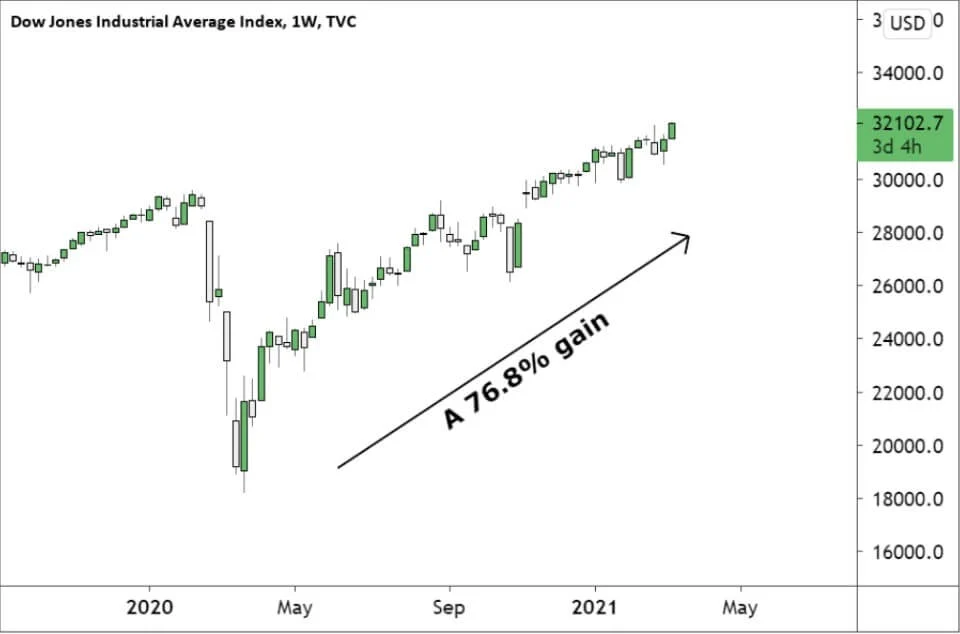
Ultimately, the price of the Dow Jones is a reflection of the enduring nature of American capitalism. While the constituents change—companies like Sears and General Electric have been replaced by the likes of Amazon and Nvidia—the index continues to march upward over the long term.
For the disciplined investor, the daily “price” of the Dow is less important than its decade-over-decade trajectory. Historically, the Dow has survived world wars, depressions, and pandemics, consistently recovering to reach new all-time highs. Understanding how its price is calculated and what factors move it allows investors to cut through the noise of daily volatility and focus on the fundamental strength of the world’s leading corporations. Whether the Dow is at 10,000 or 100,000, its value lies in its ability to tell the story of where the economy has been and where it is likely headed.
aViewFromTheCave is a participant in the Amazon Services LLC Associates Program, an affiliate advertising program designed to provide a means for sites to earn advertising fees by advertising and linking to Amazon.com. Amazon, the Amazon logo, AmazonSupply, and the AmazonSupply logo are trademarks of Amazon.com, Inc. or its affiliates. As an Amazon Associate we earn affiliate commissions from qualifying purchases.