
The suspension system is a cornerstone of any vehicle’s design, profoundly impacting not only ride comfort but also safety and handling. At its heart are components designed to absorb and dampen kinetic energy, preventing oscillations that could make a car uncontrollable or severely uncomfortable. While often used interchangeably, “shocks” (shock absorbers) and “struts” are distinct components with unique functions and designs, though both contribute to the same overarching goal: maintaining tire contact with the road and smoothing out the ride. Understanding their individual roles is crucial for proper vehicle maintenance, performance optimization, and informed repair decisions.

The Fundamental Role of Automotive Suspension
The primary purpose of a vehicle’s suspension system is to maximize friction between the tires and the road surface, provide steering stability with good handling, and ensure the comfort of passengers. Without an effective suspension, every bump and dip would translate directly into the car’s chassis, leading to a jarring, uncomfortable, and potentially dangerous driving experience. It’s a complex interplay of springs, linkages, bearings, and dampers working in concert.
Beyond Just a Smooth Ride
While ride comfort is a noticeable benefit, the safety aspect of a well-functioning suspension system is paramount. It ensures that the tires remain in consistent contact with the road, which is vital for effective braking, steering, and acceleration. A car with worn suspension components can experience reduced traction, increased stopping distances, and unpredictable handling, especially during evasive maneuvers or on uneven surfaces. This constant contact allows the driver to maintain control, irrespective of road conditions.
The Core Principles of Damping
Damping is the process of converting the kinetic energy of suspension movement into heat, dissipating it to prevent continuous bouncing after hitting a bump. Springs absorb the initial impact and store energy, but without damping, this energy would cause the vehicle to oscillate endlessly. Shock absorbers and struts contain hydraulic fluid and internal valving systems designed to resist motion, thereby controlling the speed at which the springs compress and rebound. This controlled movement is what makes a ride smooth and stable.
Understanding Shock Absorbers
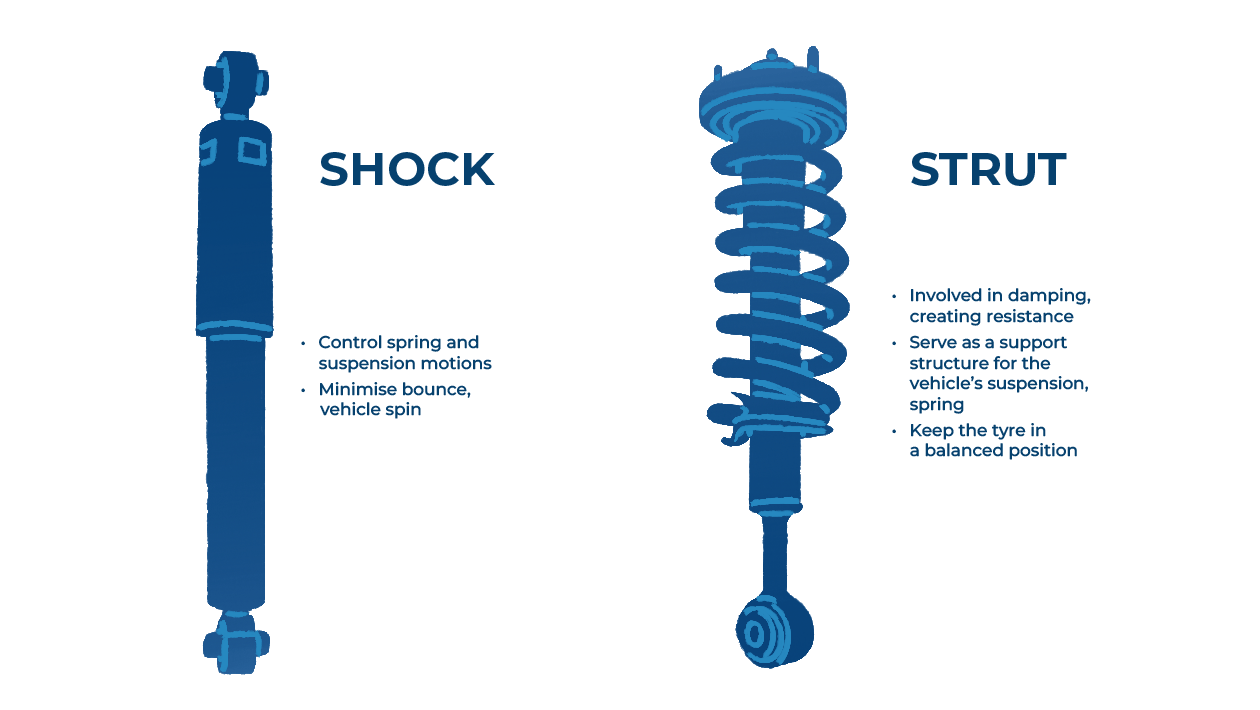
A shock absorber is a purely damping device, designed solely to control spring oscillation. It is not a structural part of the vehicle’s suspension geometry; rather, it works in conjunction with a separate spring, usually a coil spring, to manage the vehicle’s movement. They are typically found in older car models or specific modern vehicles where the suspension components are separated.
Design and Operation
Shock absorbers consist of a piston attached to a rod, moving within a fluid-filled cylinder. As the wheel moves up and down, the piston pushes through the hydraulic fluid. Small orifices in the piston head restrict the fluid flow, creating resistance. This resistance converts the kinetic energy of the suspension movement into thermal energy (heat), which is then dissipated into the atmosphere. The valving inside the shock absorber is precisely engineered to control both compression (when the wheel moves up) and rebound (when the wheel moves down) rates, offering a balanced ride.
Advantages and Applications
The primary advantage of a separate shock absorber is its specific focus on damping. This can allow for more precise tuning of ride characteristics, as the spring and damper can be optimized independently. They are common in setups where coil springs or leaf springs bear the vehicle’s weight, and the shock absorber is mounted separately, often parallel to the spring. This design can sometimes offer greater flexibility in suspension geometry and packaging.
Key Characteristics
Shock absorbers are distinct for being non-load-bearing. Their failure typically results in excessive bouncing and reduced control but doesn’t usually lead to structural collapse of the suspension system itself. They are a critical component for ride quality and vehicle stability, preventing the tires from losing contact with the road during dynamic driving conditions. Their construction is generally simpler than that of a strut, as they don’t integrate steering or structural elements.
Demystifying Suspension Struts
A suspension strut is a more complex, multi-functional component that integrates several elements into a single unit. Unlike a standalone shock absorber, a strut is a structural part of the vehicle’s suspension system. It provides damping, supports the vehicle’s weight, and helps maintain the wheel’s alignment. This integrated design is prevalent in most modern front-wheel-drive vehicles and many rear-wheel-drive cars.
A Multifunctional Component
The strut typically combines the coil spring and the shock absorber into one assembly. It is bolted directly to the vehicle’s chassis at the top and to the steering knuckle or lower control arm at the bottom. This means that the strut itself carries the vehicle’s weight, absorbing vertical loads, and also plays a crucial role in maintaining the wheel’s alignment, including camber angle. In many designs, the top of the strut serves as the upper pivot point for the steering knuckle, making it an integral part of the steering mechanism.

How Struts Work
Inside a strut, the damping mechanism (similar to a shock absorber) controls the spring’s movement. As the vehicle encounters bumps, the coil spring compresses and expands, while the internal hydraulic damper resists this motion, preventing uncontrolled oscillation. Because it is a structural component, the strut also withstands significant side loads and forces from steering and braking, helping to keep the wheel in proper alignment relative to the vehicle body. This combined functionality simplifies the suspension design and reduces manufacturing costs for many carmakers.
Benefits and Common Uses
The integration of multiple components into a single unit simplifies suspension design, often leads to a more compact assembly, and can reduce overall vehicle weight. Struts are particularly advantageous in McPherson strut suspension systems, which are widely used due to their simplicity, compactness, and cost-effectiveness. The strut’s ability to maintain wheel alignment means fewer independent components are needed, streamlining the suspension architecture.
Struts vs. Shocks: A Direct Comparison
The fundamental distinction between struts and shocks lies in their structural role and the functions they perform. While both aim to dampen suspension oscillations, their integration into the vehicle’s design sets them apart.
Structural vs. Non-Structural
The most significant difference is that a strut is a structural component of the suspension, meaning it supports a portion of the vehicle’s weight and helps maintain wheel alignment. If a strut fails, it can lead to severe alignment issues and potential structural compromise. A shock absorber, conversely, is a non-structural component. It merely dampens oscillations and does not support vehicle weight. A failed shock absorber will result in a bouncy ride but will not typically affect wheel alignment or cause structural collapse.
Integration and Complexity
A strut is an integrated assembly that usually combines the coil spring, spring seat, and the internal damping mechanism (similar to a shock absorber) into one unit. It often includes a bearing at the top to allow for steering rotation. Shock absorbers, on the other hand, are standalone damping units that work in tandem with separate springs. The complexity of a strut makes it generally more expensive to replace than a simple shock absorber, as it often requires more specialized tools and labor for the entire assembly.
Impact on Ride and Handling
Both components are critical for ride comfort and handling. A failing shock absorber will lead to excessive bouncing, reduced tire contact with the road, and compromised braking and steering. A failing strut will exhibit similar symptoms of poor damping, but also potentially include clunking noises, uneven tire wear (due to alignment issues), and a noticeable sag in the vehicle’s ride height if the spring element is compromised. Vehicles with struts often have a more direct steering feel due to the strut’s role in maintaining wheel alignment and its direct connection to the steering knuckle.
Maintenance and Replacement Considerations
When replacing these components, the approach differs significantly. A shock absorber can often be replaced independently of the spring. For struts, the entire strut assembly is frequently replaced, or specific components like the internal damping cartridge and spring can be serviced individually, though this usually requires specialized spring compressors which can be dangerous if not used correctly. Due to their structural role, replacing struts often necessitates a wheel alignment afterward to ensure proper geometry and prevent premature tire wear.
When to Choose or Replace Which
The choice between a shock absorber and a strut is determined by the vehicle’s original suspension design, not by user preference. Modern vehicles are predominantly designed with struts for their compactness and efficiency, especially in the front suspension. Replacement, therefore, means replacing the type of component originally fitted.
Identifying Wear and Tear
Common signs of worn shock absorbers or struts include excessive bouncing or swaying after hitting bumps, a “nose dive” during braking, uneven tire wear, fluid leaks from the units, and visible damage or corrosion. A “cupping” or scalloped wear pattern on tires is a classic indicator of poor damping. While a failing shock absorber primarily affects ride quality and control, a failing strut can also impact steering response and vehicle alignment, often manifesting as clunking sounds or a noticeable change in ride height.
Performance vs. Standard Replacements
When replacing struts or shocks, owners can often choose between standard OEM (Original Equipment Manufacturer) replacements, which aim to restore the original ride characteristics, or aftermarket performance upgrades. Performance struts and shocks often feature stiffer valving, larger piston diameters, or adjustable settings to improve handling and reduce body roll, albeit sometimes at the expense of ride comfort. For everyday drivers, reliable OEM-quality replacements are usually sufficient to restore safety and comfort. However, enthusiasts or those looking to modify their vehicle’s handling can explore performance options that cater to specific driving styles or conditions. Always ensure that replacement parts are compatible with your vehicle’s make and model for optimal performance and safety.
aViewFromTheCave is a participant in the Amazon Services LLC Associates Program, an affiliate advertising program designed to provide a means for sites to earn advertising fees by advertising and linking to Amazon.com. Amazon, the Amazon logo, AmazonSupply, and the AmazonSupply logo are trademarks of Amazon.com, Inc. or its affiliates. As an Amazon Associate we earn affiliate commissions from qualifying purchases.