
The quest for more power and efficiency in internal combustion engines has led to a variety of technological advancements. Among the most exciting and impactful are forced induction systems, namely turbochargers and superchargers. While both serve the fundamental purpose of forcing more air into an engine’s cylinders, thereby enabling it to burn more fuel and produce greater power, they achieve this through distinctly different mechanisms. Understanding these differences is crucial for anyone interested in automotive performance, engine technology, or even the broader landscape of engineering innovation. This exploration will delve into the core principles of turbochargers and superchargers, dissecting their operational mechanics, advantages, disadvantages, and the impact they have on the broader technological and financial spheres.

The Core Principle: Forced Induction
Before we dissect the nuances of turbos and superchargers, it’s essential to grasp the overarching concept of forced induction. In a naturally aspirated engine, the piston’s downward stroke creates a vacuum, drawing air into the cylinder. This process is limited by atmospheric pressure. Forced induction, on the other hand, bypasses this limitation by actively pressurizing the intake air before it enters the combustion chamber. Think of it like this: instead of passively sipping air, the engine is actively being “fed” a denser charge.
This denser air charge is the key. It contains more oxygen molecules than an equivalent volume of naturally aspirated air. With more oxygen available, the engine can burn more fuel, leading to a more powerful explosion within the cylinder and ultimately, more horsepower and torque. This efficiency gain is often a significant motivator for manufacturers, as it can allow smaller, more fuel-efficient engines to produce power comparable to larger, naturally aspirated ones.
The Power Source: Exhaust vs. Engine Drive
The fundamental distinction between a turbocharger and a supercharger lies in their power source. This is where their operational philosophies diverge dramatically, leading to unique performance characteristics and engineering challenges.
Turbochargers: Harnessing the Exhaust Stream
A turbocharger, often colloquially referred to as a “turbo,” is a complex device that cleverly utilizes wasted energy from the engine’s exhaust gases. It consists of two main components: the turbine and the compressor, both mounted on a shared shaft.
- The Turbine: Hot, expanding exhaust gases are directed from the engine’s exhaust manifold through the turbine housing. These gases spin the turbine wheel at incredibly high speeds, often exceeding 100,000 RPM. The force of the exhaust gases provides the rotational energy for the entire turbocharger unit.
- The Compressor: Connected to the turbine via the shared shaft, the compressor is located in the engine’s intake system. As the turbine spins, it drives the compressor wheel, which draws in ambient air and compresses it, increasing its pressure and density. This pressurized air is then pushed into the engine’s intake manifold.
The beauty of a turbocharger lies in its efficiency. It’s essentially a free power boost, converting otherwise wasted energy into useful work. This energy recovery can lead to improved fuel economy under certain driving conditions and allows for downsizing of engines without sacrificing performance.
However, turbochargers are not without their complexities. The reliance on exhaust gas flow means they are not instantly responsive. There’s a brief delay, known as “turbo lag,” as the exhaust gases build up enough pressure to spin the turbine and the compressor to effective speeds. This lag can manifest as a noticeable hesitation in acceleration, particularly at lower engine RPMs. Modern turbocharger technology, including variable geometry turbos (VGTs) and twin-scroll designs, has significantly reduced this lag, but it remains an inherent characteristic of the system.
Superchargers: Directly Driven by the Engine’s Crankshaft
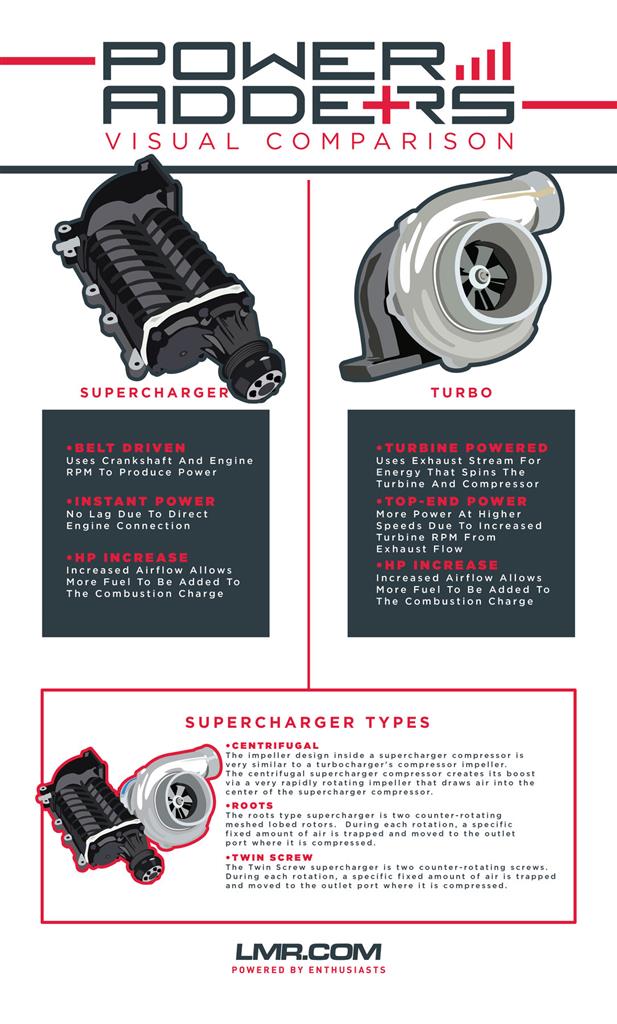
In contrast to the turbocharger’s reliance on exhaust gas, a supercharger is directly driven by the engine’s crankshaft, typically via a belt, gears, or a chain. This direct mechanical link ensures that the supercharger spins whenever the engine is running, providing a more immediate and consistent boost.
There are several common types of superchargers, each with its own design and operational characteristics:
- Roots Supercharger: This is one of the oldest and simplest designs. It uses two or more lobes that rotate in opposite directions, trapping air and forcing it through the intake. Roots superchargers are known for their excellent low-end torque but are generally less efficient at higher RPMs.
- Twin-Screw Supercharger: Similar in principle to Roots superchargers, twin-screw designs feature two intermeshing helical screws that compress air as it’s drawn in and moved towards the outlet. They offer good efficiency across a wider RPM range than Roots types.
- Centrifugal Supercharger: These operate much like a reverse fan. A spinning impeller draws air in and accelerates it outwards, using centrifugal force to compress it. Centrifugal superchargers are often described as a good balance between responsiveness and efficiency, with their boost levels increasing with engine RPM.
- Wankel (Rotary) Supercharger: This less common design utilizes a rotor that spins within a chamber to compress air.
The primary advantage of a supercharger is its instantaneous response. Because it’s directly coupled to the engine, boost is available almost immediately upon acceleration, leading to a smooth, linear power delivery. This makes them a popular choice for performance applications where immediate throttle response is paramount.
The trade-off for this responsiveness is that superchargers draw power directly from the engine. This parasitic drag means that a portion of the engine’s output is consumed simply to drive the supercharger, potentially reducing overall efficiency compared to a well-designed turbocharger system, especially under light load conditions.
Technological Innovations and Performance Implications
The evolution of both turbocharging and supercharging technologies has been driven by relentless innovation, aiming to mitigate their respective drawbacks and enhance their performance benefits. These advancements have profound implications for vehicle design, efficiency, and the driving experience.
Mitigating Turbo Lag: The Quest for Instantaneous Power
Turbo lag, the delay between pressing the accelerator and the turbocharger delivering significant boost, has long been a perceived weakness. However, significant strides have been made to minimize this effect.
- Variable Geometry Turbos (VGTs): These turbos feature adjustable vanes within the turbine housing. At low engine speeds, the vanes narrow, increasing exhaust gas velocity and spinning the turbine faster, thus reducing lag. At higher RPMs, the vanes open to allow more exhaust gas flow, preventing over-boosting and maintaining efficiency.
- Twin-Scroll Turbochargers: This design separates exhaust pulses from different cylinder banks, directing them through separate “scrolls” in the turbine housing. This optimizes the flow of exhaust gases, improving turbine spool-up speed and reducing lag.
- Electric Turbochargers (e-turbos): An emerging technology, e-turbos utilize an electric motor to pre-spin the turbine, eliminating lag altogether. The electric motor can also act as a generator, recovering energy.
These innovations have made turbochargers far more responsive, often rivaling the immediate boost of superchargers, while retaining their inherent efficiency advantages.
Supercharger Efficiency and Packaging Improvements
While superchargers offer instant response, engineers have continuously worked to improve their efficiency and integration into vehicle designs.
- Intercooling: Both turbochargers and superchargers compress air, which increases its temperature. Hot air is less dense and can lead to detonation (engine knock). Intercoolers are radiators that cool the compressed air before it enters the engine, increasing its density and allowing for more aggressive boost levels safely.
- Bypass Valves and Blow-Off Valves: These systems manage boost pressure. Bypass valves recirculate excess boost back into the intake, reducing noise and wear, while blow-off valves release excess pressure into the atmosphere with a distinctive “psst” sound, preventing compressor surge.
- Compact Designs: Modern supercharger designs are increasingly compact, making them easier to package within engine bays and contributing to better weight distribution.
Brand, Marketing, and Consumer Perception
The choice between a turbocharger and a supercharger often extends beyond pure engineering to encompass brand identity, marketing strategies, and consumer perception.
The “Turbocharged” Image: Performance and Technology
The term “turbo” itself has become synonymous with performance and cutting-edge technology. Many manufacturers leverage this association in their branding and marketing. A “turbocharged” engine often implies a more exciting, dynamic driving experience, even if the underlying technology is shared with other forced induction systems. Marketing campaigns frequently highlight the enhanced acceleration, fuel efficiency, and the “thrill” associated with turbo power.
For performance brands, turbochargers can be a key differentiator, signaling a commitment to advanced engineering and exhilarating driving dynamics. The association with motorsports further solidifies this perception.
Supercharging: The All-Wheel Drive of Power Delivery
Superchargers, while perhaps less “sexed-up” in marketing than turbos, often carry an aura of brute force and immediate, predictable power. The smooth, linear delivery appeals to drivers who prioritize a consistent, accessible surge of acceleration.
Brands that heavily utilize superchargers might emphasize the “effortless power” or the “muscular torque” available from low RPMs. This can resonate with a segment of consumers who value a more visceral and less nuanced power delivery.
From a brand strategy perspective, the choice between turbocharging and supercharging can influence how a manufacturer positions its vehicles. A brand focused on technological innovation and fuel efficiency might lean towards turbos, while a brand emphasizing raw power and immediate response might opt for superchargers.
Financial Implications: Cost, Efficiency, and Value
The financial implications of turbocharging and supercharging are multifaceted, impacting not only the initial purchase price of a vehicle but also its long-term operating costs and resale value.
Cost of Technology and Manufacturing
Both turbochargers and superchargers add complexity and cost to an engine’s manufacturing process.
- Turbochargers: The intricate nature of the turbine and compressor assembly, along with associated plumbing and intercooling systems, can contribute to a higher upfront cost. However, their ability to enable engine downsizing can lead to overall manufacturing cost savings by allowing smaller, lighter engines to be used.
- Superchargers: The mechanical drive systems, whether belts, gears, or chains, and the supercharger unit itself, add to the cost. The parasitic drag they impose can also lead to higher fuel consumption, impacting long-term running costs.
Fuel Efficiency and Running Costs
The impact on fuel efficiency is a significant consideration.
- Turbochargers: When integrated effectively, turbochargers can lead to improved fuel economy, especially in smaller displacement engines that can deliver the performance of larger naturally aspirated ones. This is a key selling point in an era of increasing environmental regulations and consumer demand for fuel efficiency.
- Superchargers: Due to their parasitic power draw, superchargers can sometimes result in slightly lower fuel efficiency compared to equivalent naturally aspirated engines or well-optimized turbochargers, particularly during everyday driving where the full boost potential is not consistently utilized.

Resale Value and Consumer Demand
Consumer perception, heavily influenced by marketing and brand image, can also affect resale value.
- Turbocharged Vehicles: The association of turbos with performance and modern technology can contribute to strong demand and a favorable resale value, especially for performance-oriented models.
- Supercharged Vehicles: Vehicles with superchargers, particularly those known for their raw power and unique driving characteristics, can also command a premium in the used car market, appealing to enthusiasts who specifically seek out this type of performance.
Ultimately, the “better” choice between a turbocharger and a supercharger is not an absolute. It depends on the specific application, the desired performance characteristics, the target market, and the overall engineering philosophy of the vehicle manufacturer. Both technologies represent remarkable achievements in automotive engineering, pushing the boundaries of what’s possible with internal combustion engines and continuing to shape the future of automotive performance and efficiency.
aViewFromTheCave is a participant in the Amazon Services LLC Associates Program, an affiliate advertising program designed to provide a means for sites to earn advertising fees by advertising and linking to Amazon.com. Amazon, the Amazon logo, AmazonSupply, and the AmazonSupply logo are trademarks of Amazon.com, Inc. or its affiliates. As an Amazon Associate we earn affiliate commissions from qualifying purchases.