
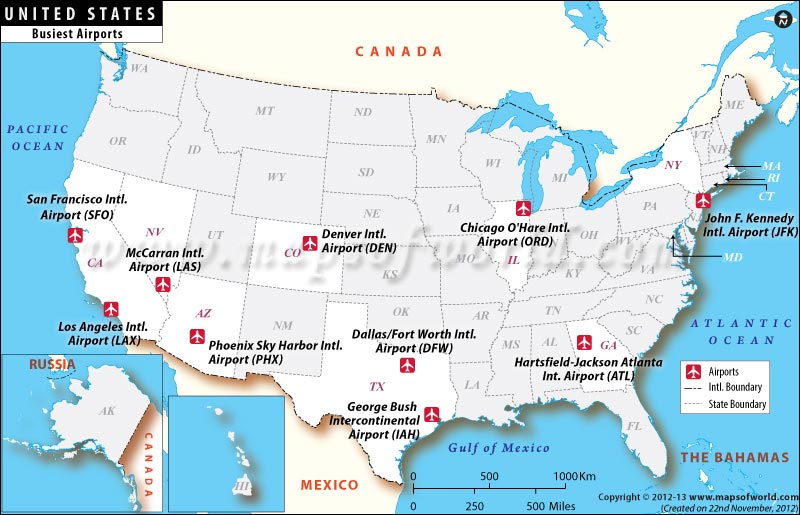
When one thinks of the United States, images of bustling cities, vast landscapes, and a vibrant economy often come to mind. Underlying much of this interconnectedness is a complex network of transportation, with airports serving as critical arteries. Among these giants, one consistently rises above the rest, earning the title of the busiest airport in the US: Hartsfield-Jackson Atlanta International Airport (ATL).
For decades, ATL has held this distinction, not just in the US but often globally, based on passenger traffic and aircraft movements. Its strategic location, serving as a primary hub for Delta Air Lines, and its unparalleled connectivity make it a linchpin in both domestic and international air travel. But merely stating its dominance only scratches the surface. The story of ATL is a sophisticated narrative woven from threads of cutting-edge technology, meticulous brand strategy, and immense financial implications, echoing the core tenets of modern industry. Understanding what makes ATL the busiest isn’t just about counting planes and people; it’s about dissecting the technological marvels that keep it running, the branding efforts that define its identity, and the profound economic ripples it creates.

Atlanta Hartsfield-Jackson: A Hub of Activity and Innovation
Atlanta’s reign as the world’s busiest airport is no accident. It is the result of strategic geographical placement, visionary infrastructure development, and a relentless focus on operational efficiency. The sheer volume of activity at ATL is staggering, making it a micro-economy and a technological marvel in its own right.
The Numbers Don’t Lie: Why ATL Reigns Supreme
Year after year, Hartsfield-Jackson Atlanta International Airport consistently leads in passenger volume, often exceeding 100 million travelers annually prior to global disruptions, and quickly rebounding to similar levels. This figure isn’t just a statistic; it represents an incredible orchestration of logistics, safety, and customer service. Beyond passenger numbers, ATL also frequently ranks high in aircraft movements, signifying the sheer number of takeoffs and landings handled daily. This consistent performance can be attributed to several key factors.
Firstly, Atlanta’s geographic location plays an unparalleled role. Situated within a two-hour flight of 80% of the U.S. population, it naturally serves as an ideal connecting point for domestic travel. This centrality minimizes flight times for a vast majority of Americans, making it a convenient choice for airlines and passengers alike. Secondly, its role as the primary hub for Delta Air Lines, one of the world’s largest airlines, is indispensable. Delta leverages ATL to connect its vast network of destinations, channeling millions of passengers through its gates daily. This symbiotic relationship ensures a constant flow of traffic, anchoring ATL’s position.
Furthermore, ATL’s extensive infrastructure, featuring five parallel runways and two massive terminal complexes (Domestic and International), provides the capacity needed to handle such immense traffic. The sheer scale allows for simultaneous operations that would overwhelm lesser airports. This combination of strategic location, airline dominance, and robust infrastructure solidifies ATL’s position as the uncontested leader in air travel volume.
Beyond the Tarmac: The Economic Juggernaut of Airport Operations
The economic impact of ATL extends far beyond the airport perimeter, acting as a powerful engine for the city of Atlanta, the state of Georgia, and the broader southeastern United States. This bustling hub is a prime example of how an airport functions not just as a transportation facility, but as a critical financial asset and job creator, directly aligning with the “Money” aspects of our discussion.
Directly, ATL supports tens of thousands of jobs, ranging from air traffic controllers, pilots, flight attendants, and ground crew to security personnel, customer service agents, and retail staff within the terminals. These are well-paying jobs that contribute significantly to the local economy. Indirectly, the airport’s operations create a multiplier effect, supporting countless other industries. The influx of business travelers and tourists generates revenue for hotels, restaurants, convention centers, and local attractions. Logistics companies thrive on the air cargo moving through ATL, facilitating trade and supply chains. Real estate values in areas surrounding the airport are influenced by its presence, and construction projects related to airport expansion or maintenance inject further capital into the economy.
Airport revenue streams are diverse and substantial. They include landing fees paid by airlines, terminal rents, parking fees, rental car concessions, and a wide array of retail and food & beverage operations. These revenues not only fund airport operations and infrastructure improvements but also often contribute to municipal budgets, reducing the tax burden on residents. For investors, the stability and growth potential of airport-related businesses, from concessionaires to aviation tech providers, present significant opportunities. ATL, therefore, isn’t just a point of transit; it’s a monumental economic anchor, showcasing how strategic infrastructure can drive regional prosperity and contribute billions to the national GDP.
The Technological Backbone: Keeping the Busiest Airport Running Smoothly
The constant flow of millions of passengers and thousands of flights through Hartsfield-Jackson Atlanta International Airport would be impossible without a sophisticated and continuously evolving technological framework. From managing air traffic to enhancing passenger experience and ensuring digital security, technology is the silent, yet essential, partner in ATL’s success. This aspect deeply resonates with the “Tech” focus of our discussion, highlighting innovation across various domains.
From Air Traffic Control to Biometric Boarding: The Tech Revolution
The orchestration of aircraft movements on five parallel runways and countless taxiways is a monumental feat of precision and technology. Air Traffic Control (ATC) systems at ATL utilize state-of-the-art radar, sophisticated communication networks, and predictive analytics to safely guide planes through busy airspace and on the ground. These systems process vast amounts of data in real-time, anticipating potential conflicts and optimizing flight paths to minimize delays – a critical function for an airport handling so much traffic.
Beyond the cockpit and control tower, technology permeates every facet of the passenger journey. Baggage handling systems are complex automated networks, often miles long, employing lasers, sensors, and AI-driven routing to ensure bags reach their correct destinations efficiently. For passengers, the rise of mobile apps, digital signage, and self-service kiosks has transformed the check-in and boarding process, offering greater control and reducing wait times. Biometric scanning technologies, such as facial recognition for boarding and programs like CLEAR or TSA PreCheck, leverage advanced AI and data processing to expedite security checks, a necessity given ATL’s volume.
Security itself is a domain heavily reliant on technology. Advanced X-ray scanners, millimeter-wave body imagers, and explosive trace detectors are standard. Increasingly, AI tools are being deployed to analyze security footage and detect potential threats with greater accuracy and speed. Operationally, predictive maintenance systems, employing IoT sensors and data analytics, monitor the health of everything from jet bridges to baggage conveyors, ensuring proactive repairs and minimizing disruptions. This continuous embrace of technological innovation is what allows ATL to maintain its high level of efficiency and safety despite its immense operational scale.
Digital Security and Productivity in a High-Stakes Environment
Given the critical nature of airport operations, digital security is paramount. A cyberattack on an airport like ATL could have catastrophic consequences, disrupting global travel, compromising sensitive passenger data, and impacting national security. Therefore, robust cybersecurity measures are not just advisable; they are an absolute imperative. This includes multi-layered firewalls, intrusion detection systems, encryption protocols for data in transit and at rest, and continuous threat monitoring by dedicated security teams. Regular penetration testing and vulnerability assessments are crucial to identifying and mitigating potential weaknesses before malicious actors can exploit them. The integration of AI tools for anomaly detection and automated response systems is also becoming increasingly vital in defending against sophisticated cyber threats.
In addition to security, productivity tools are indispensable for the myriad of staff members, airline personnel, and ground services operating within ATL. These tools range from sophisticated resource management software that optimizes gate assignments, baggage cart allocation, and personnel scheduling, to collaborative platforms that facilitate real-time communication between different operational teams. AI-driven analytics help forecast passenger flow, predict peak times, and optimize staffing levels, ensuring that resources are efficiently deployed to handle the busiest periods. Mobile applications enable maintenance crews to receive and update work orders on the go, while digital dashboards provide real-time operational insights to management. The effective deployment of these productivity and digital security tools is fundamental to maintaining ATL’s reputation for efficiency and resilience, allowing it to manage complex logistics and ensure uninterrupted service in a high-stakes environment.
Building a Brand in the Sky: ATL’s Identity and Passenger Experience
While technology ensures operational efficiency and financial models underscore economic impact, the “Brand” aspect of an airport like ATL is equally vital. It’s about shaping perceptions, delivering on promises, and cultivating an experience that resonates with millions of travelers. An airport isn’t just infrastructure; it’s a gateway, a first and last impression, and a critical component of a city’s identity.
More Than Just a Gateway: Branding an Airport
How does an airport, particularly one of ATL’s size and complexity, build and maintain a strong brand identity? It begins with clearly defining its purpose and promise. For ATL, its brand revolves around efficiency, unparalleled connectivity, and its status as a global gateway. Marketing and communication strategies play a crucial role in conveying this. This includes active social media engagement, public relations efforts that highlight operational achievements and community involvement, and partnerships that promote Atlanta as a destination.
Customer service, though challenging in an environment of high volume, is a core pillar of the airport’s brand. Initiatives aimed at improving passenger flow, providing helpful information, and ensuring a comfortable experience contribute significantly to how the airport is perceived. The curated retail and dining experiences within the terminals also serve as brand ambassadors. ATL’s concessions feature a blend of globally recognized brands and local Atlanta favorites, offering travelers a taste of the city even during a layover. This careful selection not only generates revenue but also enhances the passenger experience, making the airport feel less like a mere transit point and more like an extension of the vibrant city it serves. By focusing on these elements, ATL cultivates a brand that promises seamless travel and a welcoming atmosphere, reinforcing its position as a leading global hub.
The Passenger Journey: Design, Experience, and Reputation
The physical design and aesthetic elements of an airport significantly impact the passenger journey and, by extension, its reputation. ATL, despite its functional focus, incorporates art installations, comfortable waiting areas, and clear wayfinding signage to improve the passenger experience. These details, often overlooked, contribute to a sense of calm and efficiency, mitigating the stress often associated with air travel. Cleanliness, accessibility, and the availability of amenities like Wi-Fi and charging stations are also critical factors that shape a traveler’s perception.
An airport’s reputation is built on countless individual experiences. For ATL, maintaining a positive reputation amidst such high traffic volume is a continuous challenge. Factors like on-time performance, baggage handling efficiency, and responsiveness to customer feedback are constantly monitored. A single negative experience can quickly spread through social media, impacting the brand. Therefore, ATL invests in continuous improvement, leveraging passenger feedback and data analytics to identify pain points and implement solutions. The integration of technology for personalized travel experiences, such as mobile notifications for gate changes or lounge access, further enhances the journey and reinforces a positive brand image. By consistently delivering on its promise of efficiency and a thoughtful passenger experience, ATL not only solidifies its market position but also enhances the global perception of Atlanta as a dynamic and welcoming city.
The Future of Air Travel: Trends Shaping Tomorrow’s Busiest Airports
The aviation industry is in a constant state of flux, driven by technological advancements, evolving economic landscapes, and a growing global consciousness around sustainability. The busiest airports, like ATL, must continuously adapt and innovate to maintain their dominance and relevance in an ever-changing world.
Technology-Driven Evolution and Sustainability
Looking ahead, technology will continue to be the primary catalyst for transformation in air travel. We can expect to see further integration of AI for predictive maintenance, not just for ground infrastructure but for aircraft turnarounds and gate management, optimizing every minute an aircraft spends on the ground. Smart infrastructure, incorporating IoT sensors throughout the terminals, runways, and baggage systems, will provide real-time data for unprecedented operational oversight and efficiency. The emergence of Electric Vertical Take-off and Landing (eVTOL) aircraft could revolutionize short-distance travel, potentially integrating new “vertiports” into or around existing airport complexes, creating entirely new operational challenges and opportunities.
Sustainability is another critical trend. Airports are under increasing pressure to reduce their carbon footprint. ATL, like many major hubs, is pursuing ambitious carbon neutrality goals, which will involve transitioning to electric ground vehicles, investing in sustainable aviation fuel (SAF) infrastructure, optimizing flight paths to reduce fuel burn, and implementing energy-efficient building designs. These initiatives not only address environmental concerns but also present opportunities for cost savings and enhance the airport’s brand image as a responsible global citizen. The busiest airports of tomorrow will be defined not just by their capacity, but also by their environmental stewardship and technological sophistication.
Global Competition and Economic Imperatives
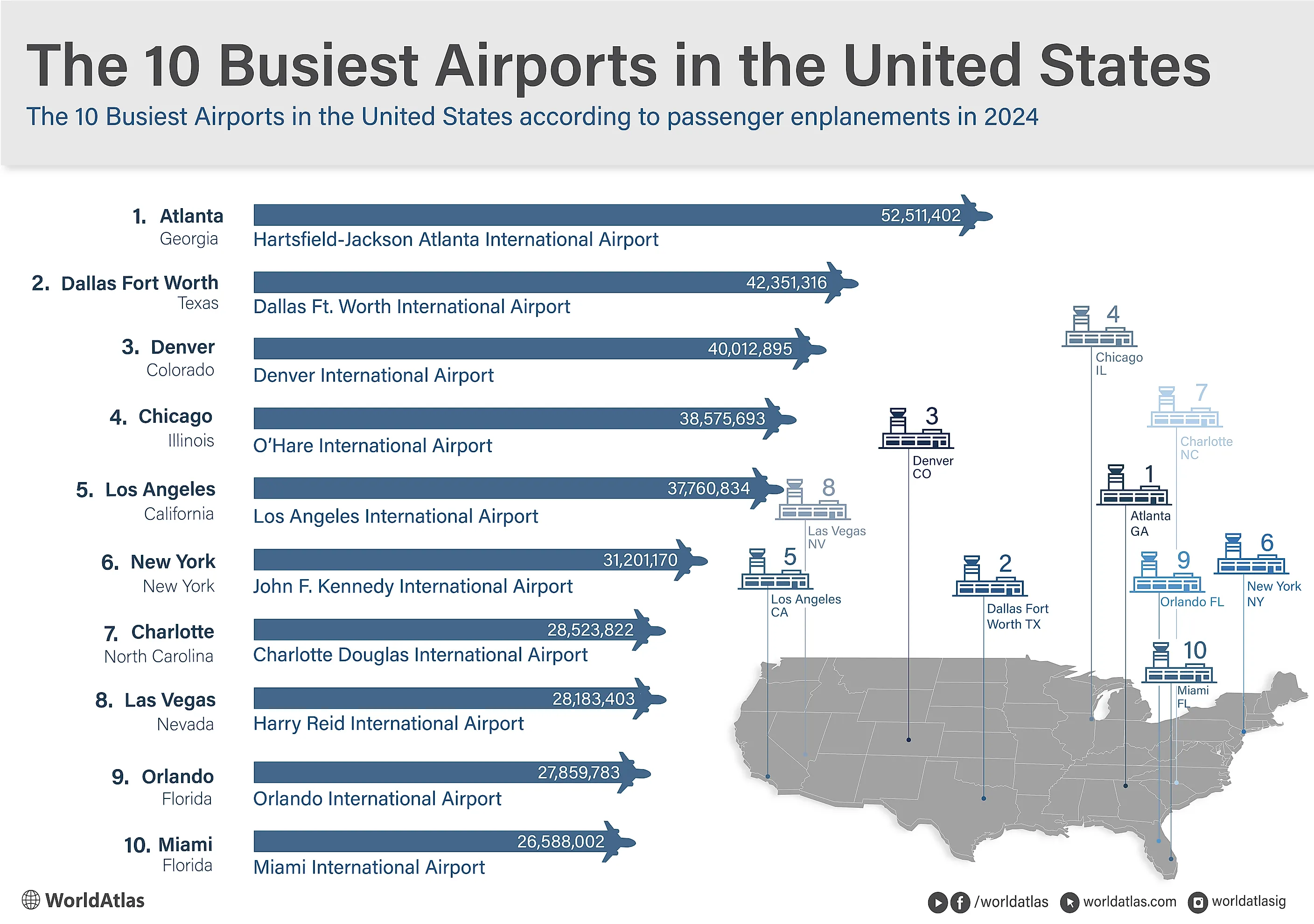
While ATL has long held its top spot, global competition is fierce, and other major US airports are continuously expanding and modernizing their facilities. Airports like Denver International (DEN), Dallas/Fort Worth (DFW), and Chicago O’Hare (ORD) are investing heavily in new terminals, runways, and technological upgrades, all vying for increased passenger traffic and international routes. This competitive landscape means ATL cannot rest on its laurels; continuous investment in infrastructure, technology, and passenger services is an economic imperative to maintain its leading edge.
The aviation industry is also highly susceptible to global economic shifts, geopolitical events, and public health crises, as evidenced by recent history. The busiest airports must have robust financial models and strategic flexibility to navigate these uncertainties. This includes diversified revenue streams, efficient cost management, and the ability to adapt quickly to changing travel patterns and airline demands. Future success will depend on strategic foresight, continuous innovation, and a deep understanding of the interwoven dynamics of technology, brand, and money that fuel the modern aviation powerhouse.
In conclusion, Hartsfield-Jackson Atlanta International Airport stands as a testament to the complex interplay of location, infrastructure, strategic partnerships, and relentless innovation. Its status as the busiest airport in the US is not merely a quantitative measure but a reflection of its mastery in integrating cutting-edge technology for operational excellence, cultivating a strong brand identity for passenger satisfaction, and generating immense economic value. As air travel continues to evolve, ATL’s ongoing commitment to these pillars will undoubtedly ensure its continued prominence in the skies.
aViewFromTheCave is a participant in the Amazon Services LLC Associates Program, an affiliate advertising program designed to provide a means for sites to earn advertising fees by advertising and linking to Amazon.com. Amazon, the Amazon logo, AmazonSupply, and the AmazonSupply logo are trademarks of Amazon.com, Inc. or its affiliates. As an Amazon Associate we earn affiliate commissions from qualifying purchases.