
The term “index fossil” might evoke images of dusty museum halls and ancient rocks. While its origins lie firmly in geology, the concept of an “index fossil” – something specific, widespread, and short-lived that helps us date and correlate rock layers – has surprisingly potent parallels in our modern, fast-paced world of technology, branding, and finance. This article will explore the geological definition of an index fossil and then draw compelling connections to how similar principles are at play in the evolving landscapes of Tech, Brand, and Money.
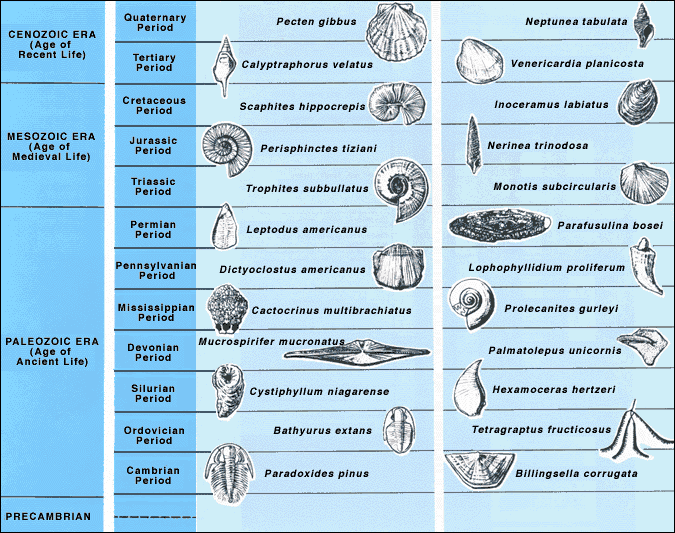
Understanding the Geological Foundation: The Power of the Index Fossil
In geology, index fossils are the rock stars of paleontology. These are the remains or traces of an organism that lived for a geologically short period, was widely distributed across the Earth, and is easily recognizable. Think of a specific type of ammonite that only existed for a few million years and has been found on multiple continents.
The significance of an index fossil lies in its ability to act as a chronological marker. If you find that particular ammonite in a sedimentary rock layer, you can confidently say that the rock formed during the specific time period when that ammonite species thrived. This is invaluable for geologists trying to:
- Date Rock Layers: By identifying index fossils within different rock formations, geologists can determine the relative ages of these layers. This is like creating a timeline for Earth’s history.
- Correlate Rock Layers Across Distant Locations: If the same index fossil is found in rock layers in, say, North America and Europe, it indicates that these rock layers are roughly the same age, even though they are geographically separated. This helps scientists understand past geological events and the distribution of ancient life.
- Understand Past Environments: The types of organisms that become index fossils often lived in specific environments. Their presence can therefore provide clues about the climate, sea levels, and ecosystems of the past.
The key characteristics that make a fossil an “index fossil” are its:
- Short Stratigraphic Range: It existed for a relatively brief period in geological time. This limits the number of rock layers it can be found in.
- Wide Geographic Distribution: It was found in many different places. This allows for correlation across vast distances.
- Abundance and Ease of Identification: It was common enough to be found frequently and distinct enough to be easily recognized and differentiated from other fossils.
Without index fossils, piecing together Earth’s history would be infinitely more complex, akin to trying to assemble a jigsaw puzzle with no reference image.
Tech: The Fleeting “Index Gadgets” and AI Eras
In the realm of technology, the concept of an “index fossil” manifests in the rapid evolution of trends, the lifecycle of gadgets, and the distinct eras shaped by groundbreaking AI advancements. Unlike the millions of years of geological time, technology operates on a scale of months, years, and at most, a decade.
H2: The Ephemeral “Index Gadgets” of Tech Eras
Just as a specific trilobite might define a period in Earth’s history, certain gadgets or software releases have become markers for distinct technological eras. These aren’t necessarily fossils in the traditional sense, but rather highly influential products that, in retrospect, define a period of innovation and adoption.
Consider the early smartphone. The introduction of the first iPhone wasn’t just another phone; it was an “index gadget” that fundamentally reshaped how we interact with technology. Its touch interface, app store concept, and always-on connectivity became the blueprint for all subsequent smartphones, allowing us to broadly date technological advancements and user habits to the “post-iPhone era.”
Similarly, the rise of cloud computing services like AWS, Azure, and Google Cloud didn’t just offer new ways to store data; they created an entirely new paradigm for businesses. The widespread adoption and integration of these platforms serve as an “index” for the shift from on-premise infrastructure to a more flexible, scalable model. Any company heavily reliant on these services can be placed within this defining technological epoch.
More recently, the explosion of generative AI tools like ChatGPT, Midjourney, and DALL-E has created another distinct “index” for our current technological moment. The accessibility and impressive capabilities of these tools have rapidly changed the discourse around creativity, content generation, and automation. Finding references to extensive use or development of these specific AI models in documentation or discussions immediately places that context within the “era of advanced generative AI.”
These “index gadgets” and software platforms share key characteristics with geological index fossils:
- Short but Defined Impactful Lifespan: While the physical devices might last longer, their peak influence and the period they define are relatively brief before they are superseded by newer iterations or entirely new paradigms.
- Widespread Adoption (within the tech-savvy): The impact isn’t confined to a single region or niche; these technologies are adopted globally by consumers and businesses, creating a correlated experience.
- Distinctive Features and Functionality: Their revolutionary aspects make them easily identifiable and memorable, distinguishing them from the incremental updates that came before or after.
The rapid pace of technological change means these “index fossils” are constantly being unearthed and replaced. A gadget that defined the “mobile computing revolution” of the late 2000s might seem quaint by today’s standards, but its significance as a marker of that era remains.
H3: AI Advancements: The “Strata” of Machine Learning
Within the broader “era of advanced generative AI,” specific breakthroughs in machine learning act as even finer “index fossils,” defining sub-periods of AI development. The transition from rule-based systems to machine learning, then to deep learning, and now to large language models (LLMs) represents distinct “strata” in the development of artificial intelligence.
The development of Convolutional Neural Networks (CNNs), for example, was a significant marker for the advancement of image recognition capabilities. Finding research papers, product integrations, or discussions heavily focused on CNN architectures clearly delineates a period where this specific type of neural network was at the forefront of AI innovation.
Similarly, the introduction of the Transformer architecture for natural language processing was a paradigm shift. Its ability to handle sequential data with unprecedented effectiveness paved the way for LLMs. Identifying the widespread implementation and research around Transformers is a clear indicator of the “pre-LLM” or “early LLM” era.
These AI advancements, like geological index fossils, provide crucial dating and correlation for the technological progress within the field. They allow researchers and developers to understand the lineage of ideas and the evolutionary path of AI capabilities.
Brand: The “Brand Fossils” that Define Market Eras
The world of branding, marketing, and corporate identity also has its own set of “index fossils.” These aren’t physical artifacts but rather iconic brand elements, campaigns, or strategic shifts that define specific periods in consumer culture and market evolution.
H2: Iconic “Brand Fossils” and Marketing Epochs
Just as a trilobite tells us about ancient seas, a particular advertising slogan, a distinctive logo evolution, or a groundbreaking marketing campaign can tell us about the prevailing consumer attitudes and market dynamics of its time.

Consider the McDonald’s “I’m Lovin’ It” campaign. Launched in 2003, this slogan became globally ubiquitous and has been a cornerstone of McDonald’s branding for nearly two decades. While the company has evolved, the enduring presence and widespread recognition of “I’m Lovin’ It” serve as an “index” for the early 21st-century era of globalized fast-food marketing, emphasizing emotional connection and consistent messaging.
Another example could be the evolution of Apple’s branding. From the rainbow logo to the sleek, minimalist silver and white aesthetic, each iteration of Apple’s visual identity has coincided with significant shifts in its product line and market position. The adoption of the minimalist aesthetic, for instance, became a defining characteristic of the premium tech and design-conscious consumer market of the late 2000s and beyond.
The emergence of “disruptor” brands that utilized direct-to-consumer (DTC) models and heavy social media marketing also created a distinct “brand fossil” for a specific market era. Brands like Warby Parker, Dollar Shave Club, or Casper revolutionized their respective industries not just through their products but through their innovative marketing strategies. The widespread discussion and emulation of their DTC approaches mark an era of entrepreneurial agility and digital-first consumer engagement.
These “brand fossils” share key attributes with their geological counterparts:
- Distinctive and Memorable: They are easily recognizable and evoke strong associations.
- Widespread Impact: They influenced not just a single company but often entire industries or consumer behaviors.
- Defined but Enduring Influence: While their peak may have passed, their legacy continues to shape current branding strategies and consumer perceptions.
The analysis of these “brand fossils” allows marketers and brand strategists to understand the historical context of consumer behavior, identify successful strategies from different eras, and avoid repeating past mistakes.
H3: Personal Branding and the “Digital Fingerprints” of Identity
In the realm of personal branding, individuals also leave behind “digital fingerprints” that act as markers for their evolving identity and influence. These aren’t necessarily intentional “fossils” but rather the accumulated online presence, content, and interactions that can define a person’s professional or public persona within a specific timeframe.
For example, a LinkedIn profile that showcases a consistent career trajectory, endorsements for specific skills, and participation in industry discussions can serve as an “index” for an individual’s professional journey. The types of skills highlighted, the networking connections made, and the content shared can pinpoint when certain career shifts or areas of expertise became dominant for that individual.
Similarly, a blogger or influencer’s early content can act as a “fossil” for their initial foray into a particular niche or their early experimentation with content formats. The language used, the topics explored, and the platform engagement can all provide clues about their foundational personal brand and how it has evolved over time.
These “digital fingerprints” allow for the dating and correlation of personal brand development, offering insights into how individuals have navigated their public presence and established their reputation within the digital landscape.
Money: The “Index Investments” and Financial Epochs
The world of finance, whether personal or corporate, is also marked by periods of innovation and dominant trends that can be viewed through the lens of “index fossils.” These are the investments, financial instruments, or economic policies that define specific eras of wealth creation and management.
H2: “Index Investments” Shaping Market Cycles
Certain investment vehicles or asset classes have, at different times, become synonymous with significant market booms and busts, acting as “index investments” for those periods.
The Dot-com bubble of the late 1990s and early 2000s is a prime example. The rapid rise and subsequent crash of technology stocks, particularly internet-related companies, created a distinct financial epoch. Anyone heavily invested in “dot-com” stocks during this period can be firmly placed within this “index investment” era. The subsequent scrutiny of valuations and the shift towards more sustainable business models were direct consequences.
More recently, the rise of cryptocurrencies like Bitcoin has created another powerful “index” for a specific financial period. The speculative fervor, the debates around their intrinsic value, and the rapid emergence of decentralized finance (DeFi) have defined a new era of digital asset investment. Discovering individuals or institutions with substantial holdings or active trading in cryptocurrencies immediately signals their participation in this recent financial epoch.
These “index investments” share the defining characteristics:
- Significant but Fleeting Dominance: They capture the public imagination and investment capital for a period, driving significant market activity, before often receding or transforming.
- Widespread Impact (on investors): They attract a broad range of investors, from retail to institutional, influencing broader market sentiment and capital allocation.
- Distinctive Characteristics: Their underlying technology, risk profile, or market mechanism sets them apart from previous investment paradigms.
Understanding these “index investments” is crucial for financial historians, economists, and investors seeking to learn from past cycles and identify emerging trends.
H3: The Evolution of Financial Tools and “Digital Wallets” as Markers
The tools and infrastructure we use for managing money also leave behind “index fossils” that mark financial evolution. The shift from physical cash and checks to credit cards, then to online banking, and now to digital wallets and mobile payment systems, represents a series of distinct “strata” in how we conduct financial transactions.
The widespread adoption of online banking portals in the early 2000s was an “index” for the digitization of personal finance. The ability to manage accounts, pay bills, and transfer funds electronically became a defining feature of a modern financial life.
More recently, the proliferation of mobile payment apps like Apple Pay, Google Pay, and Venmo have created another “index” for the current era of frictionless, on-the-go financial transactions. The integration of these apps into our daily lives signifies a new stage in the evolution of financial convenience and the decline of traditional payment methods.
These “financial tool fossils” are vital for understanding the adoption rates of new technologies, the changing expectations of consumers, and the ongoing digital transformation of the financial industry. They help us map the journey of money from tangible assets to purely digital exchanges.

Conclusion: The Enduring Relevance of the “Index”
While the geological context of index fossils is millions of years old, the underlying principle – using specific, impactful markers to understand time and correlation – is remarkably relevant across diverse fields. Whether it’s identifying a groundbreaking AI tool, a defining brand campaign, or a transformative investment, the concept of the “index” helps us make sense of rapid change.
By understanding these “index fossils” in Tech, Brand, and Money, we gain a deeper appreciation for the historical trajectory of innovation, the evolution of consumer behavior, and the dynamic forces that shape our modern world. Just as geologists reconstruct Earth’s past by studying ancient life, we can better navigate the present and future by recognizing the markers that define our technological, commercial, and financial epochs. The “index fossil” may be a geological term, but its spirit of temporal clarity lives on, providing invaluable insights in the most modern of landscapes.
aViewFromTheCave is a participant in the Amazon Services LLC Associates Program, an affiliate advertising program designed to provide a means for sites to earn advertising fees by advertising and linking to Amazon.com. Amazon, the Amazon logo, AmazonSupply, and the AmazonSupply logo are trademarks of Amazon.com, Inc. or its affiliates. As an Amazon Associate we earn affiliate commissions from qualifying purchases.