
The traditional image of marriage often conjures up images of wedding bells, rings, and a formal ceremony. However, the landscape of relationships is far more diverse, and legal recognition for committed partners extends beyond the confines of a marriage license. One such recognition comes in the form of “common law marriage,” a concept that, while not universally recognized, can confer significant legal rights and responsibilities on partners who meet specific criteria.
Understanding what constitutes a common law spouse is crucial for individuals in long-term, committed relationships who may not have formalized their union through a traditional wedding. This article will delve into the intricacies of common law marriage, exploring its origins, its current standing in various jurisdictions, and the practical implications for your financial well-being, personal branding, and even your understanding of digital security and productivity within the context of such a partnership.
Unpacking the Concept: Origins and Recognition
The notion of common law marriage, also known as “marriage in fact” or “informal marriage,” has roots in English common law. Historically, in times when formal registration of marriages was not readily available or universally practiced, a couple could be considered legally married if they presented themselves to the community as husband and wife and intended to be married. This “reputation” and “intent” were the cornerstones of establishing such a union.
Today, the legal standing of common law marriage is a patchwork across different jurisdictions. It’s vital to understand that common law marriage is not recognized in all US states, nor is it a globally accepted legal framework. In states where it is abolished, couples who believe they are in a common law marriage will not have their relationship legally recognized as such. However, if a common law marriage was legally established in a state that allowed it at the time, it is generally recognized in other states, even those that do not permit new common law marriages to be formed.
Where is Common Law Marriage Still Valid?
As of recent legal understanding, a limited number of US states still permit the formation of new common law marriages. These typically include:
- Colorado
- Iowa
- Kansas
- Montana
- New Hampshire (for inheritance purposes only)
- Oklahoma
- Rhode Island
- South Carolina
- Texas
- Utah
- District of Columbia
It’s crucial to note that even within these jurisdictions, the requirements for establishing a common law marriage are stringent and often involve a specific set of criteria that must be met concurrently. Simply living together for an extended period, often referred to as “cohabitation,” does not automatically create a common law marriage.
Key Elements of Establishing a Common Law Marriage
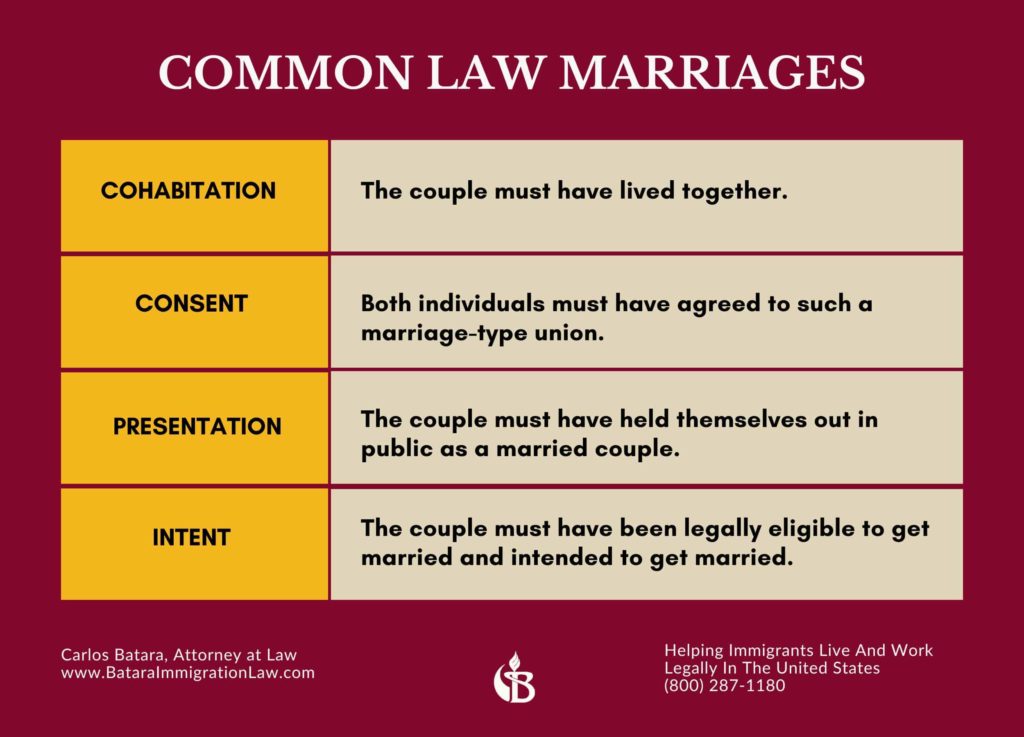
To be legally recognized as common law spouses, couples generally need to demonstrate the following three core elements:
-
Present Intent to be Married: This is arguably the most critical element. Both individuals must have a clear and present intention to be married to each other at that moment. This isn’t about a future intention to marry; it’s about a present commitment as husband and wife. This intent can be demonstrated through various actions and statements.
-
Holding Out to the Public as Married: The couple must present themselves to their community, friends, family, and the public as being married. This “holding out” involves more than just introducing each other as partners. It typically includes:
- Using the same last name.
- Referring to each other as “my husband” or “my wife” in public.
- Filing joint tax returns (though this can be complex and may require specific language indicating marriage).
- Listing each other as spouses on insurance policies or other legal documents.
- Attending social events as a married couple.
-
Cohabitation: While cohabitation alone is insufficient, it is a necessary component in most jurisdictions. Couples must live together as if they were married. This implies a shared residence and a life intertwined as a married unit.
The specific evidence required to prove these elements can vary significantly by jurisdiction. In some cases, a court may look at a totality of the circumstances, while others may have more rigid requirements.
Implications for Your Financial Well-being and Estate Planning
The legal recognition of a common law spouse has profound implications for your financial life, impacting everything from property division and inheritance to benefits and taxation. For individuals focused on Money and Personal Finance, understanding these implications is paramount.
Property Rights and Division
If a common law marriage is legally established, spouses are generally entitled to the same property rights as those in a formally married union. In the event of separation or death, this can mean:

- Equitable Distribution: Property acquired during the course of the common law marriage may be subject to division upon dissolution. This means assets accumulated jointly, even without a formal marriage certificate, could be divided equitably between the partners.
- Inheritance Rights: If one common law spouse dies without a will (intestate), the surviving spouse may have rights to inherit property, similar to a legally married spouse. This is particularly important in states like New Hampshire, where common law marriage is recognized solely for inheritance purposes.
- Spousal Support/Alimony: In some jurisdictions, a common law spouse may be eligible for spousal support or alimony following the dissolution of the relationship, provided the legal criteria are met.
Benefits and Insurance
The recognition of a common law spouse can also extend to various benefits:
- Health Insurance: An employer’s health insurance plan might extend coverage to a common law spouse, depending on the plan’s terms and the jurisdiction’s laws.
- Social Security Benefits: In certain circumstances, a surviving common law spouse may be eligible for Social Security survivor benefits.
- Retirement Funds: Pensions and retirement accounts accrued during the common law marriage may be subject to division or inheritance rights.
Taxation and Joint Filings
While not universally applicable, in some instances, common law spouses may be able to file joint tax returns. However, this often requires careful consideration of state and federal tax laws, as the definition of “spouse” for tax purposes can be specific and may not automatically align with common law marriage status without explicit legal recognition and documentation.
Common Law Marriage in the Digital Age: Brand, Productivity, and Security
The rise of technology and the evolving nature of relationships also bring new considerations for common law spouses, particularly in areas of Brand and Tech.
Personal Branding and Public Perception
Your personal brand is a curated representation of who you are, both professionally and personally. For common law spouses, the public declaration of their union, even informally, plays a role in shaping their collective and individual brands. Introducing each other as spouses, sharing social media accounts that reflect a marital status, or even the shared surname can contribute to a public perception of a married partnership. This can influence how clients, colleagues, and the broader community perceive the couple’s stability, commitment, and shared future, which can be a subtle but significant aspect of personal and corporate branding.
Digital Productivity and Shared Lives
In the digital realm, common law spouses often integrate their lives in ways that mirror formally married couples. This can include:
- Shared Cloud Storage and Accounts: Collaborating on documents, sharing photos and videos, and managing shared digital calendars are common. The “holding out” aspect of common law marriage can be evidenced by these integrated digital lives.
- Joint Financial Management Apps: Using apps for budgeting, bill payment, and investment tracking often involves shared access and collaborative financial decision-making.
- Digital Estate Planning: While less common, discussions about digital assets, social media accounts, and online legacies can become relevant for common law spouses, mirroring concerns of traditional couples.
Digital Security Considerations
As your digital lives become intertwined, so do the potential security risks. For common law spouses, this means:
- Shared Device Security: If devices are shared or accessed by both partners, ensuring strong passwords, regular updates, and secure browsing habits is crucial for both individuals.
- Data Privacy: Understanding how personal data is shared and protected across linked accounts and services becomes important, especially if one partner’s security is compromised.
- Password Management: Using a secure password manager can help both partners manage a multitude of online accounts efficiently and securely. This is a key productivity and security tool for any couple, regardless of their marital status.

Conclusion: Clarity and Legal Counsel are Key
The concept of a common law spouse offers a legal pathway for committed couples to gain recognition and rights without a formal ceremony. However, the absence of a marriage certificate can lead to ambiguity, and establishing common law marriage requires meeting specific legal thresholds.
For individuals who believe they are in a common law marriage, or for those considering such a partnership, seeking legal counsel from an attorney specializing in family law in your jurisdiction is absolutely essential. They can provide personalized advice based on your specific circumstances and the laws of your state. Furthermore, proactively documenting your intent to be married and your “holding out” as a married couple through consistent actions and communications can strengthen your position should legal recognition ever be challenged.
Navigating the complexities of common law marriage demands a clear understanding of the legal requirements, a commitment to demonstrating your intent to be married, and a willingness to seek professional guidance to ensure your relationship and your future are legally protected.
aViewFromTheCave is a participant in the Amazon Services LLC Associates Program, an affiliate advertising program designed to provide a means for sites to earn advertising fees by advertising and linking to Amazon.com. Amazon, the Amazon logo, AmazonSupply, and the AmazonSupply logo are trademarks of Amazon.com, Inc. or its affiliates. As an Amazon Associate we earn affiliate commissions from qualifying purchases.