
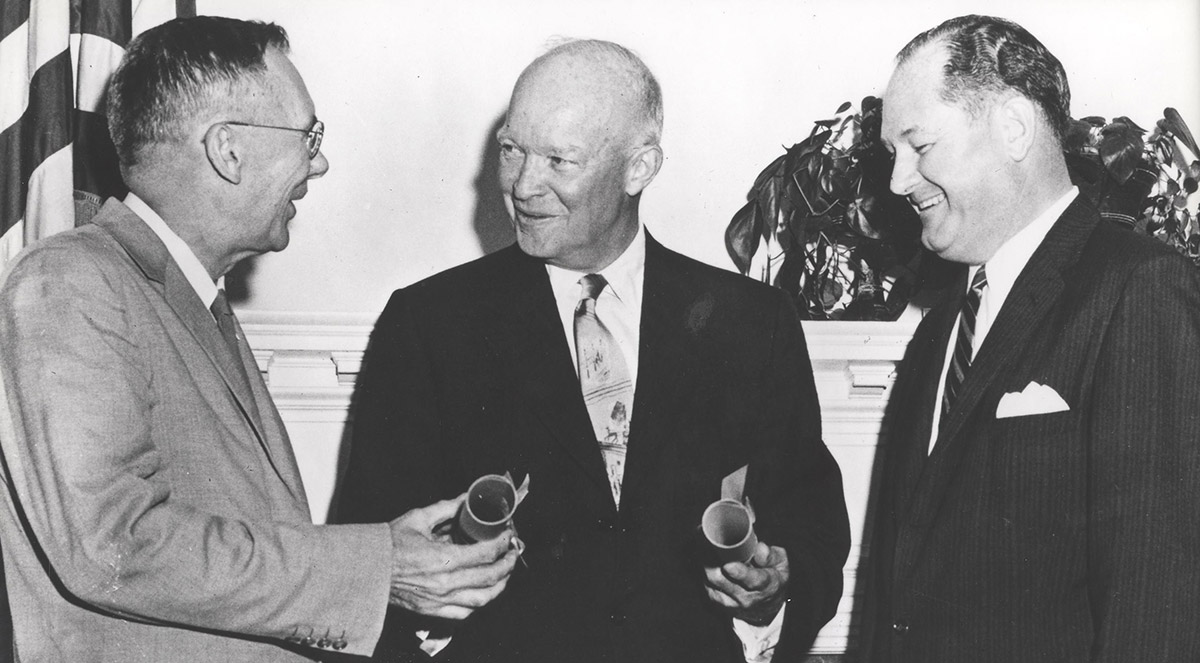
In the annals of human innovation, few dates carry as much technological weight as July 29, 1958. This was the day President Dwight D. Eisenhower signed the National Aeronautics and Space Act, leading to the official opening of the National Aeronautics and Space Administration (NASA) on October 1, 1958. While historians often view this moment through the lens of Cold War geopolitics, its true legacy lies in the radical acceleration of global technology.
The establishment of NASA was not merely a bureaucratic shift from its predecessor, the National Advisory Committee for Aeronautics (NACA); it was the birth of a centralized engine for research and development (R&D) that would eventually birth the digital age, revolutionize materials science, and set the stage for the artificial intelligence (AI) revolution we are witnessing today.
1. The Technological Genesis: From Sputnik to Silicon Valley
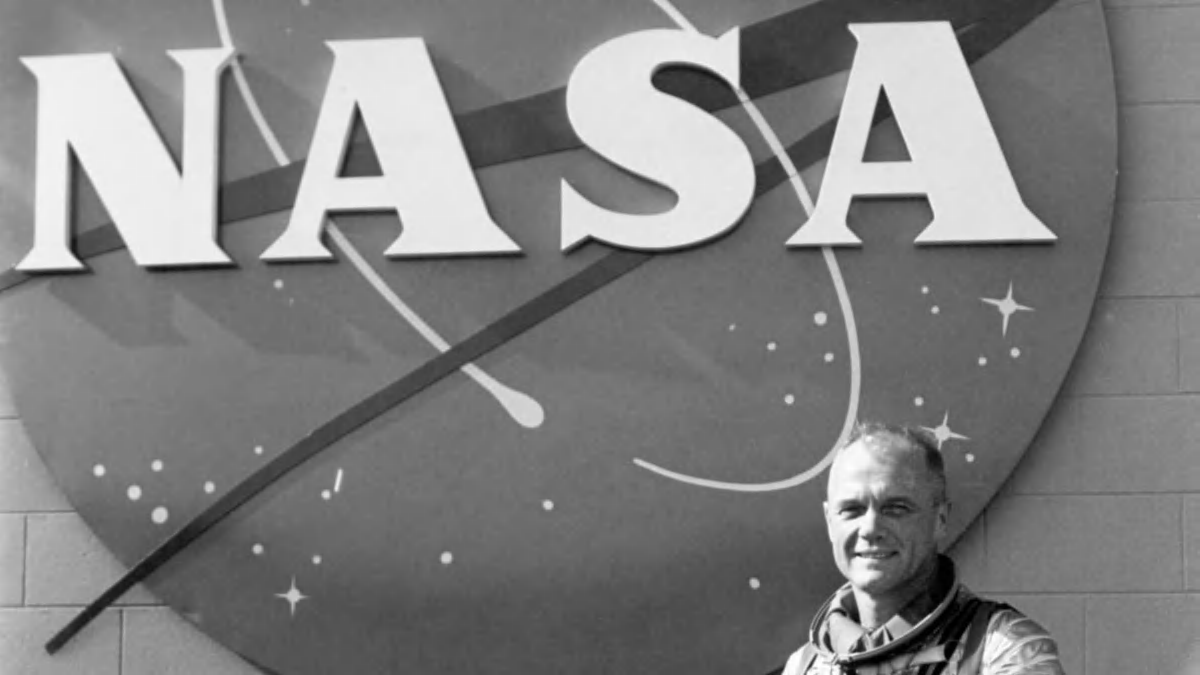
The year 1958 was a reactionary period for American technology. Following the Soviet Union’s successful launch of Sputnik 1 in 1957, the United States realized that its disparate military research programs were insufficient for the complexities of orbital flight. The creation of NASA represented the first time a civilian agency was tasked with the systemic development of high-tier aerospace technology.
Sputnik and the Pressure for Innovation
Before NASA, technology was often developed in silos. Sputnik proved that the integration of rocketry, telecommunications, and orbital mechanics required a unified technological framework. When NASA began operations in October 1958, it inherited several facilities—including the Langley Aeronautical Laboratory and the Ames Research Center—but it also inherited a daunting challenge: how to miniaturize electronics to fit into a rocket’s nose cone.
The Transition from NACA to NASA
NACA had been focused primarily on flight within the atmosphere. The 1958 shift to NASA forced a pivot toward “vacuum-compatible” technology. This required an entirely new understanding of thermodynamics and hardware durability. This transition birthed the modern concept of “Systems Engineering,” a methodology now standard in software development and complex hardware manufacturing, where every component is designed to function as part of a massive, interconnected whole.
2. NASA as an Incubator for Modern Tech Infrastructure
It is a common misconception that NASA’s only “tech” is related to rockets. In reality, the agency’s establishment in 1958 served as the ultimate venture capital project for the 20th century. By demanding solutions for problems that didn’t yet exist, NASA forced the tech industry to leapfrog decades of incremental progress.
The Birth of Software Engineering
During the early years of the Mercury and Apollo programs, “software” was not yet a recognized profession. In fact, the term “Software Engineering” was popularized by Margaret Hamilton during her work on the Apollo Guidance Computer (AGC). NASA’s need for error-free, real-time processing led to the development of asynchronous processing and priority scheduling—concepts that underpin every operating system used today, from Windows to iOS.
The Integrated Circuit Revolution
In the early 1960s, computers were the size of rooms. To get to the moon, NASA needed them to be the size of a briefcase. NASA became the largest consumer of integrated circuits (ICs) in the world, effectively subsidizing the early semiconductor industry. By purchasing these expensive, unproven chips for the Apollo program, NASA provided the financial stability that allowed companies like Fairchild Semiconductor and Intel to refine their manufacturing processes. This drive for miniaturization is the direct ancestor of the processor in your smartphone.
Materials Science and “Spinoff” Technologies
NASA’s 1958 mandate included the dissemination of its findings to the public. This resulted in the “Technology Transfer Program.” Technologies we take for granted today—such as CMOS image sensors (the cameras in our phones), scratch-resistant lenses, and memory foam—all originated from NASA’s technical requirements for space exploration. The agency’s need to protect astronauts from extreme temperatures led to the development of advanced insulation and fire-retardant fabrics used by firefighters today.
3. The Digital Transformation: From Mainframes to Remote Sensing
As NASA matured through the 1970s and 80s, its technological focus shifted from “getting there” to “understanding there.” This required a massive leap in data processing and remote communication technology, laying the groundwork for the modern internet and global positioning systems.
Remote Sensing and Satellite Data
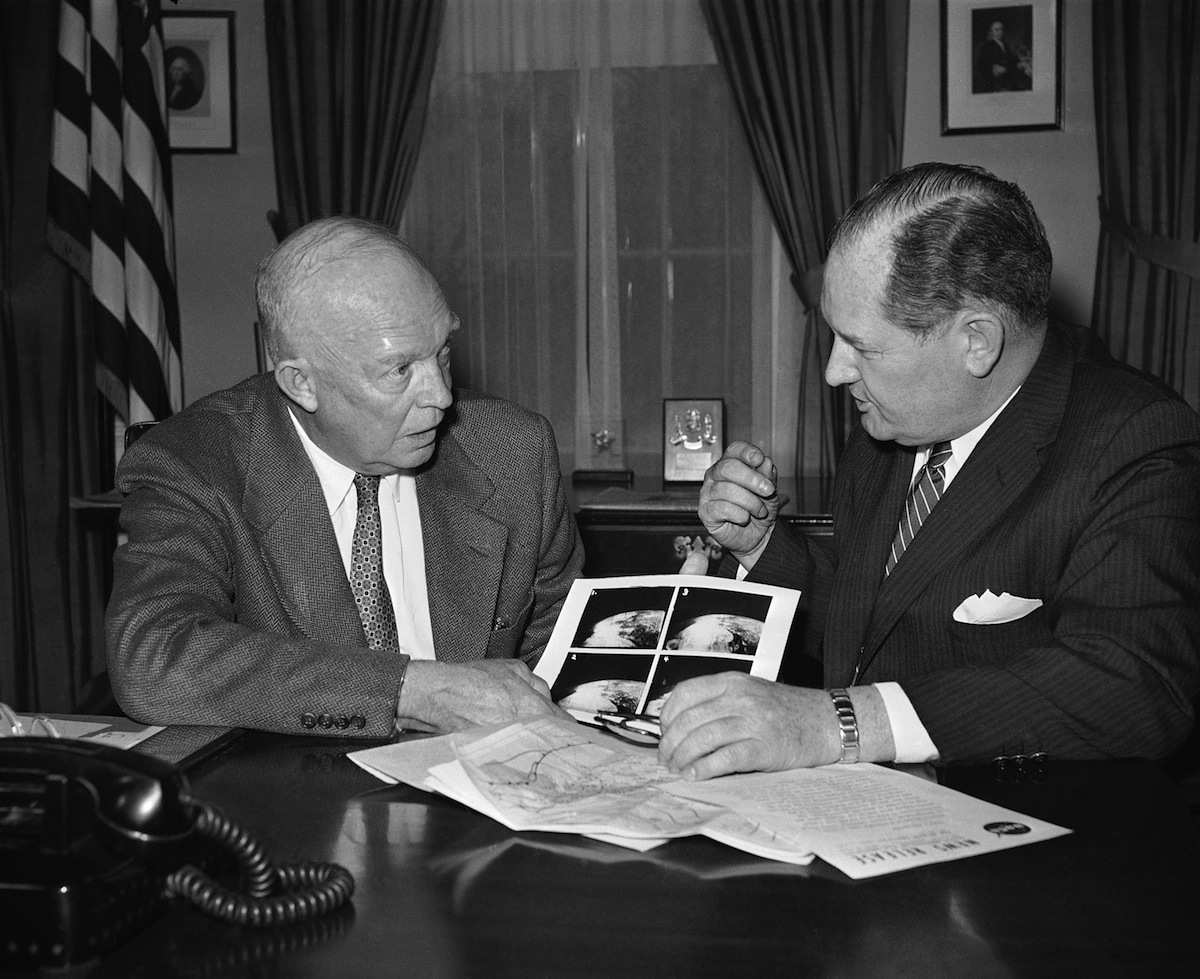
The establishment of the Landsat program in the early 1970s marked a turning point in how we use tech to monitor our planet. NASA developed advanced sensors capable of “seeing” across the electromagnetic spectrum. This technology is the backbone of modern precision agriculture, climate modeling, and even the “satellite view” on Google Maps. The ability to transmit high-resolution data across vast distances of space also pushed the boundaries of data compression and error-correction algorithms.
Telecommunications and the Global Village
NASA’s work on the Syncom satellites in the 1960s proved that geosynchronous satellites could be used for constant global communication. This tech didn’t just allow for “one small step for man” to be broadcast live; it created the infrastructure for the global telecommunications network. Every time you use a GPS or watch a live international broadcast, you are utilizing a technological lineage that traces back to the 1958 NASA charter.
Miniaturization and the PC Revolution
By the late 1970s, NASA’s demand for high-performance, low-weight computing had trickled down to the consumer market. The engineering rigor required for spaceflight influenced the design of early personal computers. NASA’s use of the GRiD Compass, one of the first laptop computers, on the Space Shuttle in the 1980s helped validate the “clamshell” design and the portability of high-level computing.
4. AI, Robotics, and the Future of NASA’s Tech Stack
Today, NASA continues to be at the bleeding edge of technology, particularly in the realms of Artificial Intelligence (AI) and autonomous systems. The agency that was established in 1958 to “catch up” with the Soviets is now the global leader in deploying AI in extreme environments.
Autonomous Rovers and Machine Learning
Because of the communication delay between Earth and Mars, NASA’s rovers—like Curiosity and Perseverance—cannot be “remote controlled” in real-time. They must be autonomous. This has driven massive advancements in computer vision and machine learning. NASA’s AI must identify obstacles, plan routes, and even select scientific targets for analysis without human intervention. These same algorithms are currently being adapted for use in self-driving cars and industrial robotics on Earth.
Digital Twins and Simulation Tech
Before NASA launches a mission, they build a “Digital Twin”—a complex virtual model that simulates every possible scenario the hardware might face. This use of “Big Data” and predictive analytics allows engineers to troubleshoot hardware millions of miles away. In the tech industry, the concept of the Digital Twin is now being used in smart cities and manufacturing to optimize performance and reduce costs.
Cybersecurity in the Final Frontier
As space becomes more commercialized and competitive, NASA has become a leader in aerospace cybersecurity. Protecting deep-space communications from interception or interference is a high-stakes tech challenge. The encryption protocols and secure communication channels developed by NASA provide a blueprint for securing the “Internet of Things” (IoT) and critical infrastructure back on Earth.
The Legacy of 1958 in a Digital World
When we ask “what year was NASA established,” the answer—1958—is more than just a trivia point. It marks the moment humanity decided to institutionalize the pursuit of the impossible. From a tech perspective, NASA serves as a permanent “R&D department for humanity.”
The agency’s establishment forced the world to move away from analog limitations and into a digital, interconnected reality. Without the push for miniaturization in the 1960s, the drive for global satellite communication in the 70s, and the development of autonomous AI for Mars exploration, the modern tech landscape would look radically different.
As we look toward the Artemis missions and the eventual human exploration of Mars, NASA continues to act as a catalyst for emerging technologies like quantum computing, 3D printing in zero-G, and advanced bioregenerative life support. The technological spark ignited in 1958 continues to burn, proving that when we invest in the most difficult technical challenges, the benefits resonate across every screen, every device, and every software program we use today. NASA didn’t just take us to the moon; it built the technological ladder we use to climb into the future.
aViewFromTheCave is a participant in the Amazon Services LLC Associates Program, an affiliate advertising program designed to provide a means for sites to earn advertising fees by advertising and linking to Amazon.com. Amazon, the Amazon logo, AmazonSupply, and the AmazonSupply logo are trademarks of Amazon.com, Inc. or its affiliates. As an Amazon Associate we earn affiliate commissions from qualifying purchases.