
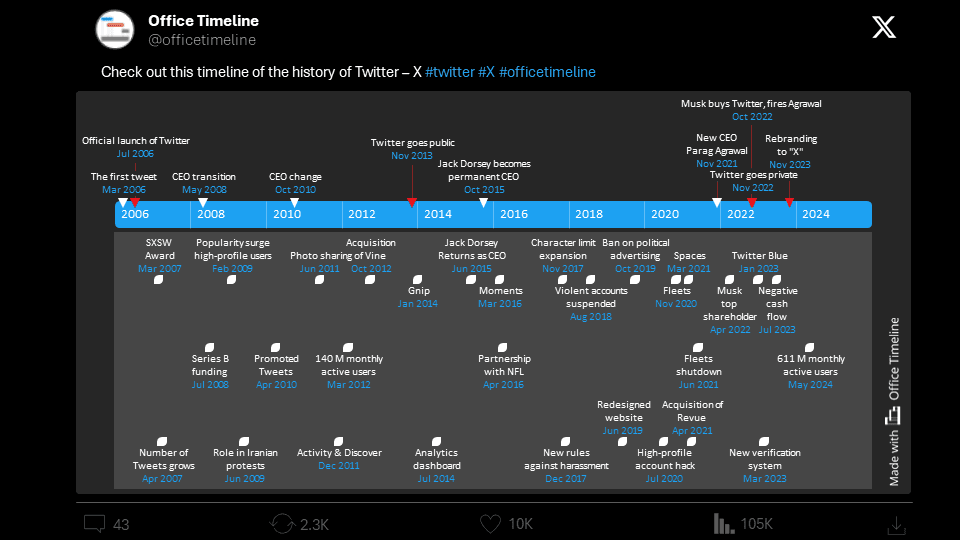
Twitter, the revolutionary microblogging platform that reshaped digital communication, officially launched in July 2006. Conceived by Jack Dorsey, Noah Glass, Biz Stone, and Evan Williams, it began as an internal project within Odeo, a podcasting company, before spinning off into its own entity. Its public debut marked the genesis of a unique social network that would fundamentally alter how individuals consume information, interact with the world, and participate in global discourse, all within the concise constraint of initially 140 characters. From its humble beginnings as a text-message-based service, Twitter rapidly evolved into a global phenomenon, demonstrating the profound impact of real-time information sharing and minimalistic communication. This article delves into the technological journey of Twitter, exploring its initial design, foundational features, scaling challenges, and enduring legacy within the digital sphere.
The Genesis of a Microblogging Revolution
The mid-2000s were a fertile ground for new internet technologies and social experiments. Friendster, MySpace, and Facebook were already carving out niches, yet there was an evident gap for a platform that prioritized brevity and immediacy. It was this whitespace that Twitter was perfectly poised to fill, born from a blend of creative vision and fortuitous timing within a dynamic tech landscape.
Concept and Founding Vision
The original idea for Twitter, then codenamed “twttr,” sprang primarily from Jack Dorsey’s fascination with status updates and the potential for a service that allowed people to share quick thoughts with a small group. He envisioned a system that combined the ubiquity of SMS with the community aspect of early social networks. The concept was simple yet radical: What if you could tell everyone what you’re doing, thinking, or seeing, in real-time, using short, atomic bursts of text? This real-time, public, and broadcast nature was a significant departure from the more contained, friend-network-centric models prevalent at the time. The constraint of 140 characters, initially mirroring the SMS character limit, was not merely a technical limitation but a design philosophy, forcing users to be concise, clever, and direct. This constraint would ironically become one of Twitter’s most defining and beloved features, fostering a unique form of digital communication.
The Early Prototyping and Launch
The initial prototype of “twttr” was developed in March 2006 by Jack Dorsey, an engineer with a background in dispatch systems, which likely informed his interest in real-time updates. The first tweet ever, sent by Dorsey on March 21, 2006, famously read: “just setting up my twttr.” The platform was initially an internal project at Odeo, a company struggling to find its footing after Apple’s iTunes took over the podcasting market. The team, including Evan Williams (Odeo’s CEO), Biz Stone, and Noah Glass, recognized the potential in this new microblogging concept.
By July 2006, the service was officially launched to the public. However, the exact timing of “launch” can be debated, as is common with many software projects that evolve from internal testing to public beta and then to a full release. What is clear is that by mid-2006, Twitter was available for anyone to sign up and begin tweeting. The platform’s early infrastructure was rudimentary, focusing primarily on stability and delivering messages efficiently. Its initial growth was organic, driven by early adopters and tech enthusiasts who recognized the novelty and utility of real-time, public messaging.
Initial Features and User Experience
In its earliest iteration, Twitter was remarkably minimalist. The core function was to post short, text-based updates. Users could “follow” other users to see their tweets in a chronological timeline. There were no hashtags, no retweets, no direct messages, and no rich media support. Communication was primarily one-way or via public replies.
The user interface, both on the web and through third-party SMS gateways, was designed for simplicity. Tweets were displayed in reverse chronological order, emphasizing immediacy. This stripped-down approach was a deliberate design choice, reflecting the platform’s core purpose: quick, effortless information dissemination. The reliance on SMS for posting updates was a crucial factor in its early accessibility, allowing users to tweet from virtually any mobile phone, long before the widespread adoption of smartphones and mobile data plans. This SMS integration was not just a feature; it was a fundamental pillar of its initial technical architecture and user engagement model, making Twitter accessible to a broad audience who might not have had constant internet access.
Twitter’s Ascent and Cultural Impact
Twitter’s growth from a niche tech tool to a global communication behemoth was propelled by its unique ability to deliver real-time information and foster connectivity, often in unprecedented ways. Its technological simplicity belied its profound potential for social and cultural transformation.
The Power of Real-time Information
A key technological innovation, perhaps unintentional at first, was Twitter’s capacity for real-time reporting. During unforeseen events, natural disasters, or major public happenings, traditional media outlets often lagged. Twitter, conversely, allowed eyewitnesses to share updates instantly, creating a distributed, live news feed. This was powerfully demonstrated during the 2007 San Diego wildfires, where users tweeted updates faster than traditional news outlets could report them. This immediate dissemination of information cemented Twitter’s reputation as a vital source during crises, a feature that was inherently built into its architecture of public, chronological updates.
The platform’s real-time nature also facilitated the emergence of “trending topics,” an algorithmically driven feature that highlighted popular subjects of discussion. This gave users a pulse on global conversations, showcasing not just what individuals were saying but what the collective was focusing on, further amplifying its role as a real-time information aggregator.
Key Milestones and Feature Evolution
Twitter’s evolution was characterized by continuous technological development, often driven by user behavior and community innovation rather than solely top-down design.
- Hashtags (#): Introduced in 2007 by user Chris Messina, hashtags became a way to categorize tweets and make them discoverable. What started as a user-generated convention was later officially integrated into the platform, becoming a global standard for topic organization. This was a critical piece of technological adoption, where user-driven innovation led to a core platform feature.
- Retweets (RT): The concept of “retweeting” (sharing another user’s tweet) also originated as a user convention, manually typing “RT @username” before a tweet. Twitter officially integrated the Retweet button in 2009, simplifying content amplification and dramatically increasing the virality of information. This formalized a crucial aspect of content sharing, making Twitter a more potent medium for viral spread.
- @ Mentions and Direct Messages: The ability to mention other users with the “@” symbol became standard early on, facilitating direct public conversation. Direct Messages (DMs) offered a private channel for communication, evolving over time to include group chats and media sharing, moving beyond just simple text.
- Media Integration: As internet speeds improved and smartphones became ubiquitous, Twitter gradually integrated support for photos and videos, transforming it from a purely text-based platform to a rich multimedia sharing environment. This required significant backend development to handle media storage, processing, and delivery at scale.
Role in Major Events and Social Movements

Twitter’s technological architecture—its open, public, and real-time nature—made it an indispensable tool for social and political movements worldwide. From the Arab Spring uprisings in 2010-2011 to various protest movements globally, Twitter provided a platform for activists to organize, disseminate information, and share their narratives, often bypassing traditional media gatekeepers. It allowed for the rapid spread of awareness, the coordination of events, and the sharing of eyewitness accounts, demonstrating its power as a tool for collective action and direct democracy. Technologically, this meant Twitter’s infrastructure had to withstand surges in activity and attempts at censorship, highlighting the political implications of its engineering decisions regarding uptime and accessibility.
Technological Underpinnings and Challenges
Behind Twitter’s deceptively simple interface lay a complex and rapidly evolving technological infrastructure, constantly battling the challenges of hyper-growth and the demand for instant delivery.
Scaling for Rapid Growth
From 2006 onwards, Twitter experienced exponential user growth, which placed immense strain on its early systems. Built initially on Ruby on Rails, a popular web application framework, the platform struggled to handle the increasing volume of tweets, user requests, and concurrent connections. The core challenge was scaling a system designed for a small user base to accommodate millions of concurrent users posting billions of messages. This involved significant engineering efforts in:
- Database Management: Moving from monolithic databases to sharded architectures and eventually adopting more specialized NoSQL databases to handle massive write and read operations.
- Real-time Processing: Developing sophisticated message queues and stream processing systems to ensure tweets appeared instantly in timelines across the globe.
- Distributed Systems: Breaking down the application into microservices and deploying them across numerous servers and data centers to improve resilience and performance.
The “Fail Whale” Era and Infrastructure Development
One of the most iconic symbols of Twitter’s early growing pains was the “Fail Whale” – an image of a whale being lifted by birds, displayed when the site was overloaded and unable to serve requests. This image, while endearing to some, represented frequent outages and performance issues that plagued Twitter between 2007 and 2010. These stability problems were a direct consequence of an infrastructure struggling to keep pace with unprecedented growth.
Addressing the “Fail Whale” era necessitated a complete overhaul of Twitter’s backend. The engineering team embarked on a multi-year effort to re-architect the platform, moving away from its initial Rails monolith. Key changes included:
- Migration to Scala and Java: Porting critical services to JVM-based languages like Scala and Java, which offered better performance characteristics and concurrency handling for high-throughput applications.
- Custom Data Stores: Developing proprietary solutions like Manhattan (a distributed key-value store) and the “T-bird” message fanout system, specifically optimized for Twitter’s unique data access patterns (e.g., highly concurrent reads and writes for timelines).
- Introduction of Mesos/Aurora: Adopting and contributing to open-source cluster management technologies to manage their vast fleet of servers efficiently.
These deep infrastructural changes were crucial in transforming Twitter from a frequently unstable service into a robust, high-availability platform capable of handling global events with minimal disruption.
Innovations in Data Handling and User Interaction
Twitter’s technological journey also saw significant innovations in how it processed and presented data. The sheer volume of tweets, user relationships, and interactions presented unique challenges and opportunities for data science and machine learning.
- Timeline Generation: Crafting algorithms to efficiently generate personalized timelines, initially purely chronological, but later incorporating algorithmic ranking to surface more relevant content, balancing recency with engagement signals.
- Spam and Abuse Detection: Developing sophisticated machine learning models to identify and combat spam, bot networks, and abusive content, a perpetual arms race in social media.
- Search and Discovery: Building powerful real-time search capabilities to index billions of tweets and make them instantly searchable, alongside features like “Who to Follow” recommendations driven by graph analysis and machine learning.
- API Development: Twitter’s robust API allowed third-party developers to build a rich ecosystem of clients and tools, extending its functionality and reach. While this relationship evolved over time, the API was a key technological enabler for its early success and integration into other applications.
The Evolving Landscape of a Social Giant
Twitter’s trajectory since its launch has not been linear. It has constantly adapted to technological advancements, competitive pressures, and evolving user expectations, culminating in a significant rebranding.
Adapting to User Needs and Market Trends
As the digital landscape matured, Twitter continued to iterate and expand its features beyond its initial 140-character constraint. The character limit itself was eventually doubled to 280 characters in 2017, acknowledging the evolving needs for richer expression while still retaining a sense of brevity. Features like Moments, Fleets (a short-lived Snapchat-like story feature), and various content formats (audio spaces, longer videos) were introduced to keep pace with multimedia-rich platforms and to broaden its appeal. Each of these additions required substantial engineering work, from backend storage and streaming solutions to front-end UI redesigns, demonstrating the continuous technical effort to remain relevant in a competitive market.
The platform also delved into areas like commerce and subscriptions (Twitter Blue, later X Premium), attempting to diversify its revenue streams beyond advertising. These efforts reflect a broader industry trend where social platforms seek to deepen user engagement and explore new monetization models, often through the integration of new technical features.
From Twitter to X: A New Era
In 2023, under the ownership of Elon Musk, Twitter underwent a radical transformation, rebranding itself as “X.” This change was more than just a logo swap; it signaled an ambition to evolve from a microblogging platform into an “everything app,” encompassing payments, messaging, and a broader range of services. Technically, this represents a massive undertaking, aiming to integrate diverse functionalities into a single, cohesive application. While the full scope of “X” is still unfolding, the rebranding highlights a significant shift in strategic direction, pushing the platform’s technological infrastructure to support a much wider array of use cases than originally conceived. The goal is to move beyond mere information sharing to facilitate complex transactions and interactions, requiring entirely new layers of security, data privacy, and interoperability.

Enduring Influence on Digital Communication
Despite the controversies and changes, Twitter’s legacy as a technological innovator remains profound. It democratized information sharing, empowered individual voices, and created a new paradigm for real-time communication. Its influence can be seen in the character limits adopted by other platforms, the widespread use of hashtags, and the expectation of instant updates from news sources and public figures. Twitter (now X) continues to be a critical component of the global digital infrastructure, a testament to its foundational design principles and the continuous technological evolution it has undergone since its launch in 2006. Its journey from a simple SMS-based status updater to a complex, global real-time information network showcases the dynamic power of software innovation and its indelible mark on modern society.
In conclusion, Twitter emerged in July 2006 as a deceptively simple yet profoundly impactful technological innovation. Its journey has been one of continuous adaptation and scaling, tackling immense engineering challenges to maintain its role as a pivotal global communication platform. From its early “Fail Whale” days to its current iteration as “X,” its story is a compelling narrative of how a minimalist concept can grow into a complex, world-changing technology.
aViewFromTheCave is a participant in the Amazon Services LLC Associates Program, an affiliate advertising program designed to provide a means for sites to earn advertising fees by advertising and linking to Amazon.com. Amazon, the Amazon logo, AmazonSupply, and the AmazonSupply logo are trademarks of Amazon.com, Inc. or its affiliates. As an Amazon Associate we earn affiliate commissions from qualifying purchases.