
In the landscape of software history, few titles have redefined a genre as profoundly as The Sims. Released at the turn of the millennium, this title did not just offer a new way to play; it introduced a sophisticated engine for life simulation that challenged the conventions of artificial intelligence and user interface design. While many remember it for the “Rosebud” cheat code or the quirky language of its inhabitants, the technological architecture beneath the surface was a masterclass in software engineering. Understanding the year The Sims came out—and the tech climate of that era—is essential for appreciating its status as a cornerstone of digital simulation.
A Millennial Milestone: The Release and Technical Origin of The Sims 1
On February 4, 2000, Electronic Arts and Maxis released The Sims to a market that was largely skeptical of its potential. At the time, the gaming industry was obsessed with high-octane shooters and complex strategy games. The idea of a “digital dollhouse” seemed technically niche. However, the software was the brainchild of Will Wright, the visionary behind SimCity, who sought to scale down urban planning to the level of individual human behavior.
The Vision of Will Wright and Maxis
The development of The Sims (initially codenamed “Project X”) began in the mid-1990s. Following the success of SimCity, Wright became fascinated with the idea of “architectural simulation.” After losing his home in the 1991 Oakland fire, he became acutely aware of the relationship between people and the objects they consume to rebuild their lives. This psychological insight became the foundation for the game’s software logic. Maxis utilized a unique isometric 2.5D engine, which allowed for complex visual representation without the heavy processing requirements of full 3D, which was still in its infancy for consumer-grade PCs in 2000.
The Tech Climate of February 2000
To understand the significance of its release date, one must look at the hardware limitations of the era. Most home computers were running Windows 98 or the newly released Windows 2000. Standard RAM hovered around 64MB to 128MB. Maxis had to optimize the game to handle hundreds of autonomous scripts simultaneously within these constraints. By launching in early 2000, The Sims capitalized on the rapidly expanding home PC market, providing a piece of software that was accessible yet computationally dense.
Transitioning from SimCity to Sim-Level Detail
The shift from managing a city to managing a household required a fundamental pivot in data management. In SimCity, the software tracked statistical trends; in The Sims, the engine had to track individual “motives” in real-time. This transition represented a significant leap in how developers thought about granularity in simulation software, moving from macro-level data sets to micro-level behavioral loops.
Breaking the Code: The AI and Engine Behind the Simulation
The true genius of The Sims lay in its “Smart Object” technology. Rather than coding every possible behavior into the characters (the Sims) themselves, the developers encoded the instructions into the objects. This decentralized approach to AI was revolutionary and allowed for a highly extensible software environment.
The Architecture of “Smart Objects”
In The Sims, a refrigerator isn’t just a static graphic; it is a script-heavy object that broadcasts its availability to any Sim with a low “Hunger” motive. When a Sim interacts with an object, the object essentially tells the Sim which animations to play and which internal variables to update. This object-oriented programming approach meant that adding new content was as simple as adding a new script, rather than rewriting the core AI of the characters. It allowed the game to scale indefinitely, a feature that would later define the franchise’s expansion-heavy business model.
Simlish: A Linguistic Innovation in Data Compression
One of the most famous aspects of the game—the Simlish language—was actually a strategic technological choice. Providing recorded dialogue for every possible interaction would have required an astronomical amount of disc space and memory. Furthermore, repetitive voice lines would have quickly broken the immersion. By using a gibberish language composed of improvised sounds, Maxis avoided the “uncanny valley” of dialogue and saved significant storage space, allowing more resources to be allocated to the simulation engine itself.

The Motive System: Managing the Finite State Machine
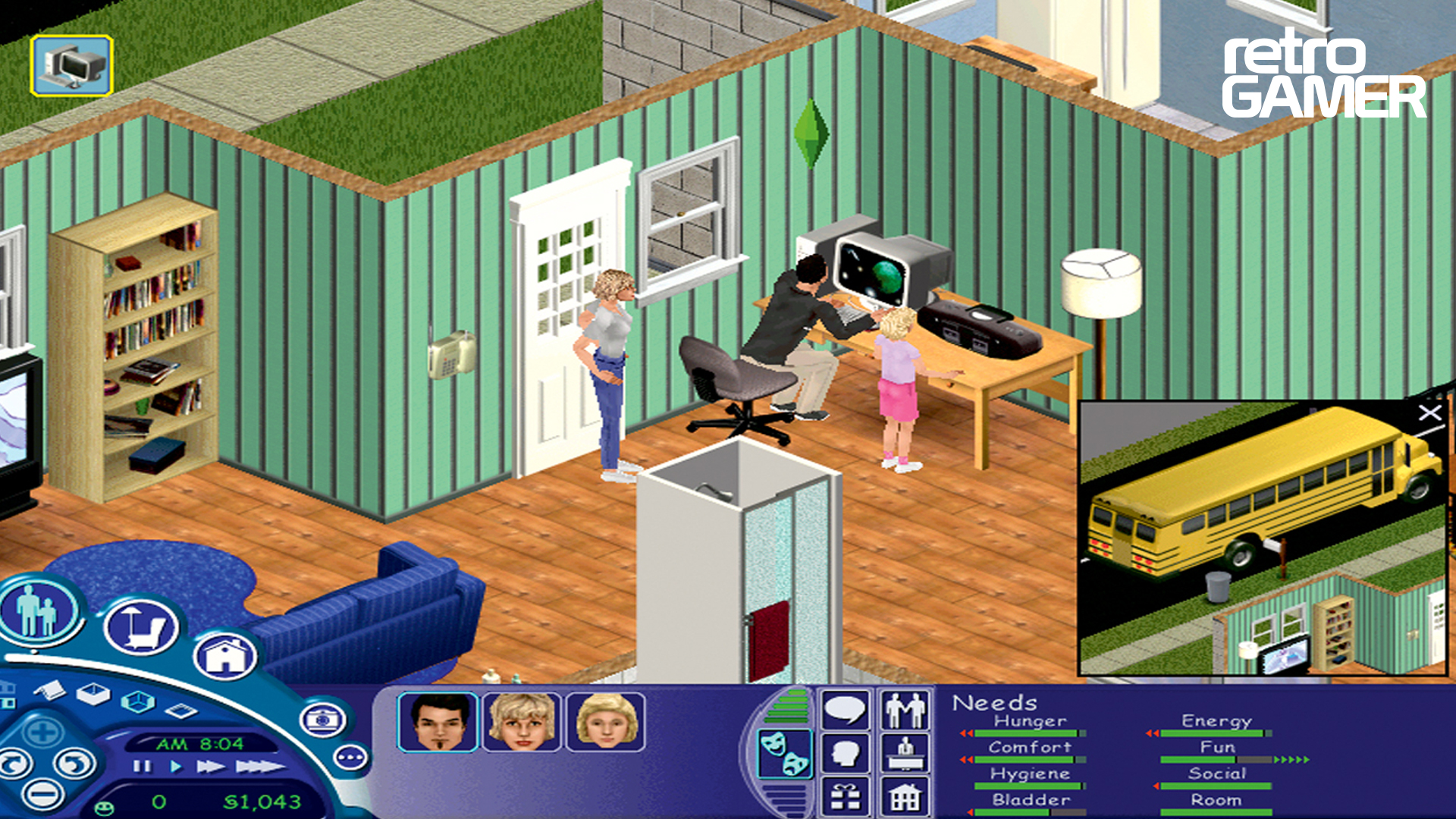
Each Sim functioned as a “Finite State Machine,” governed by eight primary motives: Hunger, Comfort, Bladder, Energy, Fun, Social, Hygiene, and Room. The software constantly ran a “weighted” calculation to determine the Sim’s next action. If the Bladder motive dropped below a certain threshold, it took priority over Fun. This priority-queue system was an elegant solution to simulating human-like decision-making, providing a sense of autonomy that was unprecedented in consumer software at the time.
Software Evolution: How The Sims Revolutionized the Expansion Pack Model
Beyond its initial release in 2000, The Sims became a pioneer in the “Software as a Service” (SaaS) precursor model through its expansion packs. Between 2000 and 2003, Maxis released seven major expansions, each introducing new technical layers to the base game.
Modular Code and Cumulative Updates
The release of The Sims: Livin’ Large (2000) and The Sims: House Party (2001) demonstrated the robustness of the game’s modular code. Each expansion had to hook into the base executable without breaking the save files of millions of users. This required a rigorous version control system and a file architecture that could handle “overwriting” old assets with new, optimized versions. Maxis successfully created a cumulative software environment where each new installment felt like a seamless upgrade rather than a separate entity.
Managing Large-Scale Data Across Add-ons
By the time The Sims: Makin’ Magic arrived in 2003, the game had grown from a simple household sim to a complex world involving pathfinding across multiple “lots” and magic-based logic gates. Managing the pathfinding AI—the code that tells a Sim how to get from point A to point B without getting stuck behind a chair—became increasingly difficult as more objects were added. The developers refined their navigation mesh algorithms with each update, ensuring that the software remained playable even as the virtual environments became more cluttered.
The Rise of Patching and Digital Support
The early 2000s saw the beginning of the “patch” era for mainstream gaming. Maxis used their website to provide technical support and executable updates to fix bugs that occurred on specific hardware configurations (such as certain graphics cards or sound drivers). This era of digital upkeep helped bridge the gap between traditional “on-disc” software and the modern era of constant cloud updates.
Technical Influence: The Lasting Impact on Modern Game Engines and UI Design
The legacy of the original The Sims extends far beyond nostalgia. Its technical breakthroughs paved the way for modern simulation engines and influenced how developers approach user interface (UI) and user experience (UX) in non-linear software.
Influencing the Sandbox and God-Game Genres
The success of The Sims validated the “sandbox” approach to software design, where there is no set “win” condition. This influenced an entire generation of developers to focus on emergent gameplay—scenarios that arise naturally from the interaction of various game systems rather than being scripted by a designer. Modern titles like RimWorld or Cities: Skylines owe a debt to the motive-based AI and object-oriented logic pioneered by Maxis in 2000.
UI/UX Innovations: The Control Panel and Build Mode
The user interface of The Sims was a masterclass in presenting complex data in an accessible way. The “Control Panel” at the bottom of the screen managed to display a Sim’s status, inventory, relationships, and house controls without overwhelming the user. Furthermore, the “Build/Buy” mode introduced a grid-based spatial editor that was intuitive even for non-technical users. This focus on “approachable complexity” has become a gold standard in modern app and software design, emphasizing that even the most powerful tools should feel simple to the end-user.

The Progenitor of User-Generated Content (UGC)
Perhaps the most significant tech legacy of The Sims was its early embrace of the modding community. Maxis released official tools like “SimShow” and “The Sims Transmogrifier,” which allowed users to export game assets, modify them in software like Photoshop, and re-import them. This early democratization of content creation turned The Sims into an ecosystem rather than just a game. It set the stage for the modern “creator economy” within software, proving that providing users with the tools to build their own content significantly extends the lifecycle and value of the core product.
In conclusion, when we ask “what year did The Sims 1 come out,” the answer—2000—marks more than just a date on a calendar. It marks the birth of a sophisticated technological framework that mastered autonomous AI, modular software expansion, and intuitive UI design. The impact of this February 2000 release continues to resonate through the tech industry, reminding us how a single piece of innovative software can redefine our relationship with the digital world.
aViewFromTheCave is a participant in the Amazon Services LLC Associates Program, an affiliate advertising program designed to provide a means for sites to earn advertising fees by advertising and linking to Amazon.com. Amazon, the Amazon logo, AmazonSupply, and the AmazonSupply logo are trademarks of Amazon.com, Inc. or its affiliates. As an Amazon Associate we earn affiliate commissions from qualifying purchases.