
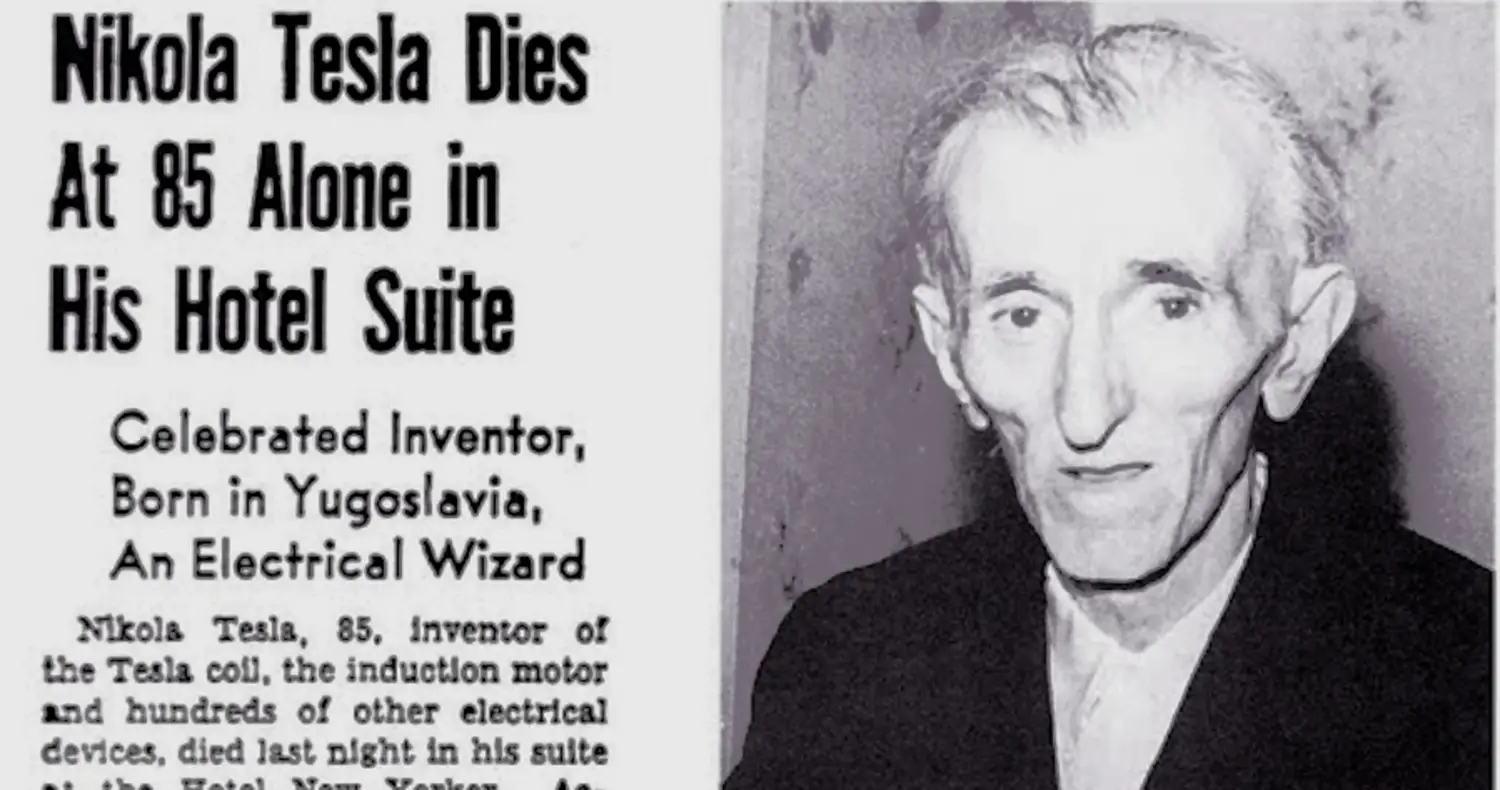
Nikola Tesla, the Serbian-American inventor whose work laid the groundwork for the modern electrical and digital world, died on January 7, 1943. While the date marks the end of his physical life, it serves as the definitive starting point for the “Tesla Era”—a period of rapid technological advancement that saw his once-marginalized theories become the bedrock of global infrastructure. Tesla passed away in Room 3327 of the Hotel New Yorker, leaving behind a massive repository of notes, patents, and conceptual frameworks that continue to drive innovation in software, hardware, and sustainable energy today.

Understanding the year of Tesla’s death is more than a historical footnote; it is a critical checkpoint in the timeline of human technology. In 1943, the world was in the throes of a mechanical revolution, yet Tesla was already conceptualizing the digital revolution. His death triggered a scramble for his research by the Office of Alien Property, highlighting just how valuable his intellectual property was to the future of national security and industrial progress. Today, as we navigate the complexities of AI and wireless communication, the blueprints Tesla left behind remain strikingly relevant.
1943: The Passing of a Visionary and the Dawn of a New Electrical Age
When Tesla died in early 1943, the technology sector was focused on the immediate demands of the Second World War. However, Tesla was preoccupied with concepts that the world would not catch up to for another half-century. His passing marked a transition from the era of individual eccentric genius to the era of corporate R&D labs and government-funded technological initiatives.
The Seizure of Technical Papers
Immediately following his death, the United States government seized several trunks of Tesla’s documents. These papers contained theories on directed-energy weapons, advanced wireless power transmission, and early iterations of what we now recognize as radar technology. The technical community spent decades declassifying and analyzing these notes. This period of secrecy underscores the sheer “tech-forward” nature of Tesla’s mind; he was working on hardware architectures that were physically impossible to build with 1940s metallurgy and vacuum tube technology.
The Shift from Mechanical to Electronic Logic
Tesla’s death coincided with the birth of the first programmable digital computers, such as the Colossus and ENIAC. While Tesla was primarily an electrical engineer, his mastery of the electromagnetic spectrum provided the necessary physics for the binary logic gates that would eventually power the software revolution. His work on “teleautomaton”—the precursor to modern robotics—showed that he understood the concept of hardware being controlled by invisible signals, a fundamental pillar of modern IoT (Internet of Things) and remote-access software.
From Alternating Current to Wireless Transmission: Tesla’s Technological Blueprints
The core of Tesla’s technical legacy is the polyphase alternating current (AC) induction motor. Before Tesla, the world relied on Thomas Edison’s direct current (DC), which was inefficient over long distances. Tesla’s AC system allowed for the electrification of the planet, providing the stable power grid required for the industrialization of the 20th century.
The Foundation of Modern Power Grids
Without the AC system developed by Tesla, the massive server farms that power today’s AI and cloud computing would be impossible. The efficiency of AC allows high-voltage electricity to be transmitted across hundreds of miles and then stepped down to usable levels via transformers. This scalability is what allows a modern tech ecosystem to exist, from the high-performance computing centers in the desert to the smartphone charging in your pocket.
Wireless Communication and the Frequency Spectrum
One of Tesla’s most ambitious projects was the Wardenclyffe Tower, an early attempt at a global, wireless communication and power system. While he lacked the funding to complete it before his death in 1943, his patents for radio and wireless resonance are the ancestors of 5G, Wi-Fi, and Bluetooth. Tesla envisioned a world where “the entire earth will be converted into a huge brain,” a prophetic description of the modern internet. His technical focus on frequency tuning—the ability to isolate a specific signal from a sea of electromagnetic noise—is the fundamental logic used in every modem and transceiver built today.
The Digital Frontier: How Tesla’s Theories Fuel Modern AI and Connectivity
While Tesla did not live to see the silicon chip, his influence on digital technology is undeniable. The transition from pure electrical engineering to software-defined systems relies on the principles of logic and remote control that Tesla pioneered.
Remote Control and Robotics
In 1898, Tesla demonstrated a radio-controlled boat at Madison Square Garden. This was not merely a toy; it was the first “teleautomaton.” He argued that machines could be endowed with their own “mind” to perform tasks autonomously. In the modern context, this is the precursor to autonomous vehicles and drone technology. The algorithms that guide a modern drone are essentially high-speed versions of the radio-frequency logic Tesla developed over a century ago.
The Prediction of Personal Mobile Devices
Tesla’s 1904 description of a “cheap and simple device, which might be carried in one’s pocket” to receive news and messages is a near-perfect prediction of the smartphone. He understood that the transmission of data was not limited by the medium (wires) but by the mastery of waves. Today’s software engineers who design data compression and transmission protocols are working within the “wireless world” that Tesla first calculated.
The Evolution of Energy Storage and Clean Tech Post-Tesla
Perhaps the most significant tech trend currently bearing Tesla’s name is the push for sustainable energy. Tesla was a vocal proponent of harnessing the “wheelwork of nature,” advocating for the use of solar and wind power long before climate change was a global concern.
Battery Technology and Electric Vehicles
Modern electric vehicle (EV) technology is a direct evolution of Tesla’s induction motor. While modern EVs use sophisticated lithium-ion battery packs and complex software for energy management, the propulsion system—the heart of the machine—is based on the electromagnetic principles Tesla perfected. The challenge of the 2020s is energy density and storage, a problem Tesla attempted to solve through wireless energy transfer. As we develop solid-state batteries and “over-the-air” charging for small gadgets, we are finally realizing the hardware dreams Tesla held in 1943.
Grid Management Software
As we integrate renewable energy sources like wind and solar into our legacy power grids, we rely on advanced software to manage the intermittent nature of these sources. This “Smart Grid” technology uses sensors and AI to balance loads and prevent surges. The architecture of these grids is still fundamentally based on Tesla’s polyphase system, proving that his 19th-century hardware designs are robust enough to support 21st-century software layers.
The Future of Innovation: Lessons from the 1943 Milestone
The year 1943 represents a pivot point where Tesla’s inventions became public domain and global standards. As we look toward the future of technology—specifically quantum computing and interstellar communication—Tesla’s philosophy of “non-local” thinking remains a guiding light for researchers.
Quantum Considerations
Tesla often spoke of the “ether” and the interconnectedness of all energy in the universe. While the “ether” theory was largely replaced by Einstein’s relativity, some of Tesla’s ideas about resonance and vibration align with modern studies in quantum entanglement and frequency-based computing. Tech startups today are looking at resonance-based data storage and processing, echoing Tesla’s belief that the universe’s secrets lie in “energy, frequency, and vibration.”
The “Tesla Effect” in Modern Tech Culture
Beyond the hardware and software, Tesla’s death in 1943 solidified the archetype of the “disruptor.” He was an inventor who prioritized innovation over monetization, a trait that both hindered his life and ensured his immortality in the tech world. Today’s tech giants—from those building reusable rockets to those developing neural interfaces—often cite Tesla as their primary inspiration. His life reminds the industry that the most impactful technologies are often those that seem like science fiction at the time of their conception.
Nikola Tesla died in 1943, but his technical blueprint is more alive today than ever before. Every time we log onto a wireless network, start an electric motor, or benefit from a stable power grid, we are interacting with the mind of a man who saw the future and gave us the tools to build it. The legacy of 1943 is not one of loss, but of a permanent shift in the trajectory of human capability, moving us closer to the fully connected, electrified world that Tesla envisioned in his final days.
aViewFromTheCave is a participant in the Amazon Services LLC Associates Program, an affiliate advertising program designed to provide a means for sites to earn advertising fees by advertising and linking to Amazon.com. Amazon, the Amazon logo, AmazonSupply, and the AmazonSupply logo are trademarks of Amazon.com, Inc. or its affiliates. As an Amazon Associate we earn affiliate commissions from qualifying purchases.