
Venice, a city synonymous with romance, canals, and a rich historical tapestry, presents an enduring enigma: how can such a magnificent metropolis exist, seemingly floating on water? The answer lies not in magic, but in a remarkable testament to human ingenuity, innovative engineering, and a deep understanding of natural resources. This article delves into the foundational elements that allowed Venice to rise from the lagoon and endure for centuries, focusing on the critical aspects of resource management and the technological prowess required for its construction. While often romanticized, the practicalities of building on marshy ground demanded a sophisticated approach to materials, structural integrity, and sustainable resource utilization, laying the groundwork for a city that defied conventional urban planning.

The Foundation of Stability: Pioneering Pile Construction
The very existence of Venice is a triumph of structural engineering, a feat accomplished by a deep understanding of soil mechanics and the strategic use of available resources. The primary challenge was to create stable ground in a soft, marshy environment prone to subsidence and tidal fluctuations. This was achieved through an ingenious system of pile construction, a technique that has since been adopted and adapted worldwide, demonstrating Venice’s lasting impact on construction methodologies.
Driving Piles into the Muds
At the heart of Venice’s stability lies the concept of driving wooden piles deep into the lagoon’s seabed. This was not a haphazard undertaking but a meticulously planned process. The lagoon floor is composed of layers of soft mud and clay, with a firmer layer of “caranto” – a dense, compact clay – found at varying depths. The primary objective was to reach this more stable stratum.
Teams of skilled laborers, using a combination of manual labor and rudimentary pile-driving equipment, would meticulously hammer thousands upon thousands of wooden piles into the lagoon floor. The wood of choice was often alder, larch, or oak, selected for its durability and resistance to waterlogging. These timbers were typically seasoned for several years to increase their density and resilience. The piles, measuring anywhere from 15 to 40 feet in length depending on the specific location and depth of the caranto, were driven closely together, forming dense clusters.
The Role of Iron and Stone in Reinforcement
Once the wooden piles reached the caranto, they were typically capped with a thick layer of wooden planks, creating a solid platform. This platform then served as the base for further construction. However, the direct contact of wood with water, even waterlogged wood, presented a long-term challenge. To mitigate this, a layer of impervious material was often laid over the wooden platforms. This was typically a mixture of clay and other natural binders, designed to create a barrier against oxygen and further decay.
Upon this prepared foundation, Venetian builders then placed layers of large Istrian stone blocks. Istrian stone, a hard, dense limestone quarried from the nearby island of Istria, was crucial. Its resistance to erosion and saltwater corrosion made it ideal for the submerged sections of the foundations. These stone blocks were carefully fitted together, forming a robust and stable base upon which the buildings of Venice would eventually rest. The weight of the stone, combined with the interconnectedness of the wooden piles beneath, distributed the load of the structures above, preventing excessive settling and ensuring long-term structural integrity. This multi-layered approach, from the submerged wooden piles to the robust stone bases, was the bedrock of Venice’s architectural marvel.
The “Black Gold” of Venice: Sustainable Timber and Resource Management
The sheer scale of timber required to construct the foundational piles for an entire city was immense. This immediately raises questions about the sustainability of such an endeavor and how Venice managed its precious timber resources. The answer lies in a sophisticated and often ruthless system of resource management, driven by necessity and a pragmatic approach to procurement.
Securing the Timber Supply: Forests and Trade Routes
Venice’s proximity to the Adriatic Sea and its burgeoning maritime power allowed it to tap into extensive timber sources far beyond its immediate surroundings. Initially, the forests of the Venetian mainland provided a significant portion of the timber. However, as the city’s population and construction demands grew, these local resources became insufficient.
The Republic of Venice strategically developed and controlled vast forest areas across its territories, including parts of the Dolomites and Friuli. This involved not only harvesting timber but also actively managing forest regeneration. Sophisticated bureaucratic systems were put in place to oversee logging operations, ensuring a continuous supply. Furthermore, Venice’s dominance in maritime trade meant it could import timber from as far afield as the Balkans and even the Black Sea. Agreements and treaties were negotiated to secure these vital supply lines, underscoring the strategic importance of timber to the city’s survival and prosperity.
Timber Treatment and Longevity: The Science of Preservation
Once harvested, the timber underwent crucial treatment processes to enhance its longevity in the challenging aquatic environment. The practice of waterlogging timber, which might seem counterintuitive, was a key element of Venetian construction. Timber was submerged in seawater for extended periods, often for years. This process served several purposes:
- Increased Density: The waterlogged timber became denser and more resistant to splitting and cracking.
- Reduced Oxygen Exposure: Submerged timber is deprived of oxygen, a critical factor in the decay process caused by microorganisms. This significantly slowed down decomposition.
- Salt Impregnation: The salt absorbed by the wood acted as a natural preservative, further inhibiting the growth of fungi and insects.
When the timber was eventually retrieved and used for piling, it was already significantly hardened and less susceptible to decay. This foresight in preserving the wood, combined with the anaerobic conditions of the lagoon floor, allowed the foundational piles to remain remarkably intact for centuries, a testament to the practical application of early preservation techniques. The careful selection of timber species, coupled with these treatment methods, transformed what would have been a transient structure into a durable foundation for a permanent city.
The Watery Highways: Navigating and Sustaining a City of Canals
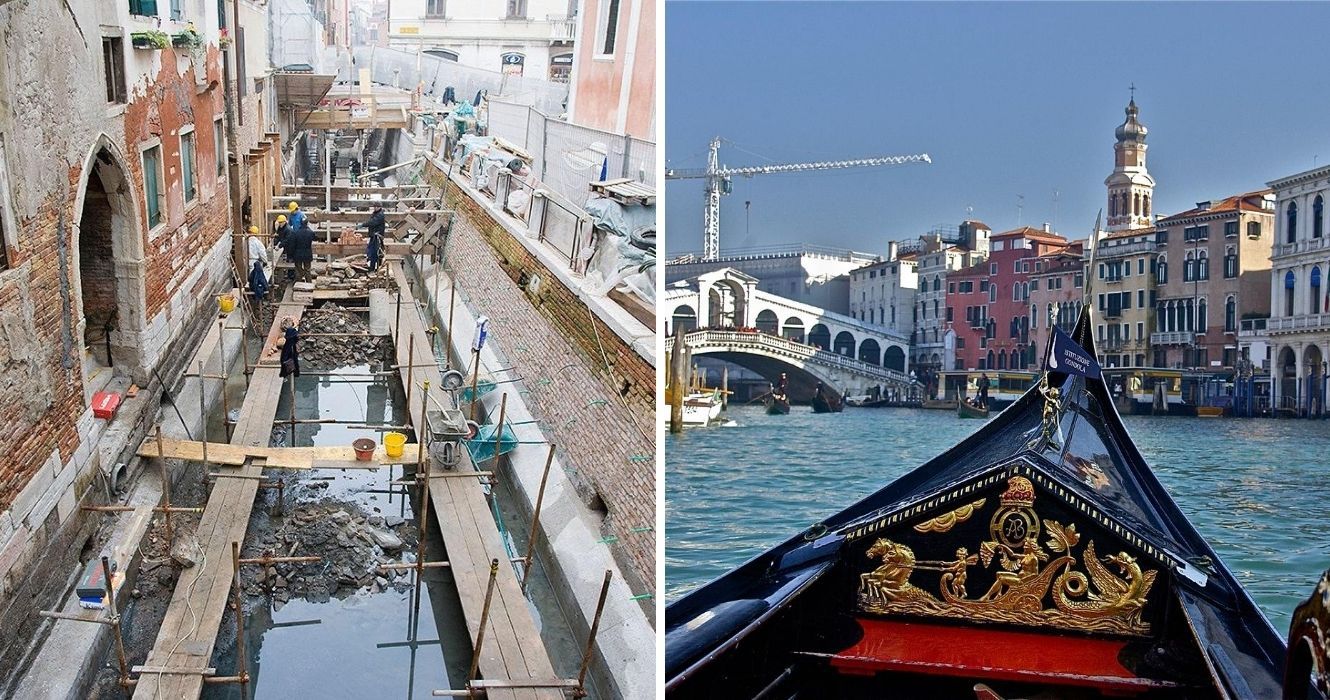
The canals are, of course, the defining feature of Venice. But they are more than just picturesque waterways; they are the lifeblood of the city, serving as essential arteries for transportation, commerce, and even a crucial part of the city’s structural integrity and sanitation. The design and management of these canals were integral to Venice’s success.
The Grand Canal and Beyond: Arteries of Commerce and Life
The Grand Canal, the city’s main thoroughfare, is more than just a scenic route. It’s a testament to the early understanding of hydraulic engineering and urban planning. Its serpentine shape was not accidental but was likely influenced by the natural course of tidal channels, optimized over time for efficient navigation. Smaller canals branched off, forming a complex network that allowed goods and people to be transported to every corner of the city.
The very existence of these canals meant that construction materials could be easily transported by boat, a vital consideration for a city built on soft ground. Heavy stones, lumber, and other supplies were ferried directly to building sites, minimizing the need for extensive road infrastructure that would have been impractical and detrimental to the foundations. The canals facilitated the growth and sustenance of Venice as a major trading power, enabling efficient movement of goods from its port to its markets and workshops.
Drainage, Sanitation, and Flood Management: The Unseen Systems
Beyond transportation, the canals played a vital role in drainage and sanitation. The low-lying nature of Venice meant that effective water management was paramount. The natural ebb and flow of the tides, along with a network of secondary channels and drains, helped to carry away waste and keep the city from becoming stagnant. While rudimentary by modern standards, these systems were remarkably effective for their time.
Furthermore, the constant movement of water through the canals helped to maintain the salinity levels in the lagoon, which in turn contributed to the preservation of the submerged wooden piles. The tides also played a role in preventing the buildup of silt, ensuring that the navigation channels remained open. While Venice has always been susceptible to flooding (acqua alta), the canal system, in conjunction with early sea defenses and adaptations, helped to manage these challenges for centuries. The city’s engineers understood the delicate balance of the lagoon and designed their infrastructure to work in harmony with its natural rhythms, rather than against them.
Enduring Legacy: Lessons in Sustainable Urban Development
The story of Venice’s construction is far more than a historical curiosity; it offers profound lessons for contemporary urban development, particularly concerning sustainable practices and resilient infrastructure. The Venetians faced environmental challenges that, in many ways, mirror those confronting us today: rising sea levels, limited resources, and the need to build on challenging terrain.
Resourcefulness and Innovation in the Face of Scarcity
The Venetians demonstrated an extraordinary level of resourcefulness and innovation. Faced with limited suitable land and a constant need for materials, they developed sophisticated methods for harvesting, treating, and utilizing timber. They understood the value of working with, rather than against, their environment. Their approach to water management and their ability to leverage the natural characteristics of the lagoon for transportation and drainage highlight a pragmatic and forward-thinking mindset. This focus on resource efficiency and adaptation is a critical takeaway for any urban planner or developer today.

The Long-Term Vision of Urban Planning
Venice’s enduring presence is a testament to a long-term vision in urban planning. The foundational engineering, while initially driven by necessity, proved to be remarkably durable. The city’s layout, its reliance on water transportation, and its integrated approach to infrastructure demonstrate a holistic understanding of how a city functions. While modern technology offers advanced solutions, the fundamental principles of careful site analysis, sustainable material sourcing, and integrated infrastructure design, as exemplified by Venice, remain as relevant as ever. The city, built on the delicate balance between human ambition and environmental reality, continues to inspire and inform our understanding of what it means to build a resilient and enduring urban environment.
aViewFromTheCave is a participant in the Amazon Services LLC Associates Program, an affiliate advertising program designed to provide a means for sites to earn advertising fees by advertising and linking to Amazon.com. Amazon, the Amazon logo, AmazonSupply, and the AmazonSupply logo are trademarks of Amazon.com, Inc. or its affiliates. As an Amazon Associate we earn affiliate commissions from qualifying purchases.