
When Usain Bolt crossed the finish line at the 2009 World Championships in Berlin, the clock stopped at 9.58 seconds. While the world gasped at the record, the technological infrastructure surrounding the track captured a more granular data point: a top speed of 27.78 mph (44.72 km/h). This wasn’t merely a feat of human will; it was a masterclass in biological engineering, captured and analyzed by the most sophisticated sports technology of the era. To understand Bolt’s top speed is to understand the intersection of high-speed kinematics, advanced timing hardware, and the biomechanical modeling that defines the limits of human performance.
The Hardware of History: How Precision Sensors Measured the 9.58s Record
In the world of elite sprinting, seconds are too large a unit of measurement. Performance is measured in milliseconds, and velocity is tracked through a network of laser-based sensors and high-speed digital imaging. When Bolt achieved his top speed between the 60-meter and 80-meter marks, it was documented by a suite of technology designed to eliminate human error.
Laser LAVEG Technology and Timing Systems
During the 2009 record-breaking run, the International Association of Athletics Federations (IAAF) utilized LAVEG (Laser Velocity Guard) systems. This technology uses the time-of-flight principle of infrared laser pulses to measure the distance and speed of an object in real-time. By aiming these devices at Bolt’s torso, sports scientists were able to generate a velocity curve that showed exactly when he hit his 27.78 mph peak. This hardware allowed for a sampling rate that provided a data point every 0.1 seconds, offering a digital blueprint of the most efficient sprint in history.
The Role of High-Frame-Rate Digital Imaging
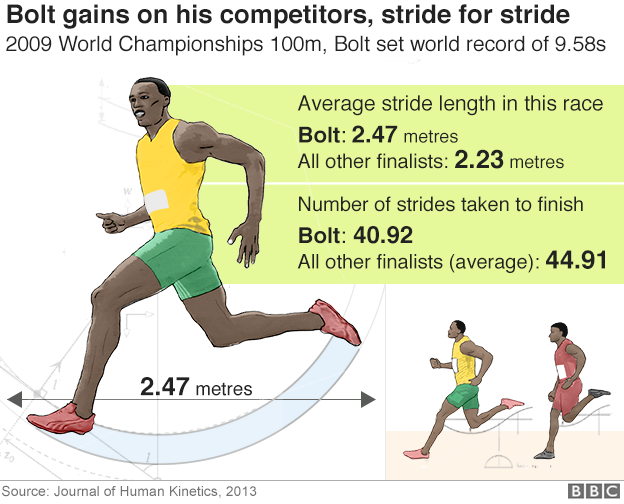
Beyond laser sensors, the “FinishLynx” photo-finish cameras played a critical role. Operating at up to 10,000 frames per second, these cameras do not take traditional photos but rather “slice” the finish line in time. This technology ensures that the official time is accurate to the thousandth of a second. For Bolt, these digital records provided the baseline data for kinematicians to analyze his stride frequency and length, turning a blur of motion into a series of calculable vectors.
The Physics of Velocity: Biomechanical Modeling of Bolt’s Stride
From a technological perspective, Usain Bolt is an anomaly. Standing at 6’5″, he contradicts the traditional “acceleration model” which favors shorter athletes with lower centers of gravity. To understand how he reached his top speed, researchers use computational biomechanics to model his gait and energy expenditure.
Kinematic Analysis of Ground Reaction Forces
The tech used to analyze Bolt’s stride reveals that his top speed was not a result of moving his legs faster than his competitors, but rather hitting the ground harder and more efficiently. Using force plate technology—sensors embedded in the track that measure the pressure exerted by an athlete—scientists found that elite sprinters like Bolt apply nearly 1,000 pounds of force in a single strike. Biomechanical software reveals that Bolt’s foot remains in contact with the ground for only 0.08 seconds. This rapid “ground contact time” is the primary technical variable that translates raw power into forward velocity.
Aerodynamic Resistance and Computational Fluid Dynamics
At 27.78 mph, air resistance becomes a significant technological hurdle. Scientists have used Computational Fluid Dynamics (CFD) to simulate Bolt’s 2009 run, discovering that he overcame an incredible amount of drag. Because of his height and broad shoulders, Bolt is less “aerodynamic” than smaller sprinters. The CFD models showed that only about 8% of the energy Bolt produced was used for motion, while the rest was spent overcoming air resistance. This data suggests that if Bolt had been more aerodynamically “efficient” through tech-driven posture adjustments, his top speed could have theoretically exceeded 28 mph.
Wearables and Sports Science: The Tech that Optimized the “Lightning Bolt”

While the 2009 record was the pinnacle, the years of training leading up to it involved a sophisticated array of wearable tech and material science designed to shave milliseconds off his time.
Advanced Footwear Engineering: The Role of Carbon Fiber
The shoes Bolt wore—specifically the Puma Yaam—were not merely leather and rubber; they were highly engineered pieces of sports tech. The spike plate was constructed from a specific grade of carbon fiber, designed to provide maximum rigidity with minimal weight. The goal of this engineering is “energy return.” When Bolt’s foot strikes the track, the carbon fiber plate acts as a spring, returning the kinetic energy back into his stride rather than absorbing it. This mechanical advantage is a primary focus of modern sports tech, where the stiffness of the sole is calibrated to the athlete’s specific force output.
Force Plate and Motion Capture Integration
In training, Bolt utilized optoelectronic systems—cameras that track reflective markers placed on the body—to create a 3D digital twin of his sprinting form. This tech allows coaches to see “micro-flaws” in joint angles that are invisible to the naked eye. By integrating this with force plate data, Bolt’s team could identify exactly which muscles were firing and at what intensity. This tech-heavy approach allowed for the optimization of his “drive phase,” ensuring he reached his top speed at the optimal point in the race.
Data Analytics and AI: Predicting the Ceiling of Human Performance
With the data harvested from Bolt’s career, the focus has shifted to predictive modeling. Data scientists and AI researchers are now using the metrics from Bolt’s top speed to determine if his record can ever be broken.
Machine Learning Models in Sprinting
Machine learning algorithms are currently being fed decades of sprinting data, including wind speed, altitude, humidity, and biometric markers. These models attempt to “build” the perfect sprinter. When analyzing Bolt’s 9.58s run, AI models suggest that if Bolt had been running at a higher altitude (like Mexico City) with a maximum allowable tailwind (2.0 m/s), he could have clocked a 9.48s. This use of “Big Data” in athletics allows researchers to separate human potential from environmental variables.
Can Technology Push Humans Past the 9.50 Barrier?
The question of “what’s next” is being answered in the lab. Through “In-silico” modeling (computer simulations), researchers are testing how different physiological traits—such as fast-twitch muscle fiber density and limb length—interact with new track technologies. Some researchers believe that with the help of “super-tracks” (engineered with tuned elasticity) and AI-optimized training loads, a human could eventually reach a top speed of 29 mph. Bolt remains the gold standard for these digital simulations, his 2009 data serving as the “Source Code” for future athletic achievement.
The Digital Legacy: Archiving Performance Data for Future Generations
Usain Bolt’s top speed is more than a historical fact; it is a permanent digital archive that continues to inform the development of sports technology.
Motion Capture and VR Simulation
Today, the data from Bolt’s top speed is used in Virtual Reality (VR) platforms to train the next generation of sprinters. By donning a VR headset, aspiring athletes can “shadow” a digital ghost of Bolt’s 9.58s run, observing his stride length and torso angle from a 360-degree perspective. This democratization of elite data is a hallmark of the current tech era, where the secrets of the world’s fastest man are translated into actionable insights for anyone with a computer.

The Intersection of Biology and Silicon
As we look back at the 27.78 mph peak, it becomes clear that Bolt was the ultimate hardware running the ultimate software. The technology used to measure, analyze, and support his career has changed the landscape of sports forever. We no longer just watch a race; we consume a stream of data that explains why a human can move that fast. Bolt’s legacy isn’t just his gold medals; it’s the gigabytes of biometric data that continue to push the boundaries of what we believe is technologically and biologically possible.
aViewFromTheCave is a participant in the Amazon Services LLC Associates Program, an affiliate advertising program designed to provide a means for sites to earn advertising fees by advertising and linking to Amazon.com. Amazon, the Amazon logo, AmazonSupply, and the AmazonSupply logo are trademarks of Amazon.com, Inc. or its affiliates. As an Amazon Associate we earn affiliate commissions from qualifying purchases.