
Project Apollo stands as one of humanity’s most audacious and technologically demanding endeavors, a testament to the boundless potential of human ingenuity when confronted with an “impossible” goal. Launched by the United States during the Cold War, its primary stated objective was famously articulated by President John F. Kennedy on May 25, 1961: “before this decade is out, of landing a man on the Moon and returning him safely to the Earth.” While this singular achievement captivated the world, the underlying goals from a technological perspective were far more profound and multifaceted, encompassing a sweeping drive for innovation, engineering mastery, and the demonstration of unparalleled technical capability. Apollo was not merely about reaching a destination; it was about building the technological infrastructure, systems, and knowledge necessary to achieve, sustain, and expand human presence beyond Earth. It spurred an unprecedented acceleration in multiple fields of engineering, computer science, materials science, and life support systems, laying foundational groundwork that continues to influence modern technology and space exploration. The project served as a crucible for technological advancement, transforming challenges into opportunities for groundbreaking scientific and engineering solutions that pushed the very limits of what was considered achievable, thereby solidifying its place as a pivotal moment in the history of technology.
A Technological Imperative: The Space Race and Geopolitical Drivers
The inception of Project Apollo was inextricably linked to the geopolitical landscape of the mid-20th century, primarily the Cold War rivalry between the United States and the Soviet Union. This intense competition manifested as the “Space Race,” a contest for technological supremacy that propelled both nations to achieve increasingly impressive feats in space exploration. For the United States, Apollo’s goal was a direct response to a perceived technological deficit and a strategic imperative to reassert global leadership through scientific and engineering prowess.
Responding to Sputnik: The Cold War and Technological Supremacy
The Soviet Union’s launch of Sputnik 1 in October 1957 sent shockwaves across the United States. As the world’s first artificial satellite, Sputnik demonstrated a startling Soviet lead in rocket technology and space capability, sparking widespread concern about national security and technological preparedness. This event ignited a fierce resolve within the U.S. to not only catch up but to surpass Soviet achievements. The subsequent Gagarin flight in April 1961, making him the first human in space, further amplified the pressure. Project Apollo, therefore, emerged as more than just a scientific venture; it was a grand strategic play designed to showcase the superior technological and industrial capacity of the free world. The goal was to prove, unequivocally, that American science and engineering could achieve the seemingly impossible, thereby garnering international prestige and demonstrating technological dominance on a global stage. This drive to prove technological superiority fueled massive government investment and galvanized national scientific and engineering communities towards a singular, ambitious objective.
Kennedy’s Vision: Unprecedented Engineering Challenges
President Kennedy’s declaration to land a man on the Moon by the end of the decade was a monumental challenge, especially considering the nascent state of space technology at the time. When Kennedy announced his vision, the U.S. had barely managed to put an astronaut into suborbital flight for a mere 15 minutes. There were no rockets powerful enough, no spacecraft capable of reaching the Moon, landing, and returning, and no sophisticated guidance systems or life support mechanisms for such an extended mission. The goal, therefore, was not just about the destination, but about forcing the development of an entirely new suite of technologies from the ground up. It mandated an unparalleled mobilization of scientific, engineering, and manufacturing resources to overcome an almost unimaginable array of technical hurdles. This included developing super-heavy lift launch vehicles, designing robust spacecraft capable of surviving the vacuum of space and lunar environment, creating precise navigation and communication systems spanning millions of miles, and ensuring the physiological and psychological well-being of astronauts for days or weeks in an alien environment. Kennedy’s audacious goal set the technological bar incredibly high, compelling innovation at every level.
Engineering the Impossible: From Earth Orbit to Lunar Surface
Achieving the lunar landing required unprecedented leaps in engineering and technological development. Every component, system, and procedure had to be designed, tested, and perfected to operate flawlessly in the unforgiving vacuum of space and on a distant celestial body. This era saw the rapid evolution of numerous critical technologies that were essential for the success of Apollo.
The Saturn V: A Colossus of Power and Precision
At the heart of Project Apollo’s technological marvel was the Saturn V rocket. Standing taller than the Statue of Liberty and weighing over 6 million pounds, it remains the most powerful rocket ever successfully launched. Its development was a monumental engineering feat, pushing the boundaries of propulsion technology, structural integrity, and manufacturing. The Saturn V’s immense thrust, generated by five F-1 engines in its first stage, was necessary to lift the massive payload required for a lunar mission: the Command Module, Service Module, and Lunar Module. Its multi-stage design, precise thrust vectoring, and sophisticated guidance systems were critical for placing the Apollo spacecraft accurately on its trans-lunar trajectory. The ability to build, test, and operate such a complex and powerful launch vehicle represented a peak in heavy engineering and rocketry, setting a benchmark for future space launch systems. The reliable performance of the Saturn V across all its crewed missions was a testament to meticulous engineering and rigorous quality control.
Command and Lunar Modules: Designing for Survival and Exploration
The Apollo spacecraft itself was a highly complex system composed of three main parts: the Command Module (CM), the Service Module (SM), and the Lunar Module (LM). Each had distinct technological goals. The CM was the crew’s living quarters and control center, designed to re-enter Earth’s atmosphere safely. Its robust heat shield and parachutes were critical for crew survival. The SM provided propulsion, electrical power, and life support for the journey to and from the Moon. The LM, however, was perhaps the most unique and innovative piece of technology. Designed solely to operate in the vacuum of space, it was an incredibly lightweight, two-stage vehicle for descent to and ascent from the lunar surface. Its sophisticated landing radar, guidance computer, and variable-thrust engines were technological breakthroughs, enabling precision landing on an unknown terrain. The necessity of modular design, precise docking mechanisms, and redundant systems across these modules pushed aerospace engineering into new territories, addressing challenges like weight reduction, thermal control, and radiation shielding.
Guidance and Navigation: The Dawn of Onboard Computing
Accurate navigation and guidance were paramount for a mission spanning hundreds of thousands of miles to a moving target. Project Apollo’s technological goal included developing cutting-edge navigation systems. The Apollo Guidance Computer (AGC) was revolutionary. While primitive by today’s standards (operating at 2.048 MHz with 2048 words of RAM and 36,864 words of ROM), it was one of the first integrated circuit-based computers, small and robust enough to fly in space. It handled everything from launch trajectory calculations to lunar orbit insertion, descent, and ascent. Astronauts interacted with the AGC via a DSKY (Display and Keyboard) interface, performing complex tasks with numerical inputs. This marked a critical transition from ground-based control to onboard autonomous decision-making capability. The Inertial Measurement Unit (IMU), star trackers, and various sensors provided critical data, which the AGC processed to calculate the spacecraft’s position, velocity, and attitude. The entire system represented a profound leap in real-time embedded computing and digital control systems, foreshadowing the pervasive role of microprocessors in modern technology.
Beyond the Moon Landing: Advancing Science and Technology
While the Moon landing was the ultimate objective, Project Apollo’s technological goals extended far beyond simply depositing humans on the lunar surface. It was also about leveraging human presence for scientific inquiry and developing the sophisticated infrastructure needed to operate and gather data in an extraterrestrial environment.
Lunar Surface Operations: Scientific Instruments and Sample Collection
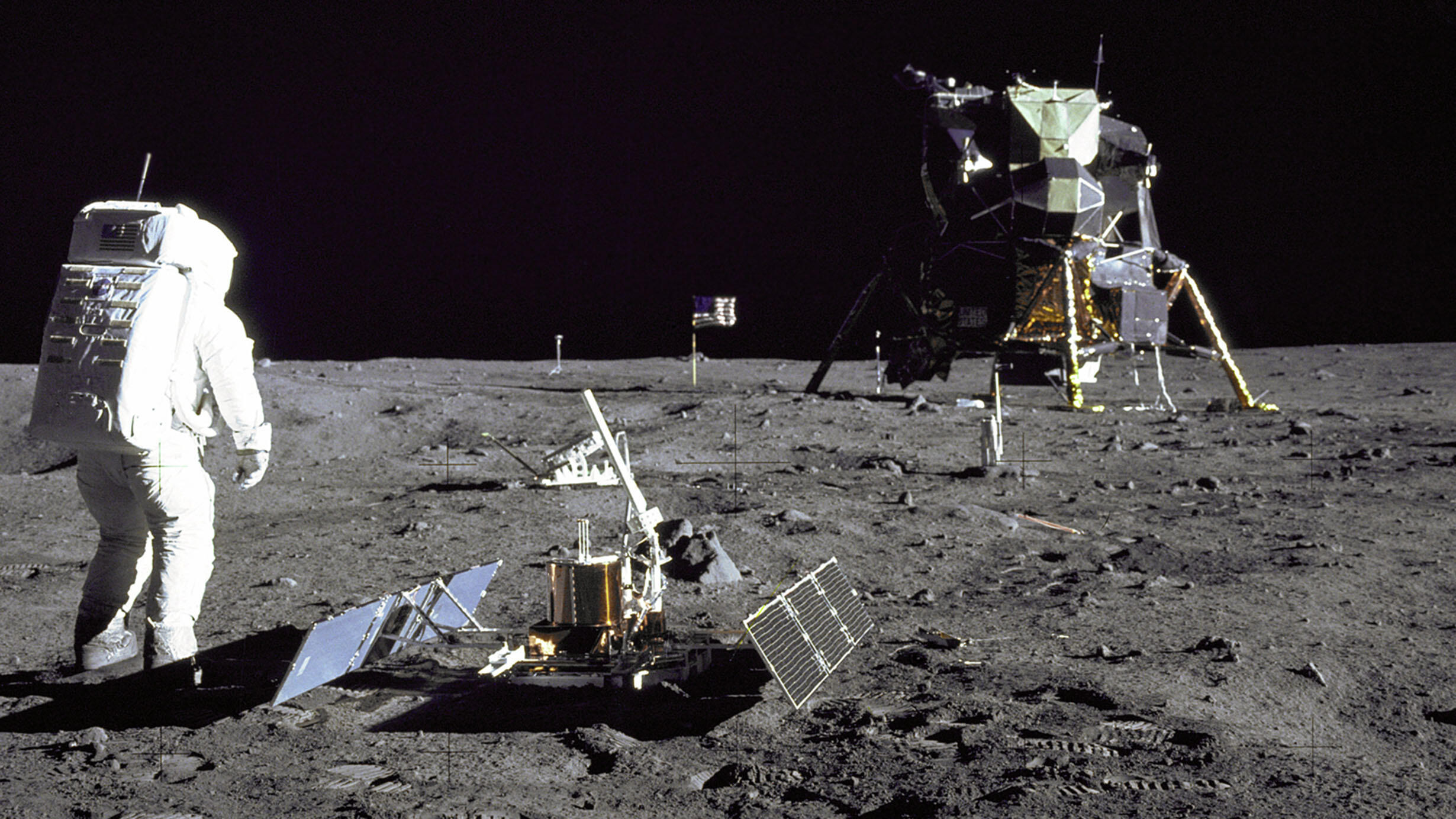
Once on the Moon, Apollo missions transitioned into complex scientific expeditions. A key technological goal was to develop and deploy instruments capable of operating in the extreme lunar environment – vacuum, harsh radiation, and wide temperature swings – to gather valuable scientific data. Astronauts deployed the Apollo Lunar Surface Experiments Package (ALSEP), a suite of experiments that included seismometers to detect moonquakes, heat flow probes, magnetometers, and solar wind spectrometers. These instruments transmitted data back to Earth for years, providing critical insights into the Moon’s interior, composition, and interaction with the solar environment. The design of tools and equipment for astronauts to collect lunar rock and soil samples was another technological challenge. Special scoops, core tubes, and hammer designs were created to ensure efficient and uncontaminated sample collection, which then had to be preserved for transport back to Earth. The successful deployment and operation of these instruments, along with the meticulous collection of over 382 kg of lunar samples, demonstrated the unprecedented capability for human-led scientific investigation beyond Earth.
Life Support and Environmental Control: Sustaining Human Life in Space
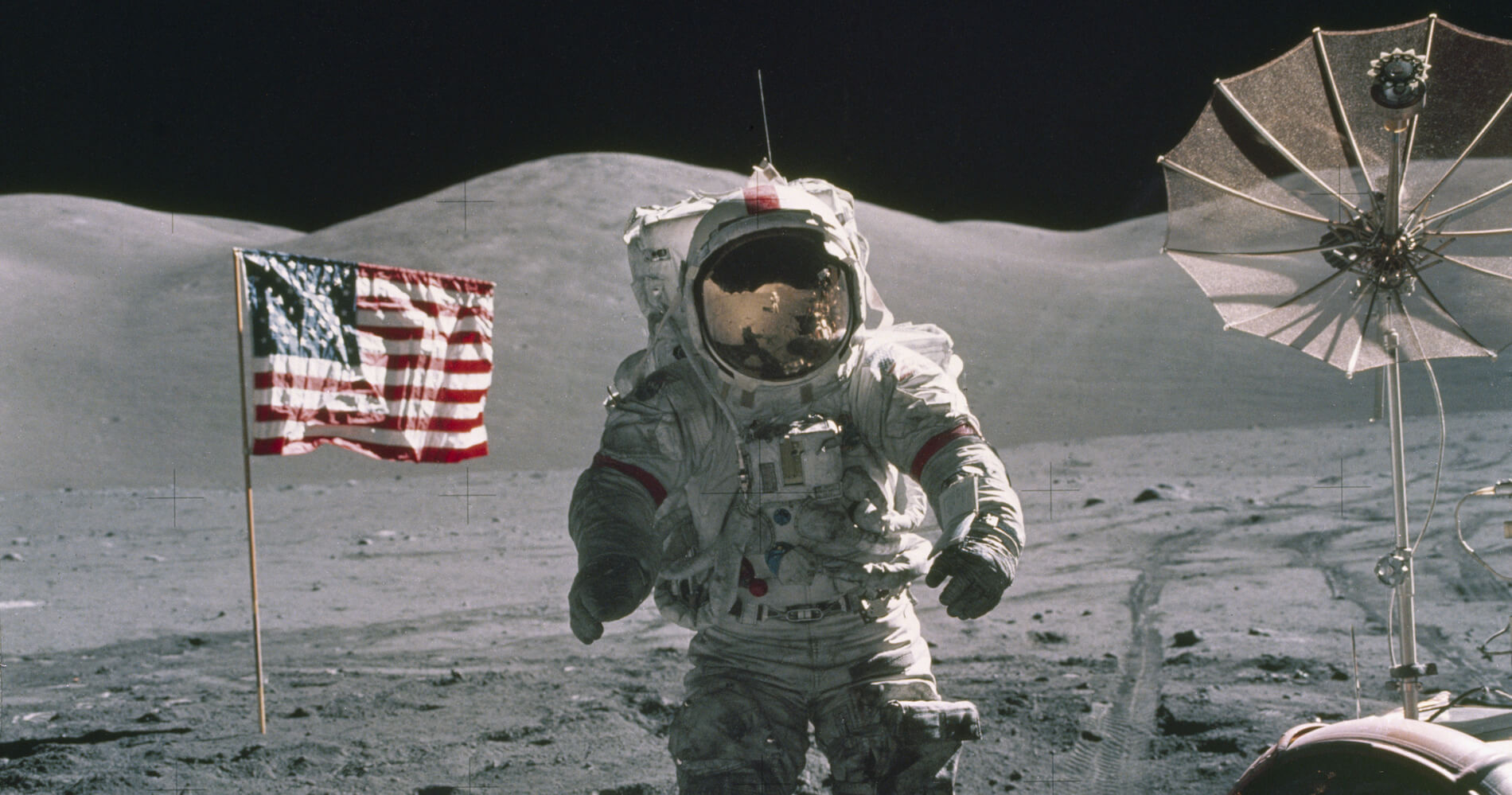
A fundamental technological goal of Apollo was to create closed-loop life support and environmental control systems (ECLSS) capable of sustaining human life for extended periods in the hostile vacuum of space. This involved maintaining breathable air (oxygen and nitrogen mixture, later pure oxygen), regulating temperature and humidity, removing carbon dioxide and other contaminants, and managing waste. The development of advanced air filtration systems, water recovery and recycling processes, and thermal control systems for both the spacecraft and the astronauts’ Extravehicular Activity (EVA) suits was critical. The EVA suit itself was a marvel of miniaturized life support technology, providing a portable, pressurized environment that allowed astronauts to work outside the spacecraft. These suits were multi-layered, providing thermal insulation, micrometeoroid protection, and incorporating communication systems, an oxygen supply, and waste management. The innovations in ECLSS were not only vital for Apollo but also laid the groundwork for future long-duration space missions, including space stations like Skylab and the International Space Station, ensuring human survival in the challenging space environment.
Telemetry and Communication: Bridging the Distance
Establishing and maintaining reliable, real-time communication between Earth and the Apollo spacecraft, hundreds of thousands of miles away, was a massive technological undertaking. The goal was to develop sophisticated telemetry and communication systems to transmit vital spacecraft data, biomedical information about the astronauts, and voice and television signals across vast distances with minimal latency and interference. This involved the development of powerful ground stations with massive parabolic antennas, such as those of the Deep Space Network (DSN), capable of tracking and communicating with the spacecraft. Onboard, advanced transponders, omnidirectional antennas, and high-gain antennas were designed to ensure continuous links. The modulation and coding techniques developed for Apollo were cutting-edge for their time, maximizing data transfer efficiency and signal integrity. The ability to broadcast live television images from the Moon, allowing billions to witness humanity’s greatest achievement in real-time, was a public relations triumph, but more importantly, a profound demonstration of advanced communication technology and signal processing capability.
Apollo’s Enduring Technological Legacy
The direct goals of Project Apollo were achieved with the final lunar landing in 1972, but its technological legacy extends far beyond those missions. The immense investment in research and development, coupled with the pressure of a seemingly impossible deadline, catalyzed innovation across a vast spectrum of industries. The breakthroughs made during Apollo continue to influence and shape our technological landscape, permeating both specialized fields and everyday life.
Spin-off Technologies: From Space to Everyday Life
One of the most significant technological legacies of Project Apollo is the myriad of “spin-off” technologies that found applications far beyond space exploration. The necessity of creating highly reliable, miniaturized, and efficient systems for Apollo led to innovations that have since become commonplace. For example, the need for robust, lightweight, and insulating materials for spacecraft and suits contributed to advancements in composite materials, fire-resistant fabrics, and specialized insulation used in everything from sports equipment to building construction. Computing technology, particularly the miniaturization of integrated circuits developed for the Apollo Guidance Computer, was a critical precursor to the microprocessor revolution, fundamentally changing the course of computing and leading to modern personal computers, smartphones, and embedded systems. Advancements in medical imaging, air purification systems, freeze-dried food, cordless tools, and even improved running shoes all have roots, directly or indirectly, in Apollo-era research and development. These spin-offs underscore how focused technological goals in one domain can yield unexpected and widespread benefits across society.
Catalyzing Innovation: A Blueprint for Future Exploration
Apollo provided a comprehensive blueprint for large-scale, complex technological projects and laid crucial groundwork for all subsequent human spaceflight. The systems engineering approach developed to manage the thousands of contractors, millions of components, and intricate interfaces of Project Apollo became a model for complex projects in aerospace, defense, and other high-tech industries. The lessons learned in mission planning, risk management, quality control, and testing protocols were invaluable. Technologically, Apollo proved the viability of multi-stage rockets, advanced propulsion systems, autonomous navigation, sophisticated life support, and long-range communication. These foundations directly enabled the development of the Space Shuttle program, the construction of orbital space stations like Skylab and the International Space Station, and continue to inform current initiatives like the Artemis program aimed at returning humans to the Moon and eventually Mars. Apollo’s technological achievements demonstrated that with sufficient will, resources, and focused engineering, humanity could overcome seemingly insurmountable technical challenges to explore and understand our universe.
The Human-Machine Interface: Pushing Operational Limits
Project Apollo also pushed the boundaries of the human-machine interface, demanding new levels of collaboration between astronauts and their technological systems. Astronauts were not merely passengers; they were critical operators, navigators, and repair technicians, often required to make complex decisions under extreme pressure, relying heavily on the sophisticated instruments and computers at their disposal. The training regimes, simulation technologies, and control room operations developed for Apollo were themselves technological innovations, designed to prepare humans to interact seamlessly and effectively with cutting-edge machinery in a hostile environment. The DSKY interface of the Apollo Guidance Computer, while rudimentary, represented an early form of interactive computing where humans directly input commands to control a complex machine in real-time. This dynamic interplay between human intelligence and machine capability, especially under high-stakes conditions, established precedents for modern command and control systems, robotics, and automation, highlighting the critical role of intuitive design and robust system reliability when operational limits are continually being tested. The Apollo era thus cemented the understanding that technological advancement is most potent when it effectively augments and extends human capability.
aViewFromTheCave is a participant in the Amazon Services LLC Associates Program, an affiliate advertising program designed to provide a means for sites to earn advertising fees by advertising and linking to Amazon.com. Amazon, the Amazon logo, AmazonSupply, and the AmazonSupply logo are trademarks of Amazon.com, Inc. or its affiliates. As an Amazon Associate we earn affiliate commissions from qualifying purchases.