
The question “What was Bitcoin’s starting price?” is far more complex than it initially appears, encapsulating the very essence of its revolutionary journey from an obscure digital experiment to a global financial phenomenon. Unlike traditional assets launched through Initial Public Offerings (IPOs) or established exchanges with clear opening prices, Bitcoin’s genesis was decentralized and organic. It didn’t emerge with a predetermined price tag from a central authority, but rather accrued value incrementally as a community of early adopters began to recognize its utility and scarcity. Understanding Bitcoin’s “starting price” requires delving into the unique circumstances of its birth, where value was first expressed not in dollars or euros, but in computational effort, cryptographic trust, and a nascent belief in a peer-to-peer digital cash system. This historical perspective is crucial for investors, economists, and enthusiasts alike, offering profound insights into the mechanics of value creation in the digital age, the dynamics of market adoption, and the foundational principles that continue to drive Bitcoin’s financial significance today. It’s a story of how an idea, encoded in software, gradually transformed into a tangible financial asset, establishing a precedent for an entire industry of digital currencies.
The Genesis of Digital Value: Bitcoin’s Inception
Bitcoin’s journey began not with a market price, but with an academic paper and a piece of software. In late 2008, an anonymous entity or group operating under the pseudonym Satoshi Nakamoto published the Bitcoin whitepaper, outlining a novel concept for “A Peer-to-Peer Electronic Cash System.” The vision was clear: to create a decentralized digital currency that could operate without the need for intermediaries like banks or payment processors, relying instead on cryptographic proof and a distributed ledger technology known as a blockchain. This foundational document laid the intellectual groundwork, but the real genesis of value began with its implementation.
The Enigmatic Launch: Satoshi Nakamoto’s Vision
Satoshi Nakamoto’s motives were rooted in a desire for financial autonomy and resistance to traditional financial systems, particularly in the wake of the 2008 global financial crisis. The whitepaper detailed a system where transactions would be verified by network participants (miners) and recorded on a public ledger, ensuring transparency and immutability. This design eliminated the “double-spend” problem inherent in digital currencies prior to Bitcoin, making it a viable form of digital cash. Satoshi’s innovation wasn’t just technical; it was a philosophical statement about trust, privacy, and economic freedom. The launch was not a corporate event with a press release, but a quiet, almost academic release to a mailing list of cryptographers and cypherpunks. This low-key introduction meant that Bitcoin’s early value was entirely conceptual, residing in the potential it offered rather than any immediate market valuation.
From Idea to Network: The First Blocks
The Bitcoin network officially went live on January 3, 2009, with the mining of the genesis block – Block 0. This pivotal moment marked the creation of the first 50 Bitcoins. Embedded within the genesis block’s coinbase transaction was a timestamp and a headline from The Times newspaper: “Chancellor on brink of second bailout for banks.” This message served as both proof of the block’s creation date and a stark commentary on the very system Bitcoin sought to circumvent. For months after, Bitcoin existed purely as an internal reward system for its early miners. These individuals were essentially hobbyists and enthusiasts, running software on their home computers, contributing computational power to secure the network, and in return, receiving newly minted Bitcoins. There was no exchange, no trading platform, and no accepted fiat currency equivalent for these digital coins. The only “cost” was the electricity used to run the mining hardware and the personal time invested.
Mining for the Future: Early Rewards and Scarcity
In these nascent stages, the value of Bitcoin was speculative at best, determined by the inherent cost of mining and the future potential envisioned by its creators and early proponents. The initial reward for mining a block was 50 BTC. As more blocks were mined, the supply of Bitcoin slowly increased, but its total supply was hard-capped at 21 million coins, a design choice baked into its protocol by Satoshi Nakamoto. This fixed supply, combined with a decreasing block reward schedule (halving approximately every four years), immediately established a principle of scarcity – a fundamental driver of value for any asset. Early miners accumulated Bitcoins with the understanding that they might one day hold significant value, but the current reality was that these digital tokens had no direct monetary exchange rate. The true “starting price” was effectively zero dollars, as it simply did not exist within any established financial market. It was a digital curiosity awaiting its first real-world transaction to confer any external economic worth.
Pinpointing the “Starting Price”: A Gradual Emergence of Value
Defining Bitcoin’s “starting price” isn’t as straightforward as looking up a stock quote from its IPO day. Because Bitcoin launched without a centralized entity setting a price, its initial value emerged organically, through a series of community-driven exchanges and its first real-world utility. This period represents a fascinating case study in how a purely digital asset transitioned from a technical curiosity to something with tangible economic worth.
The Initial Absence of a Monetary Value
For several months after its launch in January 2009, Bitcoin had no discernable monetary value in traditional currency terms. It was traded directly among a small group of cryptographers and enthusiasts, often in exchange for favors, discussions, or simply to test the network’s functionality. The closest approximation to a “cost” was the electricity consumed by early miners, who were essentially spending real-world resources to create digital tokens that had no market. These early Bitcoins were practically worthless in a conventional financial sense, yet they were intrinsically valuable to the network’s integrity and development. The concept of converting Bitcoin to fiat currency was not even a widespread consideration; the focus was on building and securing the decentralized network.
The First Real-World Transaction: Pizza for Pennies
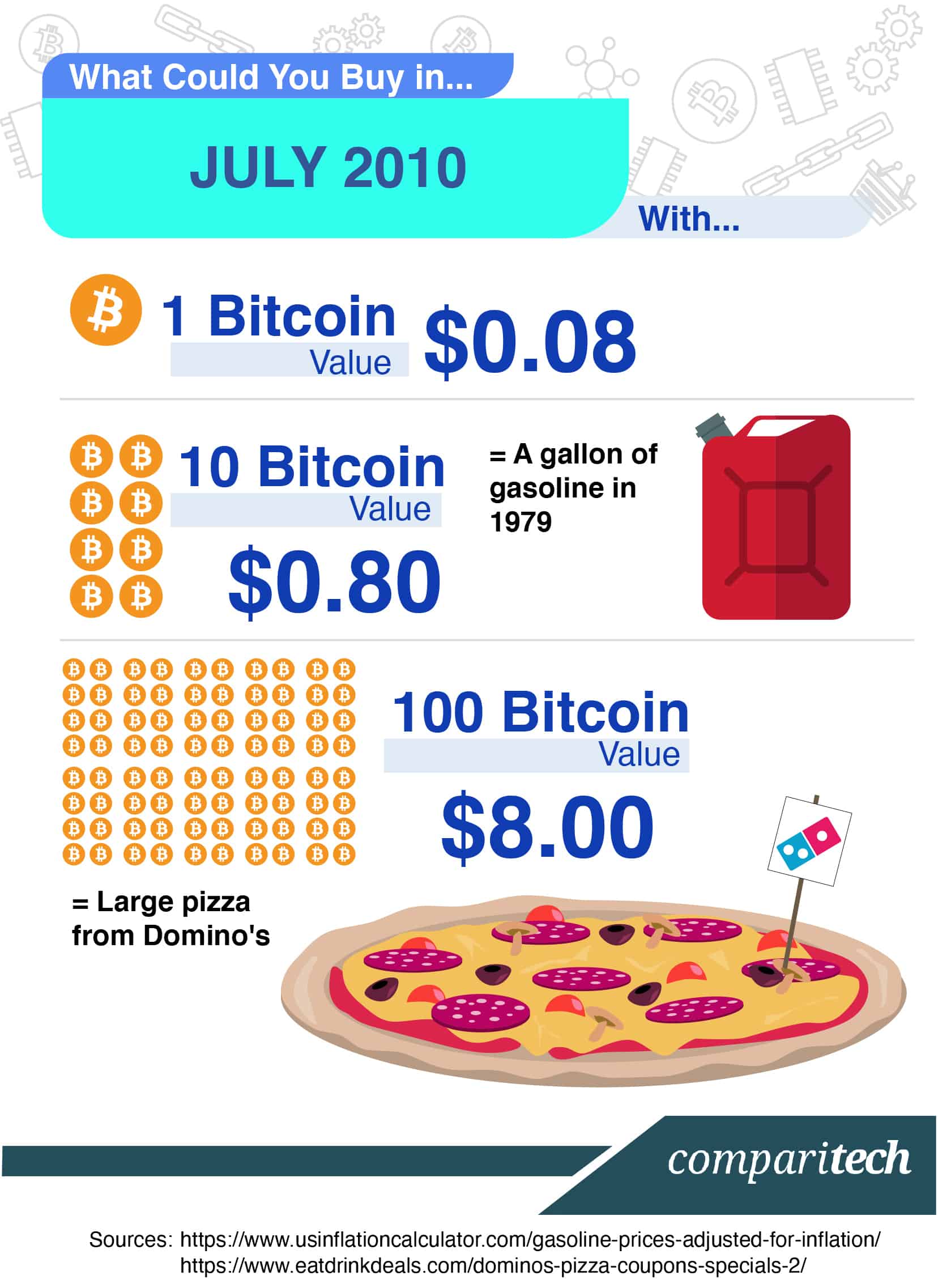
The seminal moment often cited as Bitcoin’s first real-world valuation occurred on May 22, 2010. A programmer named Laszlo Hanyecz famously paid 10,000 Bitcoins for two Papa John’s pizzas. At the time, this transaction was facilitated by a fellow Bitcoin enthusiast who bought the pizzas for Hanyecz for $25. This exchange effectively set the first widely acknowledged, albeit informal, “price” for Bitcoin: 0.0025 cents per Bitcoin (or $0.0025 for one Bitcoin). This event, now celebrated annually as “Bitcoin Pizza Day,” was monumental. It proved that Bitcoin could function as a medium of exchange for physical goods and services, bridging the gap between its digital existence and the tangible economy. While incredibly low by today’s standards, this transaction provided the initial spark that ignited Bitcoin’s economic journey, demonstrating its potential beyond a mere technological experiment.
Early Exchanges and the Dawn of Price Discovery
Following the pizza transaction, the demand for Bitcoin slowly began to grow beyond its initial core group. This led to the emergence of early online exchanges, which were rudimentary compared to today’s sophisticated platforms. One of the earliest and most notable was Mt. Gox, launched in July 2010. These exchanges allowed users to trade Bitcoin for fiat currencies like the U.S. dollar, facilitating price discovery through supply and demand. Initially, the trading volumes were minuscule, and prices were highly volatile. Bitcoin’s value oscillated dramatically, often experiencing percentage swings that would be unthinkable for traditional assets. For instance, in October 2009, New Liberty Standard, an early Bitcoin exchange, offered a conversion rate of 1,309.03 BTC for $1.00, effectively valuing one Bitcoin at approximately $0.00076. This was one of the first calculated exchange rates, predating the pizza transaction, reflecting the cost of electricity needed to mine the coins. However, the $0.0025 price from the pizza transaction often gets more popular recognition due to its tangible, real-world utility demonstration.
The Dollar Peg: How Bitcoin First Met Fiat
The establishment of these early exchanges and the willingness of individuals to trade fiat currency for Bitcoin marked a crucial turning point. It was the moment Bitcoin truly began its journey as a financial asset. The “starting price” wasn’t a singular event but a process of gradual market formation, with different early data points reflecting its nascent valuation. The prices in these early days were often just a few cents per Bitcoin, reflecting extreme undervaluation from today’s perspective, but signaling the initial intersection of revolutionary technology with traditional financial markets. This period of price discovery laid the groundwork for Bitcoin to evolve from a niche digital token into a global investment asset.
Beyond the First Price: Bitcoin’s Volatile Ascent
The journey of Bitcoin’s price from fractions of a cent to tens of thousands of dollars is a saga of extreme volatility, groundbreaking innovation, and profound market shifts. Understanding this trajectory is essential for grasping its financial significance and the lessons it offers to modern investors. The initial price discovery was just the prelude to a series of dramatic price movements that have captivated the world.
The Early Investor’s Dilemma: Patience and Conviction
For those early adopters and investors who acquired Bitcoin when it was worth practically nothing, the path was fraught with uncertainty. There were no established metrics, no historical data, and no institutional endorsement. Investing in Bitcoin at $0.01, $0.10, or even $1.00 required immense foresight, a deep belief in its underlying technology, and an iron will to withstand extreme price swings. Many early holders sold their Bitcoins too soon, missing out on parabolic gains. Others lost their access keys or had their holdings stolen from early, insecure exchanges. This era highlights the critical role of conviction and long-term vision in disruptive investments, often contrasting sharply with the short-term speculative trading that dominates later markets. The stories of early holders who accumulated thousands of Bitcoins underscore the potential, and the risk, inherent in pioneering new asset classes.
Major Price Milestones and Market Cycles
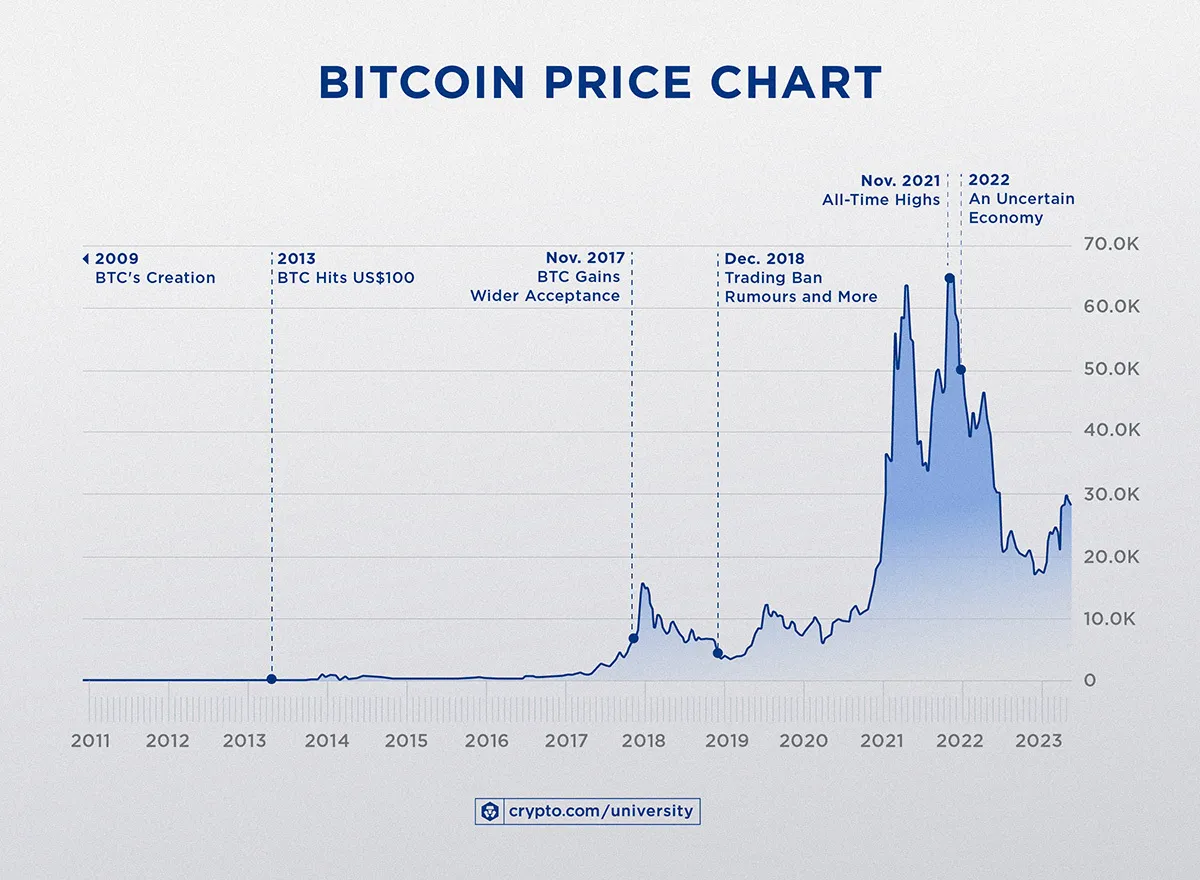
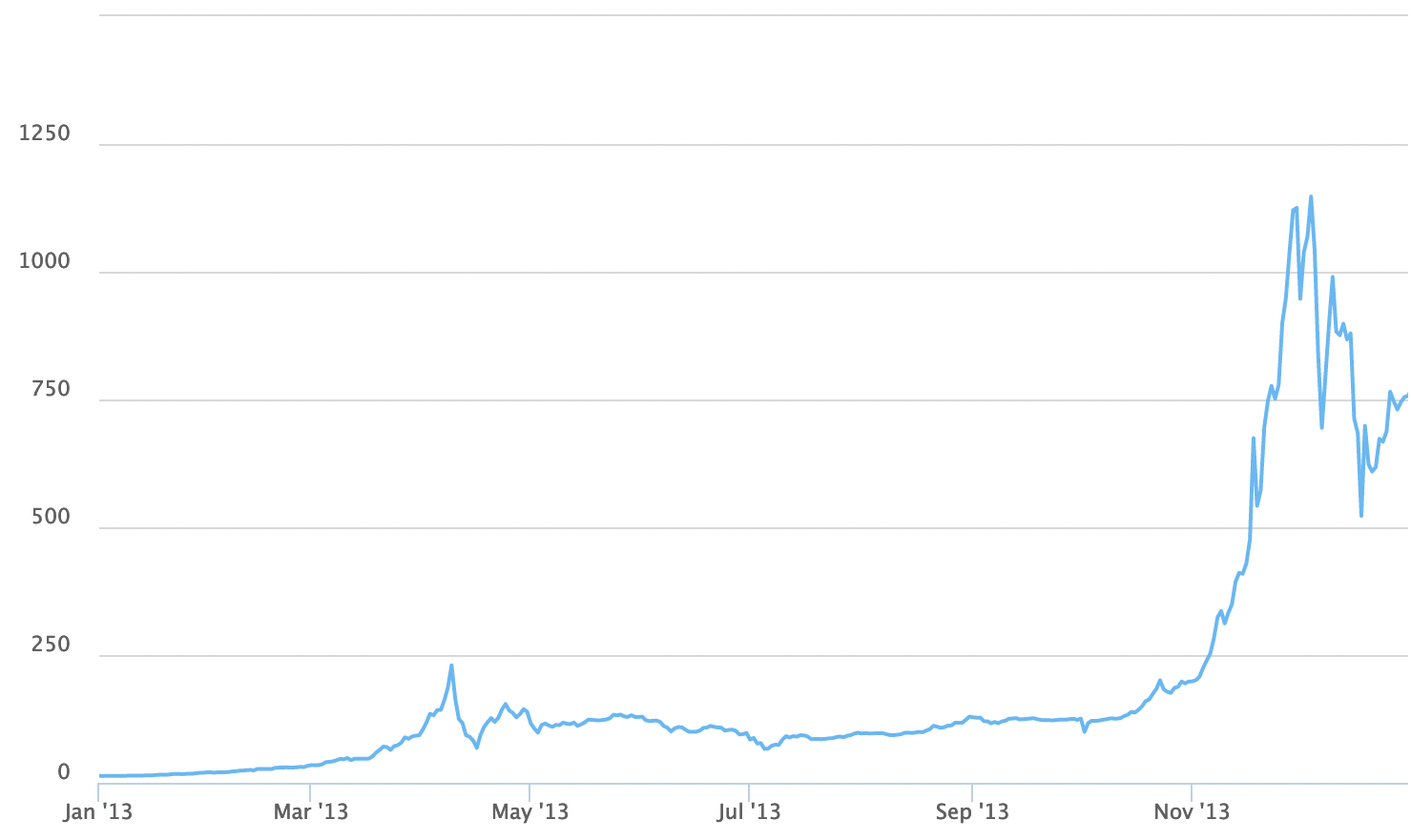
Bitcoin’s price history is punctuated by distinct bull and bear market cycles. After breaking the $1 barrier in 2011, it saw its first significant bubble, peaking around $30 before crashing back down. Subsequent cycles saw it breach $1,000 in 2013, only to experience another protracted bear market. The most explosive growth occurred in 2017, when Bitcoin surged from under $1,000 to nearly $20,000, attracting global media attention and mainstream investor interest, before a significant correction in 2018. The 2020-2021 bull run saw Bitcoin reach new all-time highs above $60,000, driven by institutional adoption, inflation concerns, and broader macroeconomic shifts. Each cycle has been characterized by increasing adoption, greater infrastructure development, and a gradual maturation of the market, albeit with persistent volatility. These cycles demonstrate a pattern of intense speculative interest followed by consolidation, which is typical for emerging, high-growth assets.
Factors Driving Price Appreciation (and Depreciation)
Several key factors have influenced Bitcoin’s volatile price trajectory. Scarcity, hard-coded into its 21-million-coin limit and halving events, drives demand as supply becomes proportionally tighter. Adoption by individuals, businesses, and institutions increases its utility and perceived value as a store of value and medium of exchange. Macroeconomic factors, such as inflation, interest rates, and global economic uncertainty, often position Bitcoin as a hedge or “digital gold.” Technological developments, including network upgrades (e.g., Taproot) and scaling solutions (e.g., Lightning Network), enhance its functionality and appeal. Conversely, regulatory uncertainty, security breaches (exchange hacks), widespread FUD (Fear, Uncertainty, Doubt), and profit-taking by large holders can trigger significant price depreciations. Understanding these interwoven factors is crucial for investors attempting to navigate the complex and dynamic Bitcoin market, distinguishing it from traditional investments that respond to more conventional economic indicators.
The Financial Legacy of Bitcoin’s Origins
Bitcoin’s “starting price,” or rather its gradual emergence of value, is more than just a historical footnote; it’s a foundational lesson for understanding the nature of decentralized finance and the potential of new asset classes. The journey from $0 to significant market capitalization offers profound insights into economic principles, investment psychology, and technological disruption. Its origins define much of its current financial identity and investment thesis.
Why the Starting Price Matters for Investors and Economists
For investors, the story of Bitcoin’s starting price is a testament to the power of early adoption and the potential for asymmetric returns in nascent technologies. It highlights the principle that truly disruptive innovations often begin with zero market value and accumulate worth through utility, network effects, and belief. Economists study Bitcoin’s early price discovery as a unique example of how a purely digital, decentralized asset can establish monetary value without state backing or traditional financial institutions. It challenges conventional definitions of money and value, offering insights into how trust and scarcity can be engineered in a peer-to-peer system. This foundational period also reveals the immense risk tolerance required by pioneers and the often-unpredictable path of innovation.
Lessons in Early Adoption and Asset Growth
Bitcoin’s initial valuation teaches invaluable lessons about early adoption. Those who recognized its potential before it had an established price were rewarded handsomely, but they also bore the highest risk. This mirrors historical patterns in other transformative technologies, from the internet to personal computing. It underscores the concept that breakthrough innovations often appear niche or even absurd at their inception, and their true value becomes apparent only over time, often through exponential growth in network participants and utility. The early days of Bitcoin demonstrate that the most significant gains in disruptive assets often accrue to those willing to engage before widespread acceptance, when the asset is still in its “pennies” or “cents” phase, making the initial, seemingly insignificant price points pivotal for subsequent growth.
Bitcoin’s Impact on Modern Investment Strategies
The financial legacy of Bitcoin’s origins has profoundly reshaped modern investment strategies. It popularized the concept of “HODLing” (holding on for dear life), a long-term investment philosophy born from its extreme volatility and eventual appreciation. It introduced the idea of a “digital gold” or a hedge against inflation and traditional financial instability, particularly appealing during periods of quantitative easing or geopolitical turmoil. Furthermore, Bitcoin’s success has spurred the creation of an entire ecosystem of cryptocurrencies and decentralized finance (DeFi), leading to new investment opportunities, risk profiles, and financial instruments. It compelled institutional investors to seriously consider digital assets as part of diversified portfolios, leading to the development of Bitcoin ETFs, futures markets, and other regulated products, all traceable back to the initial, improbable valuation of a digital token.
Evaluating Bitcoin Today: A Financial Tool for the Future
From its virtually valueless beginnings, Bitcoin has matured into a significant financial asset, influencing global markets and challenging traditional economic paradigms. Its journey from a technological novelty to a multi-trillion-dollar asset class is a compelling narrative that continues to evolve, prompting ongoing evaluation of its role in personal and business finance.
Bitcoin as an Investment Asset
Today, Bitcoin is widely recognized as an investment asset, often compared to gold due to its scarcity and role as a potential store of value. It has attracted a diverse range of investors, from retail enthusiasts to major corporations and institutional funds. Its high liquidity, global accessibility, and independence from central banks are key attributes that make it attractive, particularly in an increasingly digital and interconnected world. While its volatility remains a characteristic feature, many investors view it as a long-term strategic holding, a hedge against inflation, and an uncorrelated asset that can diversify traditional portfolios. Its performance has undeniably outstripped many conventional assets over various timeframes, prompting a re-evaluation of what constitutes a “safe” or “growth” investment in the 21st century.
The Role of Scarcity and Demand in Valuation
The enduring principle of scarcity, embedded in Bitcoin’s finite supply of 21 million coins and its halving mechanism, remains a primary driver of its valuation. Unlike fiat currencies, which can be printed indefinitely, Bitcoin’s supply is predictable and transparent. This hard cap, combined with ever-increasing global demand, creates a powerful economic force that continues to push its price upwards over the long term, despite short-term fluctuations. Demand is fueled by various factors, including its growing adoption as a payment rail, its use in emerging markets, institutional accumulation, and a burgeoning ecosystem of ancillary services. As awareness grows and access improves, the interplay between fixed supply and rising demand forms the core economic engine sustaining Bitcoin’s financial viability and future growth prospects.
Navigating the Future of Digital Currencies
The story of Bitcoin’s starting price is a foundational chapter in the ongoing narrative of digital currencies. Its success has paved the way for thousands of other cryptocurrencies and the broader decentralized finance (DeFi) movement, all aiming to replicate or improve upon aspects of its initial innovation. For investors and financial professionals, understanding Bitcoin’s journey from an obscure concept to a global financial asset is essential for navigating the future landscape of money. It highlights the increasing importance of digital literacy, risk management in volatile markets, and the potential for technologies to profoundly reshape economic systems. As the world continues its digital transformation, Bitcoin’s origins remind us that the most significant financial revolutions often begin with humble, often overlooked, beginnings, gradually building value through utility, network effects, and the collective belief in a new paradigm.
aViewFromTheCave is a participant in the Amazon Services LLC Associates Program, an affiliate advertising program designed to provide a means for sites to earn advertising fees by advertising and linking to Amazon.com. Amazon, the Amazon logo, AmazonSupply, and the AmazonSupply logo are trademarks of Amazon.com, Inc. or its affiliates. As an Amazon Associate we earn affiliate commissions from qualifying purchases.