
Mexico possesses a complex, upper-middle-income mixed market economy that serves as a critical engine for the North American region and a primary destination for global investment. As the 12th largest economy in the world by nominal GDP and the second-largest in Latin America, Mexico has transitioned over several decades from a protectionist, oil-dependent nation into a highly industrialized, export-oriented manufacturing powerhouse.
The Mexican economic model is defined by its deep integration into global value chains, particularly through its relationship with the United States and Canada under the USMCA (United States-Mexico-Canada Agreement). However, while the country boasts sophisticated high-tech manufacturing and a robust service sector, it also grapples with internal dualities, such as a large informal labor market and regional disparities in development. To understand Mexico’s economic landscape, one must look at the interplay between its industrial prowess, its fiscal policies, and the evolving trend of nearshoring that is currently reshaping its future.
The Structural Foundation: A Mixed Market System
Mexico’s economy is categorized as a mixed market system because it combines private enterprise with state intervention in strategic sectors. While the majority of the economy is driven by private domestic and foreign investment, the state maintains a significant presence in areas deemed vital for national sovereignty and public interest, most notably in energy and utilities.
The Role of the Private Sector
The private sector is the primary driver of Mexico’s economic growth, accounting for the vast majority of its Gross Domestic Product (GDP). Mexico is home to several massive multinational corporations, known as “Multilatinas,” which operate across telecommunications, retail, construction, and food processing. The government generally fosters a pro-market environment characterized by open trade and competition, which has allowed Mexico to become one of the world’s most prolific exporters of manufactured goods.
State Involvement and Strategic Industries
Despite the prevailing market-oriented approach, the state remains a powerful player. The most prominent example is Petróleos Mexicanos (PEMEX), the state-owned oil company, which has historically provided a significant portion of federal tax revenue. Similarly, the Comisión Federal de Electricidad (CFE) controls much of the country’s electricity distribution. The degree of state intervention often fluctuates depending on the political administration, with recent trends showing a push toward strengthening state-run enterprises to achieve energy independence, even as private investment continues to dominate the broader industrial landscape.
Key Pillars of the Mexican Economic Engine
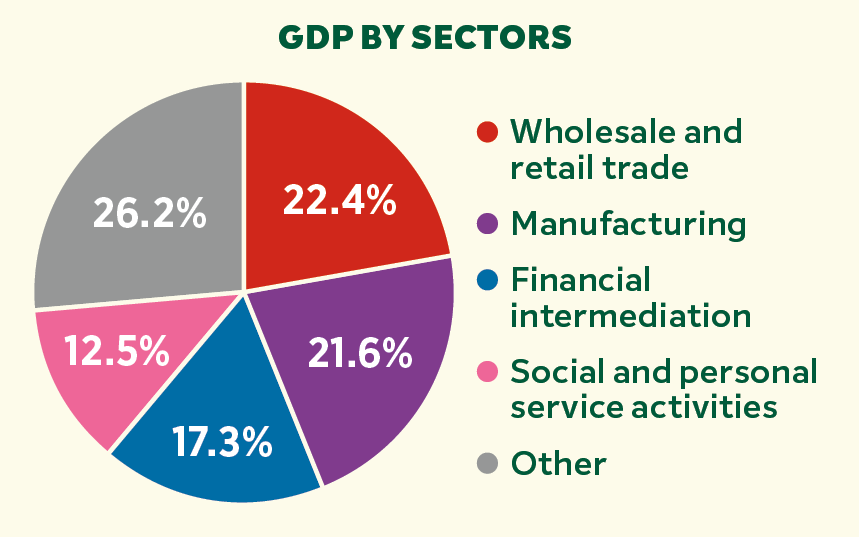
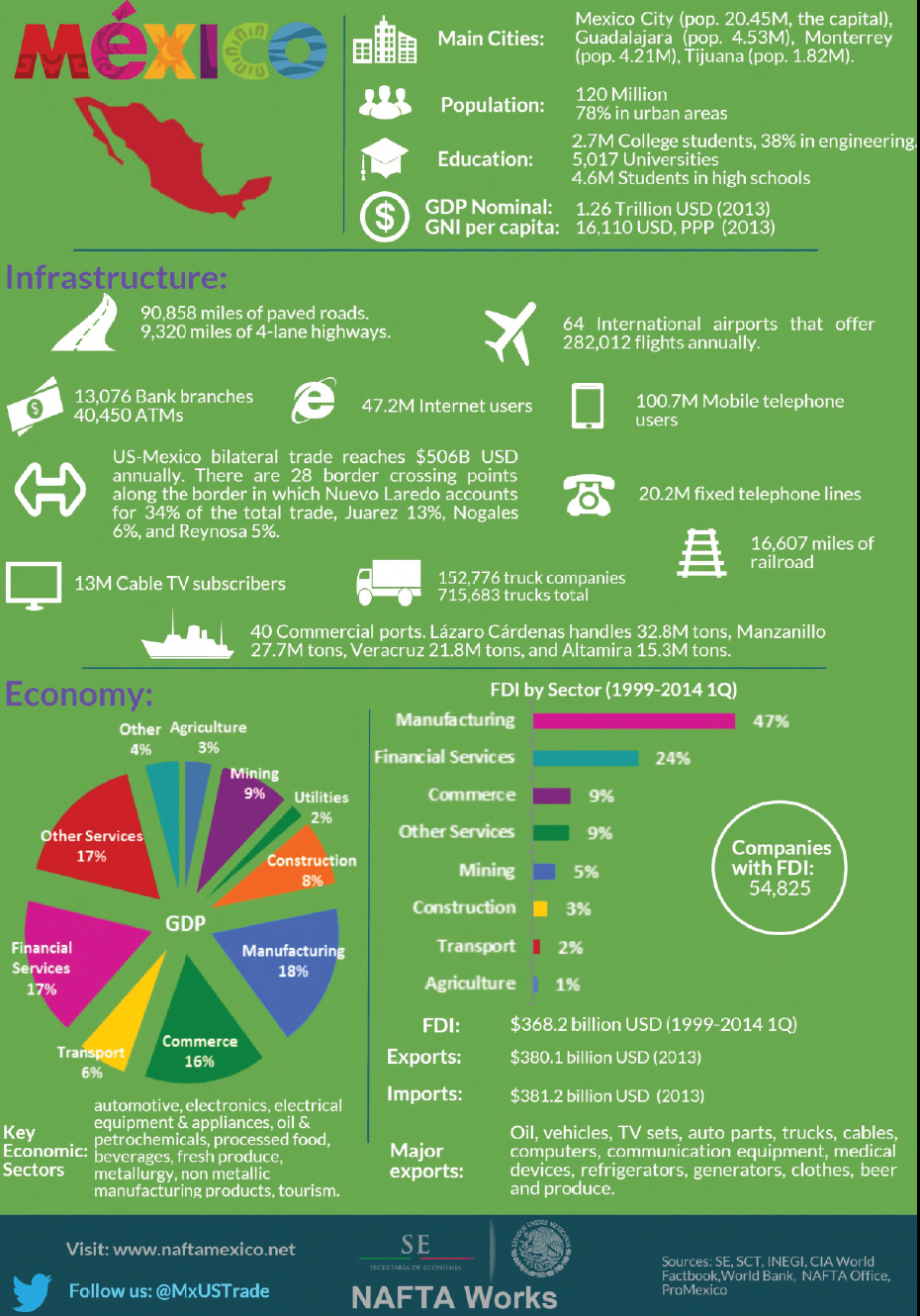
Mexico’s economy is diversified across three primary sectors: services, industry (manufacturing and mining), and agriculture. While it is often associated with oil, the reality is that Mexico’s wealth is generated through a sophisticated mix of high-end manufacturing and a dominant services sector.
The Dominance of Services
The service sector is the largest component of Mexico’s economy, contributing approximately 60% of the annual GDP. This sector is incredibly broad, encompassing everything from high-finance and telecommunications to tourism and retail. Mexico is one of the most visited countries in the world, making international tourism a vital source of foreign exchange. Furthermore, the banking sector is highly developed and largely controlled by foreign institutions, which has contributed to a stable, though conservative, financial environment.
Manufacturing and the Maquiladora System
Manufacturing is the heartbeat of Mexico’s international trade, representing roughly 18% of GDP and the bulk of its exports. Unlike many other emerging markets that rely on raw commodity exports, Mexico exports complex goods like automobiles, aerospace components, medical devices, and consumer electronics.
The “Maquiladora” program—factories located near the U.S. border that import raw materials duty-free to assemble goods for export—has been the cornerstone of this industrial success. Today, Mexico is the fourth-largest exporter of light vehicles globally and a major hub for the international aerospace industry, with clusters in states like Querétaro and Chihuahua producing sophisticated engine parts and electronics for global giants.
Energy and Agriculture
While manufacturing has overtaken oil in terms of export value, the energy sector remains a fundamental pillar of the domestic economy. Mexico is one of the largest oil producers in the world, though its production levels have faced challenges due to aging infrastructure and underinvestment. In the agricultural sector, Mexico is a global leader in the production of high-value crops such as avocados, berries, and tomatoes, primarily destined for the North American market.
The Power of Trade and the Nearshoring Revolution
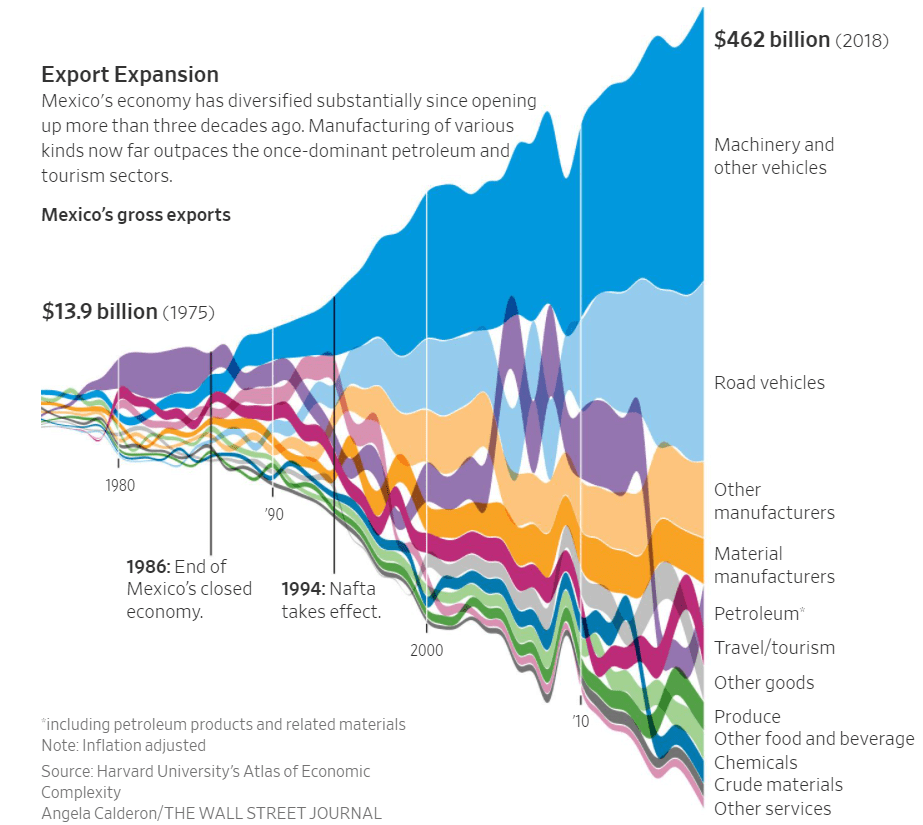
Mexico’s economic identity is inseparable from its status as a global trade hub. It has more free trade agreements than almost any other nation, providing it with preferential access to over 50 countries. However, its most significant relationship is with the United States, which receives nearly 80% of Mexican exports.
The USMCA and North American Integration
The transition from NAFTA to the USMCA has modernized the trade relationship between Mexico, the U.S., and Canada. This agreement provides the legal and regulatory framework that allows for “just-in-time” manufacturing, where components cross the border multiple times during the assembly process. This integration has turned the North American region into a unified economic bloc that competes directly with East Asia and Europe.
The Nearshoring Phenomenon
In recent years, Mexico has entered a new era of growth driven by “nearshoring”—the practice of companies moving their production closer to their final consumers in the United States to avoid trans-Pacific shipping costs and geopolitical risks. As supply chains decouple from China, Mexico has emerged as the logical alternative.
This shift is bringing billions of dollars in Foreign Direct Investment (FDI) into the country. Industrial parks in northern Mexico are reaching 100% occupancy, and global companies in the semiconductor, electric vehicle (EV), and pharmaceutical sectors are breaking ground on massive new facilities. For investors, nearshoring represents the most significant structural tailwind for the Mexican economy in decades, promising to boost productivity and wages in the industrial heartland.
Financial Landscape: Stability, Currency, and Challenges
From a financial and investment perspective, Mexico is often viewed as a “safe haven” among emerging markets due to its long-standing commitment to fiscal discipline and an independent central bank.
Monetary Policy and the “Super Peso”
The Bank of Mexico (Banxico) is widely respected for its autonomy and its hawkish stance on inflation. By maintaining higher interest rates than the U.S. Federal Reserve, Banxico has often been able to attract “carry trade” investors, contributing to the strength of the Mexican Peso (MXN). In recent periods, the currency has earned the nickname “the Super Peso” due to its resilience and appreciation against the U.S. dollar, fueled by record-high remittances and strong FDI inflows.
The Informal Economy and Inequality
A major structural challenge for the Mexican economy is the high rate of informality. Approximately 55% of the workforce operates in the informal sector, meaning they do not pay income taxes and lack access to formal credit and social security. This creates a “dual economy” where a highly productive, export-oriented North coexists with a less developed, informal South. For the government, the challenge is to bring these workers into the formal system to expand the tax base and increase overall economic productivity.
Infrastructure and Rule of Law
While Mexico offers proximity to the U.S. market, it faces hurdles regarding infrastructure and the rule of law. To fully capitalize on the nearshoring trend, the country requires significant investment in clean energy, water management, and transportation logistics. Additionally, concerns regarding security and judicial transparency remain key considerations for international corporations looking to commit long-term capital to the region.
The Outlook for Investors and the Future Economy
The future of Mexico’s economy lies in its ability to move up the value chain. As it transitions from a low-cost assembly hub to a center for high-tech research and development, the opportunities for business and investment are expanding.
The Digital and Fintech Explosion
Mexico is currently experiencing a boom in the fintech sector. Because a large portion of the population remains unbanked or underbanked, digital payment platforms and neo-banks are seeing explosive growth. This digital transformation is not only making the economy more efficient but is also providing a path for informal businesses to enter the formal financial system, potentially unlocking new layers of GDP growth.
Sustainability and the Green Transition
As global investors increasingly prioritize ESG (Environmental, Social, and Governance) criteria, Mexico is under pressure to modernize its energy mix. The country has immense potential for solar and wind energy, and the degree to which it embraces renewable power will dictate its attractiveness to the next generation of global manufacturers, particularly those in the electric vehicle sector.
In summary, Mexico has a dynamic, export-led mixed economy that is currently at a historic crossroads. Its strategic geography, coupled with a solid foundation in manufacturing and a disciplined approach to monetary policy, makes it a critical player in the global financial landscape. While internal challenges persist, the unprecedented influx of capital via nearshoring suggests that Mexico will continue to solidify its position as a primary engine of global trade and a cornerstone of the North American economic future.
aViewFromTheCave is a participant in the Amazon Services LLC Associates Program, an affiliate advertising program designed to provide a means for sites to earn advertising fees by advertising and linking to Amazon.com. Amazon, the Amazon logo, AmazonSupply, and the AmazonSupply logo are trademarks of Amazon.com, Inc. or its affiliates. As an Amazon Associate we earn affiliate commissions from qualifying purchases.