
In the fast-paced world of business, where every second counts and decision-makers are bombarded with information, the executive summary stands as your crucial first impression. It’s not just a brief overview; it’s a powerful tool that can sway opinions, secure funding, and propel your initiatives forward. Whether you’re pitching a groundbreaking tech startup, refining a corporate brand strategy, or outlining a complex financial plan, a well-crafted executive summary is your secret weapon.
This article will guide you through the essential elements that make an executive summary effective, drawing on the core pillars of technology, brand, and money that define successful ventures in today’s dynamic landscape. We’ll explore how to distill complex information into a concise, compelling narrative that resonates with busy executives.

The Purpose of an Executive Summary: More Than Just a Recap
Before diving into what to include, it’s vital to understand why an executive summary is indispensable. Its primary purpose is to provide a high-level overview of a larger document, proposal, business plan, or project, allowing stakeholders to grasp the core message and key takeaways without needing to read the entire text. Think of it as a movie trailer for your business idea or project – it needs to be engaging, informative, and leave the audience wanting more.
Who is Your Audience? Tailoring Your Message
The effectiveness of your executive summary hinges on understanding who you are addressing. Are you speaking to potential investors hungry for ROI? Are you presenting a new software solution to a technical team? Or are you proposing a rebranding initiative to the C-suite?
- For Investors: Focus on the market opportunity, competitive advantage, financial projections, and the strength of the management team. Highlight the potential for significant returns on investment.
- For Internal Stakeholders (e.g., management, project teams): Emphasize the project’s objectives, scope, timeline, resource requirements, and the expected impact on the organization. Technical details might be more relevant here.
- For Strategic Partners: Showcase the mutual benefits of collaboration, the shared vision, and how your offering complements their existing business.
By tailoring your language, tone, and the specific information you highlight to your audience, you maximize the chances of capturing their attention and achieving your desired outcome.
The Core Objectives of an Effective Executive Summary
An executive summary should achieve several critical objectives:
- Capture Attention: It must be compelling enough to make the reader want to learn more.
- Convey Key Information: It should succinctly present the most important aspects of the main document.
- Facilitate Quick Decision-Making: It allows busy executives to make informed judgments without reading the entire document.
- Highlight the Value Proposition: It clearly articulates the benefits and advantages of your proposal or project.
- Inspire Action: It should motivate the reader to take the next step, whether it’s approving a budget, signing a contract, or investing in your venture.
Key Components to Include: The Building Blocks of Your Summary
While the specific content will vary depending on the nature of your larger document, a robust executive summary generally incorporates the following crucial elements. We’ll explore these through the lens of our website’s core topics: Tech, Brand, and Money.
H2: The Problem and Your Solution (The “Why” and “What”)
Every successful venture addresses a need or a problem. Your executive summary must clearly articulate this problem and then present your solution with conviction.
H3: Tech: Identifying a Market Gap or Technological Challenge
In the realm of technology, this section is about identifying an unmet need or an inefficiency that your innovative product or service can address.
- The Problem: This could be a cumbersome manual process that can be automated by software, a lack of intuitive AI tools for a specific industry, a security vulnerability that needs a robust solution, or a gap in current gadget offerings. Be specific. Instead of “Businesses need better software,” say “Small businesses struggle with manual inventory management, leading to an average of 15% loss due to stockouts or overstocking annually.”
- Your Solution: This is where you introduce your technology. Describe your software, AI tool, app, or gadget. What makes it unique? How does it directly solve the identified problem?
- Example (Software): “Our cloud-based inventory management software, ‘StockSavvy,’ leverages real-time data analytics and predictive algorithms to automate stock level monitoring, forecast demand, and optimize reordering, reducing stockouts by an estimated 90%.”
- Example (AI Tools): “Our AI-powered content creation platform, ‘WordSculpt,’ assists marketing teams in generating high-quality, SEO-optimized blog posts and social media updates in a fraction of the time it currently takes, improving content output by over 200%.”
- Example (Gadgets): “The ‘EcoCharge’ smart plug revolutionizes home energy consumption by automatically identifying and shutting off power-hungry devices in standby mode, offering users an average monthly saving of $25 on their electricity bills.”
The key here is to be concise and benefit-oriented. Don’t get bogged down in technical jargon unless your audience is highly technical. Focus on the impact of your technology.
H3: Brand: Addressing a Market Need for a Distinct Identity or Connection
For branding initiatives, the “problem” might be a lack of brand recognition, a diluted corporate identity, ineffective marketing campaigns, or a disconnect with the target audience.
- The Problem: This could be a brand that fails to resonate with its target demographic, a competitor with a stronger visual identity, or marketing efforts that yield low engagement and conversion rates.
- Example (Brand Strategy): “Our client, ‘Artisan Roasters,’ a premium coffee brand, is experiencing stagnant growth due to an outdated brand image that no longer appeals to its increasingly young and digitally-savvy target market.”
- Example (Corporate Identity): “GlobalTech Solutions has an inconsistent corporate identity across its various subsidiaries, leading to confusion among stakeholders and diluting its overall market presence.”
- Your Solution: This is where you present your branding strategy, design proposals, or marketing campaign. How will your approach revitalize the brand, create a stronger connection, or differentiate it in the market?
- Example (Brand Strategy): “Our proposed brand revitalization strategy for Artisan Roasters focuses on a modern visual identity, a targeted social media marketing campaign emphasizing ethical sourcing and community involvement, and the launch of a customer loyalty app.”
- Example (Marketing): “We propose a multi-channel digital marketing campaign for EcoHome Appliances that focuses on influencer collaborations, educational content marketing around energy efficiency, and targeted paid social media advertising to reach environmentally conscious homeowners.”
Your solution should clearly outline how your branding expertise will solve the identified market or identity issue.
H3: Money: Identifying a Financial Opportunity or Challenge
In the financial domain, the “problem” is often an untapped investment opportunity, a need for improved financial management, or a challenge in achieving financial goals.
- The Problem: This could be a lack of accessible investment vehicles for everyday individuals, a business struggling with cash flow management, or individuals seeking effective strategies for online income generation.
- Example (Personal Finance): “Many young professionals struggle to understand and manage their student loan debt and find it challenging to begin investing due to perceived complexity and lack of accessible guidance.”
- Example (Business Finance): “Small e-commerce businesses often face significant cash flow challenges due to lengthy payment cycles from marketplaces and the need for upfront inventory investment.”
- Your Solution: This is where you present your financial tool, investment strategy, side hustle idea, or business finance advice.
- Example (Investing): “Our mobile app, ‘InvestEase,’ provides personalized investment portfolios for beginner investors, automated savings tools, and educational resources designed to demystify the stock market and empower users to build wealth.”
- Example (Online Income): “This proposal outlines a strategy for generating passive income through affiliate marketing and digital product creation, focusing on identifying high-demand niches and building a loyal online audience.”
- Example (Business Finance): “We recommend implementing a dynamic invoice factoring solution for e-commerce businesses, providing immediate access to capital based on outstanding invoices, thereby alleviating cash flow constraints and enabling growth.”
Your solution must demonstrate a clear understanding of the financial landscape and offer a practical, effective approach to addressing the identified monetary challenge or opportunity.

H2: Your Value Proposition and Competitive Advantage (The “How” and “Why You”)
Once you’ve established the problem and your solution, you need to articulate why your approach is superior and what makes you stand out from the competition.
H3: Tech: The Unique Selling Points of Your Innovation
- Value Proposition: What tangible benefits does your technology offer? Is it faster, cheaper, more efficient, more user-friendly, or more secure than existing alternatives? Quantify these benefits whenever possible.
- Example: “StockSavvy offers a 30% cost saving compared to traditional ERP systems for small businesses, coupled with an intuitive interface that requires minimal training.”
- Competitive Advantage: What is your “secret sauce”? This could be proprietary algorithms, unique data sets, a strong patent, a first-mover advantage, an exceptional user experience, or a superior technical team.
- Example: “Our proprietary AI algorithm for demand forecasting has been trained on billions of data points, achieving an accuracy rate 15% higher than industry benchmarks.”
H3: Brand: The Differentiators of Your Brand Strategy
- Value Proposition: How does your branding strategy deliver tangible benefits to the client? Does it increase brand recognition, improve customer loyalty, drive sales, or enhance market positioning?
- Example: “Our brand revitalization for Artisan Roasters is projected to increase brand engagement by 40% and boost sales by 25% within the first year.”
- Competitive Advantage: What makes your agency or your approach unique? Is it your deep understanding of a specific industry, your innovative creative process, your data-driven marketing methodology, or your proven track record of successful brand transformations?
- Example: “Our team’s unique blend of strategic market analysis and cutting-edge visual design ensures a brand identity that is not only aesthetically compelling but also deeply resonant with target audiences.”
H3: Money: The Advantages of Your Financial Strategy or Tool
- Value Proposition: What clear benefits does your financial product or strategy offer? Does it promise higher returns, lower risk, greater accessibility, simplified management, or increased income potential?
- Example: “InvestEase aims to deliver an average annual return of 8-12% for its users, with a risk profile significantly lower than actively managed mutual funds, making it an ideal entry point for new investors.”
- Competitive Advantage: What makes your financial offering stand out? Is it a unique fee structure, a proprietary analytical model, a strong network of advisors, an exclusive partnership, or a user-friendly platform that simplifies complex financial concepts?
- Example: “Our affiliate marketing strategy leverages unique SEO techniques and personalized content creation to achieve higher conversion rates than generic affiliate programs, resulting in a projected 50% increase in commission earnings for our partners.”
H2: Financial Projections and Funding Requirements (The “How Much” and “What’s Needed”)
No executive summary is complete without addressing the financial implications. This section is crucial for investors and for internal decision-makers evaluating the viability of a project.
H3: Tech: Demonstrating Financial Viability and Investment Needs
- Key Financial Highlights: Summarize the most important financial projections, such as projected revenue, profitability, and return on investment (ROI) over a specified period (e.g., 3-5 years).
- Example: “We project StockSavvy to achieve $2 million in revenue by year three, with a net profit margin of 20%, driven by a subscription-based model with a customer acquisition cost of $150 and a lifetime value of $1200.”
- Funding Requirements: Clearly state the amount of funding you are seeking and how it will be used. Be specific.
- Example: “We are seeking $500,000 in seed funding to finalize product development, expand our sales and marketing team, and scale our cloud infrastructure.”
H3: Brand: The Financial Impact of Your Branding Initiative
- Projected ROI/Impact: Quantify the expected financial returns of your branding efforts. This might include projected increases in sales, market share, brand equity, or cost savings.
- Example: “The proposed brand revitalization for Artisan Roasters is expected to generate an additional $1.5 million in revenue over the next two years, with a projected ROI of 3:1 on our marketing investment.”
- Budget Overview: Provide a high-level overview of the budget required for your branding strategy, including key cost categories.
- Example: “The total budget for this brand transformation project is estimated at $150,000, covering brand strategy development, visual identity design, website redesign, and initial marketing campaign execution.”
H3: Money: Demonstrating Financial Goals and Needs
- Projected Returns/Outcomes: For investment proposals or financial plans, clearly outline the expected returns, growth rates, or savings.
- Example (Investing): “InvestEase anticipates achieving a compound annual growth rate of 10% for investor portfolios within five years.”
- Example (Online Income): “This side hustle strategy aims to generate an additional $1,000 per month in passive income within six months, scaling to $3,000 per month within two years.”
- Capital Required/Sources: If you are seeking investment or outlining a business finance plan, state the capital required and how it will be utilized.
- Example (Business Finance): “We require $75,000 in working capital to manage increased inventory levels and expand our marketing efforts, which is projected to yield a 20% increase in sales revenue.”
H2: The Team and the Call to Action (The “Who” and “What Next”)
Finally, the executive summary should introduce the driving force behind the initiative and clearly outline the desired next steps.
H3: Tech: Showcasing Expertise and Next Steps
- The Team: Briefly highlight the key individuals involved and their relevant expertise. This instills confidence in your ability to execute.
- Example: “Our team comprises experienced software engineers with a proven track record in AI development and a seasoned marketing lead with extensive experience in tech product launches.”
- Call to Action: What do you want the reader to do next? Request a meeting, approve the proposal, sign an investment agreement, or visit your website for a demo? Be explicit.
- Example: “We invite you to schedule a follow-up meeting to discuss this opportunity in detail and explore a potential partnership.”
H3: Brand: Building Trust and Defining Next Steps
- The Team/Agency: Briefly introduce the key people or the agency behind the branding strategy, emphasizing their relevant experience and successes.
- Example: “Our branding agency brings together award-winning designers and seasoned brand strategists with a decade of experience in revitalizing consumer brands.”
- Call to Action: What is the desired next step? Approval of the proposal, a presentation of detailed design concepts, or a kick-off meeting?
- Example: “We request the opportunity to present our detailed brand strategy and initial design concepts to your team next week.”
H3: Money: Establishing Credibility and Outlining Next Steps
- The Team/Advisor: Briefly highlight the experience and credentials of the individuals or firm behind the financial strategy or tool.
- Example: “Our investment platform is managed by a team of certified financial planners with over 30 years of combined experience in wealth management.”
- Call to Action: What should the reader do next? Sign up for a demo, schedule a consultation, or review the full investment prospectus?
- Example: “We encourage you to visit our website to sign up for a free trial of InvestEase and experience its intuitive features firsthand.”
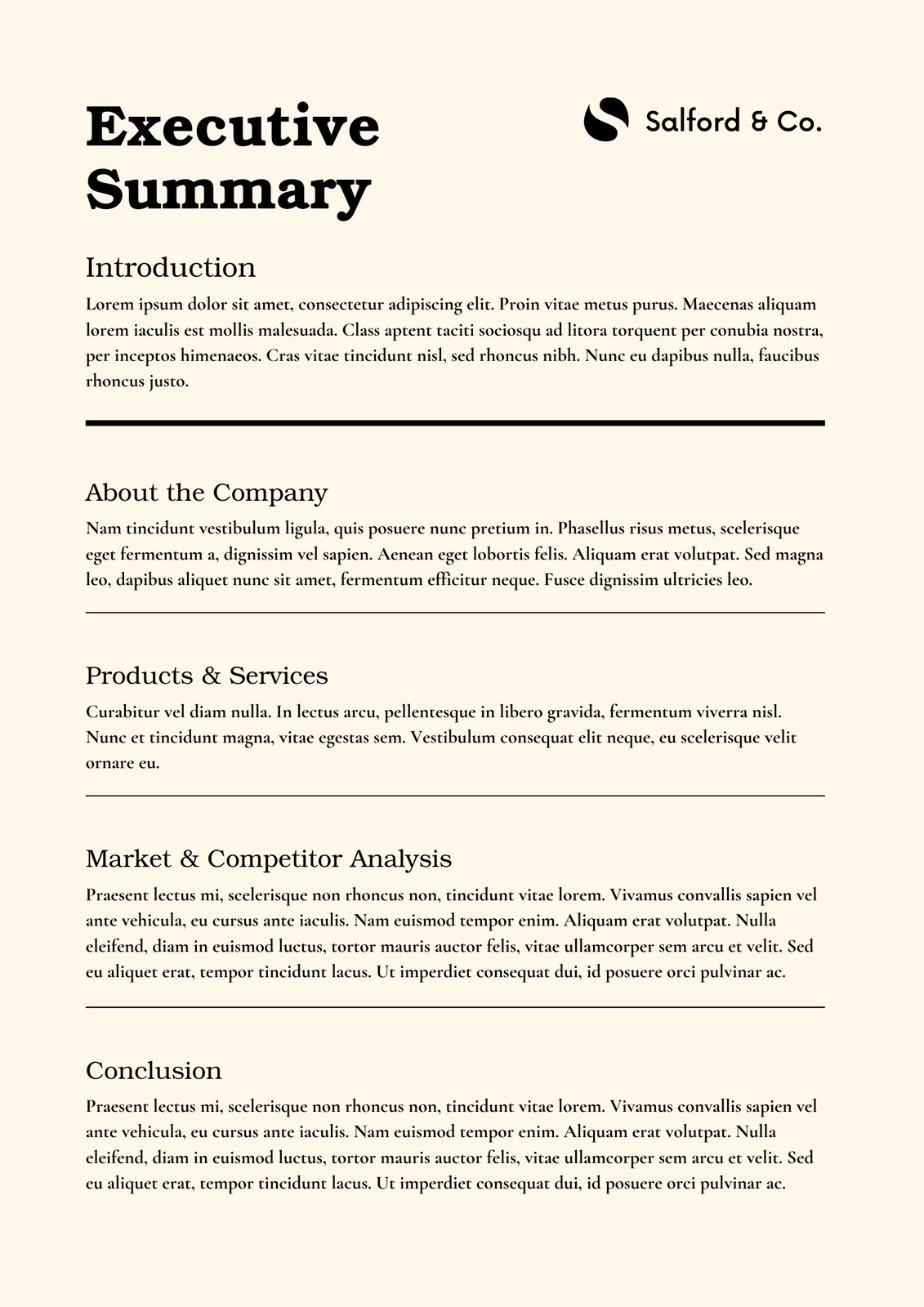
Formatting and Presentation: Making Your Summary Shine
Beyond the content, the presentation of your executive summary is critical.
- Conciseness: Aim for one to two pages at most. Every word counts.
- Clarity: Use clear, straightforward language. Avoid jargon and overly technical terms unless absolutely necessary for your audience.
- Professionalism: Ensure impeccable grammar, spelling, and punctuation.
- Visual Appeal: Use headings, bullet points, and white space to make the summary easy to scan and digest.
- Consistency: Ensure the tone and messaging are consistent with the rest of your document.
In conclusion, a well-crafted executive summary is more than just a formality; it’s a strategic imperative. By thoughtfully addressing the problem, presenting a compelling solution, highlighting your unique value, outlining financial projections, and introducing your team, you can create a powerful document that commands attention and drives action. Whether you’re navigating the complex world of tech innovation, shaping a powerful brand identity, or managing critical financial strategies, your executive summary is your key to unlocking success.
aViewFromTheCave is a participant in the Amazon Services LLC Associates Program, an affiliate advertising program designed to provide a means for sites to earn advertising fees by advertising and linking to Amazon.com. Amazon, the Amazon logo, AmazonSupply, and the AmazonSupply logo are trademarks of Amazon.com, Inc. or its affiliates. As an Amazon Associate we earn affiliate commissions from qualifying purchases.