
The moment you realize your debit card is missing is often accompanied by a sharp jolt of adrenaline and a sinking feeling in the pit of your stomach. Unlike a lost credit card, which offers a layer of insulation between a thief and your actual cash, a lost debit card is a direct portal to your primary checking account. In the world of personal finance, this is a “Code Red” situation that requires immediate, calculated action to mitigate risk and ensure your hard-earned capital remains secure.
How you handle the next sixty minutes—and the subsequent forty-eight hours—will dictate your level of financial liability and the ease with which you can restore your daily financial operations. This guide explores the immediate tactical responses, the legal frameworks protecting your assets, and the strategic shifts you should implement to prevent such a lapse from compromising your financial stability in the future.
Immediate Damage Control: The Critical First Steps
Time is the most valuable currency when a debit card goes missing. The distinction between a minor inconvenience and a financial catastrophe often comes down to the speed of your response.
Utilize the “Freeze” or “Lock” Feature
Most modern financial institutions have integrated “card control” features directly into their mobile banking applications. This should be your very first move. Before you even call the bank, open your app and toggle the “Lock Card” switch. This instantly prevents any new point-of-sale transactions or ATM withdrawals from being processed.
The beauty of the “freeze” feature is its reversibility. If you suspect the card is simply tucked between the seats of your car or left at a local cafe, freezing it gives you a window of time to search without leaving your account vulnerable. If you find the card, you can toggle it back on. If you don’t find it within an hour or two, you must move to the next phase: permanent cancellation.
Official Reporting and the Electronic Fund Transfer Act (EFTA)
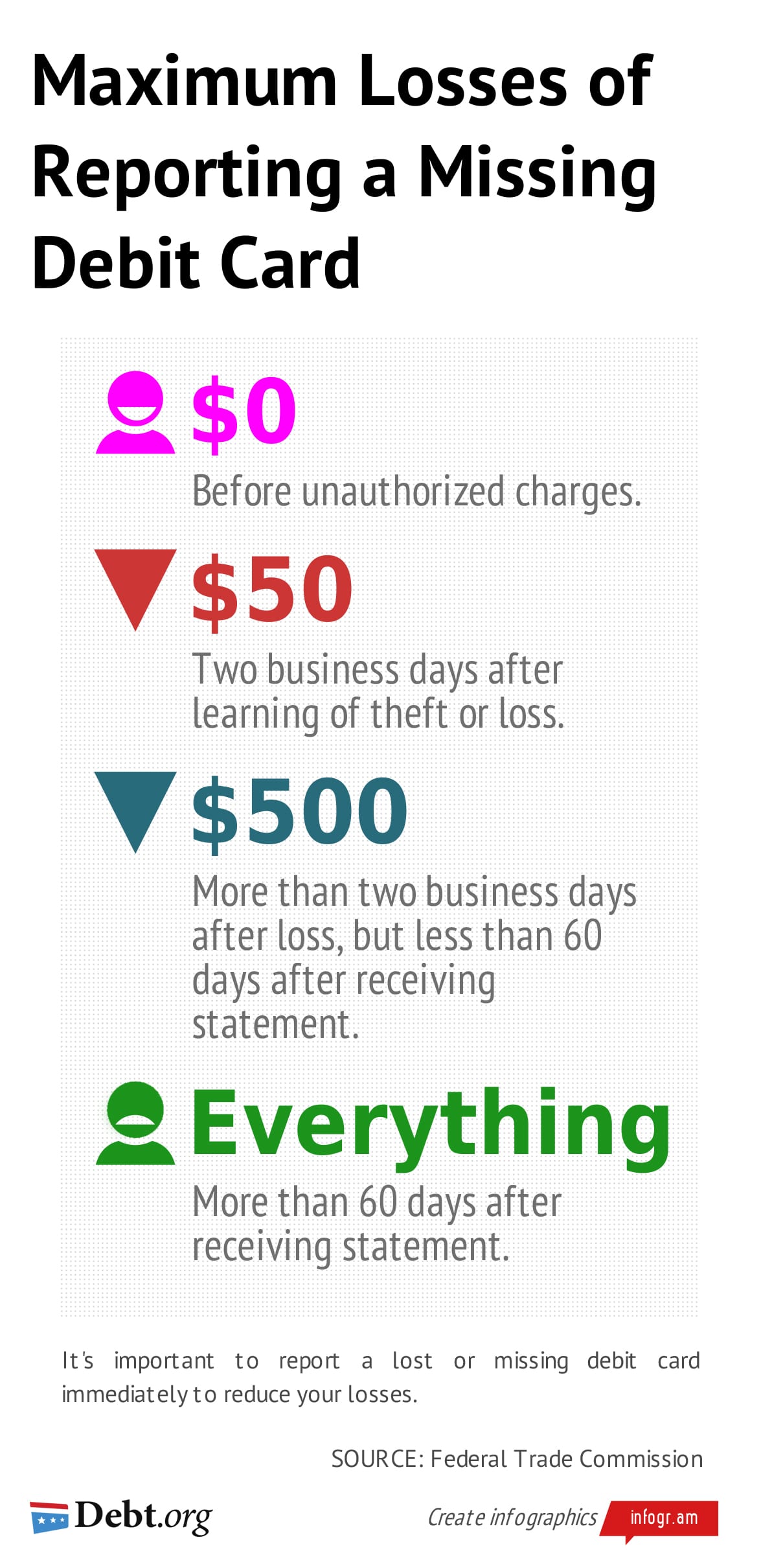
Under federal law in the United States, specifically the Electronic Fund Transfer Act (Regulation E), your liability for unauthorized transactions is determined by how quickly you report the loss.
- Before any charges occur: If you report the card as lost before any unauthorized transactions are made, your liability is zero.
- Within two business days: If you report the loss within two business days of discovery, your liability for unauthorized transfers is limited to $50.
- Between two and sixty days: If you wait longer than two days but report the loss within sixty days of your statement being mailed, you could be liable for up to $500.
- Beyond sixty days: If you fail to report the loss within sixty days of your statement being sent, you risk losing all the money taken from your account, and potentially even money linked through overdraft protection.
When you call your bank’s fraud department, record the time of the call, the name of the representative, and the reference number for the report. This documentation is your primary defense if the bank later disputes your claim of unauthorized activity.
Managing the Financial Fallout and Continuity
Once the card is cancelled and a replacement is ordered, you face a new challenge: the disruption of your financial ecosystem. In an era of automated payments and digital subscriptions, a dead debit card creates a ripple effect that can lead to missed payments and service interruptions.
Auditing Your Automated Finances
Most consumers use their debit cards as the primary engine for recurring expenses. You must perform an immediate audit of your “autopay” accounts. This includes utility companies, insurance providers, streaming services, and gym memberships.
If a payment fails because the card on file is cancelled, some providers may charge “returned payment” fees or, worse, temporarily suspend your service. Make a list of every recurring charge tied to that specific card number. If you have an alternative payment method, such as a credit card or a secondary bank account, move those payments over immediately. If not, contact the billing departments of your most critical services (like electricity or phone) to inform them that a replacement card is on the way.
Bridge Financing While Waiting for Plastic
A standard replacement card typically takes five to ten business days to arrive via mail. For many, going two weeks without access to their primary spending tool is not feasible.
First, ask your bank about “Expedited Delivery.” Many institutions will overnight a card for a fee ranging from $20 to $30. If your balance is healthy and you are a long-time customer, you can often negotiate to have this fee waived.
Second, leverage digital wallets. Many banks now allow you to add your new card number to Apple Pay, Google Pay, or Samsung Pay instantly through their mobile app, even before the physical card arrives in your mailbox. This allows you to make purchases at most major retailers using your smartphone.

Lastly, if you need physical cash, most banks allow for “Cardless ATM” access. By using your bank’s app, you can generate a one-time code that allows you to withdraw cash from the bank’s own ATMs without needing a physical card.
Rethinking Your Relationship with Debit Cards
A lost debit card is more than a logistical hurdle; it is a moment to evaluate your overall financial architecture. While debit cards are excellent tools for budgeting and avoiding debt, they possess inherent security flaws compared to other financial instruments.
The Case for Credit Over Debit for Daily Spending
From a professional financial perspective, using a debit card for daily transactions—especially at “high-risk” locations like gas pumps, independent kiosks, or online retailers—is a strategic error.
Credit cards fall under the Fair Credit Billing Act (FCBA), which offers more robust protections than the EFTA. When a credit card is compromised, the money hasn’t actually left your bank account; you are simply disputing a line of credit. With a debit card, your actual cash is gone until the bank completes its investigation, which can take up to ten business days or longer.
A more resilient strategy is to use a credit card for all daily purchases to benefit from the “buffer” it provides, then pay the balance in full every month from your checking account. This keeps your “liquidity” (your actual cash) safe from the front lines of fraud.
Implementing a Multi-Tiered Banking Structure
Relying on a single debit card linked to your primary “life” account creates a single point of failure. Consider a two-account system:
- The Vault Account: This is where your direct deposit lands and where you keep the bulk of your cash for bills and savings. This account should not have a debit card associated with it, or the card should be kept locked in a home safe.
- The Spending Account: This is a secondary account with a separate debit card. You “push” a specific amount of weekly spending money into this account. If the card for this account is lost or stolen, the thief only has access to a fraction of your wealth, and your primary bill-paying funds remain untouched and secure.
Fraud Monitoring and Long-Term Security Posture
Replacing the card is the beginning of the recovery, not the end. You must remain vigilant for several months following a loss, as your card data may have been harvested long before the physical card went missing.
Setting Up Transactional Alerts
Knowledge is power in personal finance. Go into your banking settings and enable “Push Notifications” for every transaction over $0.01. While it may seem intrusive to get a text or notification every time you buy a coffee, it ensures that you are the first to know the second an unauthorized charge is attempted. If you see a charge for a gas station in a different state, you can lock the card before the thief moves on to a larger purchase.
Protecting Your Credit Identity
If your wallet was lost or stolen—rather than just the card—you must assume that your personal identifiable information (PII) is at risk. A thief with your driver’s license and a debit card can often glean enough information to attempt identity theft.
Consider placing a “Fraud Alert” on your credit reports with the three major bureaus (Equifax, Experian, and TransUnion). This requires lenders to take extra steps to verify your identity before issuing new credit in your name. For maximum security, a “Credit Freeze” is even more effective, as it completely prevents new credit files from being opened until you manually unfreeze it.
The Evolution of Physical Access: Future-Proofing Your Wallet
As we move further into a digital-first economy, the necessity of carrying a physical debit card is diminishing. Adapting to these changes can significantly reduce the impact of losing your physical wallet.
The Rise of Virtual Card Numbers
Many fintech-forward banks now offer “Virtual Cards.” These are digital card numbers that are separate from your physical card. You can use a virtual card for online shopping or subscriptions. If that number is compromised or if you lose your physical card, the virtual card continues to function, or vice versa. This decoupling of the “physical” and “digital” spending tools adds a necessary layer of redundancy to your financial life.
Biometric and Cardless ATM Access
The “physical” card is a legacy technology. Many major banks are moving toward biometric authentication at branches and ATMs. By setting up your palm print or using face ID through a banking app to authorize ATM withdrawals, you eliminate the need to carry the plastic card at all.
Ultimately, the goal is to reach a state of “Financial Anti-fragility.” By having systems in place—automated alerts, multi-tiered accounts, and digital backups—the loss of a single piece of plastic becomes a minor administrative task rather than a financial crisis. Treat your debit card as the high-access key that it is, but build a security perimeter around your wealth that doesn’t rely on that one key alone.
aViewFromTheCave is a participant in the Amazon Services LLC Associates Program, an affiliate advertising program designed to provide a means for sites to earn advertising fees by advertising and linking to Amazon.com. Amazon, the Amazon logo, AmazonSupply, and the AmazonSupply logo are trademarks of Amazon.com, Inc. or its affiliates. As an Amazon Associate we earn affiliate commissions from qualifying purchases.