
The sudden impact of a deer collision is a jarring experience that goes beyond the immediate physical shock. Once the dust settles and you ensure everyone’s safety, the situation shifts from a road emergency to a complex financial event. In the world of personal finance and risk management, hitting a deer is a significant “leak” in your net worth if not handled with precision.
From navigating insurance nuances to calculating the opportunity cost of repairs versus replacement, the steps you take in the minutes and days following the incident will dictate the ultimate hit to your wallet. This guide outlines the strategic financial maneuvers required to mitigate losses and protect your assets after a wildlife collision.

Immediate Financial Safeguards: Navigating Insurance and Liability
The moments following a collision are critical for documentation. From a financial perspective, you are now a “claims manager” for your own household. Your goal is to ensure that your insurance provider has zero grounds to deny your claim or undervalue your loss.
Understanding Comprehensive vs. Collision Coverage
The first financial distinction to understand is the type of coverage triggered by a deer. In the insurance industry, hitting a deer is typically classified under Comprehensive Coverage, not Collision Coverage. This is a vital distinction for your premiums. Collision coverage usually applies when you hit another vehicle or a stationary object, and these are often deemed “at-fault” accidents.
Comprehensive coverage covers “acts of God” or unpredictable events like fire, theft, or hitting an animal. Because these are generally viewed as “not-at-fault” incidents, the impact on your long-term insurance premiums is often significantly lower than a standard collision. However, if you swerve to miss the deer and hit a tree instead, the incident may be reclassified as an at-fault collision, drastically changing your financial liability.
The Role of Deductibles in Out-of-Pocket Expenses
Your deductible is the first financial hurdle. Before you authorize any work, you must evaluate your liquidity. If you have a $500 or $1,000 deductible, that amount must be paid out-of-pocket before the insurance company contributes a cent.
If the damage is marginal—say, a cracked headlight and a minor dent—the total repair cost might hover around $1,200. If your deductible is $1,000, you are essentially filing a claim for a $200 benefit. From a strategic standpoint, it may be wiser to pay the full $1,200 out-of-pocket to keep your claims history “clean,” preventing a potential (albeit small) premium hike and maintaining your “claims-free” discounts.
Documenting the Scene for Claim Accuracy
Insurance adjusters look for evidence to categorize the loss. To protect your financial interest, take high-resolution photos of the vehicle, the surrounding area, and, if possible, evidence of the animal (such as hair or blood on the bumper). This proof is the cornerstone of a successful comprehensive claim. Without it, an unscrupulous or skeptical adjuster might argue you hit a pole or another car, which would move the claim into the more expensive “Collision” category, potentially costing you thousands in increased premiums over the next three to five years.
Assessing the True Cost of Repair: Beyond the Visible Damage
Modern vehicles are no longer just steel and glass; they are mobile computers. What looks like a minor “fender bender” with a buck can actually involve a cascade of technological failures that carry a heavy price tag.
Mechanical vs. Aesthetic Costs
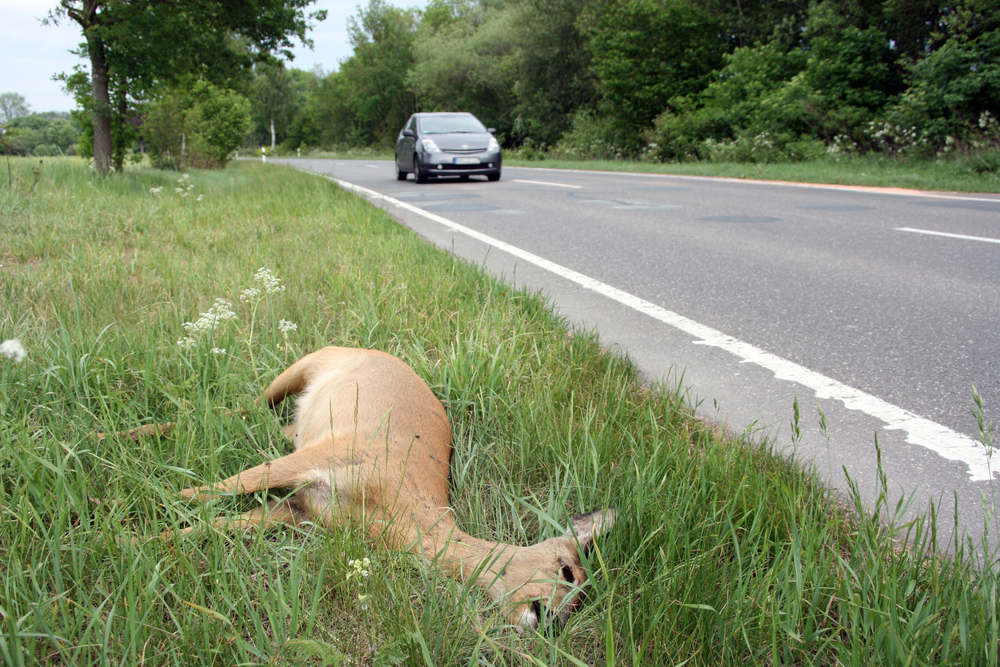
A deer collision often impacts the front fascia of the car. While the dent in the hood is an aesthetic issue, the damage to the radiator, cooling system, and AC condenser is a functional financial threat. If the radiator is cracked and the engine overheats while you try to drive the car home, a $2,000 bodywork bill can transform into a $10,000 engine replacement. Strategically, you should always account for “hidden mechanical depreciation.” Even after repairs, a vehicle with a major accident history carries a lower resale value—a concept known as “diminished value.”
The Impact of Modern Sensors on Repair Invoices
One of the most significant shifts in automotive finance is the cost of ADAS (Advanced Driver Assistance Systems). If your car has adaptive cruise control, lane-keep assist, or emergency braking, there are likely radar sensors and cameras located behind the grille or bumper.
A deer impact can knock these sensors out of alignment or destroy them entirely. Replacing and recalibrating these systems often adds $1,500 to $3,000 to a repair bill that would have cost only $500 a decade ago. When getting estimates, ensure the shop is certified to perform “electronic recalibration.” Failure to do this correctly could lead to secondary failures that are not covered if you’ve already closed your insurance claim.
To Claim or Not to Claim: The Premium Hike Calculation
Before finalizing a claim, perform a “break-even analysis.” Ask your agent (anonymously if possible) how a comprehensive claim affects your specific policy. If the repair cost is $3,000 and your deductible is $500, the insurance company is providing $2,500 in value. However, if your premium increases by $200 per year for the next three years, your “net gain” from the insurance company is actually $1,900. In most deer-related cases, the damage is high enough that filing a claim is the mathematically correct choice, but for minor incidents, the self-insurance route often preserves more wealth over time.
Total Loss Scenarios and Vehicle Valuation
In many cases, especially with older vehicles or high-mileage cars, the cost of repairing deer damage exceeds the value of the car. This leads to the “Total Loss” designation, a critical moment for your personal balance sheet.
How Insurance Companies Determine ‘Totaled’ Status
Most insurers use a “Total Loss Threshold,” which is typically between 70% and 80% of the vehicle’s Actual Cash Value (ACV). If your car is worth $10,000 and the deer caused $7,500 in damage, the insurance company will likely “total” it. They will cut you a check for the ACV and take the car to a salvage yard. The financial danger here is that “Actual Cash Value” is rarely enough to buy an equivalent replacement vehicle in the current market, especially after factoring in sales tax and registration fees.
Negotiating the Actual Cash Value (ACV)
Never accept the first offer from an insurance adjuster. They use software like CCC One to find “comparables,” but these are often low-ball figures. To protect your investment, conduct your own market research. Find at least three local listings for the same year, make, model, and mileage. If your car had recent upgrades—new tires, a recent transmission flush, or a brand-new battery—provide receipts. These can incrementally increase your settlement, ensuring your “payout” more closely reflects the true replacement cost.
Dealing with Gap Insurance and Remaining Loan Balances
The most perilous financial position to be in after hitting a deer is being “underwater” on your car loan. If you owe $20,000 on a car that the insurance company values at $15,000, you are responsible for the $5,000 “gap” even though you no longer have a car. This is where Gap Insurance becomes a critical asset. If you have it, the policy covers that $5,000 difference. If you don’t, this deer collision has essentially forced a $5,000 realization of debt. In this scenario, you may need to negotiate with your lender to roll that balance into a new loan or use emergency savings to clear the title.
Long-Term Financial Planning and Risk Mitigation
Once the immediate crisis is managed, the final step is to adjust your financial strategy to prevent future shocks to your budget.
Reviewing Your Policy After an Incident
An accident is a “financial audit” of your insurance choices. If you found yourself struggling to pay a $1,000 deductible, your emergency fund is too low, or your deductible is too high for your current liquidity. Conversely, if you realized your “Comprehensive” coverage was missing entirely, you were exposed to a 100% loss of the asset. Use the weeks following the accident to shop for new rates and adjust your coverage limits to match your current net worth.
The Financial Benefits of Defensive Driving Courses
Many insurance providers offer a “safe driver” or “defensive driving” discount that can range from 5% to 10% of your premium. Completing a certified course after an accident not only improves your skills for avoiding the next deer but serves as a proactive move to lower your fixed monthly expenses. Over five years, a 10% discount on a $1,500 annual premium results in $750 in savings—essentially paying for your next deductible in advance.
Emergency Funds and the ‘Deer Fund’ Strategy
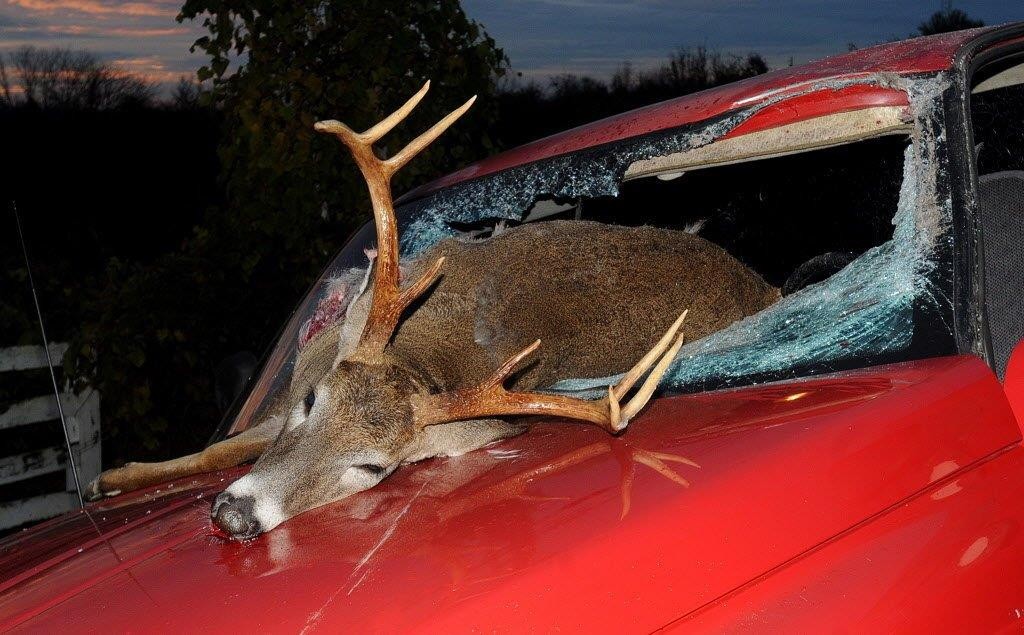
Financial planners often suggest a “Sinking Fund” for car maintenance. A wildlife collision is a perfect example of why this is necessary. By automating a small transfer—perhaps $50 a month—into a high-yield savings account designated for “Vehicle Contingencies,” you insulate your main emergency fund from the shock of a collision. When the next deer appears, you won’t be looking at a financial disaster; you’ll be looking at a pre-funded expense, allowing you to focus on your safety rather than your bank balance.
aViewFromTheCave is a participant in the Amazon Services LLC Associates Program, an affiliate advertising program designed to provide a means for sites to earn advertising fees by advertising and linking to Amazon.com. Amazon, the Amazon logo, AmazonSupply, and the AmazonSupply logo are trademarks of Amazon.com, Inc. or its affiliates. As an Amazon Associate we earn affiliate commissions from qualifying purchases.