
The question “What are your weaknesses?” is arguably one of the most dreaded, yet frequently asked, queries in professional settings. Whether it arises during a job interview, a performance review, or even a casual networking conversation, it often catches individuals off guard, prompting either a defensive stumble or a rehearsed, unconvincing platitude. However, astute professionals understand that this isn’t a trap designed to expose flaws; rather, it’s a profound opportunity to fortify one’s personal brand. In the realm of personal branding, how you address your limitations speaks volumes about your self-awareness, integrity, growth mindset, and ultimately, your readiness for new challenges. This seemingly simple question is a powerful crucible for assessing the depth and authenticity of your professional identity.

Instead of fearing this moment, imagine it as a strategic touchpoint where you can demonstrate sophisticated self-understanding and a proactive commitment to development. Your response can elevate your personal brand from merely competent to genuinely compelling, showcasing not just what you can do, but also who you are as a professional committed to continuous improvement. It’s about leveraging vulnerability as a strength, transforming a potential stumbling block into a cornerstone of a robust and trustworthy personal narrative.
The Strategic Imperative of Addressing Weaknesses in Personal Branding
In an increasingly transparent and interconnected world, authenticity has become a non-negotiable component of a strong personal brand. The ability to articulate your weaknesses thoughtfully is not a sign of deficiency but a hallmark of genuine self-awareness and a commitment to continuous growth.
Beyond the Cliché: Why Self-Awareness Matters
A truly impactful personal brand is built on a foundation of deep self-understanding. Merely rattling off a cliché like “I’m a perfectionist” without genuine insight into how it impacts your work, and more importantly, what you’re doing about it, falls flat. True self-awareness means identifying specific areas where you could improve, understanding the root causes of these limitations, and recognizing their potential effects on your performance and team dynamics. This level of introspection projects an image of maturity and conscientiousness—qualities that inherently strengthen your professional reputation. When you can articulate a weakness with specificity and context, it demonstrates that you’ve done the internal work necessary to understand your own operating system, making your brand feel more authentic and reliable.
Building Trust and Authenticity
No one is perfect, and any attempt to present an infallible personal brand often backfires, appearing inauthentic or even arrogant. By thoughtfully acknowledging a weakness, you signal trustworthiness and honesty. It humanizes your brand, making you more relatable and approachable. When you are transparent about an area you’re working on, you invite empathy and demonstrate a level of integrity that resonates deeply. This authenticity helps to build stronger professional relationships, as colleagues, clients, and potential employers are more likely to trust someone who is honest about their journey, including its challenges. A brand that admits to learning and evolving is far more resilient and appealing than one that pretends to be without fault.
Demonstrating Growth Potential
Perhaps the most potent aspect of discussing weaknesses is the opportunity to highlight your growth mindset. Framing a weakness as an area for development, rather than a fixed flaw, positions you as a forward-thinking individual who is committed to personal and professional evolution. This perspective is highly valued in dynamic environments where adaptability and continuous learning are paramount. When you outline the steps you are taking to overcome a limitation, you showcase initiative, problem-solving skills, and resilience. These attributes are not just desirable; they are essential for anyone aiming to build a brand associated with progress and innovation. Your ability to identify a gap and actively work to bridge it speaks volumes about your potential to contribute and adapt within any professional context.
Deconstructing the “Weakness” Question for Brand Advantage
To truly leverage this question for your personal brand, you must first understand its underlying purpose and then strategically construct your response. It’s not about confession; it’s about control of your narrative.
Understanding the Interviewer’s Intent
When an interviewer asks about your weaknesses, they aren’t looking for a definitive list of your shortcomings. Instead, they’re typically evaluating several key characteristics:
-
Self-awareness: Can you honestly assess yourself and identify areas for improvement?
-
Maturity & Honesty: Are you mature enough to admit imperfections, and are you honest in your self-assessment?
-
Growth Mindset: Do you actively work on developing yourself, or do you ignore your flaws?
-
Problem-solving Skills: Do you approach challenges (even personal ones) with a strategic, proactive mindset?
-
Resilience: How do you cope with personal challenges and setbacks?
Understanding these underlying motivations allows you to tailor a response that addresses these concerns directly, showcasing positive brand attributes rather than simply stating a negative.
Selecting the Right “Weakness”: The Art of Strategic Disclosure
The choice of weakness is critical. It must be genuine, but also manageable and professionally appropriate. Here’s how to make a strategic selection:
-
Avoid Deal-Breakers: Never choose a weakness that is a core requirement for the job (e.g., if applying for a meticulous accounting role, don’t say you’re disorganized).
-
Opt for Manageable Issues: Select a genuine weakness that you have actively been working to improve, or one that has a clear, actionable path to improvement. It shouldn’t be an inherent character flaw but a professional habit or skill gap.
-
Focus on Professional, Not Personal: Keep the discussion strictly within a professional context. Personal issues are irrelevant and inappropriate for this setting.
-
Consider a “Strength in Disguise”: Sometimes, a strength taken to an extreme can become a weakness. For example, being “too detail-oriented” can lead to spending excessive time on minor tasks. This demonstrates high standards while acknowledging a need for balance. Ensure you can articulate why it’s a weakness and how you’re balancing it.
The PAR Method (Problem, Action, Result) for Weaknesses
Structuring your answer using a modified Problem-Action-Result (PAR) framework is highly effective for turning a perceived negative into a positive brand narrative.
-
Problem (State the Weakness): Clearly and concisely state your chosen weakness. Be specific. Instead of “I sometimes procrastinate,” try “I’ve sometimes struggled with initiating tasks immediately when the deadline feels distant, even if I know it’s important.”
-
Action (Explain Your Steps to Overcome It): Detail the specific, concrete steps you are taking to address this weakness. This is where you demonstrate your growth mindset and proactivity. “To combat this, I’ve implemented a system where I break down larger projects into smaller, immediate steps and use a task management app to assign artificial deadlines, even for long-term projects.”
-
Result (Show the Positive Outcome or Ongoing Progress): Conclude by illustrating the positive impact of your efforts. Even if it’s ongoing, highlight the progress. “This approach has significantly improved my task initiation and reduced last-minute pressure, allowing me to deliver work more consistently ahead of schedule, especially on complex projects requiring sustained effort.”
This method transforms a potentially negative admission into a powerful testament to your self-awareness, initiative, and commitment to personal development, significantly enhancing your personal brand.
Crafting Your Brand-Enhancing Response: Practical Approaches
Beyond the structure, the delivery and framing of your response are crucial for shaping a positive perception of your personal brand. It’s about more than just the words; it’s the message your confidence, self-awareness, and dedication to growth convey.
Emphasize Improvement and Proactivity
The core of a strong “weakness” answer lies in demonstrating that you are not passive about your limitations. Your personal brand should convey a dynamic, evolving individual. Don’t just name a weakness; immediately pivot to the active steps you are taking to mitigate it. For example, instead of saying, “I tend to be shy in large group settings,” elaborate with, “While I’m naturally more introverted, I recognize the value of active participation in team brainstorms. To address this, I’ve started preparing key discussion points in advance and make it a point to contribute at least one idea early in meetings, which has helped me build confidence and engage more effectively with colleagues.” This proactive stance signals strong self-management and a commitment to professional growth.
Frame Weaknesses as Learning Opportunities
Every perceived weakness can be reframed as a valuable learning opportunity. This perspective shifts the narrative from a deficit to a chance for growth and skill acquisition, aligning perfectly with a resilient and adaptable personal brand. For instance, if your weakness is a particular technical skill gap, you could say, “I’ve identified that my proficiency in [specific software/tool] is not as advanced as I’d like. Rather than seeing this as a roadblock, I view it as an exciting opportunity to expand my toolkit. I’ve already enrolled in an online course and dedicated [X hours] per week to practice, and I’m eager to apply these new skills to [relevant project].” This showcases enthusiasm for learning and a proactive attitude towards self-improvement, which are incredibly attractive brand traits.
Connecting to Role and Organizational Values
Where appropriate, subtly link your efforts to improve your weakness with the specific requirements of the role or the broader values of the organization. This demonstrates that you’ve done your homework and are thinking strategically about how your personal development aligns with their needs. If a company values teamwork and collaboration, addressing a past tendency towards independent work by highlighting your new strategies for collaboration (e.g., using shared documents, actively seeking feedback) would be highly impactful. This shows not only self-awareness but also an understanding of the organizational culture, making you appear as a more integrated and valuable potential brand asset.
Practice and Refine: Delivering with Confidence
Even the most perfectly crafted answer can fall flat without confident delivery. Rehearse your response until it feels natural and authentic, not rote. Pay attention to your tone, body language, and eye contact. A well-prepared and calmly delivered answer reinforces your professional brand image, projecting self-assurance and thoughtful consideration. The goal is to convey that you are comfortable with self-reflection and capable of articulate communication, even on challenging subjects. This polish in delivery can significantly elevate the impact of your message, leaving a lasting positive impression.
Common Pitfalls to Avoid in Your Brand Narrative
While strategically addressing weaknesses can elevate your personal brand, several common missteps can inadvertently undermine it. Being aware of these pitfalls is crucial for maintaining a strong, credible professional image.
The “No Weaknesses” Trap
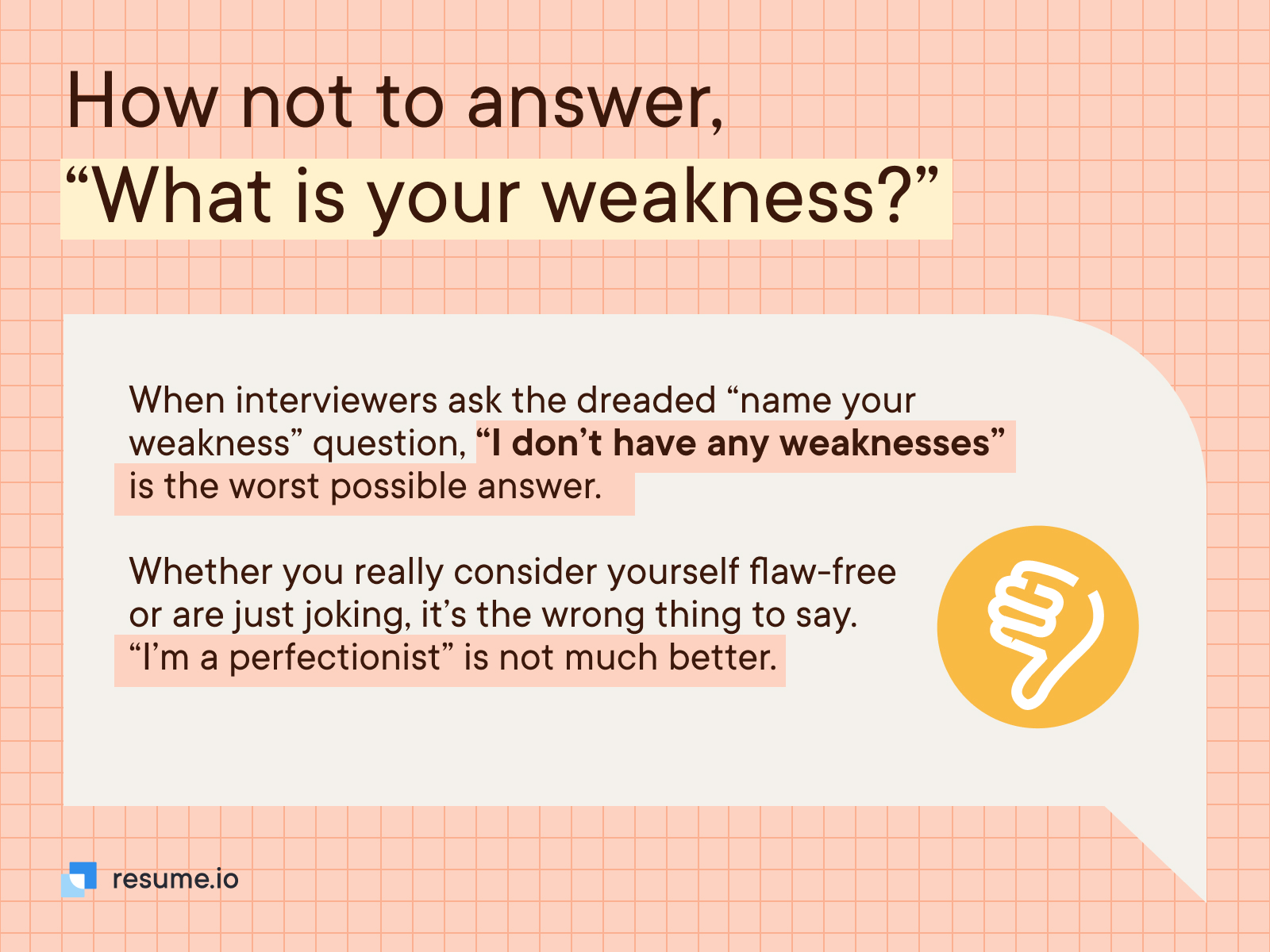
Perhaps the most damaging response to the “weaknesses” question is to claim you have none. This immediately signals a severe lack of self-awareness, arrogance, or dishonesty, all of which are detrimental to a positive personal brand. No one believes someone who claims to be perfect. Such an answer alienates the listener and raises serious doubts about your ability to self-reflect and learn. A genuinely strong personal brand is built on authenticity and a realistic understanding of oneself, including areas for development. Avoid this trap at all costs, as it can instantly derail your professional credibility.
Revealing Critical Flaws
While honesty is important, there’s a fine line between strategic disclosure and professional self-sabotage. Avoid mentioning weaknesses that are fundamental to the job’s requirements or that highlight serious character flaws (e.g., “I struggle with meeting deadlines,” “I have trouble getting along with colleagues,” or “I’m not good under pressure”). These kinds of admissions are red flags that demonstrate poor judgment in managing your personal brand, as they directly undermine your suitability for the role or even for professional interaction in general. The goal is to show growth, not to confess deal-breakers.
Generic, Unbacked Answers
Vague or overused clichés, like “I’m a perfectionist” or “I work too hard,” without concrete examples of how they manifest as weaknesses and, more importantly, what specific actions you’ve taken to address them, lack substance. Such answers come across as unoriginal and superficial, failing to showcase genuine self-awareness or a growth mindset. Your personal brand needs depth and evidence to be credible. If you choose a common “strength-as-weakness,” be prepared to elaborate on its negative impact and the tangible steps you’ve taken to find a healthier balance. Without this backing, your response will simply be dismissed as an attempt to evade the question.
Dwelling on Negatives
While you must state the weakness, the focus of your answer should quickly shift to resolution, improvement, and growth. Dwelling excessively on the negative aspect, lamenting the weakness, or offering excuses can cast a pessimistic shadow over your personal brand. The interviewer wants to see your capacity for resilience and self-improvement, not a detailed account of your struggles without a clear path forward. Keep the explanation of the weakness concise, and dedicate the majority of your response to the actions you’ve taken and the positive results or ongoing progress you’ve achieved. Your brand narrative should always be forward-looking and solutions-oriented.

Conclusion
The question “What are your weaknesses?” is far more than a simple query; it’s a pivotal moment to define and strengthen your personal brand. Rather than a source of anxiety, it stands as a unique opportunity to demonstrate self-awareness, integrity, and a profound commitment to continuous growth—qualities that are universally valued in any professional landscape.
By strategically selecting a genuine, manageable weakness, framing it as a learning opportunity, and detailing the proactive steps you’re taking for improvement, you can transform a perceived negative into a powerful testament to your dynamic professional identity. Leverage frameworks like the PAR method to structure a compelling narrative that shifts the focus from fault to future-oriented development. Avoid common pitfalls such as claiming perfection, revealing critical flaws, or offering generic responses, as these can severely undermine your credibility and authenticity.
Ultimately, your ability to articulate your weaknesses thoughtfully, demonstrate accountability, and showcase a relentless pursuit of self-improvement will not only answer the question effectively but also significantly enhance your personal brand. It proves that you are not just capable in your strengths, but also mature and insightful enough to navigate your challenges, making you a more resilient, trustworthy, and appealing professional asset. Embrace this question, own your narrative, and let it propel your personal brand to new heights.
aViewFromTheCave is a participant in the Amazon Services LLC Associates Program, an affiliate advertising program designed to provide a means for sites to earn advertising fees by advertising and linking to Amazon.com. Amazon, the Amazon logo, AmazonSupply, and the AmazonSupply logo are trademarks of Amazon.com, Inc. or its affiliates. As an Amazon Associate we earn affiliate commissions from qualifying purchases.