
For the modern investor, timing is not just a logistical detail—it is a critical component of a successful financial strategy. Whether you are a day trader looking to capitalize on early morning volatility or a long-term investor checking the health of your portfolio, knowing exactly when the market opens and closes is essential. In the United States, the two primary exchanges, the New York Stock Exchange (NYSE) and the NASDAQ, operate on a synchronized schedule that dictates the flow of trillions of dollars daily.
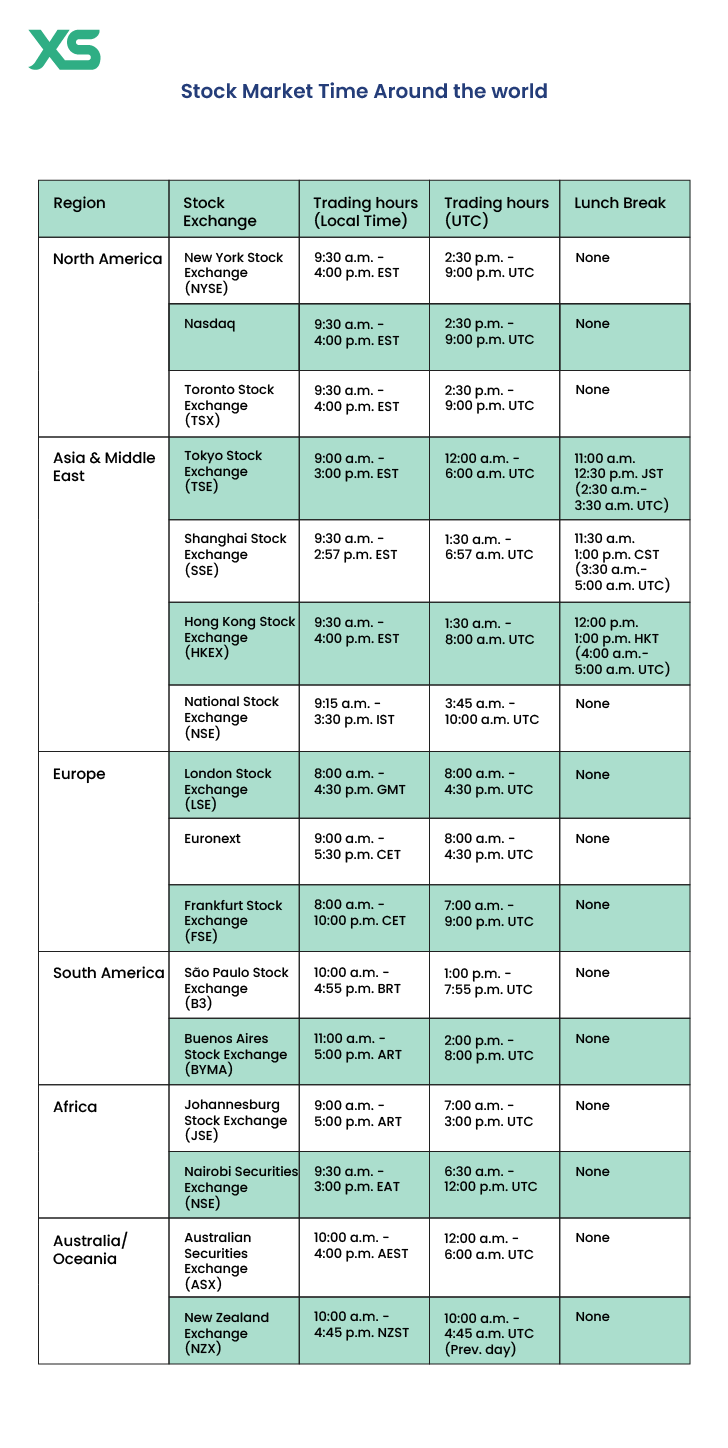
However, the question “what time does the stock market open today?” often carries more complexity than a simple numerical answer. Beyond the standard 9:30 AM bell, there are pre-market sessions, after-hours trading, holiday schedules, and international time zone considerations that every serious participant in the “Money” niche must understand.
Standard Trading Hours: The Rhythm of the New York Stock Exchange and NASDAQ
The backbone of the American financial system is the regular trading session. For the vast majority of retail investors, this is the window during which most orders are executed and where the highest levels of liquidity are found.
The Core Session: 9:30 AM to 4:00 PM ET
The official opening time for the US stock market is 9:30 AM Eastern Time (ET). This applies Monday through Friday, excluding specific market holidays. The closing bell rings at 4:00 PM ET. These hours are designed to concentrate trading activity into a 6.5-hour window, ensuring that there is enough volume to facilitate smooth price discovery and narrow bid-ask spreads.
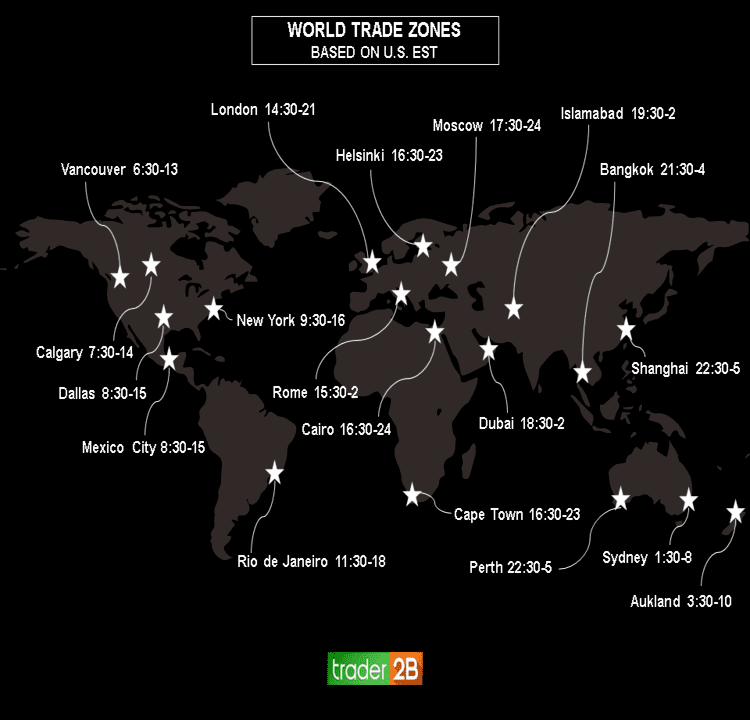
For those living in different time zones, it is vital to synchronize your clocks. For a trader in Los Angeles, the market opens at 6:30 AM PT. For an investor in London, the US market opens at 2:30 PM GMT. Miscalculating these times can lead to missed opportunities or the inability to react to breaking news in real-time.
The Significance of the Opening and Closing Bells
The “Opening Bell” is more than just a ceremonial tradition; it represents a period of intense price discovery. During the first 15 to 30 minutes of the session, the market reacts to news that broke overnight, including international market performance, economic data releases, and corporate earnings. This often leads to the highest volatility of the day.
Similarly, the “Closing Bell” at 4:00 PM ET marks the final opportunity for institutional investors to rebalance their portfolios for the day. High-volume trades often occur in the final minutes, known as the “Closing Auction,” which determines the official closing price used by mutual funds to calculate their Net Asset Value (NAV).
Beyond the Bell: Understanding Extended-Hours Trading
The digital age has fundamentally changed how we interact with the market. While the 9:30 AM to 4:00 PM window is the “standard,” the stock market technically breathes almost 24 hours a day through electronic communication networks (ECNs).
Pre-Market Trading: Seizing the Early Edge
Pre-market trading in the US generally begins as early as 4:00 AM ET, though the most significant activity starts around 8:00 AM ET. This session allows investors to react to early morning news, such as government employment reports (often released at 8:30 AM ET) or international geopolitical shifts.
While pre-market trading offers an “early edge,” it comes with significant risks. The number of participants is much lower than during regular hours, leading to lower liquidity and wider “spreads”—the gap between what a buyer is willing to pay and what a seller is willing to accept.
After-Hours Trading: Reacting to Earnings and News
The after-hours session begins immediately at 4:00 PM ET and can run until 8:00 PM ET. This is arguably the most volatile time for individual stocks, as the vast majority of public companies release their quarterly earnings reports shortly after the closing bell. If a company like Apple or Microsoft misses its revenue targets, the stock price can move 5% or 10% in minutes during the after-hours session before the general public has a chance to trade the next morning.
Risks and Rewards of Trading Outside Regular Hours
The primary advantage of extended-hours trading is the ability to act immediately on news. However, the “Money” niche requires a disciplined approach to risk management. Because of the low volume, prices in the pre-market or after-hours can be manipulated by small trades, creating “fake-outs” where a stock looks like it is crashing or soaring, only to reverse course when the regular session opens and the “big money” (institutional investors) enters the fray.
Market Holidays and Special Schedules: When the Floor Goes Silent
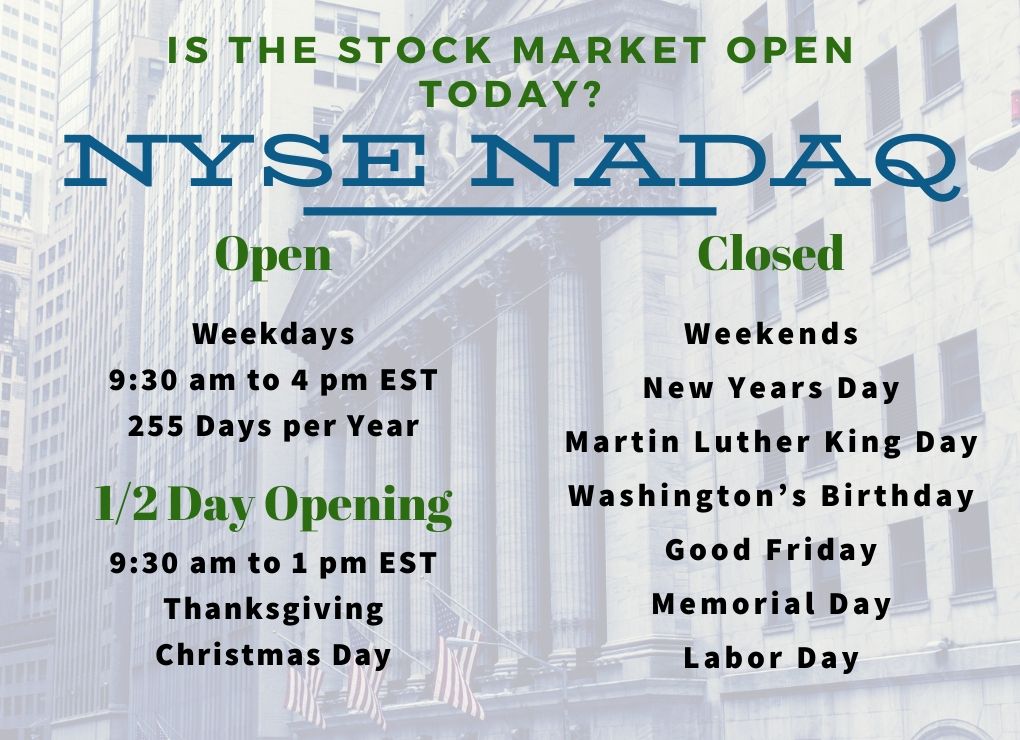
The stock market does not follow the standard retail calendar. There are specific days when the markets are closed entirely and other days when they close early. Understanding this calendar is crucial for managing margin requirements and ensuring you aren’t caught in a position you cannot exit.
Federal Holidays and Exchange Closures
The NYSE and NASDAQ observe nine major holidays per year, during which the markets are closed for the full day:
- New Year’s Day
- Martin Luther King, Jr. Day
- Washington’s Birthday (Presidents’ Day)
- Good Friday
- Memorial Day
- Juneteenth National Independence Day
- Independence Day
- Labor Day
- Thanksgiving Day
- Christmas Day
If a holiday falls on a Saturday, the market usually closes on the preceding Friday. If it falls on a Sunday, the market closes on the following Monday.
Early Closures: Half-Days in the Financial Calendar
There are also strategic “half-days” where the market opens at 9:30 AM but closes early at 1:00 PM ET. These typically occur on the day after Thanksgiving (Black Friday) and sometimes on Christmas Eve or July 3rd, depending on how the calendar falls. During these shortened sessions, trading volume is typically very thin, as many professional traders take the day off, leading to unpredictable price movements.
The Global Perspective: Trading Across Different Time Zones
We live in a globalized economy where the performance of the Nikkei in Tokyo or the FTSE in London can dictate the opening direction of the S&P 500 in New York. If you are serious about business finance and investing, you must keep an eye on the “Sun Never Sets” cycle of global capital.
Major International Markets: London, Tokyo, and Hong Kong
The financial day effectively begins in Asia. The Tokyo Stock Exchange (TSE) and the Hong Kong Stock Exchange (HKEX) provide the first clues of global sentiment. As they close, the European markets, led by the London Stock Exchange (LSE) and the Euronext, take the baton.
- London (LSE): Opens at 3:00 AM ET and closes at 11:30 AM ET.
- Tokyo (TSE): Opens at 8:00 PM ET and closes at 2:00 AM ET (with a lunch break).
There is a significant overlap between the London and New York sessions (from 9:30 AM to 11:30 AM ET). This period is often the most liquid time for the entire global financial system, as both European and American institutions are active simultaneously.
Managing Time Zone Differences for the Modern Investor
For the retail investor, this means the “market” is always moving somewhere. Using financial tools and apps that provide real-time global futures data is essential. Even if the US market hasn’t opened yet, “S&P 500 Futures” are trading, giving you a predictive look at whether the market will open higher or lower based on what happened in Europe and Asia overnight.
Strategic Timing: When Is the Best Time to Place Your Trades?
Just because the market is open doesn’t mean it’s the right time to trade. Experienced investors look for “confluence”—the meeting of timing, volume, and volatility.
The “Power Hour”: Volatility and Liquidity
In the trading world, the “Power Hour” refers to the final hour of the trading day (3:00 PM to 4:00 PM ET). During this time, institutional investors, hedge funds, and pension funds execute large block trades. This surge in volume provides the liquidity needed for large positions to be filled without causing massive slippage in price. For those focused on technical analysis, the price action during the Power Hour often dictates the trend for the following day.
Avoiding the Mid-Day Lull
Between 12:00 PM and 2:00 PM ET, the market often experiences what is known as the “lunchtime lull.” Volume drops as floor traders and institutional desks take breaks. During this period, the market can become “choppy,” meaning prices move sideways with no clear direction. Many professional traders avoid taking new positions during these hours to avoid being “chopped up” by minor fluctuations.
Aligning Your Strategy with Market Momentum
Understanding the clock is about more than just knowing when the doors open; it’s about understanding the psychology of the participants at each hour. The 9:30 AM open is for the emotional reaction; the mid-day is for the drift; and the 4:00 PM close is for the professional conviction.
By mastering the schedule of the stock market, you position yourself to manage your money with greater precision. Whether you are navigating the pre-market for an early entry or waiting for the closing bell to confirm a long-term trend, the clock is one of the most powerful tools in your investment arsenal. Always check the calendar, synchronize your time zone, and remember that in the world of finance, time is quite literally money.
aViewFromTheCave is a participant in the Amazon Services LLC Associates Program, an affiliate advertising program designed to provide a means for sites to earn advertising fees by advertising and linking to Amazon.com. Amazon, the Amazon logo, AmazonSupply, and the AmazonSupply logo are trademarks of Amazon.com, Inc. or its affiliates. As an Amazon Associate we earn affiliate commissions from qualifying purchases.