
For the modern investor, the question “what time does the market open today?” is more than a simple inquiry about a clock; it is the starting gun for a day of strategic decision-making. Whether you are a day trader looking to capitalize on morning volatility or a long-term investor checking your portfolio’s health, understanding the operational rhythms of the world’s financial hubs is essential. While the advent of digital platforms suggests a market that never sleeps, the reality is governed by strictly regulated sessions, holiday schedules, and time zone shifts that dictate liquidity and opportunity.
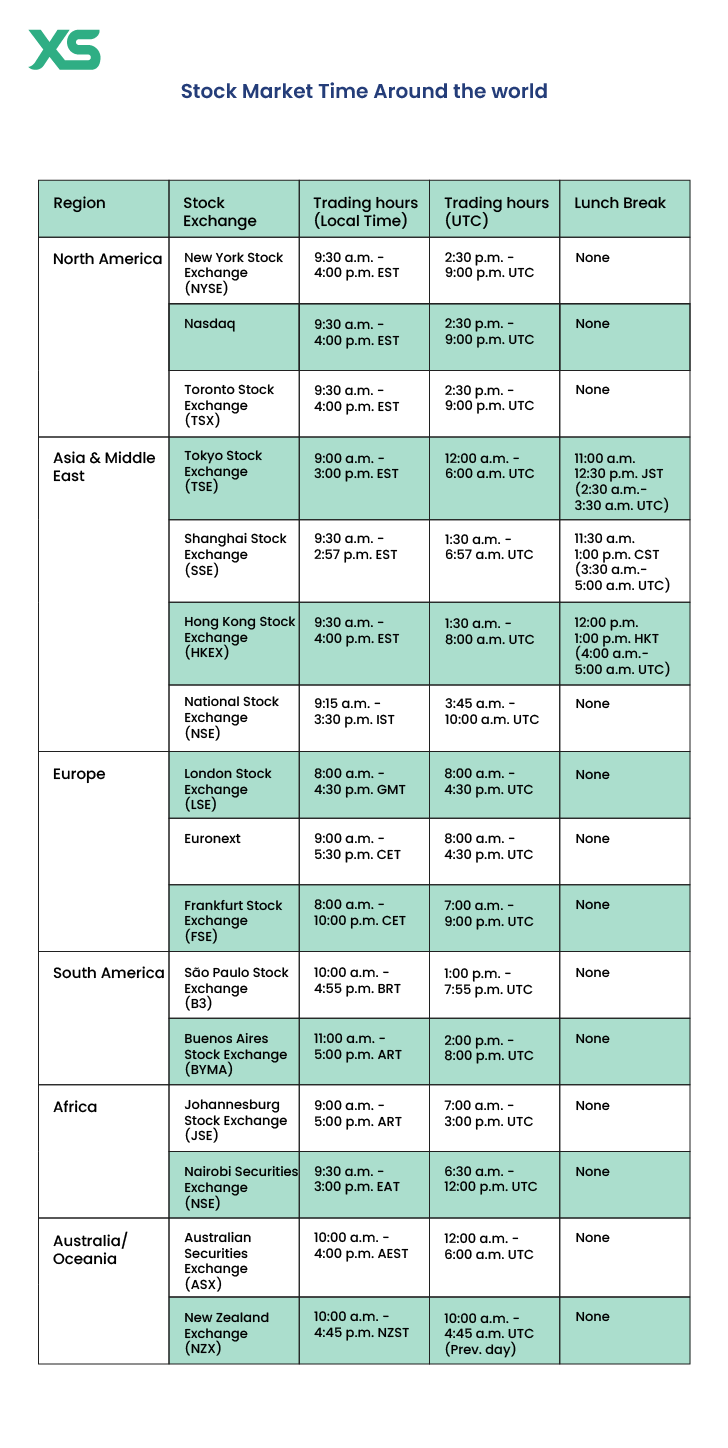
Standard Operating Hours for Major Global Exchanges
The heartbeat of the global financial system is found in its primary stock exchanges. While we live in a 24/7 news cycle, equity markets operate within specific windows to ensure concentrated liquidity and fair price discovery.
The New York Stock Exchange and NASDAQ (United States)
In the United States, the two primary exchanges—the New York Stock Exchange (NYSE) and the NASDAQ—operate on a synchronized schedule. The standard trading session begins at 9:30 AM Eastern Time (ET) and concludes at 4:00 PM ET. This 6.5-hour window is where the vast majority of retail and institutional trading occurs. It is important to note that these exchanges do not close for lunch, unlike some international counterparts, maintaining a continuous flow of capital throughout the business day.
The London Stock Exchange and European Markets
Across the Atlantic, the London Stock Exchange (LSE) follows a slightly longer schedule, opening at 8:00 AM GMT and closing at 4:30 PM GMT. European markets, such as the Euronext Paris and the Frankfurt Stock Exchange (DAX), typically operate between 9:00 AM and 5:30 PM Central European Time (CET). For North American investors, this creates a crucial overlap in the early morning hours, where European closing sessions coincide with the US opening bell, often leading to increased global volatility.
The Tokyo and Hong Kong Exchanges (Asian Markets)
The Asian trading day begins while the West sleeps. The Tokyo Stock Exchange (TSE) operates from 9:00 AM to 3:00 PM JST, but notably includes a lunch break from 11:30 AM to 12:30 PM. Similarly, the Hong Kong Stock Exchange (HKEX) opens at 9:30 AM HKT and closes at 4:00 PM HKT, with a break between 12:00 PM and 1:00 PM. These breaks are a vestige of traditional trading culture but remain vital periods for traders to digest morning news before the afternoon session.
Extended Trading Sessions: Pre-Market and After-Hours
While the “opening bell” at 9:30 AM ET signifies the start of the core session, the digital age has ushered in extended-hours trading. These sessions allow investors to react to news that breaks outside of standard business hours, such as corporate earnings reports or geopolitical shifts.
Navigating the Pre-Market
In the U.S., pre-market trading can begin as early as 4:00 AM ET, though the bulk of activity starts around 8:00 AM ET. Pre-market trading is conducted through Electronic Communication Networks (ECNs), which match buyers and sellers directly without a centralized exchange floor. This session is often used by professional traders to “set the stage” for the day, though it is characterized by lower volume and wider bid-ask spreads.
The Dynamics of After-Hours Trading
After-hours trading begins immediately following the 4:00 PM ET close and typically runs until 8:00 PM ET. This session is famously volatile, especially during “earnings season.” When a major tech giant releases its quarterly results at 4:05 PM, the stock price can swing violently in the after-hours market. For the average investor, these hours offer a chance to manage risk before the next day’s open, but they come with significant caveats.
Risks and Opportunities for Retail Investors
The primary risk of extended trading is “slippage.” Because there are fewer participants, a large order can move the price of a stock significantly more than it would during the day. Furthermore, many brokerages only allow “limit orders” during these sessions to protect investors from executing trades at unintended prices. Despite the risks, the ability to trade extended hours is a powerful tool for those who can interpret low-volume signals correctly.
Market Holidays and Early Closures
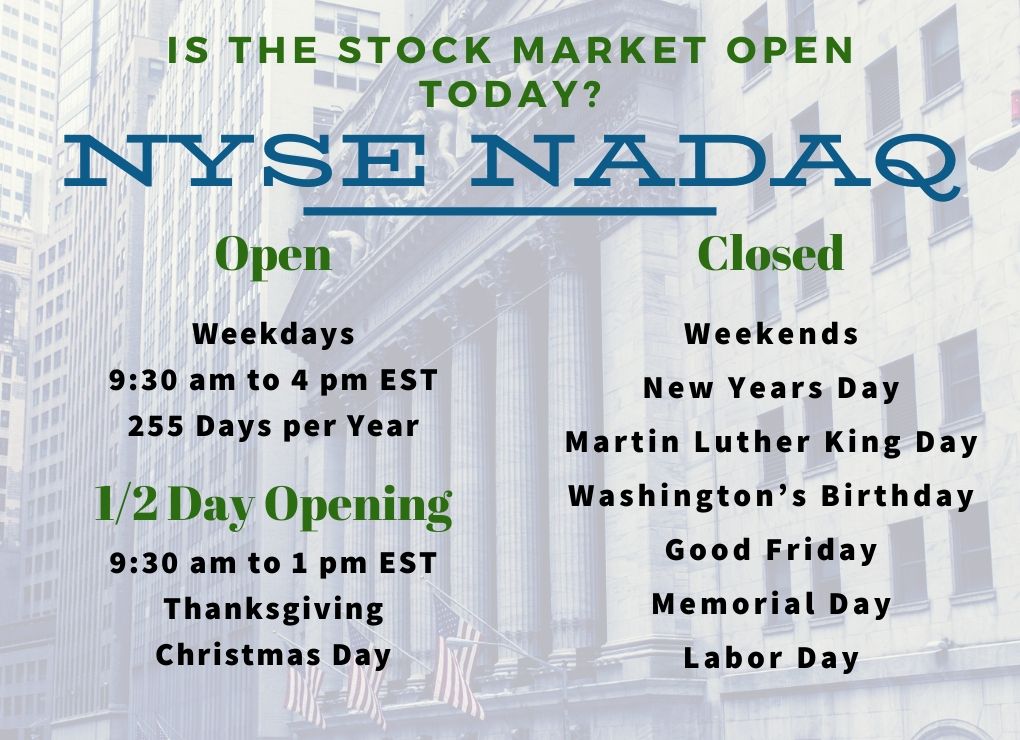
Knowing the time of the open is useless if the market is closed for a federal holiday. The U.S. market observes several holidays throughout the year where the NYSE and NASDAQ are completely shuttered.
Federal Holidays in the United States
Investors must keep a close watch on the financial calendar. Standard closures include New Year’s Day, Martin Luther King Jr. Day, Presidents’ Day, Good Friday, Memorial Day, Juneteenth, Independence Day, Labor Day, Thanksgiving Day, and Christmas Day. When these holidays fall on a weekend, the market typically closes on the preceding Friday or the following Monday.
Early Close Procedures (The Half-Day Schedule)
Beyond full closures, the U.S. markets occasionally observe “early closes,” usually ending at 1:00 PM ET. This most frequently occurs on the day after Thanksgiving (Black Friday) and sometimes on Christmas Eve, depending on which day of the week it falls. During these half-days, liquidity often thins out significantly by noon, as institutional traders exit early for the holidays.
Why Timing Your Trades Matters: Liquidity and Volatility
Successful investing is as much about when you trade as it is about what you buy. Market participants categorize the trading day into distinct phases, each offering different levels of risk and reward.
The “Opening Bell” Effect
The first 30 to 60 minutes of the trading day (9:30 AM – 10:30 AM ET) are often the most volatile. This is the period when the market absorbs all the news that occurred overnight and in the pre-market. For disciplined investors, this is often a time to wait and watch; for day traders, it is the most fertile ground for profit. The high volume during this window ensures that even large trades can be executed with minimal impact on the share price.
The “Power Hour” Before Closing
The final hour of trading, from 3:00 PM to 4:00 PM ET, is known as the “Power Hour.” Institutional investors, mutual fund managers, and hedge funds often rebalance their positions during this time. This leads to a surge in volume and frequently dictates the “closing price,” which is the benchmark used for most historical data and technical analysis.
Avoiding the “Mid-Day Slump”
Between 12:00 PM and 2:00 PM ET, trading volume typically drops as floor traders and institutional desks take lunch breaks. During this “mid-day slump,” prices may drift aimlessly, and liquidity can dry up. Trading during this window can be frustrating, as stocks may lack the “follow-through” momentum seen during the morning or late afternoon.
Tools and Strategies for Global Market Monitoring
To effectively manage a portfolio in a globalized economy, investors need more than just a wall clock. They need a suite of tools to track time zone differences and economic releases.
Financial Calendars and News Alerts
In the Money niche, information is the most valuable currency. Utilizing financial calendars (such as those provided by Bloomberg, Reuters, or Investing.com) allows you to see not just when the market opens, but when the Federal Reserve is scheduled to speak or when Consumer Price Index (CPI) data will be released. These “macro” events often cause more price movement than the opening bell itself.
Managing International Time Zone Differences
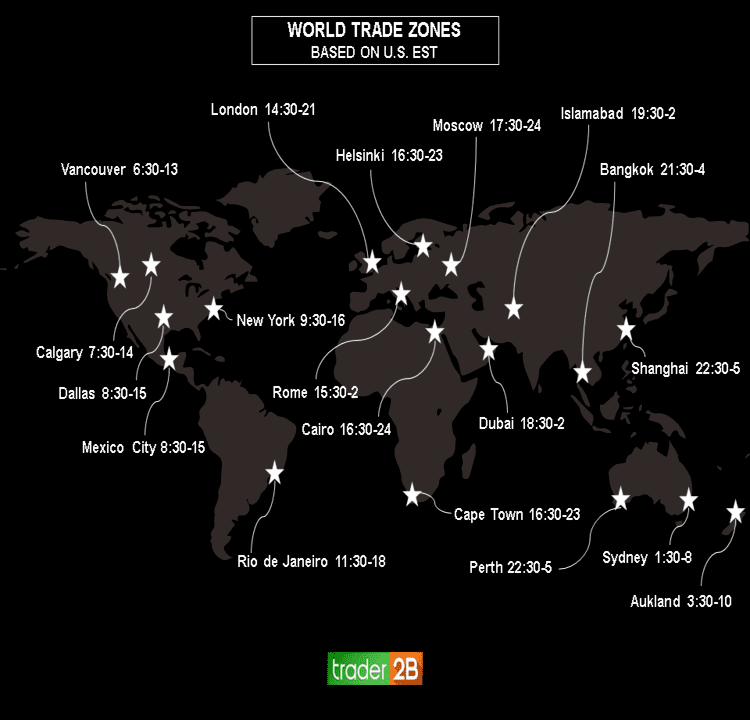
For those trading international stocks or ADRs (American Depositary Receipts), time zone conversion is a constant challenge. Tools like world clock converters specifically designed for traders can help visualize which markets are “overlapping.” For instance, the 8:00 AM to 12:00 PM ET window is particularly significant because the US and European markets are both open, representing a massive concentration of global liquidity.
Automating with Limit Orders
If you cannot be at your desk when the market opens at 9:30 AM, the most effective financial tool is the limit order. By setting a specific price at which you are willing to buy or sell, you can participate in the market’s opening move without having to manually execute the trade. This removes the emotional pressure of the “opening scramble” and ensures you stick to your financial plan.
In conclusion, the question of “what time does the market open today” is the gateway to understanding the complex machinery of global finance. By mastering the standard hours, recognizing the risks of extended sessions, and respecting the impact of liquidity cycles, you position yourself as a sophisticated participant in the market. Whether it is the 9:30 AM opening bell in New York or the 8:00 AM start in London, timing is the silent partner in every successful investment strategy.
aViewFromTheCave is a participant in the Amazon Services LLC Associates Program, an affiliate advertising program designed to provide a means for sites to earn advertising fees by advertising and linking to Amazon.com. Amazon, the Amazon logo, AmazonSupply, and the AmazonSupply logo are trademarks of Amazon.com, Inc. or its affiliates. As an Amazon Associate we earn affiliate commissions from qualifying purchases.