
The world of futures trading is often perceived as a relentless, 24-hour beast, a financial arena that never truly sleeps. While this perception holds a significant degree of truth, accurately understanding the “closing” times of the futures market is far more nuanced than a simple clock-out. For both aspiring and seasoned traders, grasping the intricate schedule of futures exchanges, including their continuous nature, specific settlement periods, and maintenance windows, is not merely an academic exercise—it is fundamental to effective risk management, strategy execution, and ultimately, trading success.
Unlike the traditional stock markets, which famously open at 9:30 AM and close at 4:00 PM EST, the futures market operates on a globally interconnected, almost round-the-clock basis for much of the week. This unique characteristic is designed to provide continuous liquidity and allow participants worldwide to react to economic data and geopolitical events as they unfold, irrespective of local time zones. However, “almost” is the operative word here, as there are critical distinctions between continuous trading, daily settlement cut-offs, and brief, scheduled intermissions that every serious futures trader must comprehend.

The 24-Hour Nature (with Nuances) of Futures Trading
The idea that the futures market “never closes” is largely accurate in spirit, but not entirely in practice. Electronic trading systems have revolutionized how markets operate, enabling a truly global and near-continuous flow of orders. Yet, even in this always-on environment, there are specific timings and procedures that define its operational rhythm.
“Almost Always Open”: Understanding the Concept of Continuous Trading
The bedrock of futures trading, particularly for major products like equity indices, commodities, and currencies, is its electronic nature. Major exchanges such as the CME Group (Chicago Mercantile Exchange) and ICE Futures (Intercontinental Exchange) host platforms that facilitate trading sessions spanning multiple global time zones. This means that a futures contract on, say, crude oil or the S&P 500 can be traded in Asia during its market hours, then seamlessly transition to European and finally North American sessions, creating a near 24-hour trading window from Sunday evening EST through Friday afternoon EST.
This continuous trading paradigm stands in stark contrast to cash equity markets, where trading typically ceases for several hours each day. The advantages for futures traders are manifold: the ability to react immediately to overnight news, greater flexibility in entering and exiting positions, and reduced gap risk from unexpected weekend or overnight events. However, it also demands constant vigilance and strategic adaptation.
Key Trading Sessions and Overlaps
While trading is continuous, market activity and liquidity fluctuate significantly across different global sessions. Traders often identify three primary overlapping sessions:
- Asian Session (e.g., Tokyo/Sydney): This session typically kicks off the trading week on Sunday evening EST and sees initial activity in Asian-focused futures, but also provides early liquidity for global products.
- European Session (e.g., London/Frankfurt): As Asia winds down, European markets pick up, often bringing increased volatility and liquidity, particularly in currency and European equity index futures.
- North American Session (e.g., New York/Chicago): This is often the most active and liquid period, especially when European markets are still open, creating a significant overlap. Key US economic data releases during this time drive substantial price action.
Understanding these overlaps is crucial for strategizing. Periods of overlap, particularly between the European and North American sessions, generally exhibit the highest liquidity and volatility, offering prime opportunities for many trading styles. Conversely, trading during less liquid sessions can lead to wider bid-ask spreads and increased slippage.
The Significance of the “Daily Close” and Settlement
Despite the continuous trading, futures markets do have an official “daily close” time, not in the sense of stopping trading entirely, but for administrative, reporting, and crucially, settlement purposes. This daily settlement time is when the exchange officially calculates the daily mark-to-market value of all open positions. It’s the moment when profits and losses are credited or debited from trading accounts, margin calls are often triggered, and the official closing price for the day is recorded.
For most CME Group products, the official daily settlement time is 4:00 PM Central Time (CT). While trading continues past this point into the Asian session of the next calendar day, this 4:00 PM CT snapshot is critical for:
- Margin Calculations: Determining if a trader’s account meets minimum margin requirements.
- Profit & Loss (P&L) Realization: The exchange updates account balances based on daily price movements.
- End-of-Day Reporting: Providing reference prices for financial statements and risk assessments.
Ignoring this “administrative close” can lead to unexpected margin calls or misinterpretations of daily performance.
Specific Market Hours: A Closer Look at Major Exchanges
To navigate the futures market effectively, traders must delve into the specific schedules of the exchanges where their desired products are listed. The CME Group and ICE Futures are two of the largest and most influential.
CME Group (Chicago Mercantile Exchange)
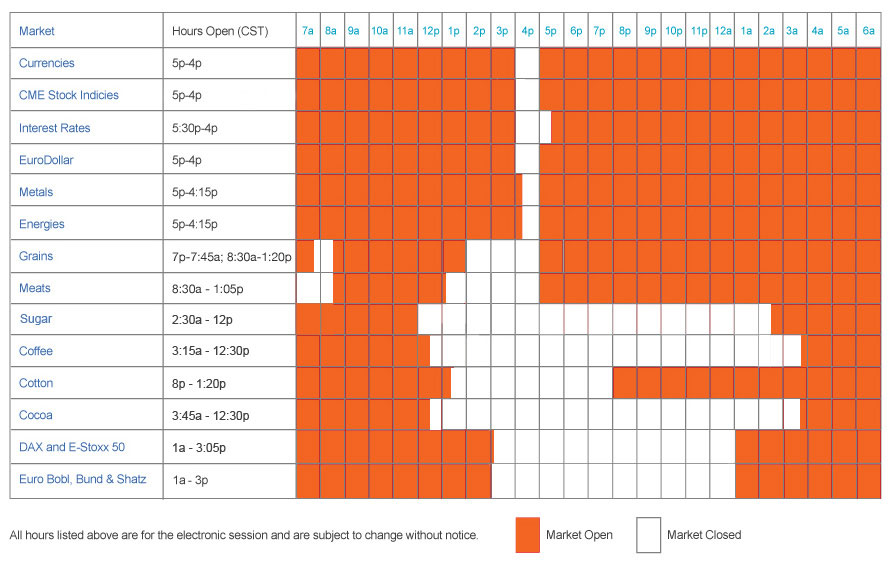
The CME Group, encompassing the Chicago Mercantile Exchange (CME), Chicago Board of Trade (CBOT), New York Mercantile Exchange (NYMEX), and Commodity Exchange Inc. (COMEX), offers a vast array of futures contracts. While specific hours can vary slightly by product, a common pattern exists:
- Equity Index Futures (e.g., E-mini S&P 500, Nasdaq 100): Typically trade Sunday 5:00 PM CT to Friday 4:15 PM CT, with a daily maintenance break from 4:15 PM CT to 4:30 PM CT. This 15-minute window is the closest thing to a “daily close” for active trading.
- Interest Rate Futures (e.g., US Treasuries, Eurodollars): Generally follow a similar schedule: Sunday 5:00 PM CT to Friday 4:00 PM CT, with a 60-minute break from 4:00 PM CT to 5:00 PM CT each day.
- FX Futures (e.g., EUR/USD, GBP/USD): Trade Sunday 5:00 PM CT to Friday 4:00 PM CT, with a 60-minute break from 4:00 PM CT to 5:00 PM CT daily.
- Energy Futures (e.g., Crude Oil, Natural Gas – NYMEX): Trade Sunday 5:00 PM CT to Friday 4:00 PM CT, with a 60-minute break from 4:00 PM CT to 5:00 PM CT daily.
- Metals Futures (e.g., Gold, Silver – COMEX): Trade Sunday 5:00 PM CT to Friday 4:00 PM CT, with a 60-minute break from 4:00 PM CT to 5:00 PM CT daily.
It is critical to note the Sunday evening open (which marks the beginning of the trading week) and the Friday afternoon close (which marks the end of the trading week). During this Friday-to-Sunday period, futures markets are entirely closed, creating a significant “weekend gap” risk.
ICE Futures (Intercontinental Exchange)
ICE Futures also operates a significant global market, particularly known for its energy products like Brent Crude Oil and Natural Gas. While similar in their continuous nature, their specific hours can differ from CME.
- ICE Brent Crude Futures: Trade Monday to Friday, from 1:00 AM London Time (Sunday 8:00 PM EST) to midnight London Time (7:00 PM EST). There’s a short 1-hour break each day around midnight London time.
- ICE Gasoil Futures: Follow a similar schedule to Brent.
- ICE Natural Gas (Henry Hub) Futures: Generally trade Sunday 6:00 PM EST to Friday 5:00 PM EST, with a daily 1-hour break from 5:00 PM EST to 6:00 PM EST.
These examples highlight that while the overarching principle of near 24/5 trading holds, the precise start, end, and break times are exchange and product-specific. Traders must always consult the official exchange websites for the most accurate and up-to-date information.
Why Market Hours Matter for Futures Traders
Understanding the nuances of futures market hours is not just about knowing when you can trade; it’s about optimizing your strategy and mitigating risks.
Volatility and Liquidity Management
Market activity, and consequently volatility and liquidity, are not constant throughout the 24-hour cycle.
- High Liquidity Periods: Coincide with major global market overlaps (e.g., London and New York sessions). During these times, spreads are tighter, order execution is generally better, and significant price movements are more common.
- Low Liquidity Periods: Often occur during isolated Asian sessions, late North American sessions, or early European sessions, particularly for products not directly tied to those regions. Trading during these times can lead to wider spreads, increased slippage, and the potential for exaggerated price swings on relatively small trading volumes. This can be detrimental to strategies reliant on tight spreads or large order fills.
Risk Management and Overnight Exposure
The “always open” nature of futures can lull traders into a false sense of security regarding risk.
- Gaps: While continuous trading reduces overnight gaps, they are still a significant risk, especially over the weekend closure (Friday close to Sunday open). Major news events that occur when markets are closed can lead to massive price gaps, potentially triggering significant losses or margin calls immediately upon market re-opening.
- Illiquid Hours: Holding positions through extremely illiquid hours increases risk. If a sudden event occurs, liquidity might be insufficient to exit a position at a reasonable price, leading to substantial losses. Traders often adjust their position sizing or even flatten positions before entering these periods.
Strategy Adjustment and Time Zone Considerations
Trading strategies often need to be tailored to specific market sessions.
- Day Trading: Requires focusing on the most liquid and volatile sessions to capture intraday movements.
- Swing Trading: Might involve holding positions overnight or even over the weekend, making gap risk a primary concern.
- Time Zone Alignment: Traders must align their personal trading schedule with the market hours most relevant to their strategy and the products they trade. A European trader focusing on US equity futures might prioritize the overlap with the North American session, while an Asian trader might look for opportunities during their local hours or early European session.
Practical Tips for Navigating Futures Market Hours
Mastering the rhythm of the futures market requires diligence and a proactive approach.
Always Verify with the Exchange
Market hours are subject to change due to holidays, daylight saving adjustments, or unexpected exchange rule modifications. Always consult the official exchange websites (e.g., CME Group, ICE Futures) for the most current and accurate trading schedules, especially around holiday periods. Relying on outdated information can lead to missed opportunities or unexpected exposure.
Utilize Trading Platforms
Most reputable trading platforms integrate real-time market hours and display upcoming closures or special schedules directly within their interface. Familiarize yourself with these features, as they can serve as an excellent daily reminder and planning tool. Many platforms also allow you to set alerts for market open/close times.
Develop a Trading Schedule
Based on your strategy, the products you trade, and your personal availability, develop a consistent trading schedule. This involves identifying the sessions that offer the best opportunities for your approach and planning your trading activities around them. Avoid the temptation to trade continuously just because the market is open; focus on periods that align with your edge.
Stay Informed About Economic Releases and Events
Economic calendars are essential for futures traders. While not directly dictating market hours, major economic data releases (e.g., NFP, FOMC announcements, CPI) or geopolitical events can significantly impact volatility and liquidity, sometimes influencing specific trading hours or creating higher risk around certain times. Be aware of when these events occur relative to the market hours you’re trading.

Conclusion: The Constant Vigilance of the Futures Trader
The question “what time does the futures market close” ultimately reveals a deeper truth about the nature of modern financial markets. While a definitive “close” akin to stock market hours is rare during the trading week, critical daily settlement times and brief maintenance windows punctuate the continuous flow. More importantly, understanding the ebb and flow of liquidity and volatility across global sessions is paramount.
Successful futures traders don’t just know when the market technically closes; they grasp the strategic implications of market hours for risk management, trade execution, and overall profitability. By staying informed, utilizing available tools, and developing a disciplined approach to market timing, traders can navigate the dynamic, almost 24/5 world of futures with greater confidence and precision. The futures market may rarely sleep, but a smart trader certainly should, knowing their positions are managed and their strategy aligned with its intricate rhythms.
aViewFromTheCave is a participant in the Amazon Services LLC Associates Program, an affiliate advertising program designed to provide a means for sites to earn advertising fees by advertising and linking to Amazon.com. Amazon, the Amazon logo, AmazonSupply, and the AmazonSupply logo are trademarks of Amazon.com, Inc. or its affiliates. As an Amazon Associate we earn affiliate commissions from qualifying purchases.