
For investors, traders, and financial enthusiasts, the rhythm of the New York Stock Exchange (NYSE) dictates the pulse of global finance. Located at 11 Wall Street in Lower Manhattan, the NYSE is the world’s largest stock exchange by market capitalization. While the digital age has made trading accessible at the tap of a smartphone screen, the physical and electronic infrastructure of the exchange still operates on a strict, traditional schedule. Understanding exactly when the New York Stock Exchange closes—and what happens in the minutes surrounding that closure—is fundamental to managing a portfolio, executing timely trades, and understanding market liquidity.

The Core Trading Session: Anatomy of the NYSE Standard Day
The standard operating hours of the New York Stock Exchange are designed to concentrate liquidity, ensuring that buyers and sellers can interact efficiently. For the vast majority of retail investors, these hours represent the window in which their orders are most likely to be filled at competitive prices.
The Core Trading Window (9:30 AM – 4:00 PM ET)
The NYSE is open for core trading from Monday through Friday, starting at 9:30 AM and ending promptly at 4:00 PM Eastern Time. This six-and-a-half-hour window is when the “Open Outcry” (though now largely symbolic and electronic) and high-volume automated systems are most active. Unlike some international markets, such as those in Asia that take a midday lunch break, the NYSE remains open continuously throughout the day. This continuity is vital for maintaining price discovery and allowing the market to react in real-time to economic data releases, corporate earnings, and geopolitical events.
The Opening and Closing Auctions
The “close” of the NYSE is not merely a cessation of activity; it is a complex algorithmic event known as the Closing Auction. Between 3:50 PM and 4:00 PM ET, the exchange begins to aggregate “Market-on-Close” (MOC) and “Limit-on-Close” (LOC) orders. The Closing Auction is designed to determine the final official closing price for every security listed on the exchange. This single price is crucial because it serves as the benchmark for mutual fund Net Asset Valuations (NAVs), index calculations, and derivative settlements. Understanding the mechanics of the 4:00 PM bell helps investors realize why volatility often spikes in the final ten minutes of the day.
Extended-Hours Trading: Navigating the Pre-Market and After-Hours Landscape
While the 4:00 PM bell signals the end of the core session, the modern financial world rarely sleeps. Electronic Communication Networks (ECNs) allow for trading outside of standard hours, providing a venue for investors to react to news that breaks when the floor is officially closed.
Pre-Market Sessions: The Early Bird’s Edge
The NYSE Arca platform and other electronic exchanges allow for pre-market trading, which typically begins as early as 4:00 AM ET, though significant volume rarely appears until 8:00 AM ET. Professional traders use this time to position themselves ahead of major economic reports, such as the Consumer Price Index (CPI) or the monthly Jobs Report, which are often released at 8:30 AM ET. For the average investor, however, pre-market trading carries risks: liquidity is thin, meaning the gap between the bid and ask prices (the spread) can be wide, leading to unfavorable execution prices.
After-Hours Trading: Reacting to the News Cycle
After the 4:00 PM ET close, the “After-Hours” session begins, typically running until 8:00 PM ET. This period is arguably more critical than the pre-market for corporate news. Most publicly traded companies wait until after the closing bell to release their quarterly earnings reports to prevent sudden, panicked volatility during the core session. If a company misses its revenue targets at 4:05 PM, the stock price can move violently in the after-hours market. While this provides an opportunity for nimble traders to react, the lack of institutional participation means that price movements in the after-hours can sometimes be exaggerated and may partially reverse when the market opens the following morning.
Risks and Rewards of Extended Trading
The primary appeal of trading before 9:30 AM or after 4:00 PM is the ability to act on information immediately. However, the Money niche cautions that “just because you can, doesn’t mean you should.” The lower volume during these hours means that a single large trade can move a stock’s price significantly. Furthermore, many retail brokers require users to place “limit orders” during these times to protect them from the volatility inherent in a thin market.
Holiday Schedules and Market Closures: When the Floor Goes Dark
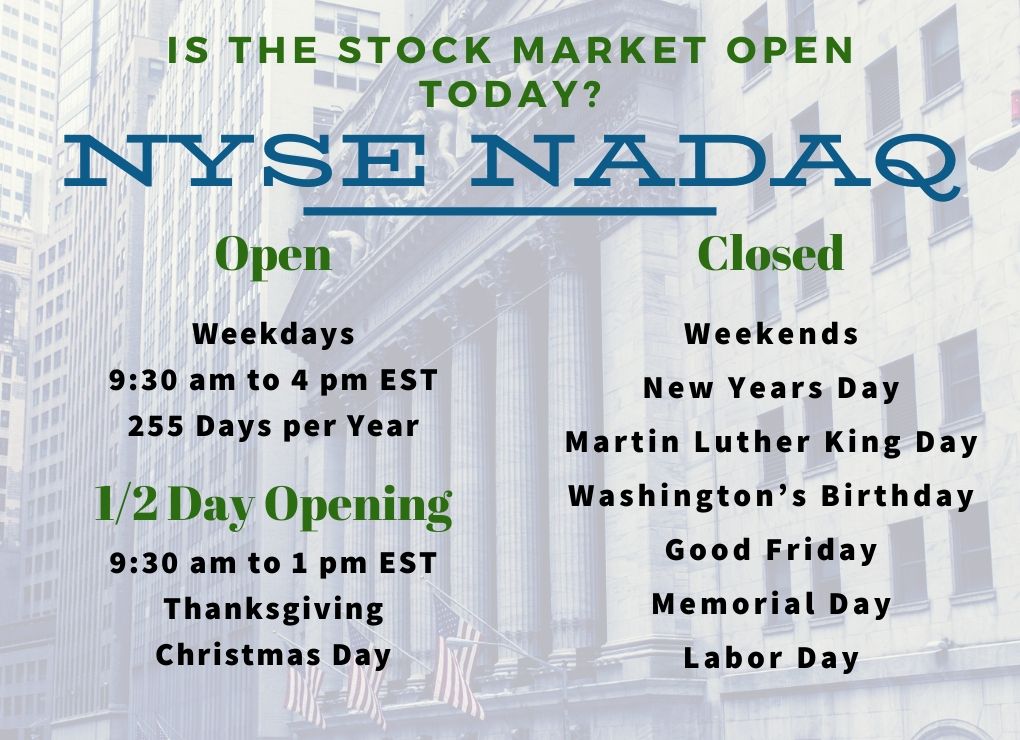
The New York Stock Exchange does not operate on weekends, and it observes several federal and market-specific holidays throughout the year. Planning your investment strategy requires a clear view of the calendar to avoid being caught in a position you cannot exit.
Standard Holiday Observances
The NYSE generally follows the U.S. federal holiday schedule, with a few exceptions. Key closures include:
- New Year’s Day
- Martin Luther King, Jr. Day
- Washington’s Birthday (Presidents’ Day)
- Good Friday (A market holiday, though not a federal one)
- Memorial Day
- Juneteenth National Independence Day
- Independence Day (July 4th)
- Labor Day
- Thanksgiving Day
- Christmas Day
If a holiday falls on a Saturday, the market typically closes on the preceding Friday. If it falls on a Sunday, the market closes on the following Monday.
Early Closures: The “Half-Day” Phenomenon
On certain days—most notably the day after Thanksgiving (Black Friday) and sometimes Christmas Eve (depending on the day of the week)—the NYSE observes an early close. On these days, the core session ends at 1:00 PM ET rather than 4:00 PM. These “half-days” are notorious for low trading volume. Many institutional traders take the day off, leaving the market prone to “drift” or erratic movements. For personal finance management, these are often the best days to step away from the screen, as the lack of liquidity makes meaningful price discovery difficult.
The Significance of the Closing Bell: Liquidity, Volatility, and Price Discovery
Why does the 4:00 PM close matter so much in an era of 24/7 digital connectivity? The answer lies in the concentration of capital.
The “Power Hour” Dynamics
The final hour of trading, from 3:00 PM to 4:00 PM ET, is colloquially known as the “Power Hour.” During this time, institutional investors—such as pension funds, hedge funds, and mutual funds—frequently rebalance their portfolios. Because these entities move millions of shares, they require the deep liquidity that only the NYSE core session provides. For a retail investor, the “Power Hour” is a double-edged sword: it offers the best chance to buy or sell large quantities of stock without moving the price, but it also exposes the trader to sudden shifts as the “big money” completes its daily maneuvers.
Why Price Discovery Centers on the Close
The closing price is the “gold standard” for financial record-keeping. When you check your 401(k) balance or a stock’s performance on a financial news site, you are seeing the result of the 4:00 PM Closing Auction. This price is used to calculate the performance of the S&P 500, the Dow Jones Industrial Average, and the Nasdaq. Without a definitive “close,” the financial world would struggle to value assets consistently, leading to chaos in the insurance, banking, and retirement sectors.
Global Synchronicity and the Future of 24/7 Trading
The 4:00 PM ET close of the NYSE is a pivotal moment for global markets. As New York closes, it often sets the tone for the opening of the Asian markets (like the Nikkei in Tokyo) a few hours later.
The Intersection of Global Markets
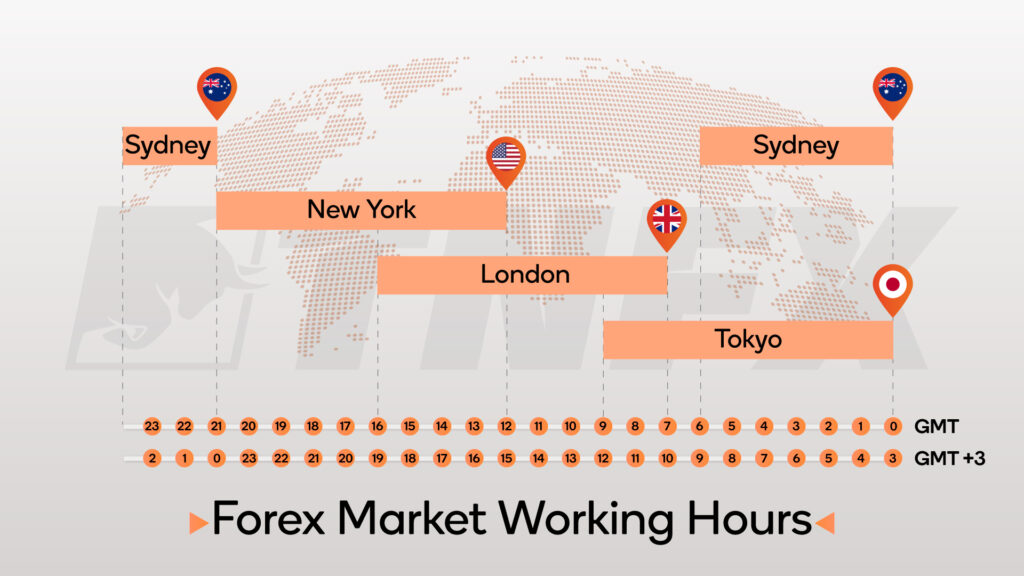
Active investors must look at the NYSE close in the context of the global clock. The London Stock Exchange (LSE) usually closes at 11:30 AM ET, meaning there is a two-hour window (9:30 AM to 11:30 AM ET) where the two largest financial hubs in the world are trading simultaneously. This overlap is often the most liquid and volatile part of the day. Once the NYSE closes at 4:00 PM, the focus shifts to the West Coast and eventually across the Pacific.
Will the NYSE Ever Be 24/7?
In recent years, there has been increasing discussion about extending NYSE trading hours even further, potentially moving toward a 24/7 model similar to the cryptocurrency markets. Proponents argue that in a global economy, news happens around the clock, and investors should have the tools to react instantly. However, the financial community remains divided. Many experts in the Money niche argue that 24/7 trading would lead to fragmented liquidity, increased costs for brokerage firms, and higher risks for retail investors who may not have the resources to monitor their portfolios at 3:00 AM on a Sunday.
For now, the 4:00 PM ET closing bell remains one of the most important landmarks in the world of finance. It provides a necessary “reset” for the markets, a moment for reflection, and a standardized benchmark that keeps the global engine of capitalism running smoothly. Whether you are a long-term investor or a day trader, mastering the schedule of the New York Stock Exchange is an essential step in taking control of your financial future.
aViewFromTheCave is a participant in the Amazon Services LLC Associates Program, an affiliate advertising program designed to provide a means for sites to earn advertising fees by advertising and linking to Amazon.com. Amazon, the Amazon logo, AmazonSupply, and the AmazonSupply logo are trademarks of Amazon.com, Inc. or its affiliates. As an Amazon Associate we earn affiliate commissions from qualifying purchases.