
Understanding the precise operating hours of the US stock markets is foundational for anyone involved in investing, from seasoned institutional traders to budding retail investors. While the conventional image of the opening bell at 9:30 AM Eastern Time (ET) and the closing bell at 4:00 PM ET holds true for the major exchanges like the New York Stock Exchange (NYSE) and Nasdaq, the reality of market access extends far beyond these widely recognized six-and-a-half hours. This comprehensive guide will delve into the standard trading sessions, illuminate the nuances of pre-market and after-hours trading, and explore the strategic implications and inherent risks associated with participating in these extended periods. Grasping these dynamics is crucial for optimizing investment strategies, reacting effectively to market-moving news, and mitigating potential financial pitfalls.
The Core Trading Session: Unpacking the Standard Hours
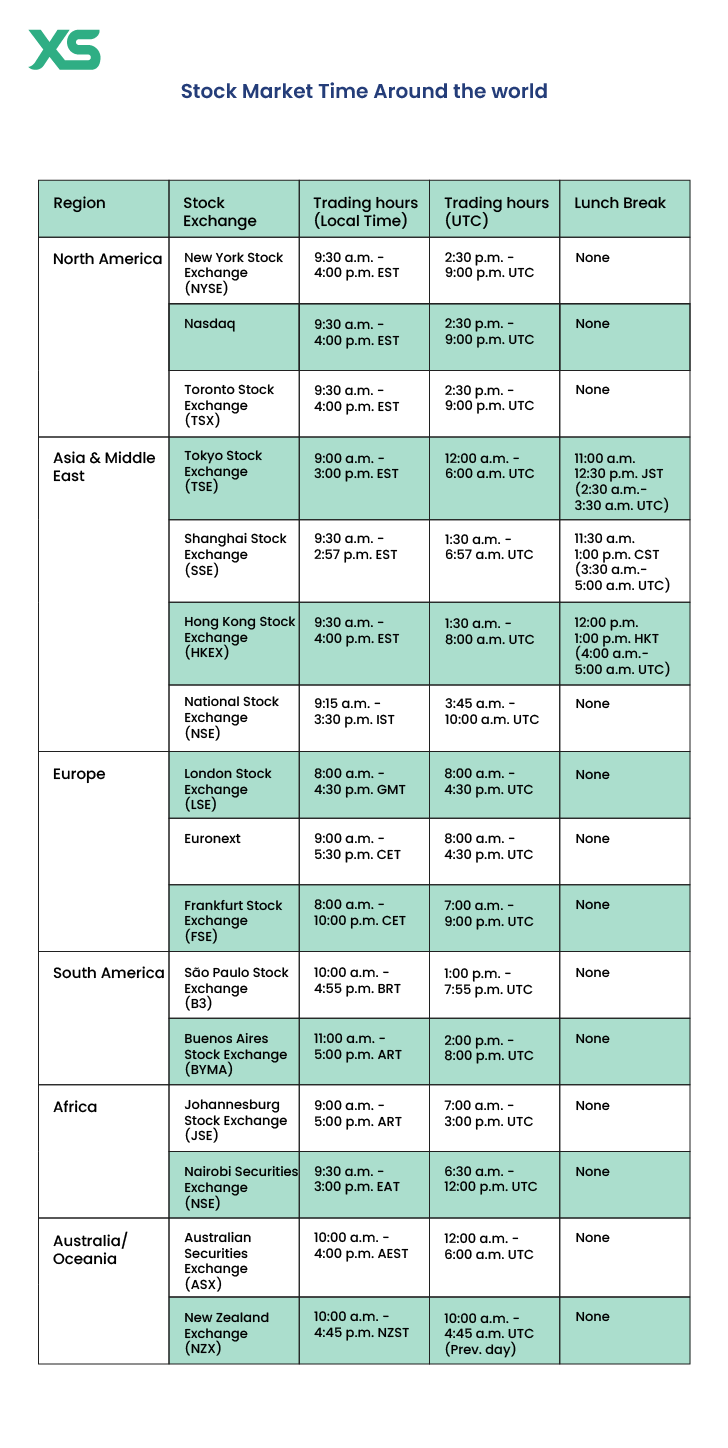
For the vast majority of investors, the “standard” or “regular” trading hours define the typical rhythm of the US stock market. This window represents the period of highest liquidity and, generally, the most efficient price discovery. Understanding its parameters and how time zones affect it is the first step towards informed participation.
NYSE and Nasdaq: The Bell and Beyond
The two titans of American equity trading, the New York Stock Exchange (NYSE) and the Nasdaq Stock Market, operate concurrently during these standard hours. Both exchanges, domiciled in New York City, adhere to Eastern Time.
- Opening Bell: The US stock market officially opens at 9:30 AM Eastern Time (ET). This moment is marked by the iconic opening bell ceremony at the NYSE, a symbolic gesture signifying the start of the trading day. At this juncture, all orders placed before market open (pre-market orders) are typically processed, often leading to a surge in volume and potential volatility as the market absorbs overnight news and pre-market activity.
- Closing Bell: The market officially closes at 4:00 PM Eastern Time (ET). Similar to the opening, the closing bell at the NYSE marks the end of the regular trading session. The last few minutes before 4:00 PM ET, often referred to as “the close,” can also see heightened activity as traders seek to execute orders before the session concludes, or institutions participate in “market-on-close” (MOC) orders.
This six-and-a-half-hour window is where the bulk of daily trading volume occurs, characterized by a continuous auction process where buyers and sellers interact, driven by real-time information, economic data releases, and corporate announcements.
Why 9:30 AM to 4:00 PM ET Matters
The regularity and high liquidity of the standard trading session are fundamental to market stability and investor confidence. During these hours, a confluence of factors contributes to robust market dynamics:
- Maximized Participation: Most institutional investors, professional traders, and a significant portion of retail investors conduct their primary trading activities during these hours. This concentration of participants ensures a deeper order book and tighter bid-ask spreads, making it easier and often more cost-effective to buy and sell securities.
- Information Efficiency: Key economic reports (e.g., CPI, jobs data), corporate earnings announcements, and analyst ratings are frequently scheduled to be released either before market open or after market close, allowing the market to fully digest and react to this information during the standard session. This helps in efficient price discovery, as new information is quickly incorporated into stock prices.
- Regulatory Oversight: The standard hours are where regulatory bodies, such as the Securities and Exchange Commission (SEC) and Financial Industry Regulatory Authority (FINRA), maintain their most active oversight, contributing to market fairness and transparency.
- Psychological Anchoring: For many, the 9:30 AM to 4:00 PM ET window provides a clear structure, aligning with traditional business hours, making it easier to monitor investments and make timely decisions.
Navigating Time Zones Across the US
While the market operates on Eastern Time, the United States spans multiple time zones, a critical consideration for investors located outside the ET zone.
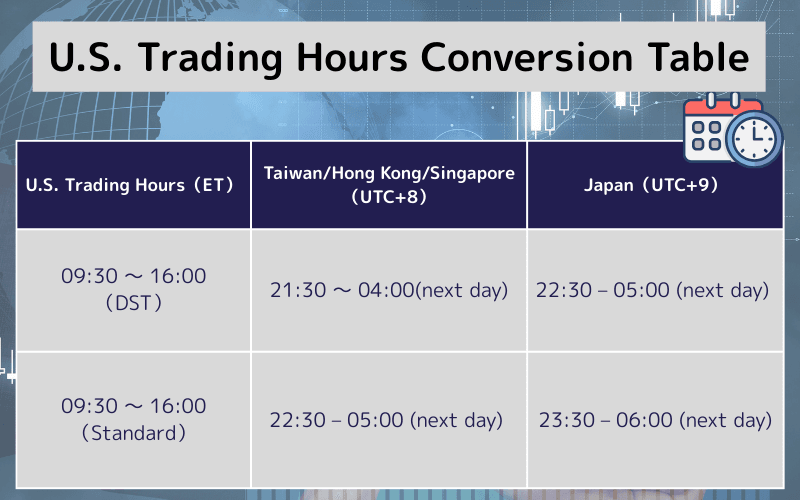
- Eastern Time (ET): 9:30 AM to 4:00 PM
- Central Time (CT): 8:30 AM to 3:00 PM (ET – 1 hour)
- Mountain Time (MT): 7:30 AM to 2:00 PM (ET – 2 hours)
- Pacific Time (PT): 6:30 AM to 1:00 PM (ET – 3 hours)
- Alaska Time (AKDT): 5:30 AM to 12:00 PM (ET – 4 hours)
- Hawaii Time (HST): 3:30 AM to 10:00 AM (ET – 6 hours; note: Hawaii does not observe Daylight Saving Time, so it’s often -5 hours from ET during DST and -6 hours during standard time).
Understanding these conversions is vital for investors to ensure they are placing orders or monitoring their portfolios during their desired market hours, especially for those who wish to participate right at the open or close. For example, an investor in California wanting to trade at the market open would need to be ready by 6:30 AM PT.
Beyond the Bell: Exploring Extended Trading Hours
The perception that trading ceases at 4:00 PM ET is an outdated one. Modern electronic communication networks (ECNs) and brokerage platforms have democratized access to extended trading hours, offering opportunities to trade before the market officially opens and after it closes. These periods, while offering flexibility, also come with a distinct set of characteristics and risks.
Pre-Market Trading: Setting the Stage for the Day
Pre-market trading allows investors to execute trades before the standard 9:30 AM ET open. This session typically begins as early as 4:00 AM ET and runs until the market’s official opening.
- When it Happens: Generally, 4:00 AM ET to 9:30 AM ET. The earliest start time can vary by broker, with some platforms offering access from 7:00 AM ET onwards.
- Why it’s Important: Pre-market trading is a crucial period for institutional investors and astute retail traders. It’s when markets react to:
- Overnight News: Developments from Asian and European markets, global economic announcements, and geopolitical events.
- Early Morning Corporate News: Companies often release earnings reports, guidance updates, or major press releases before market open to allow analysts and investors time to digest the information.
- Brokerage Updates: Research reports and ratings changes from investment banks are often published during these hours.
- Strategic Use: Investors can use pre-market trading to react quickly to news that might significantly impact stock prices, potentially locking in gains or limiting losses before the wider market reacts at the open. It’s also a period where institutional block trades can occur, signaling potential shifts in sentiment.
After-Hours Trading: Responding to Late-Breaking News
After-hours trading extends the trading day beyond the 4:00 PM ET closing bell, often continuing until 8:00 PM ET or even later, depending on the brokerage and ECNs.
- When it Happens: Generally, 4:00 PM ET to 8:00 PM ET. Like pre-market, specific end times can vary by platform.
- Why it’s Important: After-hours trading is primarily driven by:
- Post-Market Corporate Earnings: Many companies, particularly technology and growth firms, release their quarterly earnings reports immediately after the market closes at 4:00 PM ET. This gives a chance for these announcements to be disseminated and processed without interrupting the standard trading session.
- Late-Breaking News: Unexpected news, political developments, or regulatory announcements can occur after market close, prompting an immediate reaction in after-hours trading.
- Analyst Calls: Post-earnings conference calls with analysts often happen after hours, influencing investor sentiment and stock prices.
- Strategic Use: Similar to pre-market, after-hours trading allows investors to immediately respond to critical information, adjusting positions based on fresh data rather than waiting until the next trading day. This can be particularly beneficial for managing event-driven risk or capitalizing on immediate opportunities.
The Mechanics of Extended Trading: How It Works
Extended-hours trading doesn’t occur on the primary exchanges (NYSE, Nasdaq) themselves but through Electronic Communication Networks (ECNs). These are automated systems that match buy and sell orders outside of traditional exchange hours. When you place an order with your broker for extended hours, it is routed through one or more of these ECNs. It’s important to note that specific order types (e.g., market orders vs. limit orders) may behave differently or be restricted during these periods. Limit orders are generally preferred during extended hours due to volatility.
Strategic Considerations and Risks of Off-Hours Trading
While extended trading hours offer significant flexibility and the potential for early reaction to market-moving events, they are not without their unique set of challenges and risks that investors must carefully consider.
Understanding Liquidity and Volatility
The most significant difference between standard and extended trading hours lies in liquidity and volatility.
- Lower Liquidity: Fewer participants are active during pre-market and after-hours sessions compared to the regular trading day. This thinner trading volume means there are often fewer buyers and sellers for a given stock. Lower liquidity can make it harder to execute trades at desired prices, especially for larger orders.
- Higher Volatility: Due to lower liquidity and the often event-driven nature of extended-hours trading (e.g., reacting to earnings), price movements can be more exaggerated and unpredictable. A small number of trades can have a disproportionately large impact on a stock’s price, leading to wider bid-ask spreads and potentially significant price gaps when the market opens the next day.
- Wider Bid-Ask Spreads: The difference between the highest price a buyer is willing to pay (bid) and the lowest price a seller is willing to accept (ask) is typically wider during extended hours. This means that investors may pay more when buying and receive less when selling, impacting the profitability of their trades.
The Impact on Retail Investors vs. Institutions
Extended-hours trading was initially dominated by institutional investors who had access to sophisticated ECNs. While retail access has significantly improved, the playing field is still not entirely level.
- Information Asymmetry: Institutional players often have faster access to breaking news, analyst reports, and proprietary data feeds, giving them an edge in reacting quickly. Retail investors, even with modern tools, might receive information slightly later.
- Execution Risk: Retail investors placing market orders during extended hours face a higher risk of adverse price execution due to the wider spreads and lower liquidity. Using limit orders is almost universally recommended to control the price at which a trade is executed.
- Technological Infrastructure: Large institutions have robust, high-speed trading systems designed to navigate complex market conditions. While retail brokers offer access, the underlying technology might not be as optimized for ultra-fast, high-volume extended-hours trading.
Tools and Platforms for Extended Access
Most major online brokerage firms now offer access to extended trading hours. However, investors should verify the specifics with their broker:
- Availability: Confirm that your brokerage supports pre-market and after-hours trading.
- Hours of Access: Check the exact start and end times for extended trading available through your platform.
- Order Types: Understand which order types are permitted (usually limit orders are strongly encouraged or mandated). Market orders can be particularly risky.
- Fees: Some brokers might have specific fees or commissions associated with extended-hours trading, though this is less common now.
- Data Feeds: Ensure your platform provides real-time quotes during extended hours, as delayed data can lead to poor decision-making.
Market Holidays and Shortened Trading Days
The regular 9:30 AM to 4:00 PM ET schedule is generally consistent from Monday to Friday, but US stock markets observe several holidays throughout the year, during which they remain closed. Additionally, some holidays result in shortened trading days.
Key US Stock Market Holidays
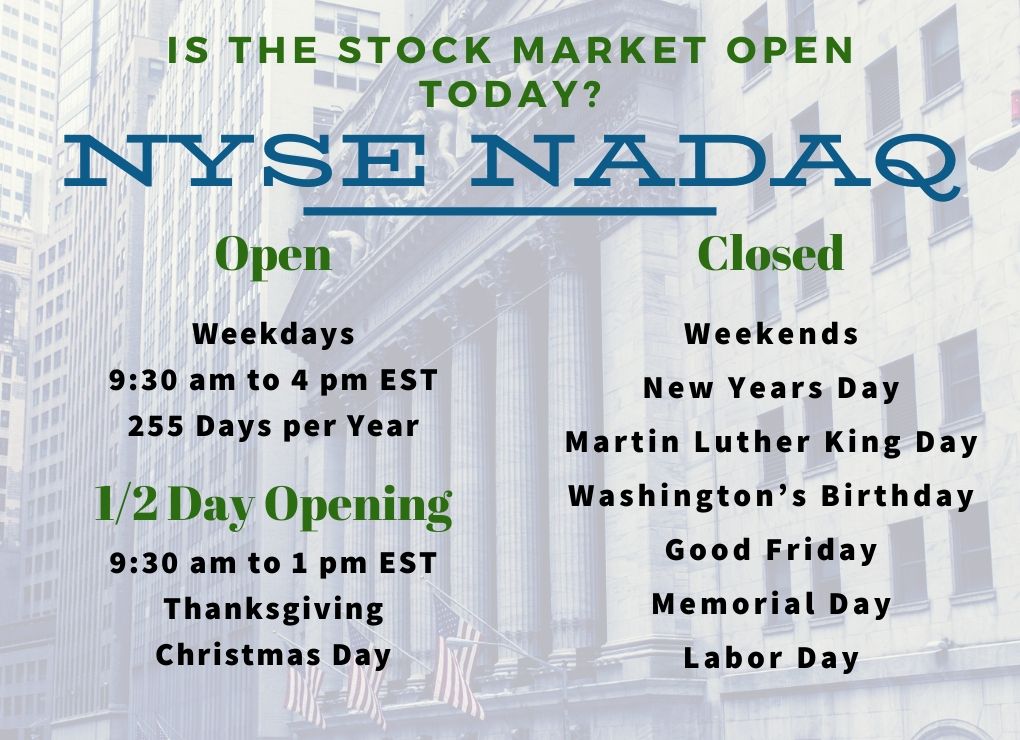
The NYSE and Nasdaq typically observe the same set of holidays, which align with federal holidays. These include:
- New Year’s Day (January 1)
- Martin Luther King, Jr. Day (Third Monday in January)
- Presidents’ Day / Washington’s Birthday (Third Monday in February)
- Good Friday (Friday before Easter)
- Memorial Day (Last Monday in May)
- Juneteenth National Independence Day (June 19)
- Independence Day (July 4)
- Labor Day (First Monday in September)
- Thanksgiving Day (Fourth Thursday in November)
- Christmas Day (December 25)
When these holidays fall on a weekend, the market may observe the holiday on the preceding Friday or the following Monday. It’s crucial for investors to consult the official holiday schedules published by the NYSE and Nasdaq each year.
Special Circumstances: Early Closures and Market Interruptions
Beyond full-day holidays, there are instances where the market operates on a shortened schedule:
- Day Before Independence Day: If Independence Day falls on a weekday, the market typically closes early at 1:00 PM ET on the preceding day.
- Day After Thanksgiving (Black Friday): The market usually closes early at 1:00 PM ET on the Friday after Thanksgiving.
- Christmas Eve: If Christmas Eve falls on a weekday, the market typically closes early at 1:00 PM ET.
- Market Interruptions: In rare events of extreme volatility, natural disasters, or technical failures, exchanges may temporarily halt trading or close entirely, though this is uncommon and usually a last resort to maintain orderly markets. Circuit breakers are also in place to temporarily halt trading during severe market declines.
Being aware of these holidays and shortened trading days is essential for financial planning, order placement, and avoiding unexpected delays in transactions.
The Broader Landscape: Other US Financial Markets
While the focus has been on US equity markets (stocks), it’s important to recognize that other financial markets operate on different schedules. Investors diversifying their portfolios into these asset classes must understand their specific trading hours.
Futures and Options: Different Calendars
Derivatives markets, such as those for futures and options, often have longer trading hours than the standard equity market.
- Futures Markets: Futures contracts (e.g., on commodities, indices, currencies) often trade almost 24 hours a day, five days a week, on exchanges like the Chicago Mercantile Exchange (CME) Group. For instance, E-mini S&P 500 futures can trade from Sunday evening through Friday afternoon, with only short breaks. These extended hours allow investors to react to global events and underlying asset movements around the clock.
- Options Markets: Options contracts typically follow the trading hours of their underlying securities. So, options on US stocks trade during the same standard and extended hours as the stocks themselves. However, options on futures or other assets will follow the hours of those respective underlying markets.
Forex Market: The 24/5 Global Trading Arena
The foreign exchange (Forex) market, where currencies are traded, is unique in its operating schedule. It is a truly global, decentralized market that operates 24 hours a day, five days a week, starting from Sunday evening (ET) to Friday evening (ET).
- Continuous Trading: As major financial centers around the world (Sydney, Tokyo, London, New York) open and close, the Forex market seamlessly transitions, ensuring continuous liquidity. This means there is no “opening bell” or “closing bell” in the traditional sense for the entire market.
- Peak Activity: While open 24/5, different currency pairs experience peak liquidity and volatility when their respective regional markets are open. For instance, USD/JPY sees higher activity during Asian and US sessions, while EUR/USD is most active during European and US sessions.
The Evolving Nature of Market Access
The landscape of financial market access is continuously evolving. Technological advancements, driven by ECNs and sophisticated trading algorithms, have pushed the boundaries of traditional market hours. The trend points towards increasing electronification and extended access, blurring the lines between standard and off-hours trading.
For investors, staying informed about these changes, understanding the specific hours and nuances of each market they participate in, and adapting their strategies accordingly is paramount. The US stock market, with its core 9:30 AM to 4:00 PM ET session, forms the backbone, but a deeper dive reveals a more intricate, extended, and globally interconnected trading environment that demands informed engagement.
aViewFromTheCave is a participant in the Amazon Services LLC Associates Program, an affiliate advertising program designed to provide a means for sites to earn advertising fees by advertising and linking to Amazon.com. Amazon, the Amazon logo, AmazonSupply, and the AmazonSupply logo are trademarks of Amazon.com, Inc. or its affiliates. As an Amazon Associate we earn affiliate commissions from qualifying purchases.