
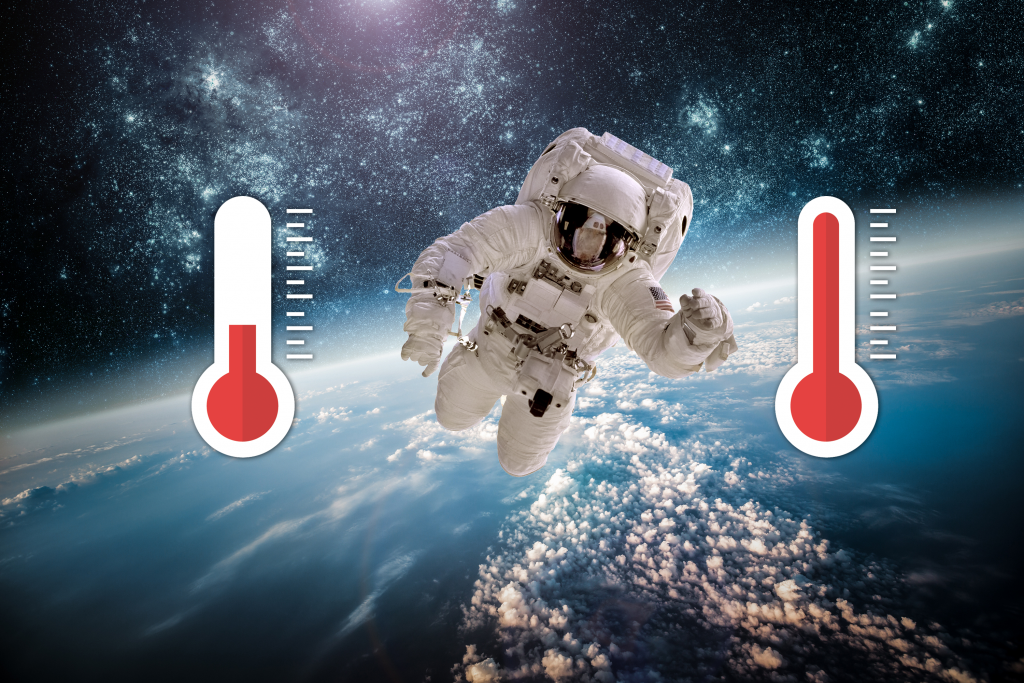
When we ask the question, “What temperature is it in outer space?” we are not merely asking a meteorological question. We are delving into the complex intersection of thermodynamics, aerospace engineering, and high-precision sensor technology. In the vacuum of space, temperature does not behave the way it does on Earth. There is no air to conduct heat, no breeze to cool a surface, and no atmospheric buffer to shield equipment from the raw radiation of stars.
For the tech industry—specifically those involved in satellite manufacturing, deep-space exploration, and sensor development—the “temperature” of space is a variable that must be managed with absolute precision. This article explores the technological innovations required to measure the cosmic background, the engineering marvels that keep hardware functioning in extreme thermal gradients, and the future of thermal management in the final frontier.

The Technological Challenge of Measuring “Nothingness”
To understand space temperature, we must first understand that “space” itself doesn’t have a temperature in the traditional sense because it is a vacuum. Temperature is the measurement of the kinetic energy of particles; in a vacuum, there are very few particles. However, there is radiation. The “temperature” of deep space is generally accepted to be approximately 2.7 Kelvin (-270.45 Celsius or -454.81 Fahrenheit). This is the remnant heat from the Big Bang, known as the Cosmic Microwave Background (CMB).
Sensors and the Detection of Cosmic Microwave Background
Measuring a temperature so close to absolute zero requires specialized tech that goes far beyond a standard digital thermometer. Scientists utilize bolometers—highly sensitive detectors used to measure the power of incident electromagnetic radiation. Modern bolometers used in space missions, such as those on the Planck observatory, are cooled to temperatures even lower than the space they are measuring. This is achieved through sophisticated “dilution refrigerators,” a tech marvel that uses a mix of Helium isotopes to reach temperatures within millikelvins of absolute zero. By being colder than the vacuum itself, these sensors can detect the faint whispers of thermal energy left over from the dawn of time.
The Role of Infrared Spectroscopy in Thermal Mapping
Because we cannot “touch” space to measure it, we rely on remote sensing technology. Infrared spectroscopy allows tech systems to analyze the heat signatures of distant nebulae, planets, and the vacuum itself. By hardware-encoding the laws of blackbody radiation—specifically Wien’s Displacement Law—astrophysical software can calculate the temperature of an object based on the wavelength of light it emits. This digital translation of light into thermal data is the backbone of modern astronomical imaging, allowing us to see the “heat” of a universe that looks cold to the naked eye.
Thermal Management Systems: Engineering for 500-Degree Fluctuations
In low Earth orbit (LEO), a satellite can experience a temperature swing of over 300 degrees Celsius as it moves from the direct glare of the sun into the shadow of the Earth. This creates a brutal environment for semiconductors and batteries. The technology used to stabilize these environments is a masterclass in passive and active thermal control.
Passive Thermal Control: The Power of Multi-Layer Insulation (MLI)
If you have ever seen a satellite or lunar lander covered in what looks like gold tinfoil, you are looking at Multi-Layer Insulation (MLI). This is not just for show; it is a sophisticated tech stack consisting of multiple layers of Kapton or Mylar coated with vapor-deposited aluminum. MLI works by minimizing radiative heat transfer. In the vacuum of space, where conduction and convection are non-existent, radiation is the only way heat moves. MLI acts as a high-tech “thermos,” reflecting solar radiation away from sensitive electronics while trapping internal heat generated by the craft’s processors to prevent them from freezing.
Active Cooling Tech: Heat Pipes and Fluid Loops
For high-performance hardware, such as the AI-processing units now being sent into orbit, passive cooling is often insufficient. Engineers employ active thermal control systems (ATCS). One of the most common technologies is the “Heat Pipe.” These are vacuum-sealed pipes containing a working fluid (like ammonia) that evaporates at the “hot” end (near the electronics) and condenses at the “cold” end (near a radiator). This phase-change technology allows for the rapid movement of heat without the need for heavy, power-hungry mechanical pumps, making it an ideal tech solution for the weight-sensitive aerospace industry.
The James Webb Space Telescope: A Case Study in Cryogenic Tech
The James Webb Space Telescope (JWST) represents the pinnacle of thermal engineering. To see the faint infrared light from the first stars, the telescope itself must be kept incredibly cold. If the JWST were “warm,” its own infrared glow would blind its sensors, much like trying to use a flashlight to see the stars during the day.
The Sunshield: A Technological Shield Against Solar Heat
The JWST features a five-layer sunshield the size of a tennis court. Each layer is made of Kapton and is coated with aluminum and “doped” silicon. The tech behind the spacing of these layers is critical; each gap acts as an additional insulator, allowing heat to radiate out the sides into the vacuum. The result is a technological feat: while the “hot side” of the shield is bombarded by 200°F (93°C) of solar heat, the “cold side” where the mirrors sit remains at a staggering -370°F (-223°C).
MIRI and the Cryocooler Innovation
While most of the JWST can operate at 40 Kelvin via passive cooling, the Mid-Infrared Instrument (MIRI) needs to be even colder—specifically, 7 Kelvin. To achieve this, NASA engineers developed a “Cryocooler.” This is essentially a high-tech refrigerator that uses a sophisticated reciprocating piston to pump helium gas through a series of tubes. The innovation here is the vibration-free design; any mechanical shaking would blur the telescope’s images. The engineering required to create a sub-zero cooling system with no moving parts that could cause interference is one of the greatest technological achievements in modern optics.
AI and Machine Learning in Thermal Forecasting
As we look toward the future of deep space exploration and the eventual colonization of the Moon or Mars, thermal management is evolving from hardware-based solutions to software-driven ones. Managing the temperature of a lunar base, where the “day” lasts two weeks and temperatures drop to -280°F, requires more than just insulation; it requires intelligence.
Predictive Modeling and Autonomous Regulation
Space agencies are increasingly integrating AI and Machine Learning (ML) into their thermal control units (TCUs). Instead of reacting to temperature changes after they occur, AI models can predict thermal loads based on orbital mechanics, solar flare activity, and internal power usage. By utilizing “Digital Twins”—virtual replicas of the spacecraft—the software can run millions of simulations to determine the most energy-efficient way to distribute heat. This tech ensures that power-hungry heaters are only used when absolutely necessary, preserving the precious battery life of the craft.
Smart Materials and Nano-Tech Coatings
The next generation of space tech involves “smart” materials that change their thermal properties in response to the environment. Scientists are developing nano-scale coatings that can switch from being “absorptive” (to soak up heat) to “emissive” (to shed heat) using a small electrical charge. This electronic control of material physics would allow a spacecraft to “sweat” or “shiver” autonomously, mimicking biological systems to maintain an internal temperature suitable for both hardware and humans.

The Future: Tech for the Deepest Freezes
As our technology reaches further into the outer solar system—toward the icy moons of Jupiter and Saturn—the “temperature of space” becomes an even more daunting adversary. Missions like the Europa Clipper require electronics that can survive the intense radiation belts of Jupiter while maintaining operational temperatures in an environment where the sun is nothing more than a bright star.
The tech we develop to answer “what temperature is it in outer space” is the same tech that will eventually allow humanity to live beyond Earth. From the development of gallium nitride (GaN) semiconductors that can operate at higher temperatures to the refinement of cryogenic storage for long-term fuel preservation, temperature management is the silent enabler of the space age.
In conclusion, outer space is not just “cold” or “hot”—it is a complex thermal landscape that requires a multi-disciplinary tech approach. Through the use of advanced bolometers, phase-change heat pipes, AI-driven thermal models, and revolutionary cryocoolers, we have moved beyond merely measuring the temperature of the void. We have learned to master it, turning one of the most hostile environments known to science into a workspace where our most sensitive technology can thrive.
aViewFromTheCave is a participant in the Amazon Services LLC Associates Program, an affiliate advertising program designed to provide a means for sites to earn advertising fees by advertising and linking to Amazon.com. Amazon, the Amazon logo, AmazonSupply, and the AmazonSupply logo are trademarks of Amazon.com, Inc. or its affiliates. As an Amazon Associate we earn affiliate commissions from qualifying purchases.