
Navigating the landscape of federal income taxes is a fundamental aspect of personal finance management. As we approach the 2025 tax year, the Internal Revenue Service (IRS) has once again adjusted tax brackets and standard deductions to account for inflation. Understanding these shifts is not merely an academic exercise; it is a critical component of wealth preservation, retirement planning, and cash flow management.
The U.S. tax system is progressive, meaning that as your income increases, the rate at which you are taxed on additional dollars also increases. However, one of the most common misconceptions is that entering a higher tax bracket means all your income is taxed at that higher rate. In reality, your income is divided into “buckets,” and each bucket is taxed at its specific percentage. For 2025, these adjustments are particularly significant as they represent the final full year of the tax structures established by the Tax Cuts and Jobs Act (TCJA) of 2017, which is currently slated to sunset at the end of 2025.
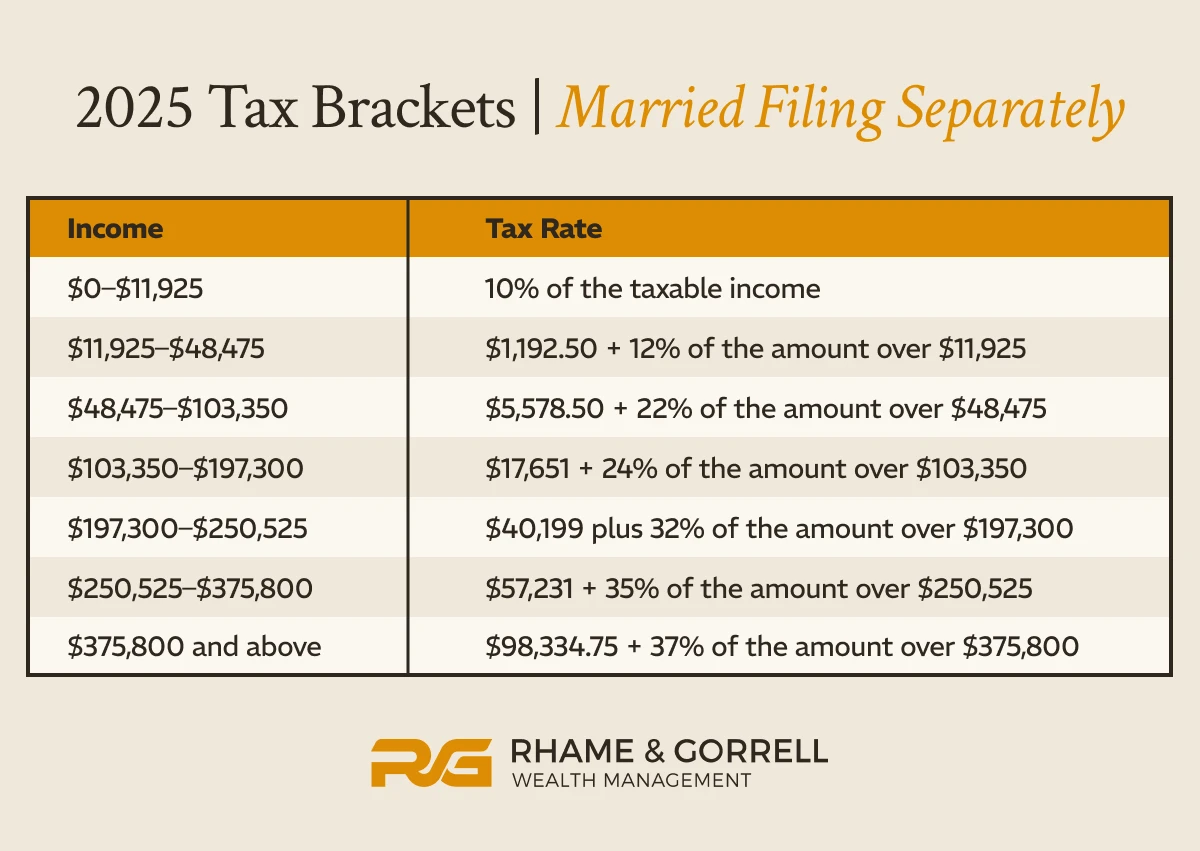
Understanding the 2025 Federal Income Tax Brackets
For the 2025 tax year (taxes filed in early 2026), the IRS has increased the income thresholds for each bracket. This indexing is designed to prevent “bracket creep,” a phenomenon where inflation-driven raises push taxpayers into higher brackets even though their actual purchasing power has not increased.
The seven federal income tax rates remain 10%, 12%, 22%, 24%, 32%, 35%, and 37%. While the rates are static, the income ranges they apply to have expanded.
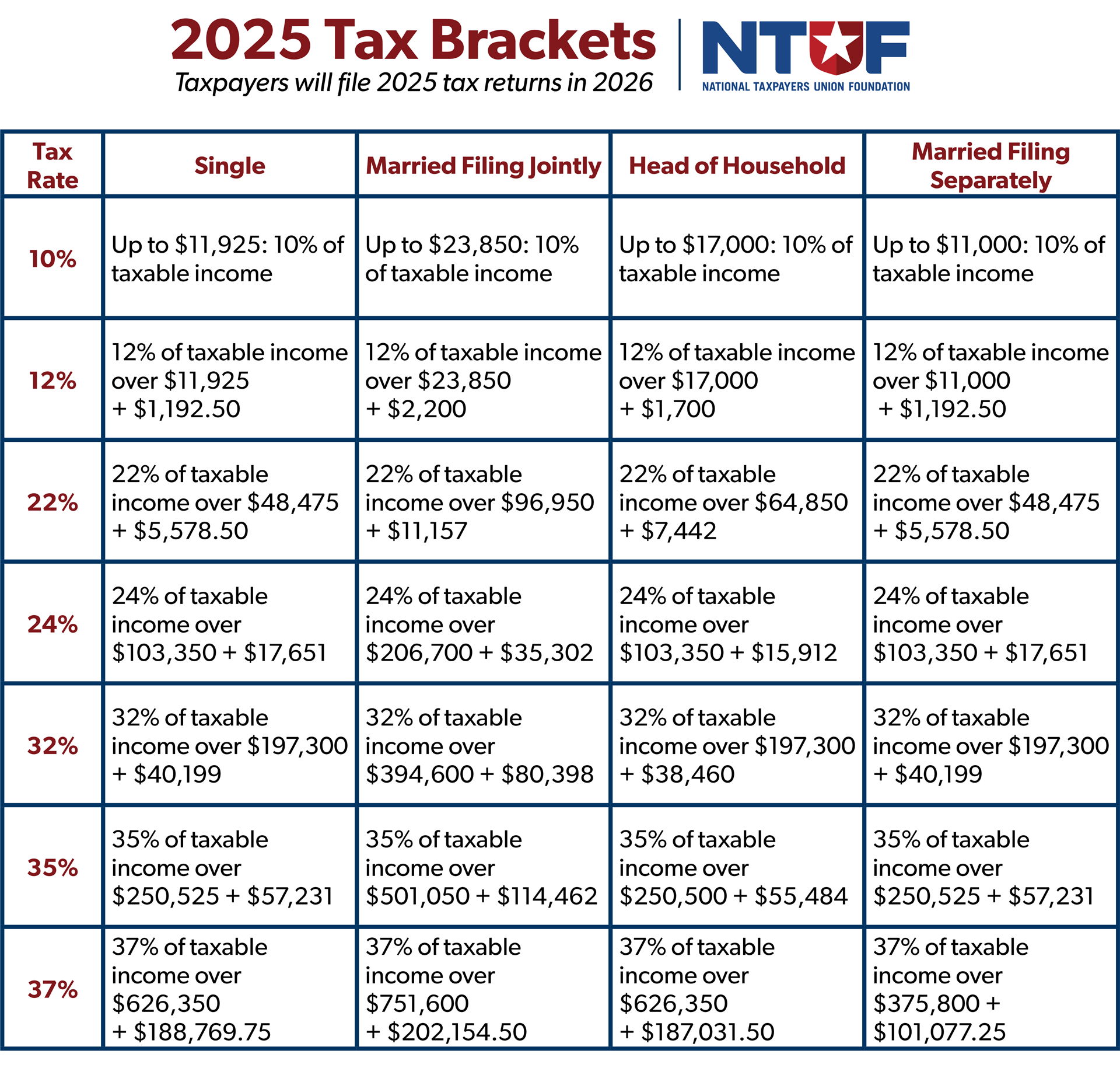
Single Filers
For individuals filing as single, the 2025 brackets reflect a modest upward shift.
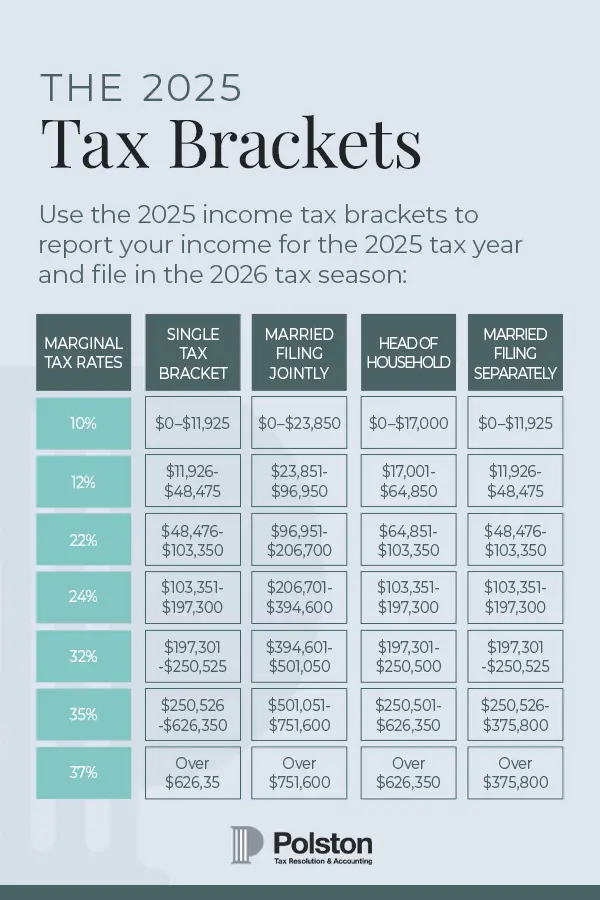
- 10%: Income up to $11,925
- 12%: Income between $11,926 and $48,475
- 22%: Income between $48,476 and $103,350
- 24%: Income between $103,351 and $197,300
- 32%: Income between $197,301 and $250,525
- 35%: Income between $250,526 and $626,350
- 37%: Income over $626,350
Married Filing Jointly
Couples filing jointly benefit from wider brackets, which often helps mitigate the “marriage penalty” for many households.
- 10%: Income up to $23,850
- 12%: Income between $23,851 and $96,950
- 22%: Income between $96,951 and $206,700
- 24%: Income between $206,701 and $394,600
- 32%: Income between $394,601 and $501,050
- 35%: Income between $501,051 and $751,600
- 37%: Income over $751,600
Head of Household
This filing status is designed for unmarried individuals who pay more than half the cost of keeping up a home for a qualifying person.
- 10%: Income up to $17,000
- 12%: Income between $17,001 and $64,850
- 22%: Income between $64,851 and $103,350
- 24%: Income between $103,351 and $197,300
- 32%: Income between $197,301 and $250,525
- 35%: Income between $250,526 and $626,350
- 37%: Income over $626,350
Marginal vs. Effective Tax Rates: The “Tax Bucket” Concept
To accurately answer “What tax bracket am I in?” one must distinguish between the marginal tax rate and the effective tax rate. This distinction is the cornerstone of effective tax planning.
The Marginal Tax Rate
Your marginal tax rate is the tax percentage applied only to the very last dollar you earned. For example, if you are a single filer earning $110,000 in taxable income in 2025, you fall into the 24% bracket. However, you do not pay $26,400 (24% of $110,000). Instead, your first $11,925 is taxed at 10%, the next portion up to $48,475 is taxed at 12%, and so on. Only the amount exceeding $103,350 is taxed at the 24% rate.
Knowing your marginal rate is vital for making decisions about incremental income, such as whether to take a side hustle, accept a year-end bonus, or realize capital gains. It tells you exactly how much of that “extra” money will actually end up in your bank account.
The Effective Tax Rate
The effective tax rate is the actual percentage of your total income that goes to the IRS. You calculate this by dividing your total tax liability by your total taxable income. For most taxpayers, the effective rate is significantly lower than their marginal rate.
Understanding your effective rate provides a clearer picture of your overall tax burden relative to your total earnings. In a professional financial plan, tracking the effective rate over several years helps determine if your tax strategies (like retirement contributions or charitable giving) are effectively lowering your overall obligation.
Standard Deductions and Adjustments for 2025
Before you can determine which bracket your income falls into, you must calculate your “taxable income.” This is your gross income minus either the standard deduction or itemized deductions. For 2025, the standard deduction has been increased to reflect the rising cost of living.
2025 Standard Deduction Amounts
- Single or Married Filing Separately: $15,000 (up from $14,600 in 2024)
- Married Filing Jointly: $30,000 (up from $29,200 in 2024)
- Head of Household: $22,500 (up from $21,900 in 2024)
For those 65 or older or blind, there is an additional standard deduction amount. For 2025, this is $1,600 for married individuals and $2,000 for singles or heads of household.
The increase in the standard deduction means that a larger portion of your income is entirely tax-free. For a married couple, the first $30,000 earned in 2025 will not be subject to federal income tax. This is a primary reason why many taxpayers no longer itemize their deductions (such as mortgage interest or state and local taxes); unless your total itemized expenses exceed these new, higher thresholds, the standard deduction offers the greatest financial benefit.
Above-the-Line Deductions
It is also important to consider “above-the-line” deductions, which reduce your Adjusted Gross Income (AGI) before you even apply the standard deduction. These include contributions to traditional IRAs, Health Savings Accounts (HSAs), and student loan interest payments. Lowering your AGI is the most direct way to potentially drop into a lower tax bracket.
Strategic Tax Planning for the 2025 Sunset
The 2025 tax year is unique because it is the “lame duck” year of the current tax code. On December 31, 2025, many provisions of the Tax Cuts and Jobs Act are scheduled to expire unless Congress intervenes. This creates a high-stakes environment for financial planning.
Preparing for Higher Rates in 2026
If the TCJA expires, tax rates are projected to revert to pre-2018 levels. The 12% bracket could return to 15%, the 22% and 24% brackets could shift upward, and the top rate could return to 39.6%. Furthermore, the standard deduction could be cut nearly in half.
For high-earning individuals, 2025 may be the “last call” to realize income at historically low rates. Strategically, this might involve:
- Roth Conversions: Converting traditional IRA funds into Roth IRAs in 2025 allows you to pay taxes at the current 2025 rates, protecting that wealth from potentially higher rates in 2026 and beyond.
- Accelerating Income: If you are a business owner or have control over the timing of bonuses, it may be beneficial to pull that income into 2025.
- Capital Gains Management: While long-term capital gains have their own brackets (0%, 15%, and 20%), these are also subject to potential legislative changes. 2025 is an ideal year to review your portfolio for tax-loss harvesting or to lock in gains if you anticipate being in a higher bracket in the future.
Maximizing Retirement and HSA Contributions
To lower your 2025 tax liability, maximizing contributions to tax-advantaged accounts remains the gold standard. For 2025, contribution limits have seen adjustments:
- 401(k), 403(b), and 457 plans: The limit for employee contributions is expected to rise (check final IRS announcements in late 2024, usually around $23,500 with a $7,500 catch-up for those 50+).
- IRA Limits: The contribution limit remains a key tool for those within the income thresholds.
- HSA Limits: For 2025, the limit for self-only coverage is $4,300, and for family coverage, it is $8,550. HSAs are particularly powerful because they offer a triple tax advantage: contributions are tax-deductible, growth is tax-free, and withdrawals for qualified medical expenses are tax-free.
Conclusion: Mastering Your 2025 Tax Outlook
Identifying your 2025 tax bracket is the first step in a broader financial strategy. By understanding that your income is taxed in segments and that the 2025 thresholds have expanded, you can more accurately forecast your net take-home pay.
However, the 2025 tax year demands more than passive observation. With the looming expiration of current tax laws at the end of the year, proactive planning is essential. Whether through maximizing deductions, strategically timing income, or utilizing Roth accounts, the actions you take in 2025 will have a lasting impact on your long-term financial health. As always, while these brackets provide a framework, consulting with a tax professional or financial advisor is recommended to tailor these insights to your specific financial situation and goals.
aViewFromTheCave is a participant in the Amazon Services LLC Associates Program, an affiliate advertising program designed to provide a means for sites to earn advertising fees by advertising and linking to Amazon.com. Amazon, the Amazon logo, AmazonSupply, and the AmazonSupply logo are trademarks of Amazon.com, Inc. or its affiliates. As an Amazon Associate we earn affiliate commissions from qualifying purchases.