
The S&P 500 is arguably the most widely recognized and influential stock market index in the world. Often cited as a proxy for the health of the U.S. economy and a benchmark for large-cap U.S. equities, its composition is a subject of intense interest for investors, economists, and financial analysts alike. Far from a static list, the S&P 500 is a dynamic entity, meticulously curated to reflect the broadest and most representative cross-section of leading American companies. Understanding what stocks make up this powerful index is key to comprehending its movements, its investment appeal, and its role as a mirror to the evolving economic landscape.
Understanding the S&P 500: A Benchmark for the U.S. Economy
At its core, the S&P 500 is more than just a list of companies; it’s a meticulously constructed index designed to capture 500 of the largest publicly traded companies in the United States, selected by a committee at S&P Dow Jones Indices. Its significance extends far beyond mere enumeration, serving as a critical barometer for economic performance and a foundational element for countless investment strategies.
What is the S&P 500?
The S&P 500, short for the Standard & Poor’s 500, is a market-capitalization-weighted index that tracks the performance of 500 large companies listed on U.S. stock exchanges. While it’s called the “500,” the actual number of companies can sometimes slightly exceed or fall short of this figure due to corporate actions like mergers and acquisitions, though the aim is to maintain approximately 500 constituents. Unlike the Dow Jones Industrial Average, which is price-weighted and composed of just 30 stocks, the S&P 500 is far broader and more representative of the overall market. Its market-cap weighting means that companies with larger market values have a greater impact on the index’s performance. This design makes it a robust indicator of the health and direction of the U.S. stock market and, by extension, the broader economy. Investors frequently compare their portfolio performance against the S&P 500, considering it the gold standard for U.S. large-cap equity returns.
Criteria for Inclusion
Entry into the elite ranks of the S&P 500 is not automatic; it’s a rigorous process overseen by the S&P Dow Jones Index Committee. This committee applies a stringent set of criteria to ensure the index remains representative and relevant. The primary criteria include:
- Market Capitalization: A company must have an unadjusted market capitalization of at least $14.5 billion (this threshold is periodically reviewed and updated).
- Liquidity: There must be sufficient liquidity in the company’s shares, meaning a substantial number of shares must be available for public trading, and a minimum of 250,000 shares must have traded in each of the six months prior to the evaluation date.
- Public Float: At least 50% of the company’s shares outstanding must be available for public trading (the “public float”).
- U.S. Company: The company must be a U.S. company, with its primary listing on a U.S. exchange.
- Financial Viability/Profitability: The company must have positive as-reported earnings for the most recent quarter and positive aggregated earnings over the trailing four consecutive quarters. This profitability requirement is critical for maintaining the index’s quality.
- Sector Representation: The committee also considers sector balance to ensure the index accurately reflects the broader U.S. economy. While not a strict quota, they aim for diversification across major sectors.
The committee’s decisions are forward-looking and involve qualitative judgment, making inclusion a significant endorsement of a company’s standing and future prospects.
Market-Cap Weighting Explained
The S&P 500 is a market-capitalization-weighted index, a crucial detail that profoundly impacts its behavior. This means that the influence of each company on the index’s overall value is proportional to its market capitalization (share price multiplied by the number of outstanding shares). For example, if Apple has a market capitalization of $3 trillion and a smaller company like Chipotle Mexican Grill has a market capitalization of $50 billion, Apple’s stock price movements will have a far greater impact on the S&P 500’s daily fluctuations than Chipotle’s.
This weighting scheme inherently gives more sway to the largest, most successful companies, leading to the index often being heavily influenced by a handful of mega-cap stocks. While this approach effectively reflects the actual distribution of wealth and investor sentiment across the largest companies, it also means that the performance of a few dominant players can significantly skew the index’s overall returns, presenting both opportunities and risks for investors tracking the S&P 500.
The Dynamic Composition of the S&P 500
Far from a static collection, the S&P 500 is a living index, constantly evolving to reflect the shifts in the U.S. economy and corporate landscape. Its composition is regularly reviewed and rebalanced, ensuring it remains a relevant and accurate benchmark.
Sectoral Representation
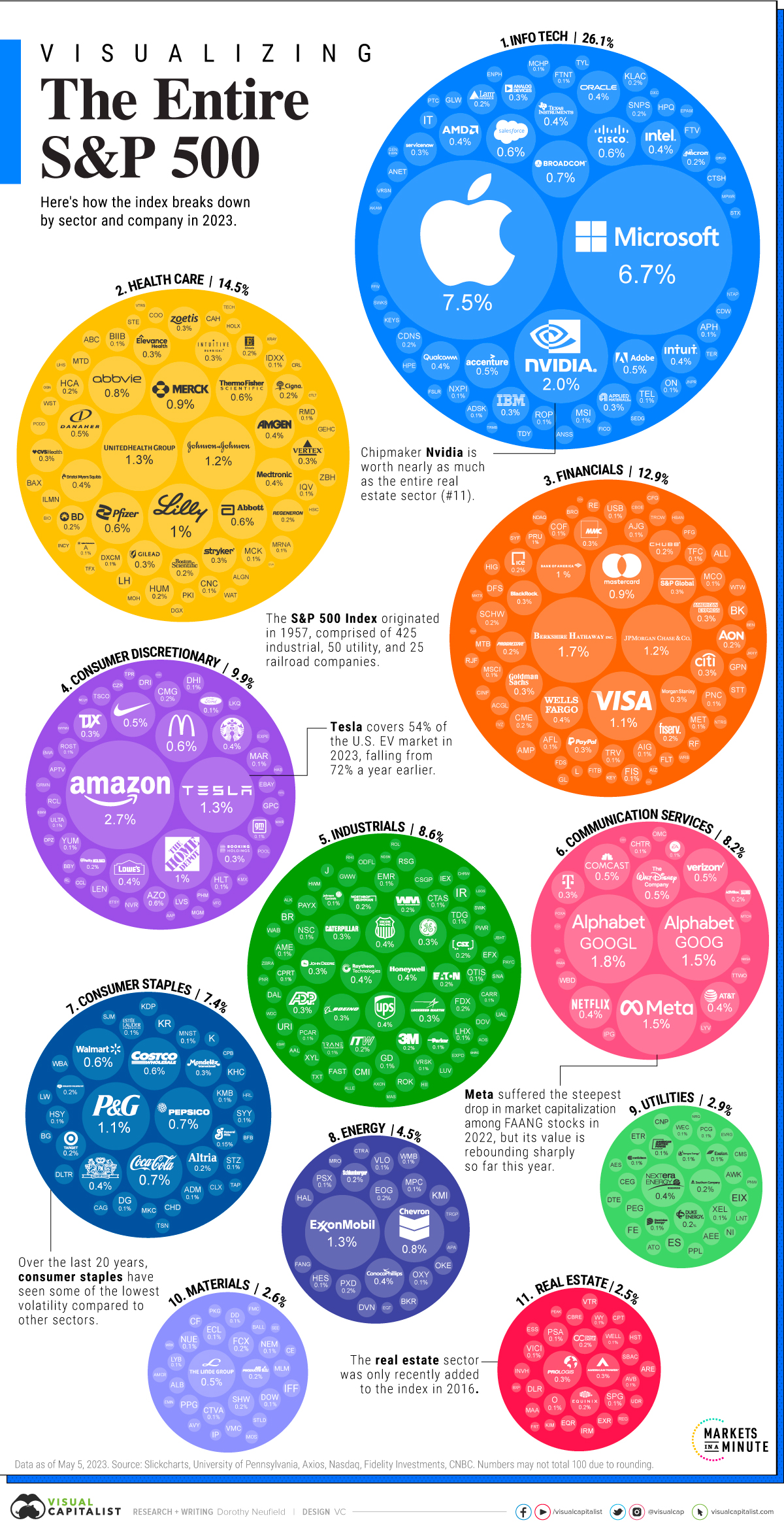
The S&P 500 is intentionally diversified across 11 Global Industry Classification Standard (GICS) sectors, providing a comprehensive snapshot of the U.S. economy. While the weighting of these sectors fluctuates over time due to market performance and economic trends, historically, Information Technology has held the largest weighting, followed by Financials, Healthcare, Consumer Discretionary, and Communication Services. Other significant sectors include Industrials, Consumer Staples, Energy, Utilities, Real Estate, and Materials.
This broad sectoral representation is one of the index’s strengths, offering investors instant diversification across various industries. For instance, a strong performance in tech stocks might drive the index up, but a robust quarter for pharmaceutical companies or banks could also contribute significantly, demonstrating the interplay of diverse economic forces within the S&P 500.
Evolution and Rebalancing
The S&P Dow Jones Index Committee conducts quarterly reviews and rebalances the index to ensure it continues to meet its criteria and remains representative. Additions and deletions occur frequently, driven by mergers and acquisitions, bankruptcies, companies failing to meet profitability or market cap thresholds, or simply being supplanted by faster-growing, more significant enterprises.
For example, a company might be added if its market capitalization surges past the minimum requirement and it meets all other criteria, indicating its growing economic importance. Conversely, a company might be removed if it’s acquired by another entity, faces financial distress, or its market cap shrinks significantly. These changes reflect the natural ebb and flow of corporate fortunes and ensure the S&P 500 accurately mirrors the current landscape of large-cap U.S. businesses rather than an outdated one.
Key Players: A Glimpse at Dominant Stocks
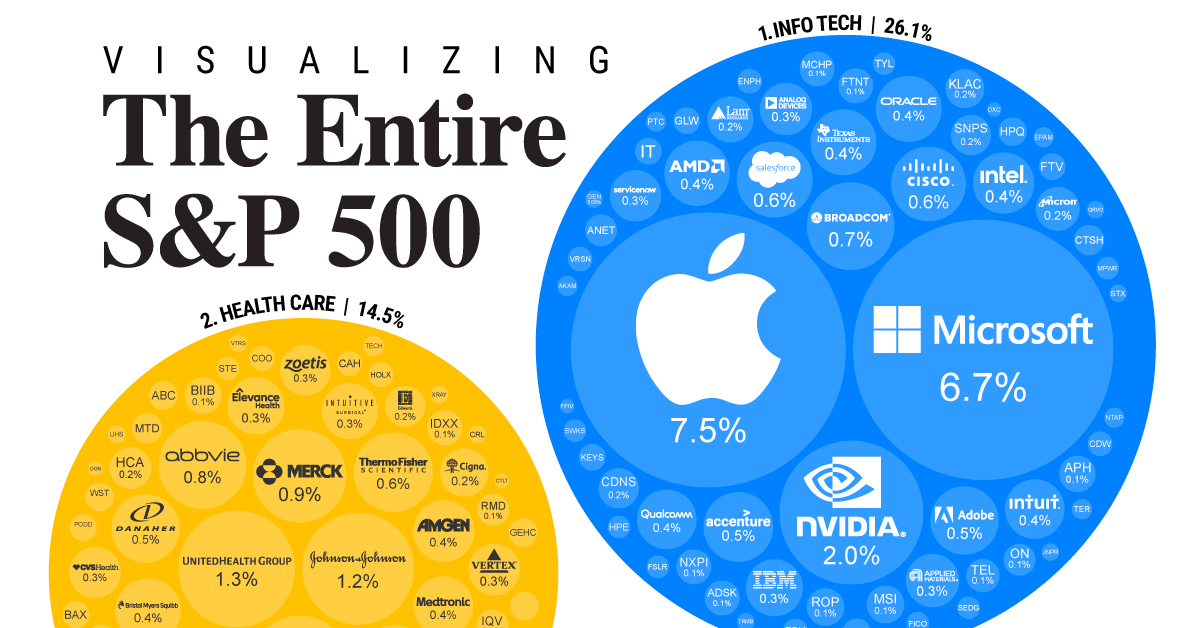
While the specific constituents and their rankings shift, certain companies consistently rank among the largest by market capitalization, wielding considerable influence over the S&P 500’s performance. For years, technology giants have dominated this list. Companies like Apple (AAPL), Microsoft (MSFT), Amazon (AMZN), Alphabet (GOOGL) (Google’s parent company), and Nvidia (NVDA) frequently hold the top spots, largely due to their massive market caps and consistent innovation. Other influential companies often include Tesla (TSLA), Meta Platforms (META) (Facebook’s parent), Johnson & Johnson (JNJ), ExxonMobil (XOM), and JPMorgan Chase (JPM), representing various sectors from consumer discretionary and healthcare to energy and financials. It’s crucial to remember that this list is not static; the composition and the top-weighted stocks are subject to change based on market dynamics and committee decisions.
Why the S&P 500 Matters to Investors
For individual and institutional investors alike, the S&P 500 is more than just a financial metric; it’s a cornerstone of modern investment strategy, offering a compelling blend of market insight and practical investment opportunities.
A Barometer of Economic Health
The S&P 500’s performance is widely regarded as a leading indicator of the U.S. economy’s health. Because it comprises 500 of the largest and most influential American companies across diverse sectors, its collective performance reflects broad corporate profitability, consumer spending, and investor confidence. A rising S&P 500 often signals economic expansion and optimism, while a significant decline can foreshadow or confirm a downturn. Investors frequently monitor its movements to gauge market sentiment and make informed decisions about their economic outlook.

Diversification Benefits
Investing in the S&P 500 offers immediate and substantial diversification. Rather than relying on the performance of a single company or even a few, an investment tracking the S&P 500 gives exposure to hundreds of companies across all major economic sectors. This inherent diversification helps mitigate single-stock risk – the risk that a poor performance by one company could disproportionately harm a portfolio. By spreading investments across a wide array of industries and company sizes (within the large-cap segment), investors can achieve a smoother, less volatile return profile over the long term, aligning with a fundamental principle of sound investing.
Investing in the S&P 500
Gaining exposure to the S&P 500 is remarkably straightforward, making it accessible to virtually every investor. The most common and cost-effective methods include:
- S&P 500 Index Funds: These are mutual funds designed to mimic the performance of the S&P 500 by holding all or a representative sample of its constituent stocks in the same proportions. They offer professional management and broad diversification.
- S&P 500 Exchange-Traded Funds (ETFs): Similar to index funds, ETFs track the S&P 500 but trade like individual stocks on an exchange throughout the day. They typically have very low expense ratios and offer flexibility for trading. Popular examples include SPDR S&P 500 ETF Trust (SPY), iShares Core S&P 500 (IVV), and Vanguard S&P 500 ETF (VOO).
- Direct Stock Purchases (Less Common): While theoretically possible to buy all 500 stocks, this is impractical due to high transaction costs and rebalancing complexities for most individual investors.
These vehicles allow investors to tap into the growth potential of the broad U.S. stock market with relative ease and efficiency.
Passive vs. Active Management
The S&P 500 plays a central role in the ongoing debate between passive and active investment management. Passive management often involves investing in index funds or ETFs that track the S&P 500, aiming to replicate the market’s return at minimal cost. The philosophy here is that, over the long term, few active managers consistently outperform the market after fees, making a broad market index a superior investment.
Active management, on the other hand, involves professional fund managers making specific investment choices with the goal of outperforming the S&P 500. They might overweight certain sectors, pick individual stocks, or employ various strategies to beat the benchmark. While some active managers do succeed, studies often show that a significant majority fail to outperform the S&P 500 over extended periods, particularly after accounting for higher management fees. The S&P 500 thus serves as a critical benchmark against which the performance of active funds is constantly measured.
The Influence and Challenges of the S&P 500
While the S&P 500’s role as a market bellwether is undeniable, its very structure and influence also present certain challenges and topics of ongoing discussion within financial circles.
The Concentration Debate
One of the most frequently discussed aspects of the S&P 500, particularly in recent years, is the concentration of its market capitalization in a handful of mega-cap technology companies. As mentioned, companies like Apple, Microsoft, Amazon, Alphabet, and Nvidia can collectively account for a substantial portion of the index’s total value. This concentration means that the performance of these few companies can heavily dictate the overall direction of the S&P 500.
While these companies have been significant drivers of growth, critics argue that such high concentration can mask underlying weakness in other parts of the market or make the index more susceptible to downturns if these dominant players face challenges. Investors tracking the index should be aware that their “diversified” investment might still carry substantial exposure to the fortunes of these few giants.
Beyond Market Capitalization
While market capitalization is the primary driver for inclusion and weighting, the S&P Dow Jones Index Committee does exercise discretion that goes beyond a purely quantitative approach. Their qualitative judgment ensures that the index represents leading companies that are stable, have strong business models, and contribute meaningfully to the U.S. economy. They consider factors like sector balance, the company’s industry leadership, and the overall “story” of the business. This blend of quantitative rules and qualitative oversight aims to maintain the S&P 500’s reputation as a high-quality, representative index, rather than merely a list of the largest companies by market cap. This explains why certain large companies might not be in the S&P 500 (e.g., private companies, or companies that don’t meet profitability/liquidity requirements).
Global Impact
The influence of the S&P 500 extends far beyond U.S. borders. Given the size and importance of the American economy and its capital markets, the S&P 500 is closely watched by investors, policymakers, and businesses around the globe. Its performance often impacts global market sentiment, influencing investment flows, currency valuations, and even economic policy decisions in other countries. A strong S&P 500 can signal robust global growth, while a significant decline can trigger worries about a worldwide economic slowdown, underscoring its pivotal role in the interconnected global financial system.
Navigating the S&P 500 in Your Investment Strategy
Incorporating the S&P 500 into a personal investment strategy involves understanding its long-term potential, recognizing market dynamics, and maintaining an informed perspective.
Long-Term Growth Potential
Historically, the S&P 500 has demonstrated remarkable long-term growth potential. Despite numerous economic downturns, recessions, and market corrections, the index has consistently recovered and reached new highs over extended periods. This resilience is attributed to the underlying strength and innovation of American corporations, coupled with the U.S. economy’s ability to adapt and grow. For investors with a long-term horizon, investing in the S&P 500 through index funds or ETFs can be a powerful way to harness the compounding effect of these returns and build substantial wealth over decades.
Risk Management and Market Volatility
While the S&P 500 offers diversification and long-term growth, it is not immune to market volatility. Short-term fluctuations are a natural part of stock market investing, driven by economic data, corporate earnings, geopolitical events, and investor sentiment. Investors should understand that the value of their S&P 500 investments will rise and fall, and patience is often required to weather these periods. Effective risk management, such as dollar-cost averaging (investing a fixed amount regularly) and aligning investments with one’s risk tolerance and financial goals, is crucial when navigating the S&P 500.
Staying Informed
The dynamic nature of the S&P 500 means that its composition and the factors influencing its performance are constantly evolving. Staying informed about major economic trends, significant changes in sector performance, and the addition or deletion of key companies can help investors understand the forces driving their S&P 500-linked investments. While passive investing in an S&P 500 index fund requires minimal active management, a foundational understanding of the index’s mechanics and the broader economic landscape remains invaluable for making sound financial decisions.
In conclusion, the S&P 500 is far more than a simple list of stocks; it is a meticulously managed, dynamic index representing the core of the U.S. economy. Its composition, governed by stringent criteria and ongoing rebalancing, offers investors diversified exposure to America’s leading companies. By understanding what stocks make up the S&P 500 and how it functions, investors can leverage this powerful benchmark to inform their strategies, achieve diversification, and participate in the long-term growth of the U.S. stock market.
aViewFromTheCave is a participant in the Amazon Services LLC Associates Program, an affiliate advertising program designed to provide a means for sites to earn advertising fees by advertising and linking to Amazon.com. Amazon, the Amazon logo, AmazonSupply, and the AmazonSupply logo are trademarks of Amazon.com, Inc. or its affiliates. As an Amazon Associate we earn affiliate commissions from qualifying purchases.